JPMorgan Humanoid Robot Research Report: Raises Unitree Robotics Price Target to RMB 1,060, Upgrades UBTECH Robotics to Overweight
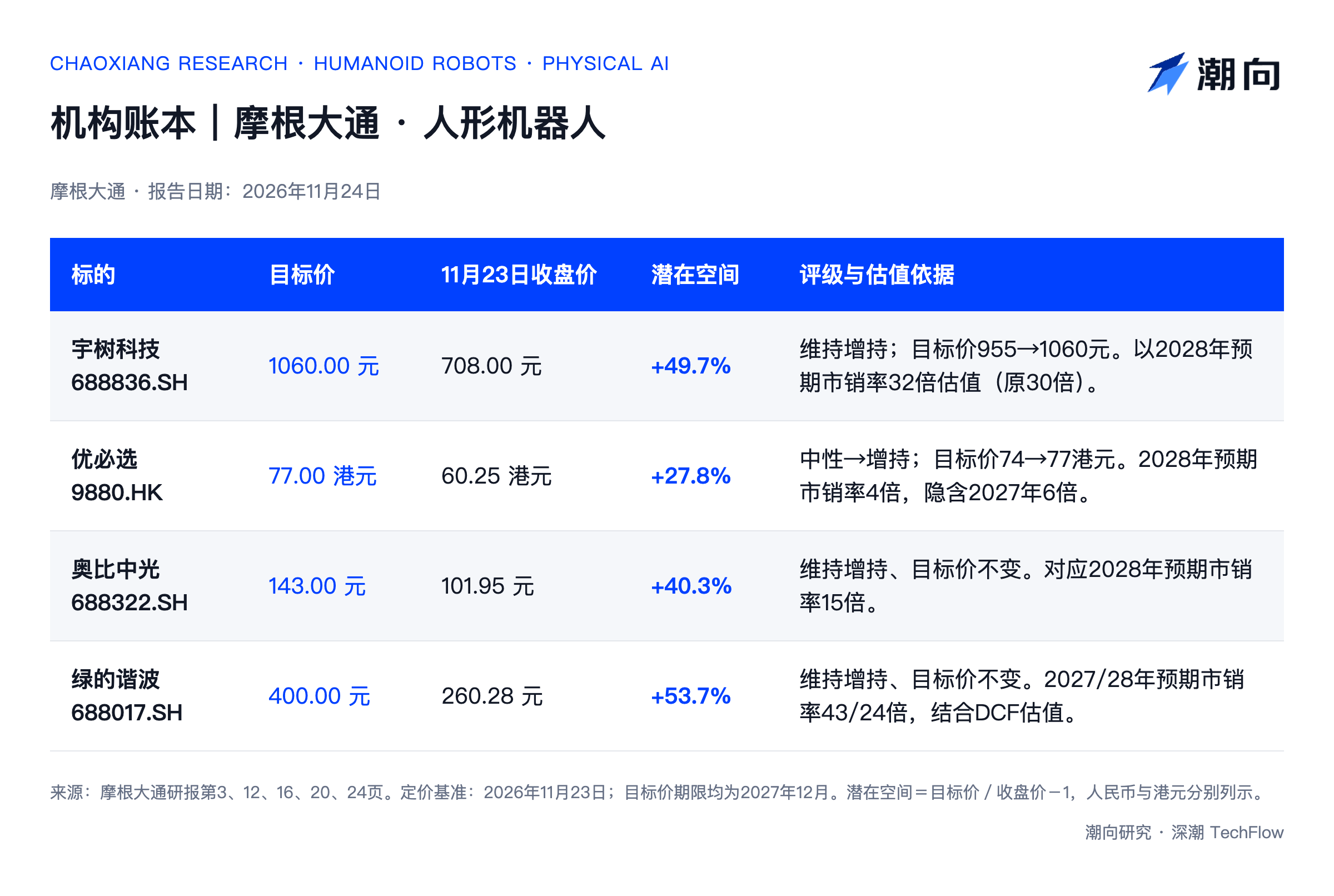
The embodied AI and humanoid robot sector is transitioning from conceptual demonstrations to commercial deployment, with its adoption S-curve steepening. In a report released on November 24, 2026, JPMorgan's Asia Pacific Equity Research team noted that amid breakthroughs in large models, Tesla's accelerated mass production, and China's dense rollout of industrial policies, the industry's competitive focus has shifted to real-world data flywheels and customer ROI. The bank raised Unitree Robotics' target price to RMB 1,060 (potential upside of approximately 50%) and upgraded UBTECH's rating to "Overweight," with a new target price of HKD 77 (potential upside of approximately 28%).
Farewell to Demos: Data and ROI Become the Deciding Factors
The industry is undergoing a harsh rite of passage.
After closed-door discussions with executives from four top robotics companies at the Asia Technology, Innovation and Growth (TIG) conference, JPMorgan found that the market narrative has completely changed. Where it used to be about who could produce the coolest demo videos, the competition now centers on bridging the Sim-to-Real gap and converting technology into replicable commercial contracts.
Iterations in frontier large models are advancing physical AI's "ChatGPT moment." As frontier multimodal models like GPT-6 Astra and Anthropic Fable demonstrate stronger reasoning and long-horizon planning capabilities, some management teams optimistically project that robotics zero-shot generalization and multi-task execution could see breakthroughs as early as 2027.
But making models smarter is only the first step.
In actual factories and commercial settings, it remains the "last few millimeters" of operational precision that determine success or failure. Executives have reached a consensus that, when factoring in deployment costs, continuous operation duration, and customer ROI, industry volume ramp-up will be a gradual process. Truly crossing the tipping point may require hundreds of thousands, or even millions, of units collecting failure and feedback data from real-world frontline operations.
Technical architectures and data recipes are also emerging. The industry currently favors a layered architecture where frontier large models act as slow-thinking "System 2" responsible for intent understanding and task decomposition, while fast-responding "System 1/0" specializes in motion control and safe execution. On the data front, the "training data pyramid" has become a closely guarded secret—the highest quality comes from teleoperation data on real machines but at a high cost, while first-person human demonstrations and simulated synthetic data are used to expand coverage affordably. JPMorgan expects the industry to face severe reshuffling and M&A consolidation over the next two to three years.
Tesla Unifies the Brain, China Sets the Tone for Mass Production
Industry giants and policymakers on both sides of the ocean are hitting the accelerator in sync.
Across the ocean, Tesla is attempting to unify the physical world using a single AI foundation. With the FSD V15 upgrade, Tesla has integrated Full Self-Driving (FSD), Robotaxi, and the Optimus humanoid robot under a shared visual encoder and world model. This means the perception and planning experience accumulated by millions of vehicles in complex traffic conditions can directly feed back into robotic manipulation training.
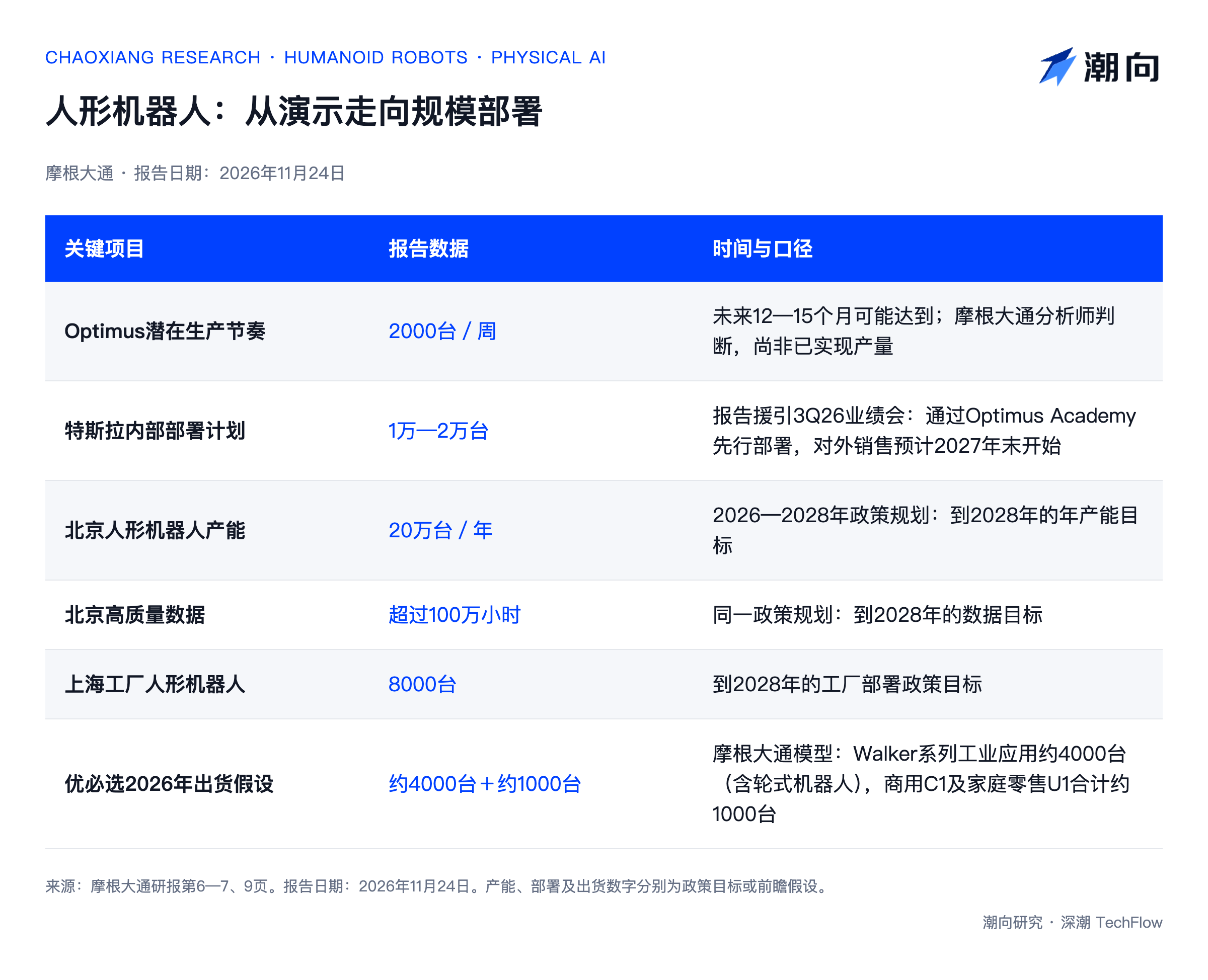
The mass production timeline is also being accelerated. Tesla plans to initially deploy 10,000 to 20,000 robots internally at the "Optimus Academy" for self-play and task refinement, before launching external sales in late 2027. JPMorgan auto analysts expect Optimus to potentially ramp up to 2,000 units per week within the next 12 to 15 months, translating to an annualized scale of around 100,000 units, while the most optimistic surveys from the Chinese supply chain even point to roughly 200,000 units shipped in 2027. Although tactile sensing and durability of dexterous hands remain challenges, Tesla will initially focus on standardized and safe workstations such as material handling, which will not hinder commercial launch.
Meanwhile, the Chinese market is driving industrial deployment with substantial capital and hard targets.
Recently, the Ministry of Industry and Information Technology (MIIT), Beijing, and Shanghai have sequentially rolled out practical roadmaps. Beijing's 2026-2028 action plan explicitly states cultivating 10 domestically leading humanoid robot OEMs, achieving an annual capacity of 200,000 units, and accumulating over 1 million hours of high-quality data by 2028. Shanghai aims to deploy 8,000 humanoid robots in factories by 2028, while MIIT has simultaneously released industry standards for intelligent grading and dexterous hands. Furthermore, the special plan for elderly care and childcare robots released on November 23, 2026, is directly positioning service robots toward rigid-demand scenarios driven by aging populations and labor shortages.
Core Components Take Priority, Unitree View Elevated and UBTECH Upgraded
Facing the accelerating industry inflection point, JPMorgan has clarified a top-down stock selection sequence: prioritize core component leaders with technological barriers and economies of scale, while OEMs focus on ecosystem and execution.
On the supply chain side, JPMorgan reiterates four "Overweight" top picks. For the domestic OEM supply chain, it favors 3D vision leader Orbbec (target price RMB 143, potential upside 40%) and harmonic reducer leader Leader Harmonious Systems (target price RMB 400, potential upside 54%), with the former holding over 70% market share in domestic service and humanoid robot vision hardware, and the latter deeply tied to mainstream domestic OEMs. For Tesla's robot supply chain, it prioritizes Hengli Hydraulic (target price RMB 126, potential upside 35%) and Sanhua Intelligent Controls (A-share target price RMB 50, potential upside 48%; H-share target price HKD 38, potential upside 78%).
Regarding OEMs, Unitree Robotics (688836.CH) remains JPMorgan's top pick.
Analysts note that the market is re-evaluating Unitree's value—not only does it boast globally leading hardware mass production scale, but it is also fully strengthening "brain" computing power and developer ecosystems. While maintaining unchanged financial forecasts for 2026-2028 (projecting revenue to surge from RMB 2.819 billion in 2026 to RMB 13.383 billion in 2028), given the earlier commercialization S-curve and the scarcity premium from delayed IPO approvals for the new share, JPMorgan raised Unitree's 2028 target P/S ratio from 30x to 32x, corresponding to a December 2027 target price of RMB 1,060 (implying approximately 50% upside from the November 23 closing price of RMB 708).
UBTECH (9880.HK) sees a rating reversal, upgraded from "Neutral" to "Overweight".
Since September 28, 2026, UBTECH's stock has cumulatively pulled back 18%, significantly underperforming the 8% decline of the Hang Seng State-owned Enterprise Index and the 54% gain of Unitree over the same period. Incorporating insights from the TIG conference, JPMorgan slightly adjusted UBTECH's 2026 shipment forecast for the industrial Walker series (including wheeled models) to approximately 4,000 units, and approximately 1,000 units each for the commercial C1 and home U1 series, while reducing its average revenue forecast for 2026-2028 by approximately 10%. However, the bank believes prior stock declines have fully digested bearish factors, and as frontier large models lower the threshold for proprietary foundation development, UBTECH's progress in scenario deployment and data flywheels is materializing. Assigning a 2028 P/S of 4x, it raised the target price to HKD 77 (potential upside approximately 28%). The report also cautions that UBTECH's book cash dropped to RMB 2.4 billion by mid-year 2026, with days sales outstanding reaching 242 days; subsequent cash collection and financing pace remain key observation points.
This article is a compilation and interpretation by Chaoxiang Research of third-party brokerage research reports. The ratings, target prices, earnings forecasts, and related judgments cited herein are solely those of the respective broker analyst, reflecting only their institutional stance, not Chaoxiang Research's viewpoint, and do not constitute investment advice.
Markets carry risks, and decisions must be independent. This article should not serve as a basis for buying or selling any securities.
Join TechFlow official community to stay tuned
Telegram:https://t.me/TechFlowDaily
X (Twitter):https://x.com/TechFlowPost
X (Twitter) EN:https://x.com/BlockFlow_News
 @chaoxiangooo