
Bitget UEX Daily | Bitcoin loses $60k again; AI rebound faces profit-taking test; Tonight's focus on PCE (November 25, 2026)
Author: Bitget
Key News Highlights
U.S. Economy: Consumer Confidence Rises, Tonight's Inflation Data Sets Rate Expectations
The U.S. consumer confidence index rose to 103.3 in November, with October's revised figure at 91.9, marking the highest level since January 2025. Consumers' evaluations of current business conditions, employment, future income, and economic prospects improved simultaneously.
This provides a positive signal for year-end consumption, but improved confidence still requires verification through actual spending. Tonight's PCE and income/expenditure data will test whether demand resilience is accompanied by price pressure: if inflation remains sticky, a stronger economy could also intensify tightening expectations, constraining high-valuation assets.
Global Energy: Strait of Hormuz Shipping Risks Drive Oil Price Rebound
On November 24, WTI crude oil futures settled at $82.05/barrel, and Brent rose to $91.40/barrel. News of attacks on ships near the Strait of Hormuz has led markets to reprice shipping risk premiums.
Whether the oil price rebound can sustain depends on whether risks materialize into actual delivery disruptions. For equities, rising energy prices may also squeeze profit margins for transport and manufacturing companies, undermining the valuation support provided by cooling inflation.
Technology & AI: Rebound Enters Divergence, Earnings Become Next Validation Phase
Nvidia fell 5.86%, AMD dropped 8.86%, Micron declined 11.01%; Apple and Microsoft rose 1.43% and 0.74%, respectively. The pullback in the AI supply chain did not evolve into a synchronized drop across the Magnificent Seven tech giants.
From a chart perspective, yesterday's rebound has not yet formed a stable broad-based recovery. Moving forward, server orders, delivery revenue, and cash collection ratios hold more explanatory power than sentiment boosts from isolated events, with after-hours earnings reports also serving as key tests for the next trading session.
Market Review
Analysis of Market Moves
On November 24, the Nasdaq fell 1.48%, the S&P 500 dropped 0.50%, and the Dow Jones advanced 0.85% to reclaim 50,000 points. Of the Magnificent Seven tech stocks, 2 rose and 5 fell; BTC once again broke below $60,000; and the VIX dipped slightly to 26.36, indicating significant market divergence and that risk appetite has not fully recovered.
First, following the sharp rebound, markets are once again questioning earnings realization. The prior significant recovery in AI-related stocks improved sentiment but did not directly address customer financing, project delivery, or investment return issues; when these conditions remain unverified, further multiple expansion requires additional earnings support.
Second, the macro environment continues to cap valuation expansion. Strengthening consumer confidence supports demand but makes tonight's PCE data even more critical; if price pressures persist, the drag of higher interest rates on long-term profit valuations will be hard to shake. With the 10-year U.S. Treasury yield dipping slightly overnight, it would be simplistic to attribute the tech stock decline solely to a same-day yield spike.
Third, index performance reflects structural divergence. The rise in the Dow Jones, along with strength in Apple and Microsoft, occurred alongside a pullback in semiconductor and AI infrastructure stocks; this means investors are still differentiating between earnings certainty and future growth promises, and a single day of broad gains is insufficient to confirm that the entire risk asset market has stabilized.
Commodities & Forex Performance
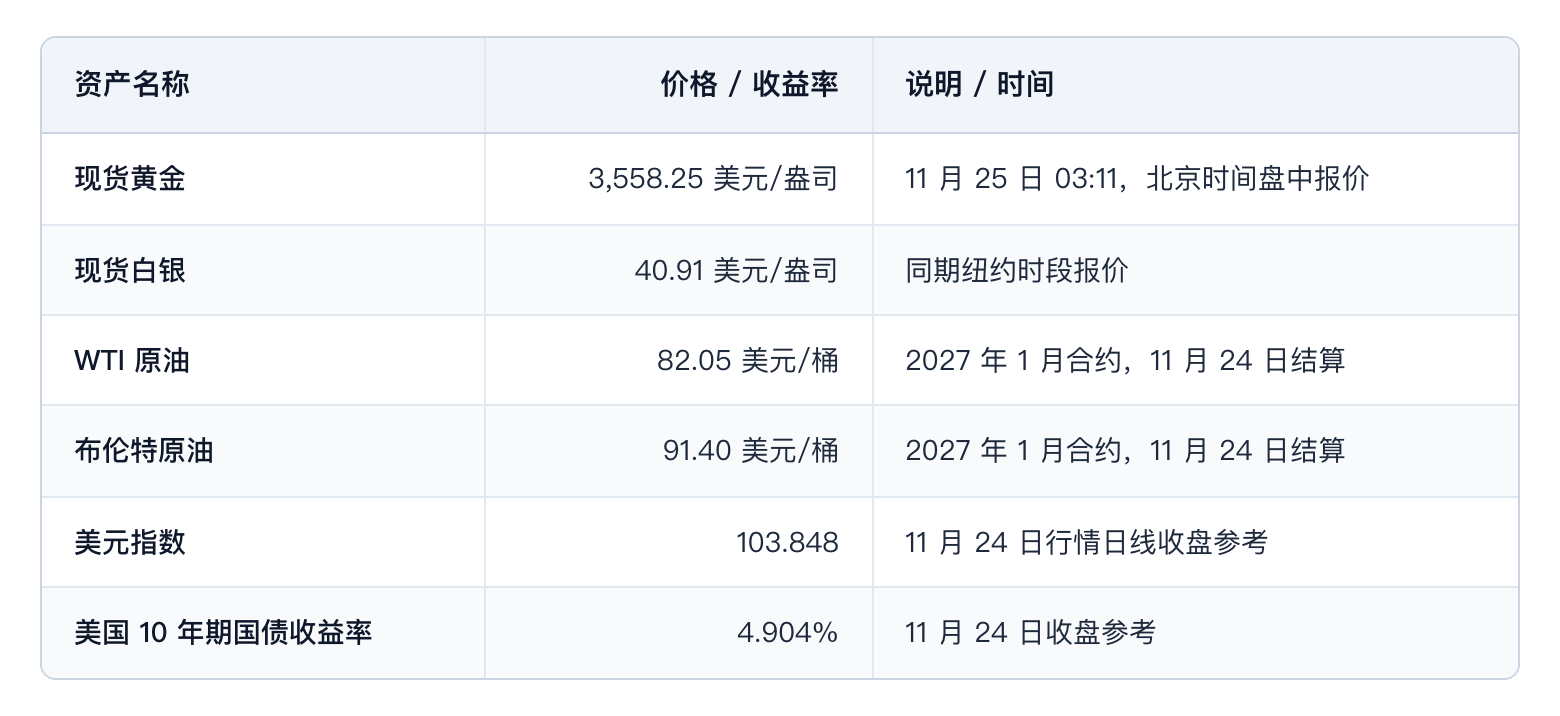
Pressure on gold and silver alongside an oil price rebound indicates divergent drivers across commodities. Interest rate expectations constrain precious metals, while disruption risks support crude oil; a pullback in the U.S. dollar alone was insufficient to reverse the weakness in precious metals, requiring further analysis tied to inflation and funding conditions.
Cryptocurrency Performance
As of 08:12 Beijing Time on November 25, BTC stood at approximately 59,596.45 USDT, down 2.56% over 24 hours; ETH was around 1,673.88 USDT, down 1.93% over 24 hours. Total cryptocurrency market capitalization was approximately 2.072 trillion USDT, declining 4.66% over 24 hours; last updated at 08:04.
BTC | Liquidation Zone Observation: Clearer potential short liquidation clusters above are roughly at $60,600 and $61,200, representing ~1.80% and ~2.81% from the current price; potential long liquidation clusters below are around $58,700 and $59,200, distances of ~0.55% and ~1.39%. Currently closer to the lower region; if it continues to fall, monitor the de-leveraging pressure on longs.
ETH | Liquidation Zone Observation: Clearer potential short liquidation clusters above are roughly at $1,708 and $1,724, representing ~2.16% and ~3.11% from the current price; potential long liquidation clusters below are around $1,648 and $1,665, distances of ~0.42% and ~1.43%. The nearer lower distance is shorter, so intraday trades should first observe buying support near this zone.
Institutional Holding Cost | BTC: Strategy disclosed on November 23 that as of November 22, it held 851,305 BTC, with an average cost including fees of approximately $75,446; the current token price is ~21.10% below this cost, representing a paper loss at the token price level. This cost is far from current liquidation zones and has not triggered nearby price resonance.
One-line Market Take: For BTC, watch price action near $59,200; for ETH, watch near $1,665. If the lower zones break, monitor whether de-leveraging amplifies volatility. If stabilization and recovery occur, then observe the respective upper liquidation zones; do not rely solely on map patterns to confirm a reversal.
Major U.S. Equity Index Performance
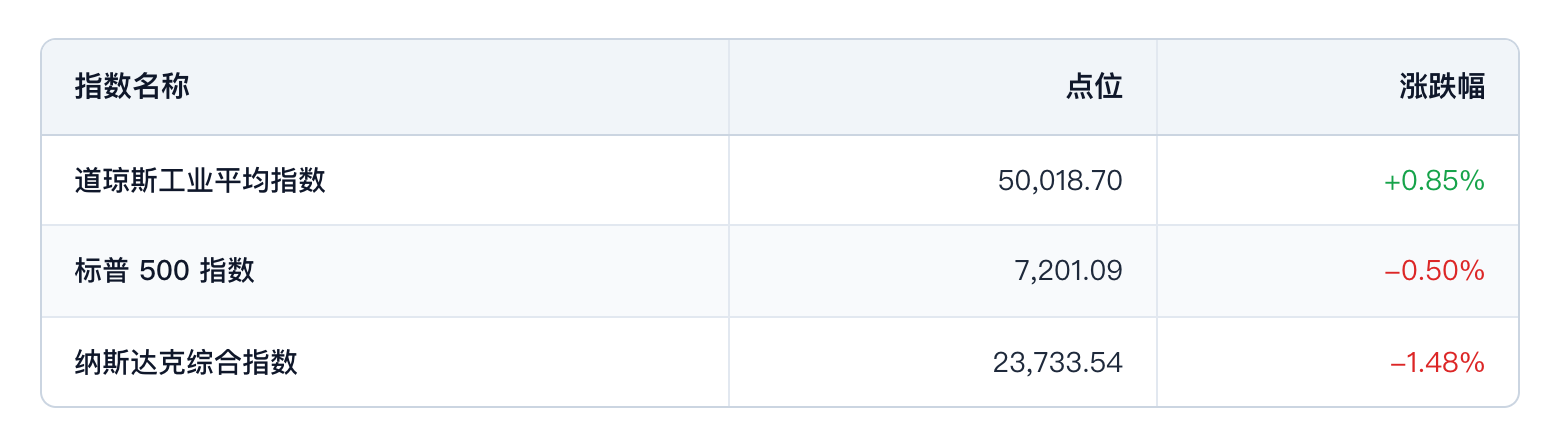
The divergence between the Dow and Nasdaq trends indicates that market selection regarding sectors and earnings quality remains pronounced. Next, observe whether tech stocks can halt their decline supported by earnings reports, and whether the breadth of the advance can expand.
Magnificent Seven Tech Performance
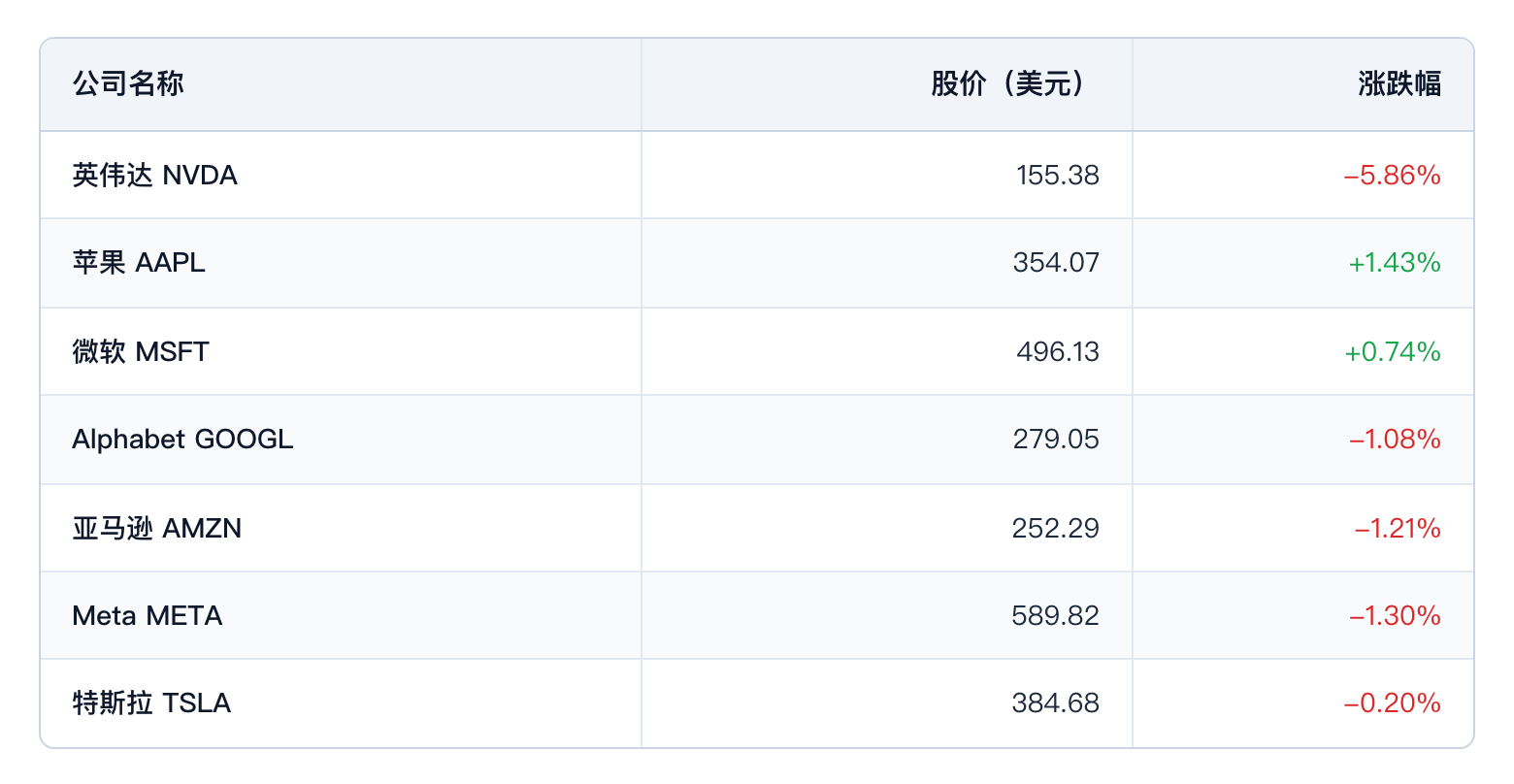
The Magnificent Seven posted 2 gains and 5 losses overall, with Nvidia seeing the sharpest pullback. Gains in Apple and Microsoft indicate internal divergence among large tech firms; one cannot simply extrapolate AI supply chain volatility to represent operational changes across all technology companies.
Sector Movement Observations
High volatility in semiconductors and AI infrastructure. Micron fell 11.01%, CoreWeave dropped 11.85%, and Nebius declined 10.73%; hardware and computing power services fell in tandem, showing this trade direction remains sensitive to growth realization and funding conditions.
Crypto-linked equities continued under pressure. Strategy fell 8.12%, Coinbase dropped 5.92%, and Robinhood declined 2.55%; token prices, corporate financing capacity, and trading activity must be monitored separately; equity declines cannot be directly attributed to corporate coin sales.
Some consumer and healthcare stocks remained relatively resilient. Best Buy rose 2.70%, UnitedHealth gained 1.73%, creating a divergence from the AI supply chain's downturn; future performance will require sales, profits, and guidance to confirm whether this relative strength can sustain.
In-Depth Analysis of Key U.S. Stocks
Dell DELL: Strong Order Growth, Realization Quality Determines Sustainability
Event Overview: Dell closed regular trading down 11.83% at $295.28, followed by Q3 FY2027 earnings: revenue of $54.9 billion, up 103% YoY; non-GAAP EPS of $9.45. Quarterly new AI server orders totaled $60.2 billion, with backlog ending at $132.3 billion; full-year revenue guidance raised to $202 billion.
Market Interpretation: The earnings report provides strong evidence of demand, but backlogged orders still need to convert into deliveries, revenue, and cash. The regular-session decline occurred prior to the earnings release and cannot be attributed to this after-hours results package.
Investment Implications: Closely track order cancellations and delays, AI server profit margins, and collection speed. Only when delivery and cash flow consistently match order growth will it better support valuation repair.
HP HPQ: Revenue Growth, Cost Pressures Continue to Impact Profits
Event Overview: HP declined 3.32% in regular trading to $27.94; after-hours reported Q4 FY2026 revenue of $16 billion, up 9.3% YoY, non-GAAP EPS of $0.83, down 10.8% YoY. Non-GAAP EPS guidance for FY2027 is set at $3.15–$3.45.
Market Interpretation: Sales growth has not yet synchronized into EPS improvement, warranting attention to memory and storage costs. The company adjusted its non-GAAP methodology starting FY2027 by excluding share-based compensation expenses, requiring consistent cross-year comparisons.
Investment Implications: Monitor whether product price hikes can offset component costs, and whether inventory and cash flow improve. The value of rising AI PC penetration ultimately needs to manifest in profits and receivables collection.
Workday WDAY: AI Commercialization Advances, Subscription Growth Remains Central
Event Overview: Workday rose 1.79% in regular trading to $179.23; after-hours disclosed Q3 FY2027 revenue of $2.705 billion, up 11.2% YoY. AI products contributed nearly $150 million in new annual contract value; Q4 subscription revenue guidance implies 10% YoY growth.
Market Interpretation: AI sales progress can now be measured via contract metrics, though ACV does not equal recognized quarterly revenue. Whether subscription business can accelerate further will determine if new products drive broader growth.
Investment Implications: Watch AI paying customer expansion, contract-to-revenue conversion, and renewal performance. The regular-session gain occurred prior to earnings; subsequent stock price action will need to absorb the new guidance.
Market & Project Developments
Bitcoin ETFs: Latest Full Trading Day Still Sees Net Outflows
Data updated by Farside shows that on November 23, U.S. spot Bitcoin ETFs saw combined net outflows of $569.7 million, with IBIT alone recording $509.3 million in outflows. Data for November 24 is not yet complete; announced funds show combined net inflows of $7.1 million, but this cannot be used to conclude that full-day fund flows turned positive.
Stablecoins & On-chain Finance: Circle & Paribu Sign Memorandum of Understanding
On November 24, Circle and Paribu announced the signing of a memorandum of understanding to explore opportunities for USDC, Arc-related products, real-world asset tokenization, and institutional custody in the Turkish market. The MOU serves as a cooperative exploration framework; follow-up observations will focus on specific product launches, compliance arrangements, and actual usage.
Korean Regulation: Comprehensive Digital Asset Legislation Continues to Advance
The South Korean Financial Services Commission published implementation arrangements for a comprehensive digital asset bill on November 24, proposing to segment businesses such as trading, brokerage, custody, and utilization, while strengthening entry, governance, and user asset protection requirements. Measures remain in the legislative phase, and business impact hinges on the final enacted text and implementation plans.
Today's Market Calendar
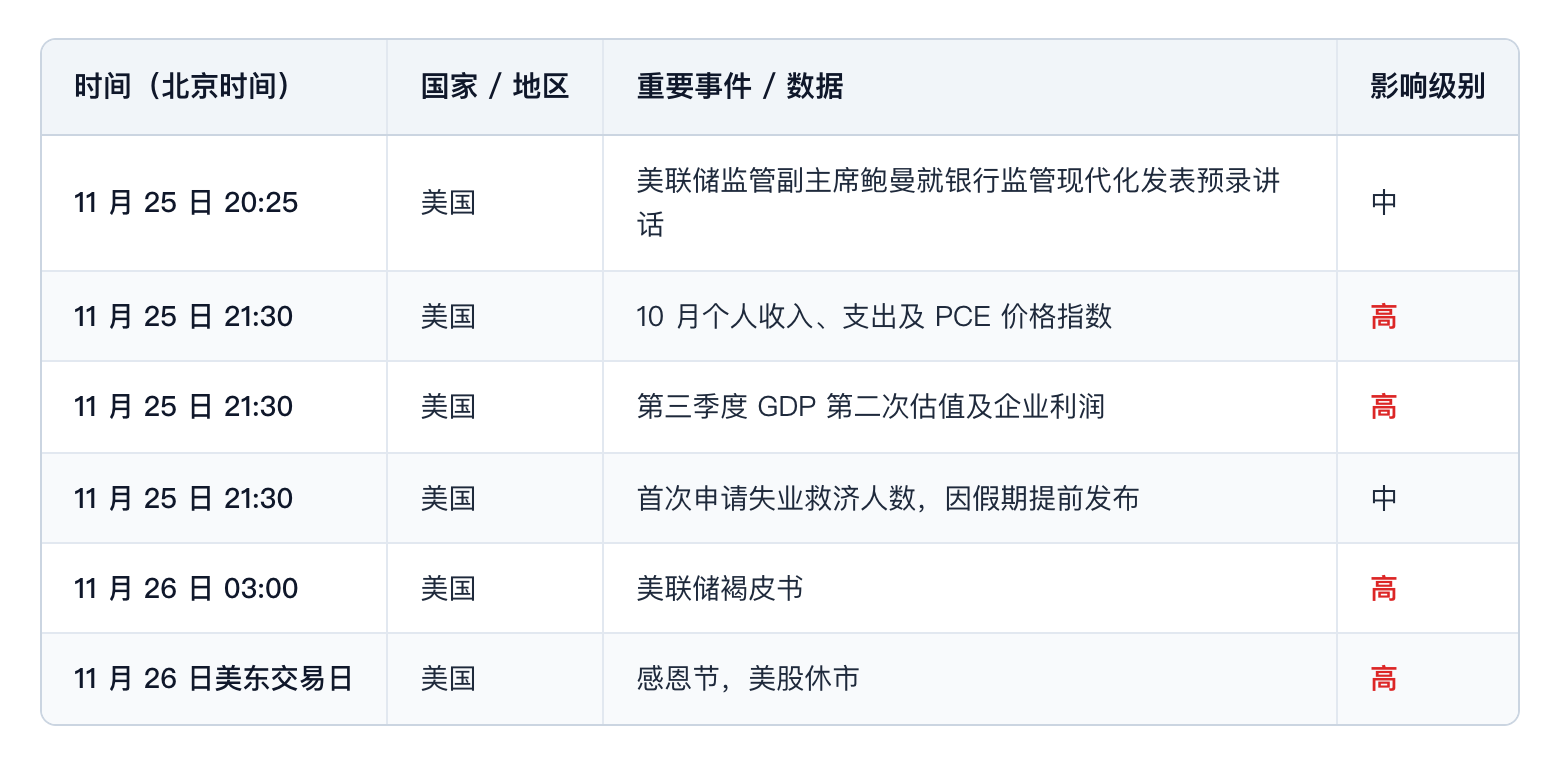
Key Event Outlook: Tonight, focus first on MoM PCE and core price pressures, then assess demand strength using actual consumption, GDP, and employment data. If inflation cools while consumption holds firm, asset recovery conditions will improve; if inflation proves sticky, AI earnings tailwinds may face headwinds from rate expectations. U.S. markets will close early on November 27, with regular trading ending at 02:00 Beijing Time on November 28.
Institutional View: Senior Economist Fergus McCormick of The Conference Board noted on November 24 that rising confidence may correlate with reduced uncertainty post-midterm elections, as consumers' assessments of employment and the business environment improve. However, confidence surveys still require verification through actual consumption and cannot be directly equated with spending growth.
This article is for market information reference only and does not constitute investment advice.