The Profitability Dilemma of New Crypto Banks: The More Card Swipe Cashbacks Are Issued, the Greater the Losses — Who Can Break Through Using Stablecoin Yield and Local Clearing?
Author: DWF Ventures
Translated by: TechFlow
TechFlow Guide: Weekly spending on crypto debit cards has surpassed $300 million, but the vast majority of the market is monopolized by a few top players. As card-issuing infrastructure becomes increasingly homogenized, customer acquisition models relying on subsidy cashback are trapping most neobanks in profitability struggles, while users are accelerating their shift to treat these platforms as interest-bearing savings vehicles rather than mere spending tools.
To break out of intense competition and build genuine competitive moats, crypto neobanks are evolving into on-chain financial super apps: capturing interest on idle funds through self-issued stablecoins, leveraging lending protocols and perpetual contracts to diversify revenue streams, and deeply integrating local fiat on/off-ramp channels to penetrate emerging markets.
Core Highlights
• Crypto card spending is growing rapidly but remains highly concentrated among a few top projects. Among the top 20 projects by volume, the top 5 accounted for 86% of total spending over the past 30 days.
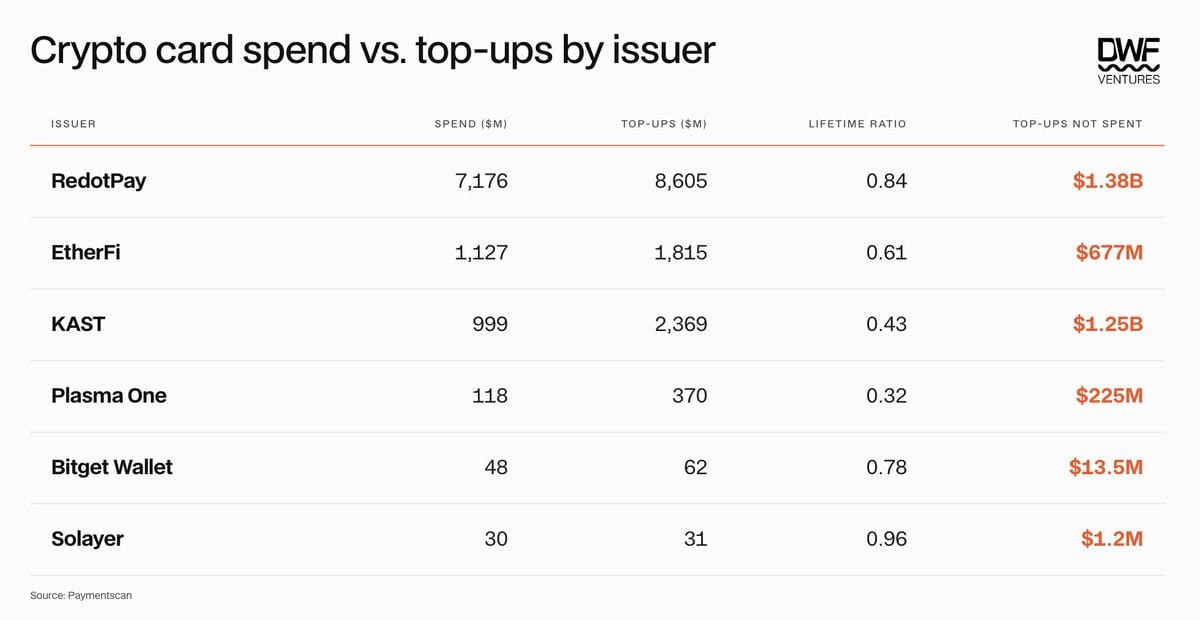
• Beyond daily spending, users are increasingly treating crypto neobanks as savings channels for wealth growth. On average, for every $1 deposited, actual spending amounts to only $0.65 to $0.75.
• Cashback subsidies often impose heavy financial costs on issuing projects. Only by offering differentiated, non-homogeneous features, such as high-demand local clearing channels and multi-currency settlement capabilities, can long-term moats be built.
• The on-chain architecture provides neobanks with a powerful testing ground for innovation, enabling them to evolve into super apps that integrate asset storage, wealth growth, and capital interoperability. Key growth drivers include: self-issued stablecoins to retain interest from user idle funds, lending via Aave or Morpho, and introducing high-yield trading features such as perpetual contracts.
Stablecoins are having their moment: they enable global fund transfers with low cost and high efficiency, requiring far fewer intermediary steps than traditional banking. Traditional banks, constrained by outdated technical architectures and multi-day settlement cycles, are increasingly struggling to compete in this space.
Neobanks were born to address the inefficiencies of traditional banking. The first generation, represented by Revolut and Nubank, won tens of millions of users by offering more affordable cross-border payments, faster transfer experiences, and mobile-first product designs. However, they still operate on the same underlying settlement rails as traditional banks, and each new market entry requires lengthy and cumbersome local licensing approvals, severely slowing global expansion.
Crypto neobanks represent the next iteration of this model. They settle directly on stablecoin rails and leverage foundational payment infrastructure providers like Bridge and Rain to launch simultaneously across dozens of global markets from day one. They precisely target user segments underserved by traditional banking: cross-border freelancers, SMEs, and everyday residents in economies with restricted access to USD. Furthermore, they offer robust on-chain yield-generating returns and self-custody options—advantages largely inaccessible to traditional fiat neobanks.
This report comprehensively outlines the leading landscape of this sector, deeply analyzes competitive factors across different technology stack layers, and looks ahead at innovative products that could reshape the market.
Market Landscape
Although this sector is still in its early stages in terms of overall size, it is experiencing explosive momentum, with weekly crypto card spending surpassing $300 million and year-over-year growth approaching 200%. While the number of emerging crypto neobanks continues to rise steadily, over 86% of total spending remains heavily concentrated in the top 5 issuing projects. Industry leader RedotPay alone accounts for more than 46% of the market share.
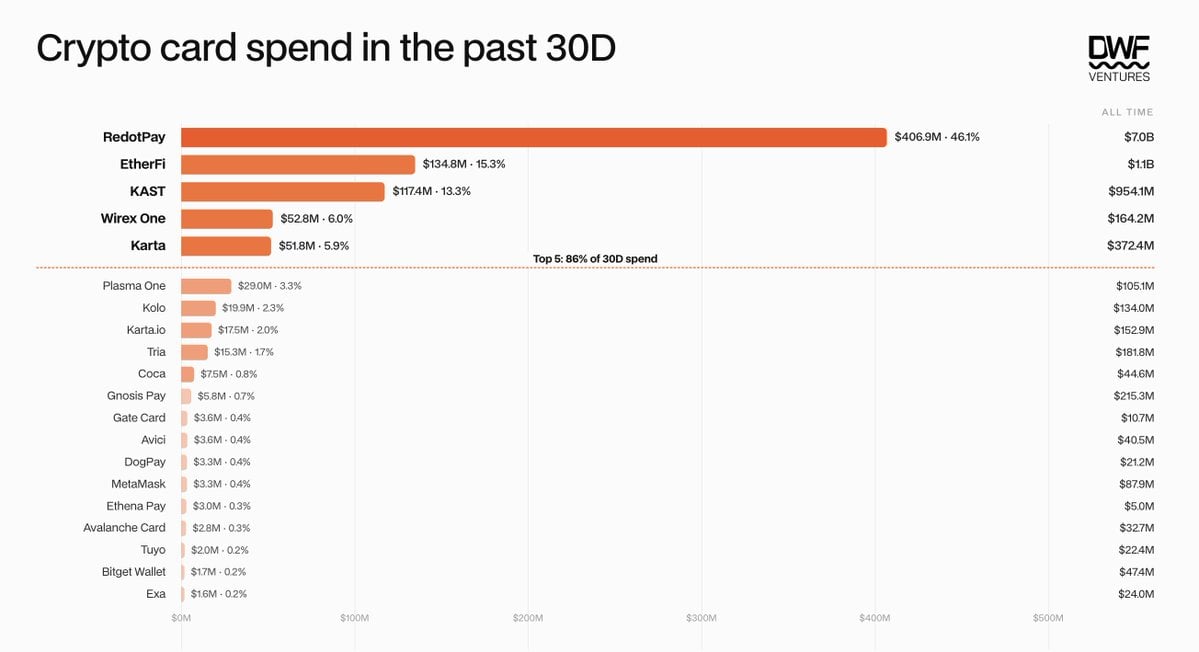
Source: PaymentScan
Note: The above data is based on publicly disclosed information from the PaymentScan platform. Data for some other card-issuing projects has not yet been made public.
This highly concentrated competitive landscape indicates that when choosing a platform, users consider far more than basic product functionality; the issuer's compliance reputation, brand strength, and first-mover distribution channels are equally crucial. Current leaders are mostly designed for high-frequency daily spending and perform particularly strongly in emerging markets like APAC and LATAM, where demand for USD-denominated assets is high. Meanwhile, users are increasingly favoring these apps as core hubs for savings and yield generation. On average, for every $1 deposited, actual spending amounts to only $0.65 to $0.75. In projects where the spending-to-deposit ratio is even lower (such as EtherFi and KAST), the annual percentage yield (APY) on USD stablecoin checking deposits reaches 7% to 9%, far exceeding traditional bank rates. This shows that yield generation has become a core attraction on par with crypto spending.
The card-issuing infrastructure behind these neobanks has become largely homogenized. A handful of issuers (such as Rain) power the vast majority of mainstream projects in the market. Consequently, competing projects mainly face off in user distribution and business functionality. Cashbacks and yield now form industry standards, while localized fiat on/off-ramps and support for non-USD balances remain highly scarce. Since most crypto card transactions ultimately settle in USD, users paying with other fiat currencies typically incur foreign exchange fees of 0.5% to 2%, which significantly erodes cashback benefits. Therefore, we believe localization and multi-currency settlement capabilities will be the most predictable growth catalysts moving forward.
How Do Neobanks Achieve Profitability?
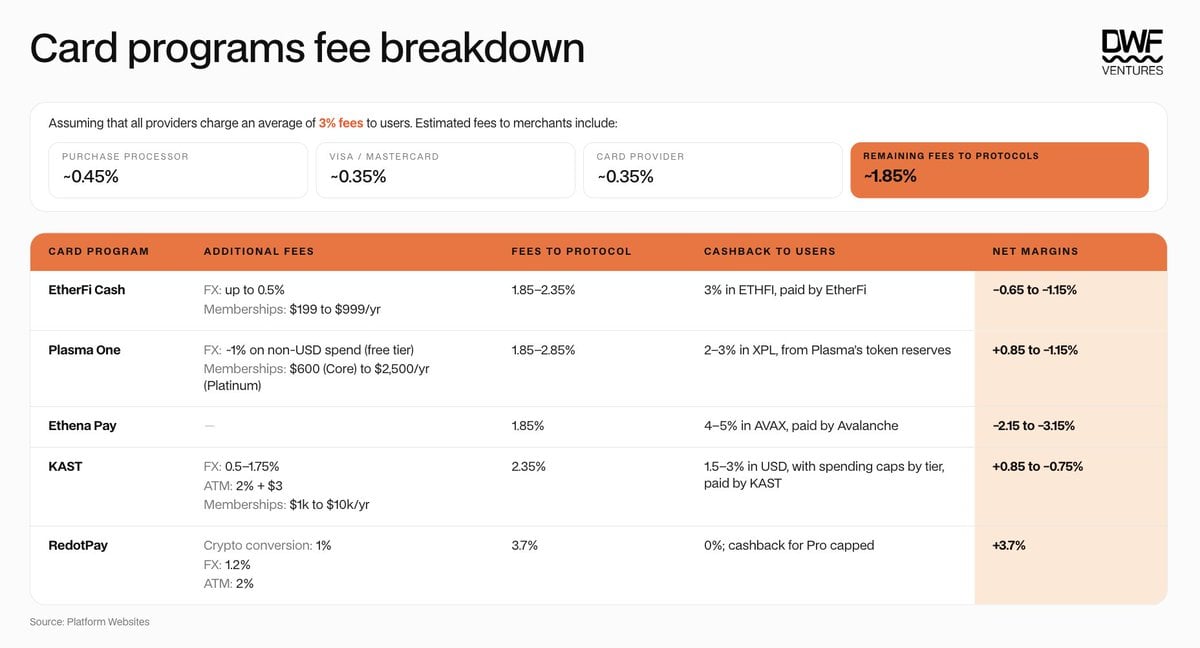
Current issuing projects primarily rely on three revenue streams: interchange fees from card spend, FX and crypto conversion fees, and deposit/withdrawal fees. However, actual profitability prospects remain highly uncertain because a large portion of revenue is ultimately cycled back to users in the form of cashbacks, effectively functioning as steep customer acquisition costs (CAC). After deducting cashback subsidies, most projects retain less than 1% net income from swipe volume, while subsidies paid out reach as high as 2% to 3% per $1 spent. Although capping cashbacks helps control CAC, high incentives remain a critical lever for sustaining growth, often at the expense of profitability. A deep dive by Blockworks meticulously calculated the actual cashback expenditure per unit of consumption across projects, revealing that most remain unprofitable on a per-transaction basis.
A standout exception in this landscape is RedotPay, which competes through global channel reach rather than pure cashback subsidies. Holding compliant financial licenses in Hong Kong, the US, Canada, Argentina, and beyond, RedotPay supports withdrawal settlements in over 35 fiat currencies via local partners. It offers a more cost-effective and highly practical alternative to traditional cross-border remittance flows heading to Africa and Latin America, allowing it to secure a massive market share despite charging higher fees.
As card-issuing features become increasingly commoditized, neobanks are strategically pivoting toward higher-tier business layers such as savings and investment. On-chain infrastructure enables the exploration of entirely new revenue sources, some of which can be shared with users. Key areas of exploration include:
• Issuing proprietary stablecoins: Issuing projects can directly capture interest generated from users' idle funds instead of handing it over to external issuers like Circle or Tether. For example, KAST issued a proprietary stablecoin via M0, while EtherFi partnered with Ethena to launch ether.fi USD. Currently, EtherFi holds approximately $48 million in idle user deposits, which could generate roughly $2 million in steady annual interest at a 4% baseline yield.
• Lending services: Users can collateralize assets held within the app to unlock liquidity. These loans are primarily facilitated through mature third-party protocols like Aave and Morpho, without straining the neobank's own balance sheet. For instance, credit lines for ether.fi Cash run directly on an Aave V4 instance, with associated lending volume already exceeding $47 million.
• Perpetual contract trading: This represents a newer initiative targeting on-chain native users and serves as a critical step toward becoming a super app. The Phantom wallet embedded perpetual trading functionality by integrating with Hyperliquid, accumulating over $20 million in ecosystem builder fees since launch. Coupled with its launched debit card, this significantly accelerates Phantom's transformation into an on-chain super app combining spending, savings, and trading.
How to Sustain Continuous Growth?
Returning to users' fundamental needs, the core value proposition of neobanks can be broken down into three pillars: asset custody, yield generation, and liquidity connectivity.
Savings is the easiest feature to deploy but the hardest to build a moat around, as it is fundamentally rooted in deep trust. Trust must be slowly cultivated through licensed credentials, compliance guarantees, and security track records that withstand long-term scrutiny. Once earned, it becomes a rock-solid foundation for growth, particularly in countries with weak local currencies, where holding USD deposits offers incomparable appeal compared to domestic fiat.
Yield generation is the next core battleground. As yields become table stakes, users will naturally gravitate toward platforms that combine high returns with sustainability. Projects with organic revenue sources will hold a decisive advantage. Ethena Pay is a prime example: user deposit yields stem directly from Ethena's own hedged arbitrage strategy. Every dollar deposited creates incremental demand for USDe, subsequently generating additional revenue for the protocol. This flywheel effect allows yield capacity to scale alongside user growth, rather than relying on expensive third-party liquidity rentals. Furthermore, the denomination of the yield matters critically: pure USD cash yields carry higher intrinsic value, whereas governance token yields lacking sustained buy pressure offer noticeably less appeal to retail users.
Connectivity remains the weakest link for the vast majority of neobanks today, specifically regarding how seamlessly users can withdraw crypto assets into their everyday local fiat bank accounts. Building a moat in this area would create a formidable barrier, as very few competitors have established comprehensive local fiat off-ramp channels. Latecomers would need to endure extremely long compliance and business development cycles to catch up.
Where Is the Market Heading Next?
Evidently, simply offering crypto card spending and cashback subsidies is no longer enough to stand out in fierce market competition. The next evolutionary focus will inevitably center on developing high-margin products, transforming every app into a super app that helps users manage, grow, and invest their wealth. Supporting multi-currency settlement and deeply integrating into local fiat payment networks present extremely high technical and compliance barriers, but they are precisely the core winning moves for applications dominating specific regional markets. While building this moat undeniably requires prolonged time investment, the neobanks that ultimately achieve scalable deployment will undoubtedly emerge as the biggest winners in this financial transformation.
Join TechFlow official community to stay tuned
Telegram:https://t.me/TechFlowDaily
X (Twitter):https://x.com/TechFlowPost
X (Twitter) EN:https://x.com/BlockFlow_News
 @DWFVentures