
How Did Revolut, Valued at 115 Billion, Become a Banking Challenger?
Author: Awang, Web3 Xiao Lü
John Collison asked Nik Storonsky on Stripe's podcast Cheeky Pint: Once in the US, will Revolut directly compete head-to-head with Amex Platinum and Chase Sapphire?
The answer from this co-founder and CEO of Revolut was one word: Yes.
Over a decade ago, Revolut offered a card for Brits traveling abroad. Users could exchange money via their mobile app before departure, then spend normally on arrival, saving on foreign exchange fees.
Today, the company has over 80 million retail customers, with its latest transaction valuing it at $115 billion. It plans to enter the market where Americans swipe their most frequently used cards.
How did Revolut achieve the customer scale of traditional banks within a decade? And how has it maintained the high-speed growth of a tech company in the financial payments industry? With these questions in mind, we reviewed Revolut's 2025 annual report to seek some answers and insights.
After 80 Million Customers, What Does Revolut Still Lack?
Revolut's growth has moved past the phase of high percentage growth fueled by a low base. a16z groups it alongside Nubank: both continue rapid growth after revenue surpassed the $1 billion mark.
a16z estimates Revolut's CAGR for revenue from 2022 to 2025 at approximately 70%. By 2025, revenue reached £4.52 billion, up 46% year-over-year. Pre-tax profit increased to £1.71 billion, up 57% year-over-year, with the pre-tax margin rising from 35% to 38%.
The $115 billion valuation comes from a secondary share transaction completed in November 2026, which brought no new capital to Revolut. The share sale in 2025 valued the company at $75 billion, roughly 19 times its $4 billion revenue in 2024. The latest deal values it at $115 billion, still roughly 19 times its $6 billion revenue in 2025.
While the pricing of the two transactions increased by 53%, the revenue multiples based on their respective most recent full fiscal years remained almost unchanged.

The business already has scale, and profits are growing even faster than revenue.
Looking back, early investors bet on a very specific use case. Balderton partner Daniel Waterhouse publicly shared excerpts from a 2015 investment memo. What attracted them was that users could make payments abroad just like using a local card while saving on foreign exchange fees.
Five years later, it shifted from payments to accounts. In its Series D announcement, Revolut had already listed increasing daily account usage frequency as a goal.
Today, when a16z looks at this company, the focus is on two things: how many more customers can be added, and how much revenue each customer can generate (ARPU).
By the end of 2025, Revolut had 68.3 million retail customers, adding approximately 16 million in a year. Figures disclosed in 2026 exceeded 80 million. For comparison, JPMorgan's Consumer & Community Banking segment serves over 88 million U.S. consumers. Revolut is no longer just a "challenger"; it has become a true industry giant, with a user base surpassing the combined total of SoFi, Robinhood, Dave, and Chime.
But when comparing their books, the gap becomes clear. Barclays Group reported pre-tax profit of approximately £9.14 billion in 2025, while Revolut's was roughly one-fifth of that.
A single card can be distributed to millions quickly, but relationships involving payroll, deposits, and lending must be accumulated gradually.
From payments to accounts, Revolut took over a decade to complete the overtaking of major banks' customer scale.
However, the profitability model beyond this point must return to transactions, balances, and credit. On this front, Barclays took over a century.
Products: From Travel Currency Exchange to Personal and Business Accounts
Travel Currency Exchange and Cards
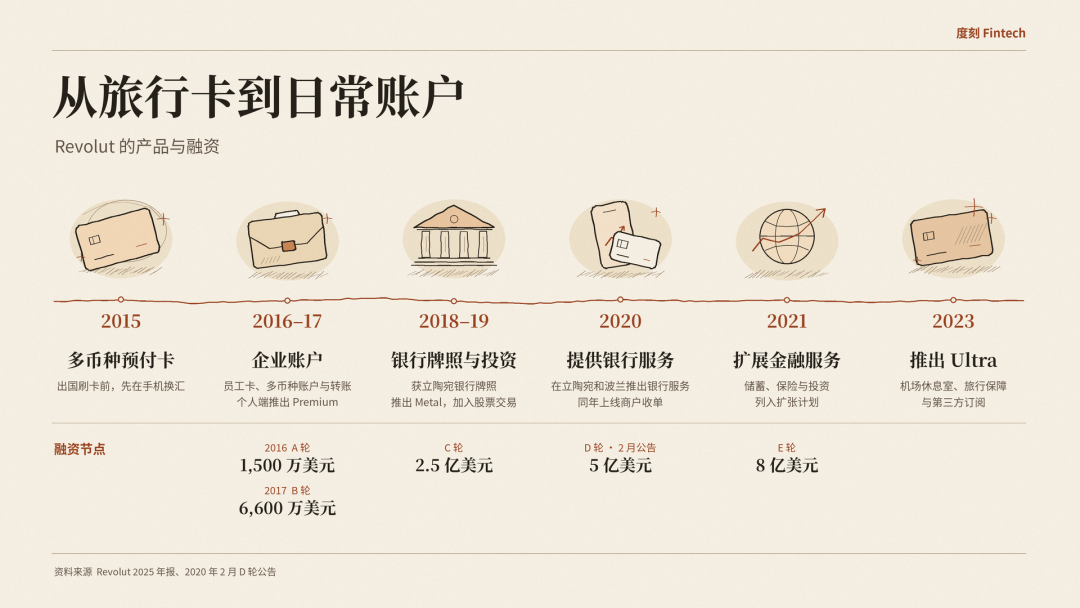
In July 2015, Revolut launched its mobile app and multi-currency prepaid card. At the time, Storonsky said in an interview that he traveled frequently and had previously spent hundreds of pounds on foreign exchange fees and commissions.
The first version bundled currency exchange and overseas card swiping. For travelers departing from the UK, exchanging pounds for euros still incurred costs even when visiting destinations like France or Spain that already used the euro. Users could check exchange rates and convert money on their phones before leaving, then use the same card locally upon arrival.
In 2016, Revolut closed its $15 million Series A. In 2017, during Index Ventures' $66 million Series B lead, Revolut already had over 700,000 customers in Europe, and its premium tier was launched for individual users.
Index partner Martin Mignot was drawn to Revolut's ability to make cross-border fund transfers simpler and more transparent.
From Personal to Business Accounts
The company subsequently brought the same currency exchange and payment capabilities to the enterprise side. Business started with multi-currency accounts, employee cards, and cross-border transfers. While travelers might exchange currency a few times a year, businesses pay suppliers and handle employee expenses every month, giving Revolut a foothold in daily operations. By the end of 2025, Business had 767,000 customers, contributing approximately 16% of the group's revenue.
Gradually Launched Financial Services
In 2018, DST Global led a $250 million Series C round, bringing the valuation to $1.7 billion. At that time, Revolut already had nearly 2 million customers and processed approximately $1.8 billion in transactions monthly.
That same year, the company obtained a Lithuanian banking license, launched Metal, and the addition of crypto trading from the previous year gave the account another purpose. In 2019, stock trading was added to the app. Users began to have reasons other than international travel to open Revolut.
In February 2020, TCV led a $500 million Series D round, valuing the company at $5.5 billion, with customers exceeding 10 million. TCV partner John Doran emphasized the banking experience Revolut created through technology.
Storonsky's goal at the time was more specific: roll out banking services across Europe so that more people would use it daily. That same year, the company launched banking services in Lithuania and Poland, and enabled merchant acquiring for enterprise clients. When it hit 1 million customers in 2017, Revolut had already noticed users employing the card for daily spending, even treating it as their primary current account. At this stage, the company gained the capability to package these usage patterns into more comprehensive services.
In 2021, SoftBank Vision Fund 2 and Tiger Global invested $800 million, pushing the valuation to $33 billion, with customers exceeding 16 million.
Tiger Global's Scott Shleifer valued the company's product development speed and user experience at the time, believing it would support further expansion. The company announced that funds would be used for savings, insurance, investments, and overseas markets.
In 2023, Revolut launched its highest-tier membership, Ultra, which includes travel insurance, airport lounge access, and third-party subscriptions in its monthly fee. Storonsky mentioned in the show that more people bought it than he initially expected.
Profit Model
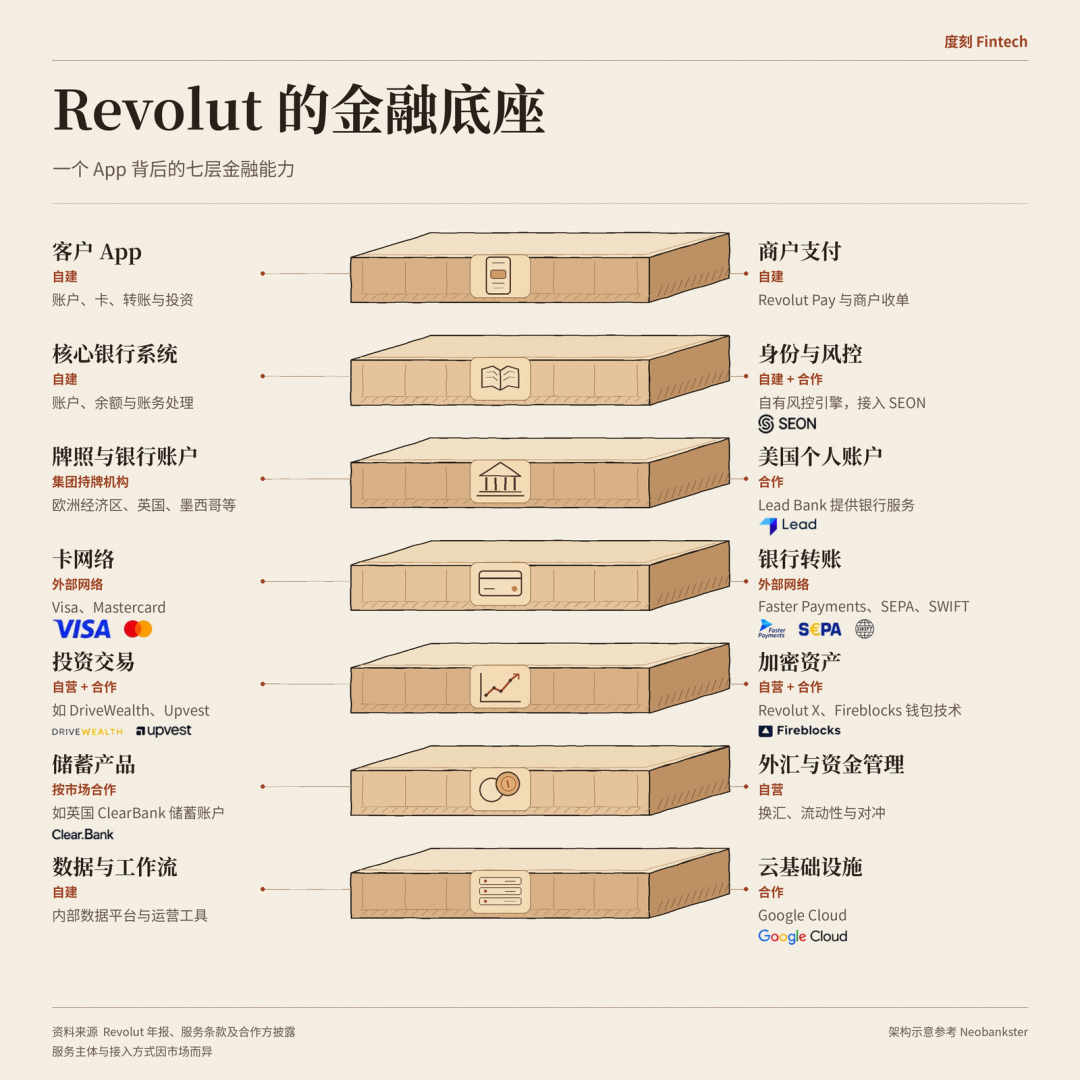
Storonsky stated in an interview that interchange fees on card swipes in Europe are low and credit regulations are strict, meaning Revolut must rely on transactions first. In 2025, of the group's £4.52 billion in revenue, approximately £3.43 billion came from fees and service charges, accounting for 76%. Users generating income through card swipes, currency exchanges, trades, or subscriptions all contribute to this revenue stream. Interest income separately accounted for 21.6% of the total.
The annual report breaks revenue down into six categories:
Bank card payments Interest Subscriptions Wealth Forex Other income
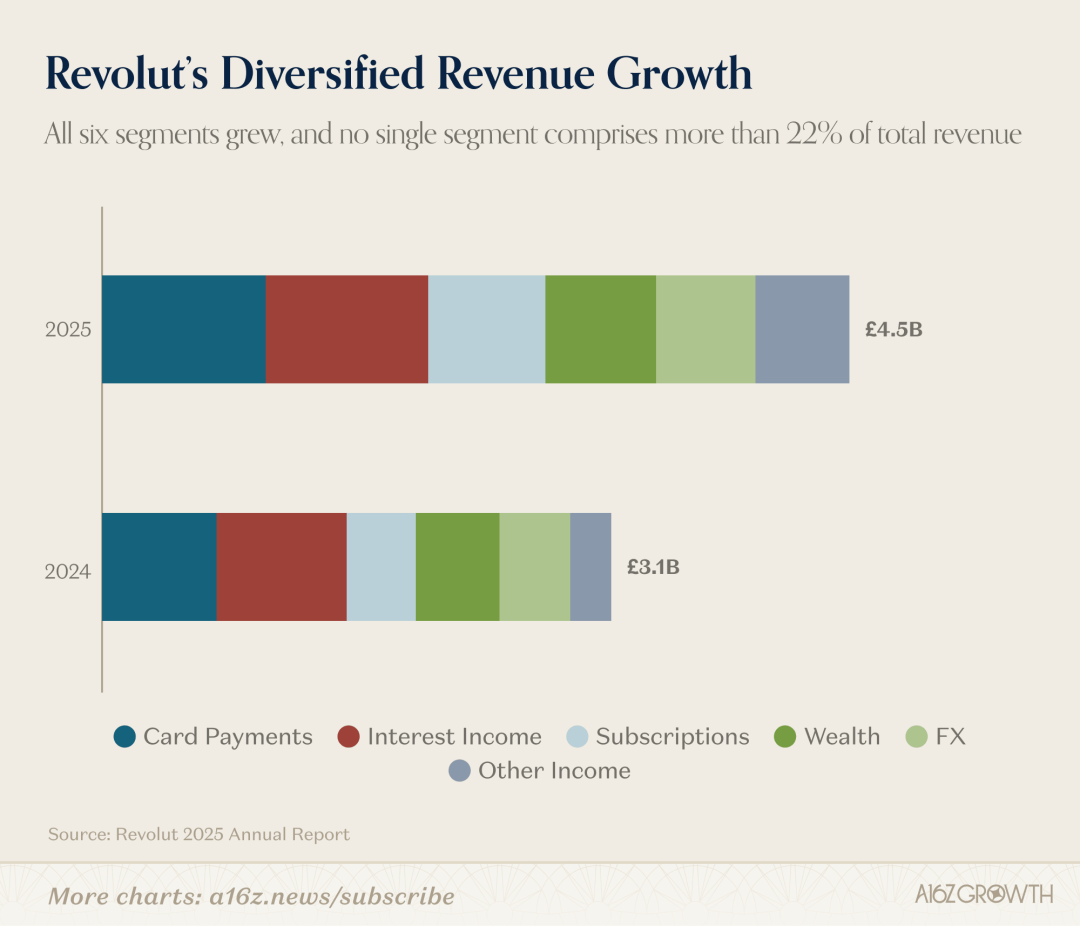
Fees by Transaction. Card payments represent the largest category, generating approximately £1 billion in 2025, or 22.2% of group revenue. When users swipe their cards, Revolut earns interchange fees as the issuer. This category also includes certain cash withdrawal and top-up fees. Foreign exchange revenue totaled approximately £606 million, derived from fiat currency conversion charges, including fees for exceeding plan allowances. The wealth business generated about £663 million, encompassing stocks, crypto assets, commodities, and savings services, with charging models including trading commissions, markups, and custody fees.
Monthly or Annual Fees. Subscriptions contributed £708 million in 2025, a 67% year-over-year increase. Individual users pay for higher exchange limits, travel insurance, and membership benefits, while enterprises purchase plans for accounts and operational tools. A company using Revolut for corporate cards may additionally pay for FX, acquiring, or expense management services.
In 2024, crypto trading was highly active, and Revolut X launched that same year, driving wealth business revenue to surge by 298%. By 2025, this growth rate moderated to 31%, while card payments still grew by 45% and subscriptions rose by 67%. If customers execute fewer trades, commissions will be impacted. As long as they remain willing to renew, Revolut still collects a membership fee the following month.
Earning Interest on Funds. Revolut reported £974 million in total interest income in 2025. After deducting interest expenses, net interest income stood at £891 million. Of the total interest income, approximately £448 million came from cash and bank balances, £371 million from treasury investments, and only about £151 million from customer loans. Cash and treasury investments accounted for roughly 84% of total interest income.
By the end of 2025, loan balances more than doubled year-on-year to approximately £2.2 billion, still representing only 6.2% of on-balance-sheet customer deposits according to the annual report.
Storonsky compares bank lending to selling options: steady interest is collected routinely, but credit losses may materialize concentratedly during economic downturns. Consumer loans, credit cards, and mortgages could all boost ARPU. To determine whether scaling up is worthwhile, it depends on whether interest income can cover funding, bad debt, and capital costs.
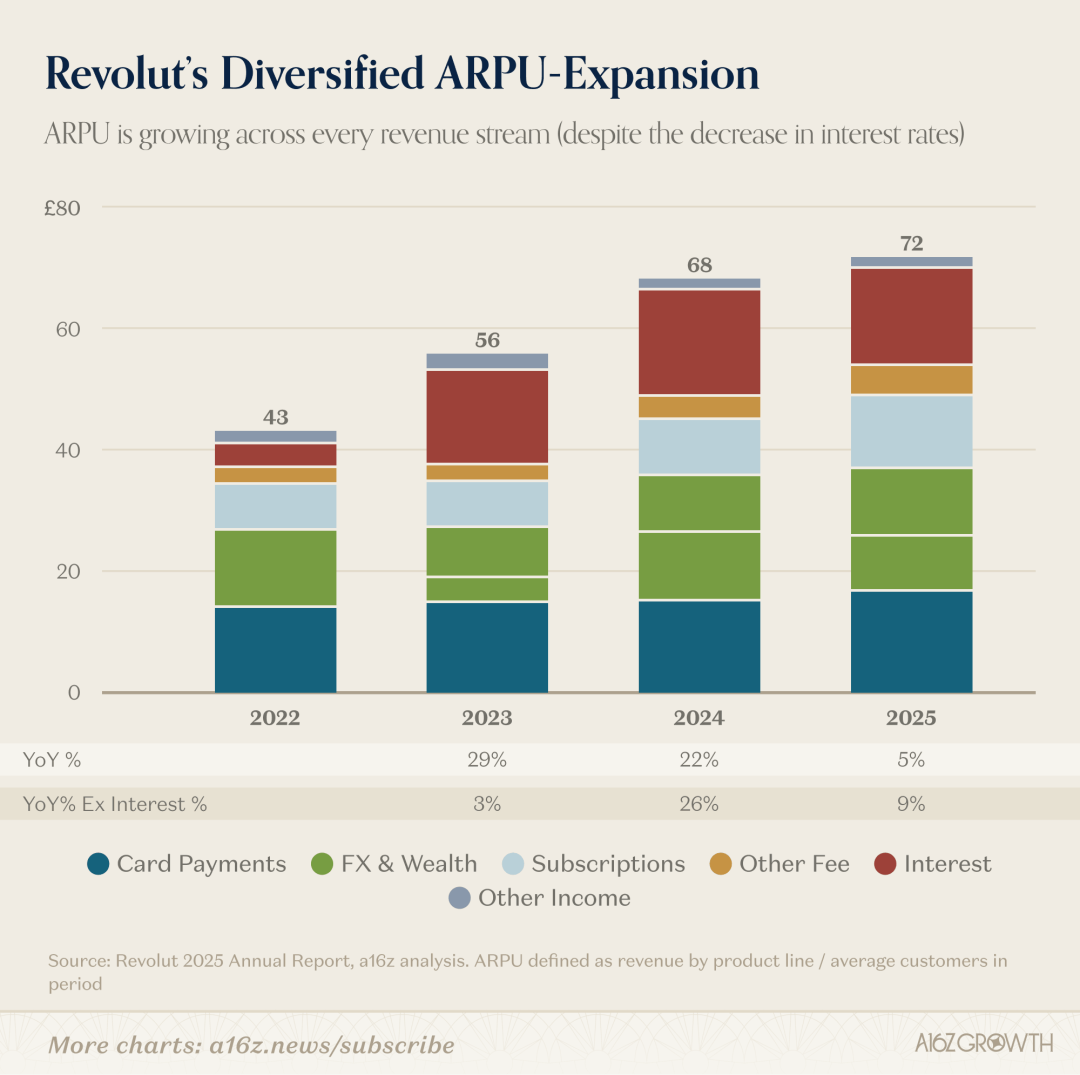
Based on a16z's estimates using average customer counts over the period, Revolut's ARPU increased by approximately 65% from 2022 to 2025. By 2025, the group already had 11 product lines each generating over £100 million in revenue. ARPU is a group average and is also influenced by regional factors, the proportion of enterprise customers, and changes in the business mix.
Beyond revenue, a16z estimated Revolut's ROAE at approximately 35% for 2025 based on average shareholder equity, attributing efficiency partly to organic customer acquisition, self-built core infrastructure, and fewer physical branches. This metric reflects returns from the existing business portfolio. If credit significantly weighs on the books in the future, capital requirements and credit cycles will both impact this calculation.
Besides organic growth, expansion also involves tangible expenditures. In 2025, Revolut's advertising and marketing expenses increased from £359 million to £529 million, a 47% year-over-year rise, closely tracking revenue growth. During the same period, administrative expenses excluding sales, advertising, and marketing as a percentage of gross profit fell from 38% to 33%. The next question is whether customer numbers and ARPU can continue to rise as Revolut persists in customer acquisition spending.
Revolut's Growth and International Expansion
Growth
Continuing to examine it through a16z's two variables.
First is customer count. A16z's European survey offers a clue: younger customers are more willing to adopt Revolut. For those who already have a primary bank, switching accounts means updating payroll direct deposits and bill deductions. For those just starting work, these habits are still forming. Growth opportunities in Europe come partly from untapped users and partly from a younger generation gradually moving more financial activities online.
Second is ARPU. a16z investor Alex Immerman told Reuters that he monitors primary account adoption rates and total customer balances. In 2025, Revolut's primary account customer base grew by 45%, outpacing the 30% growth in retail customers; absolute numbers were not disclosed by the company.
Changes in usage depth are also visible from actual transactions. In 2025, Revolut disclosed that transaction volume per customer grew 24% year-over-year, while paid plan adoption increased by 42%. The former indicates accounts are being used more frequently, and the latter shows more customers are willing to pay. Viewed alongside primary account usage and balance metrics, these figures provide clearer evidence of deepening customer relationships than merely tracking new account openings.
Balance shifts are even more intuitive. Revolut's total customer balances grew from approximately £18 billion in 2023 to £30.2 billion in 2024, and finally to £50.2 billion in 2025, representing a 66% increase in the final year.
Storonsky noted that depending on the market, roughly 10% to 20% of monthly active users deposit their salaries into Revolut. Once salaries are deposited, it becomes more likely that card swipes, bill payments, and investments will all occur within the same account. These two metrics respectively measure primary account customer growth and the proportion of MAU receiving salary deposits.
Additionally, account balances can drive payment, forex, and investment activities. For Revolut, the priority is first to encourage customers to keep more money in their accounts. Once balances grow sufficiently, the second consideration arises: should more capital continue to be allocated to cash and treasury assets, or gradually deployed into consumer loans, credit cards, and mortgages? The capital costs and risks differ along these two paths.
International Expansion

Europe remains the main driver of incremental growth. In 2025, the UK and Europe collectively contributed approximately 96% of Revolut's fee revenue. Excluding the UK, European markets saw fee revenue grow 54% year-over-year, accounting for roughly 70% of the group's net new fee revenue. Fee revenue growth outside Europe may be faster, but in terms of absolute new amounts, Europe still drives growth the most.
Revolut is essentially also an international company. When it expanded from the UK to Europe, it sold cards that saved on FX fees. In Mexico, it leveraged local banks to capture deposits. Officially launched in January 2026, by late September it had over 1 million account holders with deposits nearing 7.9 billion Mexican pesos, though it remained unprofitable in Q3. Opening accounts can happen quickly, but turning deposits and daily transactions into a profitable business requires continued observation of local performance.
The United States presents another challenge. Revolut has received preliminary conditional approval but still faces regulatory hurdles before officially launching its own bank. It aims to compete with Amex and Chase for customers using high-end credit cards. While cards drive swipe volume, the critical test lies ahead: will users entrust their payroll and deposits to the platform, and can the cost of card perks and credit be recouped?
Asia offers an observable sample as well. Revolut entered Singapore in 2019. The company stated that its local operations achieved consecutive years of net profitability in 2025, with enterprise customer numbers roughly quintupling that year. In October 2026, Revolut announced plans to invest nearly S$350 million in Singapore over the next five years. While the announcement did not disclose the absolute number of local enterprise customers, this case presents another observational pathway: establish local operations first through cross-border payments and business accounts, then assess whether customers and revenue can continue to scale as investment increases.
Revolut can bring the same account technology to many places. However, for each new market, answering why users open accounts and why they're willing to remit additional funds requires locally tailored products.
Reviewing Revolut's 2025 data clearly reveals the complete picture of emerging Neobanks that Revolut illustrates:
Starting with traffic from currency exchange payment cards, gradually building/deepening account relationships, and ultimately providing diversified financial services.
Takeaways for Emerging Neobanks
Revolut's initial batch of customers had a very specific reason to open the app: swiping cards abroad saves on exchange fees. Only after the same product suite became useful for collecting salaries and paying bills did users have a reason to continue using it post-travel.
Revolut has already integrated stablecoin transfers into its existing app. According to disclosures from Polygon Labs in November 2025, Revolut users had already processed cumulative transactions exceeding $690 million on Polygon at that time.
For teams looking to build a stablecoin-native Neobank from scratch, a more pressing question is: Revolut already has a cohort of customers accustomed to exchanging currency and transferring funds. Which specific group will you target first, and what specific inflows will you aim to capture?
Most teams target Asia, Africa, and Latin America, preaching a universal narrative of using blockchain and stablecoins to solve financial inclusion for the 1.3 billion unbanked/underbanked population.
The answer to this question varies by market. In regions where traditional bank cards and mobile banking are already convenient, a stablecoin card may not convince users to abandon their established payment methods. In places where cross-border receipts are cumbersome, a freelancer might simply want overseas clients to send payment, keeping a portion for local bills. The product must first securely receive this money. With consistent inflows the following month, users gain a genuine reason to return.
In any specific market, truly identifying a pain point (such as helping them earn money) is what constitutes real, substance-backed innovation rather than empty boasting.
Blockchain can help platforms easily globalize by connecting to cross-border settlements, while offering familiar crypto asset users more trading and wealth management options. At first glance, it seems to have reached the high-ARPU stage. However, its drawbacks lie in the relatively small addressable audience and inherent incompatibility with traditional user profiles.
Is it realistic to expect someone without a bank account to use a crypto wallet to trade Nvidia US stocks? It reminds me of a sudden realization I shared recently with a mentor:
Of the 1.3 billion unbanked/underbanked individuals, do they truly need bank accounts?
Join TechFlow official community to stay tuned
Telegram:https://t.me/TechFlowDaily
X (Twitter):https://x.com/TechFlowPost
X (Twitter) EN:https://x.com/BlockFlow_News
 0xWillmfer