
Why are institutions still continuously adding to their Bitcoin ETF positions after the sharp drop?
Author: Root, On-chain Analyst at BitcoinStrategy
Edited by: TechFlow
TechFlow Summary: The recent pullback in Bitcoin's price has cast a shadow over previously optimistic early recovery narratives, bringing renewed concerns about the four-year cycle and a double bottom. However, beneath the surface of extreme market panic, the actual flow of off-chain institutional capital reveals a sharply contrasting robust undercurrent.
Prominent on-chain analyst Root, citing the latest disclosed SEC 13F institutional holdings report, points out that institutional-held Bitcoin ETFs surged 15% in Q3 2026, breaking past 620,000 coins. This now accounts for nearly half of all spot ETFs, with over two-thirds of the top 25 institutions increasing their positions against the trend. The wave of institutionalization is irreversibly reshaping the supply distribution structure.
Price Update: Is the Four-Year Cycle Pattern Under Review Again?
To all Bitcoin investors: The recent sharp pullback in price has once again clouded the widely anticipated "early recovery" assumption with heavy uncertainty. With prices dipping to around $61,000, the traditional four-year cycle pattern has re-emerged as the core focal point of intense bull-bear debate.
From a technical perspective, Bitcoin still retains the theoretical possibility of forming its first "Higher Low," but the depth and abrupt timing of this sell-off have likely pushed the classic four-year halving cycle logic back onto the analytical table.
Frankly speaking, the false upward breakout earlier this August did somewhat interfere with my judgment. At the time, I briefly believed Bitcoin was poised for a full rebound and recovery, but in hindsight, it was merely a bullish trap followed by a brutal deep washout.
As for whether the market will stabilize at current levels to establish a higher low, or continue its inertial decline to smash out a brand new cycle bottom, both scenarios are critically important for overall position management and psychological discipline: Successfully forming a higher low in the current zone would imply that the upward slope of the broader cycle remains intact; however, if the price unfortunately breaks through prior support and slides toward a new bottom, the depth of deleveraging and the timeframe required for digestion will be significantly prolonged.
Regardless of which short-term scenario plays out, one fact is certain: the overall sentiment in the crypto market has plummeted to freezing point, and ironically, this extreme skepticism and despair often lay the very foundation for true medium-term certainty.
From a valuation model perspective, Bitcoin has returned to a clear "Undervalued" zone; although during an extreme stampede the price could theoretically be briefly smashed into the abyss of "Deep Undervaluation," excessive panic from long-term investors at this juncture holds little value.
More importantly, beneath the hood of short-term market volatility, underlying institutional capital adoption is advancing with remarkable momentum. The latest institutional ETF fund flows are providing us with an exceptionally encouraging long-term hand.
Institutional Adoption Report: Institutional Maturity Defines the Next Cycle
I firmly believe that the next major era for Bitcoin will revolve entirely around the core pillar of "Institutional Maturity." This is far from a hollow marketing narrative; it is a historical trend actively unfolding, already backed by solid data.
Of course, not all industry participants view Bitcoin's institutionalization as a positive development. You've likely frequently encountered radical statements on major social media platforms such as "institutional entry will stifle Bitcoin's decentralized spirit" or "Wall Street will destroy the native crypto ecosystem."
But in my view, I firmly embrace institutional adoption. Because humanity's journey toward a "Bitcoin Standard," and the eventual establishment of Bitcoin as a truly global, borderless, neutral base currency, inevitably requires an exponential leap in scale—one that absolutely cannot happen without deep participation from mainstream global financial institutions.
For the vast majority of traditional asset management firms that have recently entered the spot Bitcoin market, this current cycle is merely their "first complete cycle" experiencing firsthand. They completed their initial allocation in 2024 but have yet to truly endure a full bull-and-bear cycle test.
Next, let's conduct an authoritative breakdown of the actual institutional holdings from the just-concluded Q3 2026, based on the newly released SEC Form 13F institutional filing reports. (Note: Given SEC regulations require institutions to file within 45 days after quarter-end, this dataset precisely captures the real holding baseline at the tail end of Q3, immediately prior to this round's latest downturn.)
Institutional Holdings Breakdown: Single Quarter Surge Exceeds 82,000 BTC
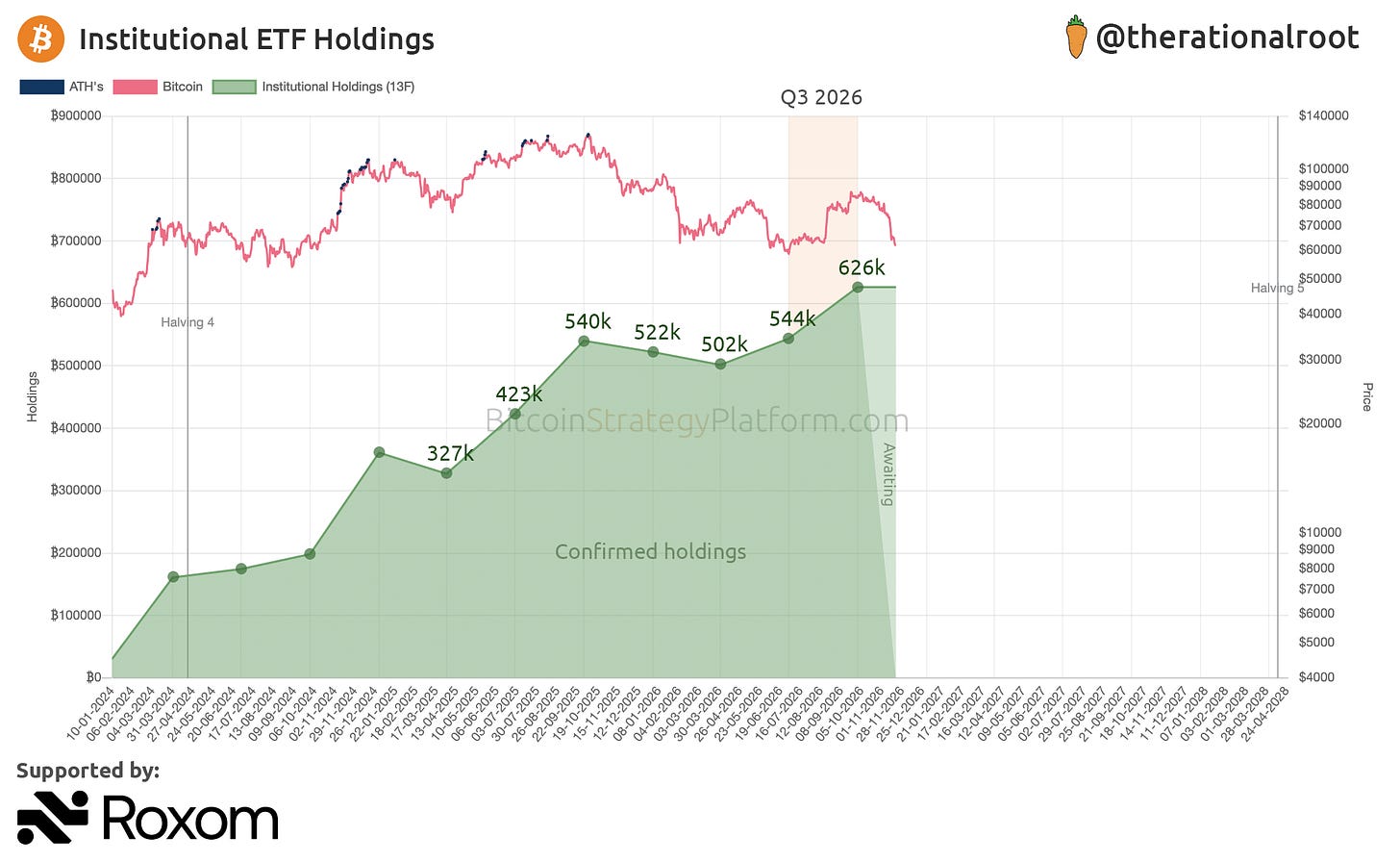
Key Insight: During Q3 2026, the total institutional holdings of US spot Bitcoin ETFs globally surged dramatically from 543,633 BTC in the previous quarter to 626,193 BTC, achieving a net increase of 82,560 BTC within a single quarter alone.
In other words, even amidst a volatile period marked by sharp spot price fluctuations and shaken retail confidence, institutional capital not only avoided panic selling, but instead aggressively accumulated over 80,000 actual BTC in a single quarter.
S Spot ETF Institutional Share: Controlling Nearly Half of All Circulating Supply in the US
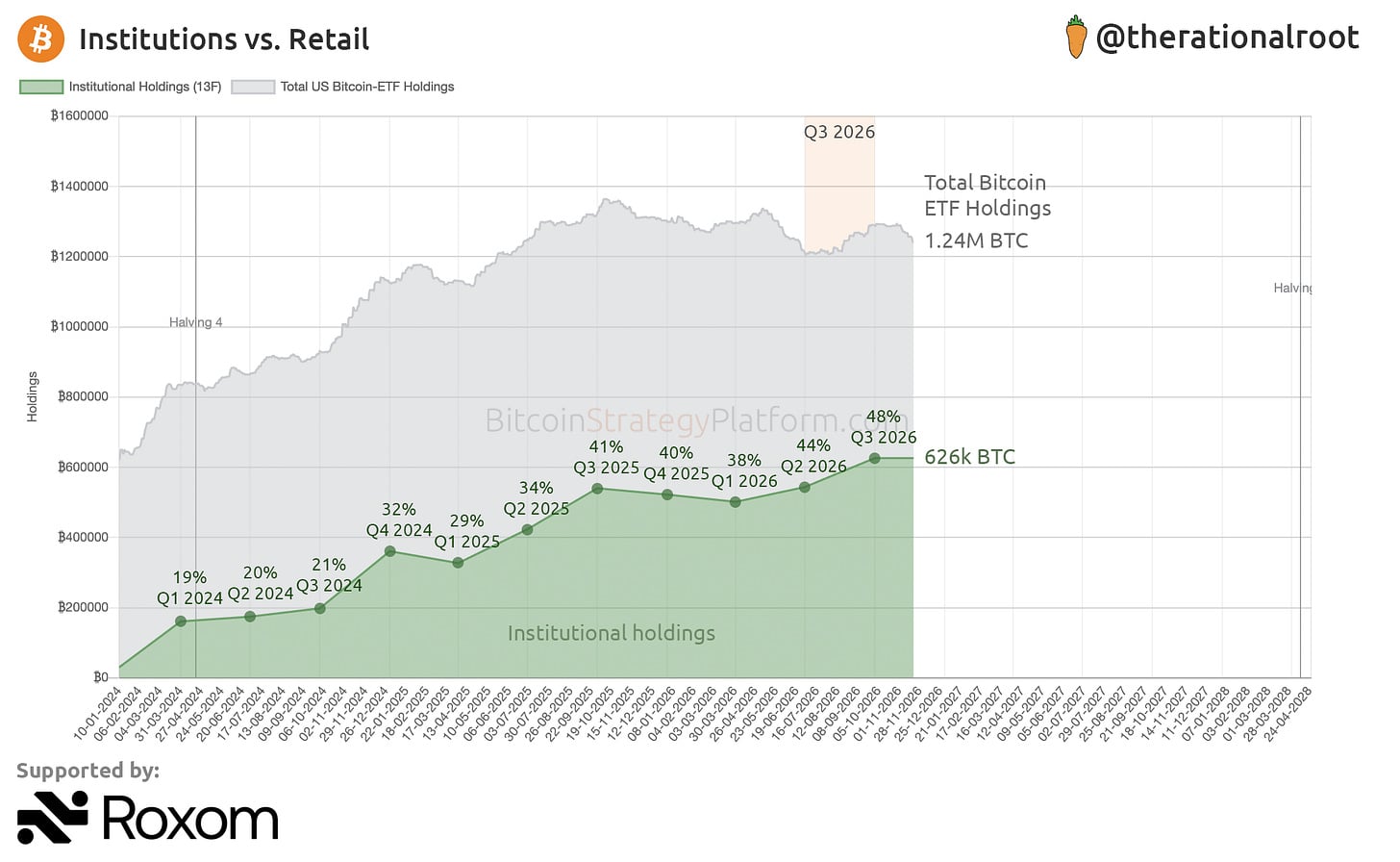
Key Insight: In Q3 2026, total institutional holdings surged approximately 15% quarter-over-quarter, directly pushing their share of all US spot Bitcoin ETF holdings to 47.7% (a robust jump from 44.4% in the previous quarter).
At present, traditional professional institutions effectively control nearly half of all circulating supply within US spot Bitcoin ETFs. Do not forget: the currently disclosed data only covers large institutional entities with assets under management exceeding $100 million, which are mandated by regulatory frameworks to submit 13F filings. This means that when adding smaller family offices, high-net-worth private funds, and offshore entities, the actual institutional holding penetration rate has long since surpassed the 50% watershed.
Top 25 Holding Giants: Over Two-Thirds Aggressively Add Positions Against the Trend
In the chart below, we comprehensively list the top 25 largest single-institution Bitcoin ETF holders across the US and their dynamic position changes:
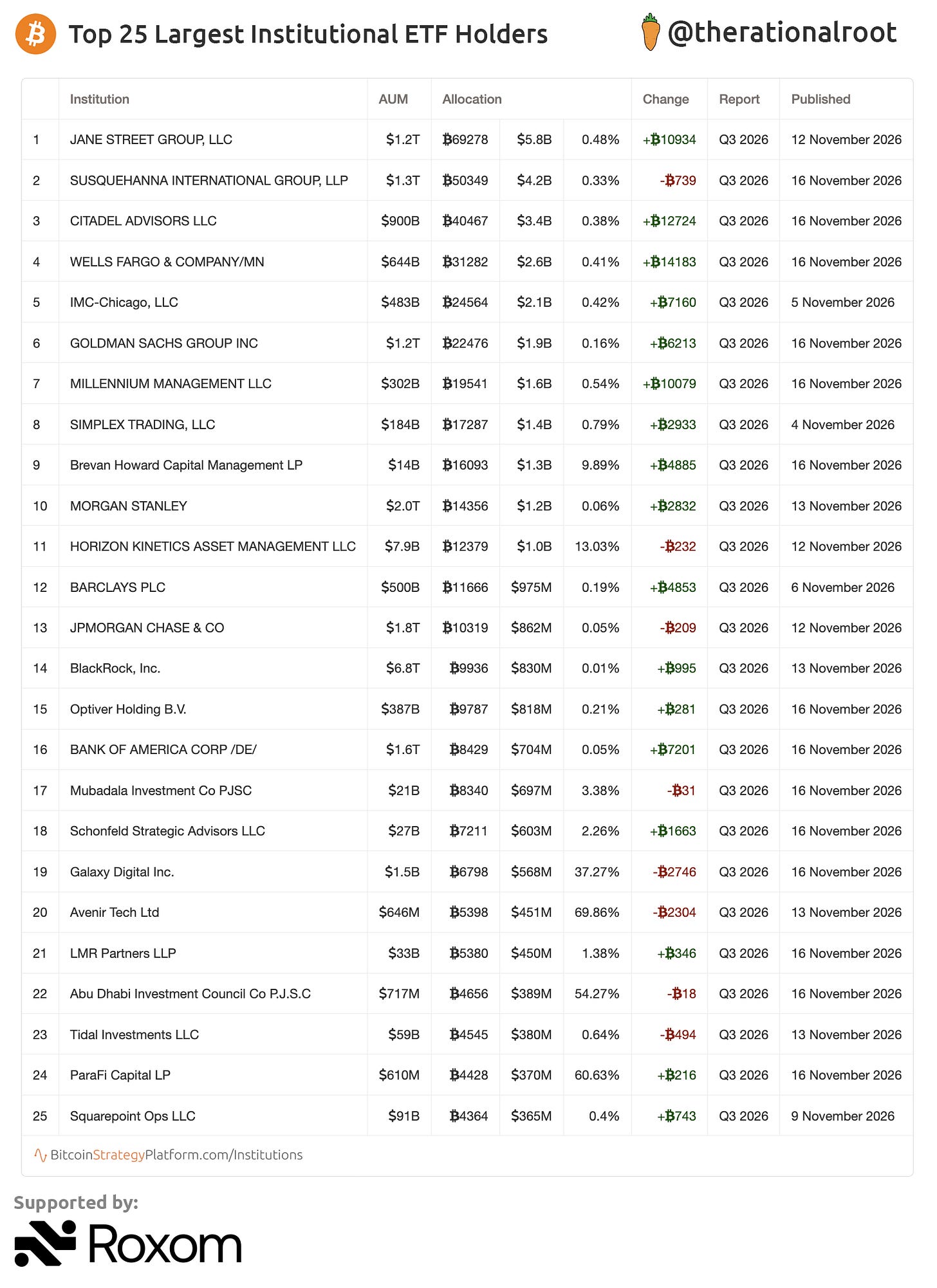
Key Insight: Among the top 25 elite whale institutions in the US, a staggering 17 chose to expand their long positions against the trend in Q3; simultaneously, another 4 global top-tier giants opted to hold steady, with only a mere 4 institutions executing minor tactical reductions during this period.
This data effectively shatters bearish rumors of "institutions fleeing at highs": The most powerful and liquid buyers on Wall Street are overwhelmingly using Q3's price consolidation phases to continuously accumulate strategic supply.
New Institutional Profiles: Irreversible Migration of Traditional Capital Toward the Bitcoin Ecosystem
Among the new institutional entrants in Q3, we clearly observe the continuation of structural trends noted over past quarters: sovereign wealth funds, state and local public pension funds, university endowments, and traditional hedge funds are systematically incorporating Bitcoin into their long-term multi-asset portfolios.
According to SEC 13F filing database statistics, the total number of US-based entity subjects explicitly disclosing holdings in spot Bitcoin ETFs has steadily increased from approximately 2,000 last quarter to over 2,100 today, demonstrating a highly stable pattern of horizontal expansion and diffusion.
Conclusion & Takeaways: Cutting Through Price Noise, Holding Firm to Deep Macro Trends
Reviewing this detailed institutional holdings report, the stark reality it reflects continues to astound me. The share of institutional capital in spot ETFs has now approached the 50% threshold with no signs of slowing; even amidst macroeconomic headwinds and short-term deep price volatility, the long-term allocation resolve of global capital giants remains rock-solid.
While short-term price crashes naturally dominate current mass sentiment and fear, I hope every serious investor can step beyond the noise of intraday charts and firmly anchor themselves to the higher-dimensional industry landscape: Short-term price action is rapidly changing and unpredictable, but the long-term trend of institutional adoption never pauses and moves steadily forward. Cutting through the fog of fear, only those who truly grasp deep capital flows will be the last ones standing.
Join TechFlow official community to stay tuned
Telegram:https://t.me/TechFlowDaily
X (Twitter):https://x.com/TechFlowPost
X (Twitter) EN:https://x.com/BlockFlow_News
 @therationalroot