
Senior Nanny
TechFlow Selected TechFlow Selected
Senior Nanny
In the early days, enterprises relied on delayed check settlements for arbitrage; nowadays, stablecoins and blockchain optimize cross-border payments and collateral circulation, yet manual risk control remains indispensable.
 Navigating Web3 tides with focused insights
By: Thejaswini M A
Translated by: Block unicorn
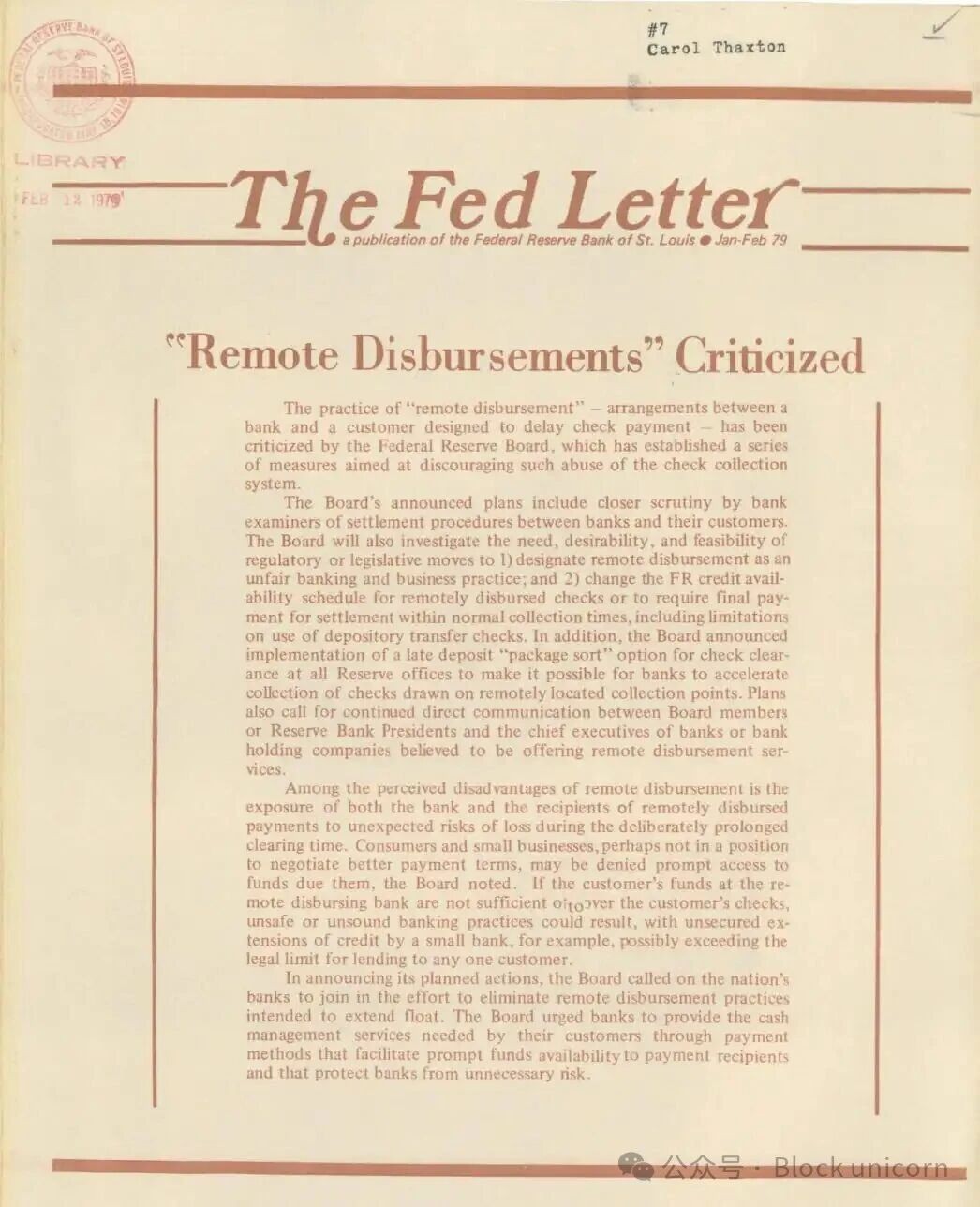
In the 1970s, American companies hired consultants to slow down the flow of funds.
This was known as remote disbursement. To delay payment, a buyer in New Jersey would write a check from an obscure bank in Montana, thousands of miles away.
Due to the distance and additional handoffs between banks, it took days for the check to clear. With interest rates soaring above 10%, keeping that money in the account for a few extra days yielded a windfall.
Some consultants were tasked with maintaining maps recording which small-town banks had the longest clearing times. It was the massive transaction volume that made this model work. In 1970, Americans wrote 8 billion checks; by 1980, that figure reached 16 billion. The Federal Reserve's float—funds that existed in two places simultaneously because checks were credited but not yet collected—averaged about $3 billion per day in 1972. Between 1975 and 1978, this number more than doubled.
The Federal Reserve was furious. In February 1979, the Fed issued a report on remote disbursement, followed by a policy statement requiring banks to stop facilitating such operations. The Monetary Control Act of 1980 mandated the complete abolition of this practice. Twenty years later, the Check Clearing for the 21st Century Act finally ended the situation. Today, most checks clear within one business day, and the Federal Reserve processes all checks in a building in Atlanta. It is all over.
Siemens has over 12,000 employees in more than 80 countries globally, with its Global Business Services department handling invoices, running payrolls, and reconciling accounts. Airbus established an office in Lisbon in July 2021 and currently has over 1,000 employees at that center and within its industrial sector in Portugal. Goldman Sachs Group has a total workforce of 47,400.
Subsequently, in September 2024, Siemens issued a €300 million bond and settled it via blockchain within minutes.
Today I want to show you the connection between these two facts. Let's get started...
Start with bonds, because they are the easiest
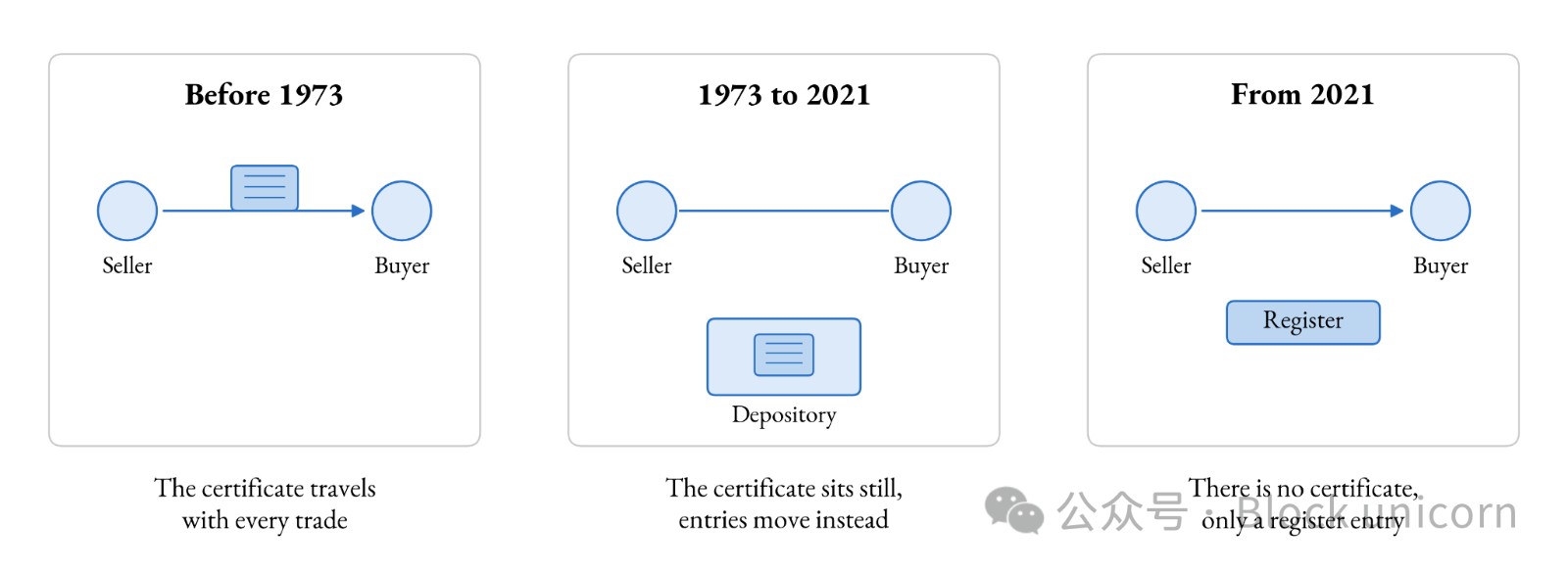
In February 2023, Siemens issued €60 million on the Polygon platform, waiting two days for transaction settlement. 18 months later, Siemens issued €300 million again, switching from the public crypto network to SWIAT. SWIAT is built by a consortium of several European banks and is a closed ledger specifically designed for transactions following institutional rules. This regulatory fit enabled it to access the German Federal Bank's trigger solution, thereby automatically settling the entire €300 million in central bank money within minutes.
Investors subscribed directly and saw their registration information immediately after settlement was completed. Corporate Treasurer Peter Lasgebu was responsible for both issuances, with the second issuance eliminating almost all settlement risk for all parties involved in the transaction.
Typically, institutions like Clearstream (a massive central securities depository) must intervene to handle such security certificates. No employee at Clearstream will lose their job over a German bond.
Next is the payroll department
Deel provides payroll management services to over 40,000 businesses and 1.5 million employees across more than 150 countries/regions, processing over $22 billion annually. Starting January 2026, businesses can directly use stablecoin treasuries to pay all their global salaries. In June 2026, Deel launched its USD-backed digital balance, DLUSD.
What problems do employers still face? Liquidity trapped in overseas bank accounts. Emergency troubleshooting after remittance failures. Exchange fees from foreign exchange intermediaries. Manual account reconciliation.
What benefits are there for workers? In Argentina, Turkey, and Ukraine, wages paid in local currency can depreciate by 20% to 40% within a year. In 2025, 85% of Deel's Argentine contractors chose to receive their wages in USD. This June, the company provided them with USD balances within the application they were already using (built on the Bridge, Privy, and Tempo platforms) and offered rewards on idle funds. This May, the company began paying full-time employees in the US and Eurozone with stablecoins issued on the Polygon platform, amounting to 10% to 25% of their net after-tax wages.
From a financial perspective, the utility of stablecoins is now supported by solid data. A joint survey by EY and PwC of 350 corporate executives showed that 13% of businesses have already adopted stablecoins. Among them, 41% achieved cost reductions of over 10% in cross-border B2B payments. This efficiency gain saved $5 million on a $50 million transfer project. These funds were previously accounted for as fixed operating costs. Looking ahead, 54% of surveyed non-users plan to adopt this infrastructure within a year.
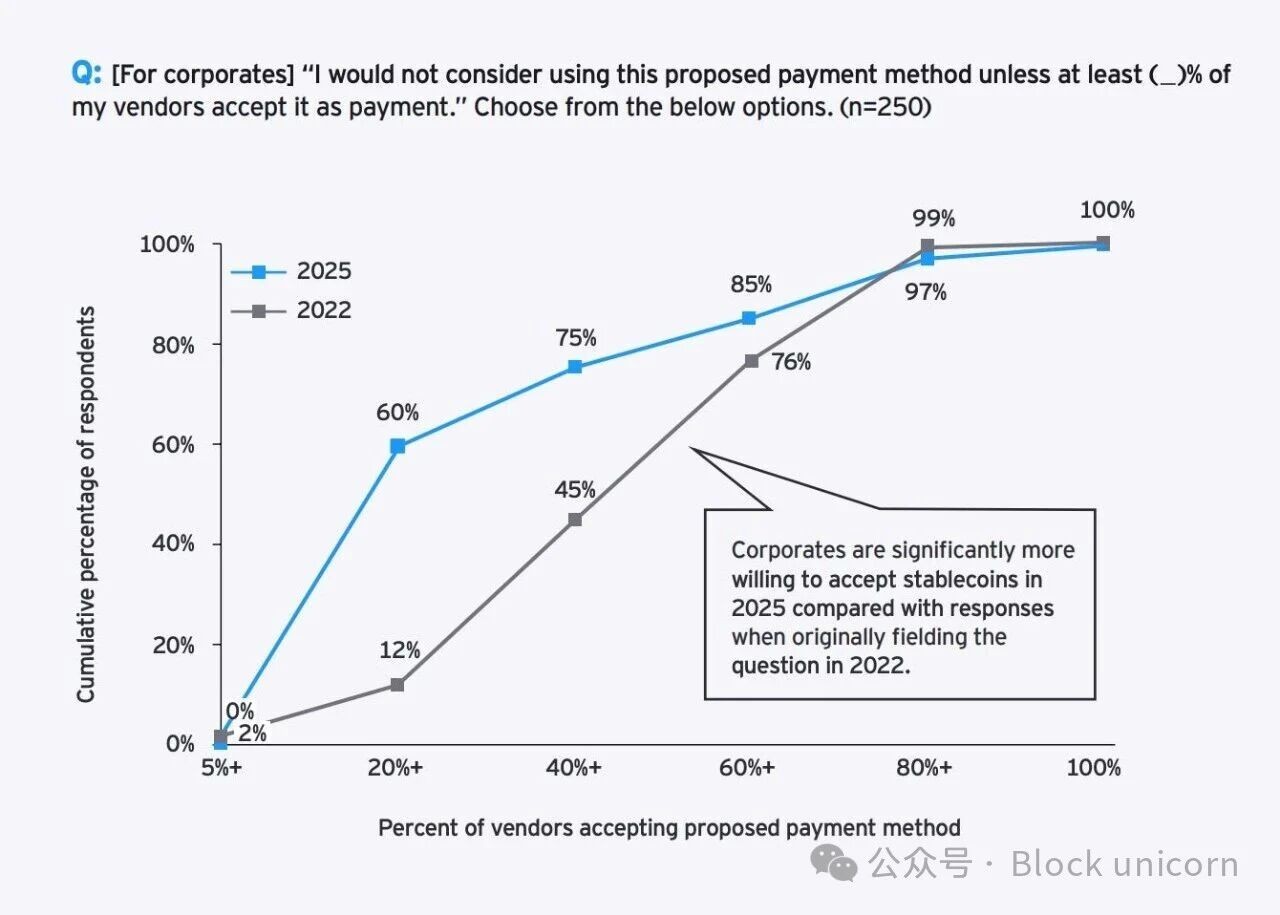
By February 2026, actual payments made by end-user stablecoins will reach approximately $390 billion annually, double that of 2024, with about 60% being business-to-business (B2B) transactions, rather than mere trading. Hyundai Card completed a cross-border corporate payment in just 7 minutes. Visa's annualized settlement volume on nine stablecoin chains reached $7 billion, growing 50% within a quarter. These are not edge experiments conducted by cryptocurrency companies.
Enterprises are using stablecoins to solve technical issues such as slow cross-border settlement and trapped funds discussed earlier.
The third, and largest, least mentioned one—collateral
Kinexys, under JPMorgan Chase, processes about $5 billion in transactions daily, with a cumulative clearing volume reaching $3 trillion, including over $1.75 trillion in intraday repo transactions alone. BlackRock has handed over tokenized money market funds to Barclays Bank as derivatives collateral. Broadridge processes $354 billion in transactions daily. The Chicago Mercantile Exchange (CME) is collaborating with Google Cloud to build a similar system, aiming to create a collateral market sized at $15 trillion.
I want to explain why collateral is something to pay attention to if you are building a house.
A hedge fund holds positions it is unwilling to sell and wants to borrow against them. Since neither party trusts the other, the collateral is handed over to a third-party agent in the middle for custody. Someone is responsible for negotiating the agent's contract beforehand. Then, the assets move around for days, and costs accumulate.
Semi-liquid assets ensure the original safety of the collateral and change how borrowers use it. It can freeze collateral, adjust spending conditions, or even skip transfers. Like Kinexys, its valuation also reaches up to $15 trillion. Look at which jobs remain after software becomes ubiquitous today; the logistics link of transferring collateral disappears, leaving only the tricky manual judgments of assessing asset value and making default decisions late at night. This is the advice I would give to anyone deciding budget direction.
This means technology cannot eliminate the cost of misjudging counterparties. This also explains why some projects succeed while others fail.
Between 2018 and 2020, several large enterprises including HSBC, Maersk, and BNP Paribas launched four trade finance blockchain networks. But none of the networks survived beyond 2023.
- June 2022—we.trade went bankrupt.
- November 2022 - Maersk and IBM shut down TradeLens.
- Early 2023 - Marco Polo closed with $4.6 million in liabilities.
- November 2023 - Contour closed after completing only 60 to 70 transactions per month on average (later acquired by XDC Network).
Faster electronic letters of credit improved document processing speed without affecting the core costs of credit underwriting.
Komgo is the only survivor among this group of companies. The reason it made it to today is that it abandoned blockchain technology. Launched by several large banks in 2018, Komgo initially offered digital letters of credit and document workflow tools. The letter of credit product ultimately failed, while the paper document product continued to operate. When competitors went bankrupt trying to digitize trust, Komgo survived by completely transforming and focusing on the mechanical pipeline business.
Tether proves what happens when a financial company refuses to assess counterparties. It plays the role of a mechanical pipeline completely, receiving USD, holding Treasury bonds, and issuing tokens, while actual customer transactions are handled by exchanges, thereby eliminating operating costs brought by human trust. This fully automated asset transfer model enabled a team of 300 to achieve a profit of $10.09 billion in 2025. Tether's revenue per employee reached as high as $33.6 million, far exceeding traditional risk management banks like JPMorgan Chase and Goldman Sachs.
Subsequently, the company began to venture into the credit field. Its secured loans increased from $14.6 billion on September 30 to $17.04 billion on December 31, an increase of nearly $7 billion in six months. Although borrower identities are confidential, these loans are protected by a $6.34 billion safety net.
When Tether started lending for the second time, it had to hire personnel to assess collateral and make margin calls late at night.
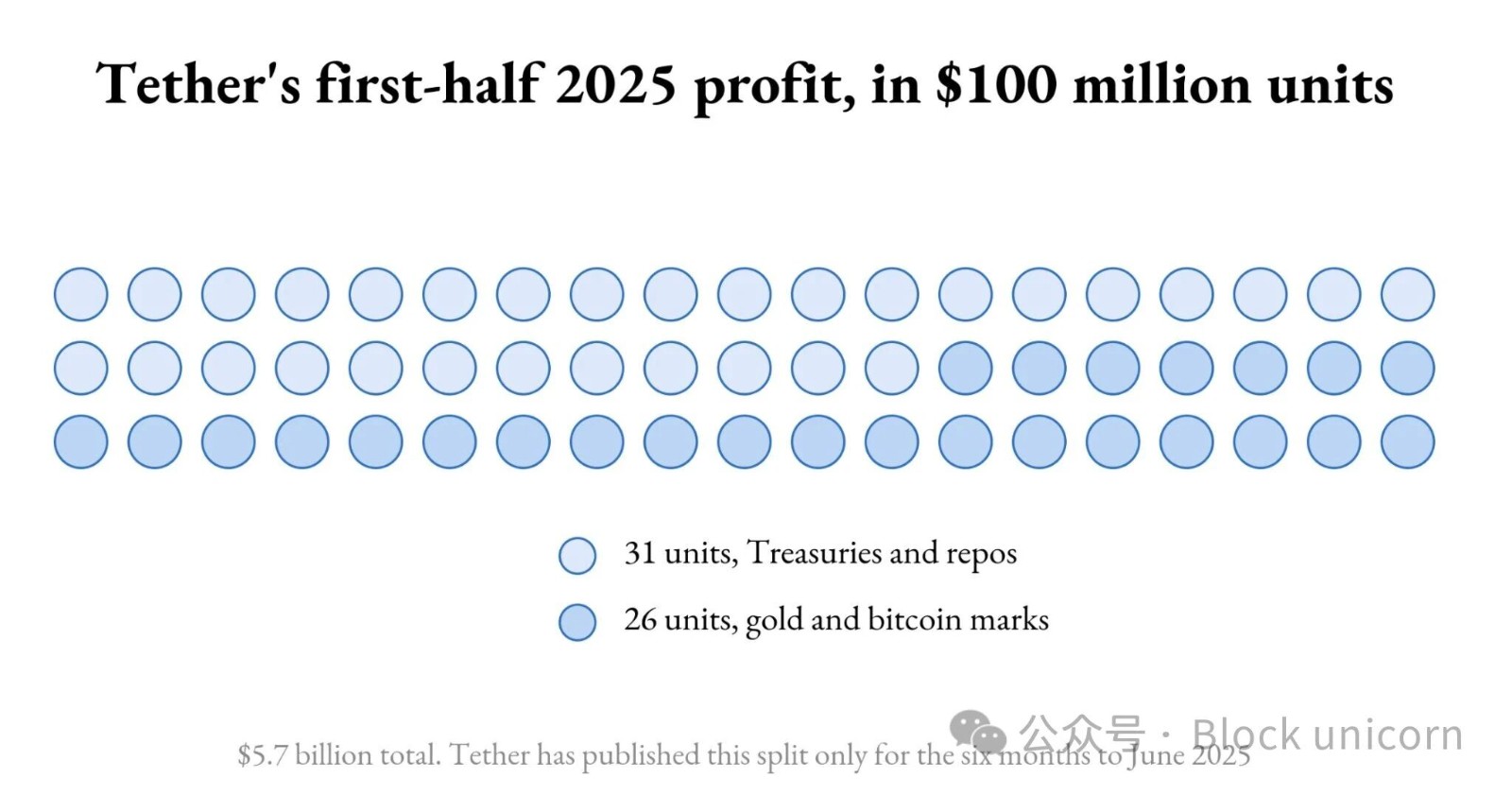
Two details seriously distort Tether's profitability. First, nearly half of its profit comes solely from the surge in the price of its massive gold and Bitcoin reserves. Second, the billions of dollars worth of tokens it issues do not require paying any interest. If a traditional bank held such a huge amount of customer funds, it would need to pay billions of dollars in interest annually.
Circle also demonstrates the same boundary from the other side. According to its 10-K report, the company expects distribution costs related to Coinbase to reach $1.4 billion in 2025, higher than the previous $924.5 million. This means 51% of its $2.7 billion revenue flows to Coinbase, a company that neither issues USDC nor manages reserves. Coinbase is responsible for user registration, KYC processes, and the anti-fraud team. Verifying customer identity still requires manual judgment. Circle reduces headcount by completely outsourcing this process, turning what should have been internal wage expenditure into an external contract expense.
So, where to build?
Enterprise blockchain and stablecoin technology solve three major operational challenges. It enables the automated flow of cash, collateral, and certificates; releases idle funds that were previously trapped in payroll float and custody accounts; and eliminates cross-border friction in Latin America, Africa, and Southeast Asia—which is exactly where executives report the key 10% cost reduction lies.
Corporate bond issuances are barely noticed. Germany's eWpG project allowed Siemens to issue successfully. As of June 2024, the total issuance of eWpG digital securities was approximately €236 million, of which KfW issued €150 million through two transactions. But this does not affect the prosperity of the European corporate bond market in the slightest.
In the past, treasurers profited from delayed settlement. After floating rates disappeared, they turned to managing pre-funded accounts. Today, tokenization has also completely changed this situation.
Join TechFlow official community to stay tuned
Telegram:https://t.me/TechFlowDaily
X (Twitter):https://x.com/TechFlowPost
X (Twitter) EN:https://x.com/BlockFlow_News