BofA and Citi Simultaneously Lower Target Prices Yet Both Issue Buy Ratings: What Exactly Happened to Corning in Q2?
TechFlow Selected TechFlow Selected
BofA and Citi Simultaneously Lower Target Prices Yet Both Issue Buy Ratings: What Exactly Happened to Corning in Q2?
The disagreement lies only in the magnitude; how much of a drop counts as bottoming out.
 Navigating Web3 tides with focused insights
By: Rita
Corning's enterprise optical communications business grew 65% in the second quarter, with overall revenue exceeding expectations. The mid-point of third-quarter revenue guidance is $4.95 billion, below market expectations. The stock price fell 19% in a single day.
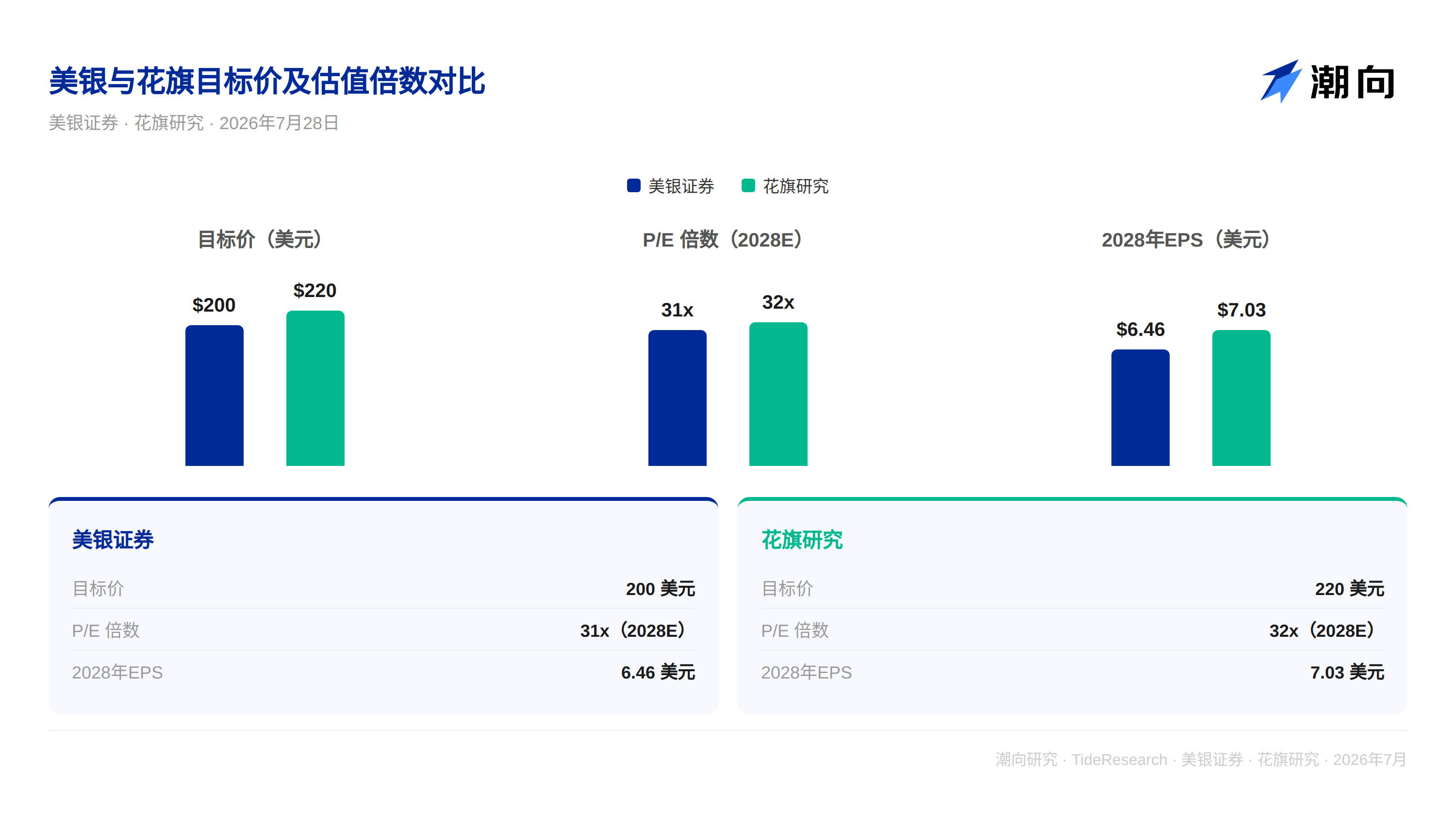
Bank of America Securities lowered its target price from $243 to $200, maintaining a Buy rating. Citi Research lowered its target price from $240 to $220, maintaining a Buy rating. There is no divergence in the judgment of the two institutions; both believe what fell was the valuation bubble, not the business itself. The divergence lies only in the magnitude—how much of a drop is enough.
Slowing Growth Punctures Valuation Bubble, AI Demand Has Not Disappeared
Corning's enterprise optical communications revenue grew 65% in the second quarter, with generative AI-related sales nearly doubling quarter-over-quarter. The 32% year-over-year growth rate for the entire optical communications segment remains considerable. Bank of America estimates this round of growth only reflects horizontal expansion demand; vertical expansion and Co-packaged Optics (CPO) waves of demand have not yet started. Citi puts it more directly: Corning Optical Communications' profits come from high-value connection solutions, not bare fiber sold by the meter; the technical barriers remain.
The mid-point of third-quarter guidance is $4.95 billion, with year-over-year growth sliding from 17% to 16%. The year-over-year growth rate for the optical communications business dropped from 81% to 32%, declining for three consecutive quarters. The issue is the pace, not the direction. The stock price previously surged to $271.78, a 52-week high, with the market giving a 2026 expected P/E ratio of over 60 times, while the five-year average is only 22 times. Corning's story is fine; it's just that the price cannot hold.
Citi mentioned a structural change: long-term supply agreements are becoming the ballast of the optical communications business, including prepayments, capacity reservations, and take-or-pay clauses; order visibility is much longer than before.
Two Major Banks Calculate AI Infrastructure Sustainability Differently
Bank of America compressed the valuation multiple from 37 times to 31 times, adjusting the 2028 earnings per share forecast from $6.50 to $6.46, a move of only 4 cents. Bank of America stated clearly that adjusting the multiple is to reflect market concerns about how long data center construction can last. 31 times is still expensive; the historical median is only 15 times, but it has converged compared to before.
Citi expects 2028 earnings per share to reach $7.03, more optimistic than Bank of America. The multiple dropped from 35 times to 32 times, implying an EV/EBITDA of approximately 27 times. Citi believes the $2 billion annual revenue run rate will be achieved one quarter ahead of schedule. The 19% revenue CAGR guidance from 2026 to 2030 remains unchanged; profits are growing faster than revenue, and free cash flow continues to expand.
The target prices of the two differ by only $20. Bank of America is more conservative on multiples, while Citi is more optimistic on profits. How long AI infrastructure capital expenditure can be sustained differs in their calculations, and so do the answers.
The Plunge Corrects Valuation, Fundamentals Are Not Rotten
Neither turned bearish. Bank of America expects enterprise optical communications business to continue growing quarter-over-quarter in the third quarter. Profits will begin to recover after the solar factory production halt ends, with operating margin expanding year-over-year by 184 basis points to 20.9%. Citi judges solar profitability will rebound in the third quarter; the impact of the production halt has been cleared. Management remains confident in the solar business, targeting over $3 billion with margins exceeding the industry average.
Consumer electronics are weak, but management believes they can weather it, relying on increased value per unit and new product introductions.
Corning's long-term logic has not changed. The market is switching from explosive expectations to a sustainable growth pace. Bank of America gives $200, Citi gives $220, which are 67% and 83% higher than the current stock price respectively. But for these gains to be realized, the market must accept a valuation of over 30 times. Corning does not need to tell stories now; it just needs to earn back trust with performance over several consecutive quarters.

Disclaimer
This article is a compilation and interpretation by TechFlow Research of third-party broker research reports (Bank of America Securities, July 28, 2026; Citi Research, July 28, 2026), combined with organized public market information. The ratings, target prices, earnings forecasts, and related judgments cited in the text are the views of the analysts of those brokers, representing only the position of their respective institutions, not the view of TechFlow Research, nor do they constitute any investment advice.
There are risks in the market; decisions must be independent. This article should not be used as a basis for buying or selling any securities.
Join TechFlow official community to stay tuned
Telegram:https://t.me/TechFlowDaily
X (Twitter):https://x.com/TechFlowPost
X (Twitter) EN:https://x.com/BlockFlow_News
 @chaoxiangooo