Has the Crypto Utopia Already Burst? Industry Reaches Turning Point After Frenzy Fades
TechFlow Selected TechFlow Selected
Has the Crypto Utopia Already Burst? Industry Reaches Turning Point After Frenzy Fades
The crypto industry no longer belongs to the frontier pioneering track; it is becoming a business.
 Navigating Web3 tides with focused insights
Author: Matti
Compiled by: Chopper, Foresight News
There is a prevailing view in the current market that the crypto industry has become a floodgate for excess liquidity.
A large number of practitioners are leaving. The core reason is that the financial returns brought by the industry fall far short of the expectations established over the past decade. The market ultimately failed to deliver on the vision that everyone once believed in.
This bear market truly marks the end of an era. We need to ask: What is it that we truly regret?
Looking back, the prosperity of 2021 has been proven to be nothing more than an illusion. If applied to the Gartner Hype Cycle, 2021 fell exactly at the Peak of Inflated Expectations.
Now we are ushering in a moment of clarity. This forces everyone to return to First Principles, re-examine token value, solidify Decentralized Finance protocol security, and explore new application scenarios that can generate real value for crypto technology.
Ironically, it can be said that "the only fact we see clearly is that uncertainty remains." The industry has never been able to clarify the root cause of failure, thus continuously repeating the same cyclical, reflexive hype loop.
As early as the multiple market validation phases of 2017 and 2021, we fell into a mindset: when you hold a hammer, everything looks like a nail. Amidst the influx of massive capital, the crypto industry became a "solution" looking for problems everywhere.
History has long confirmed that "geniuses are always scarce, but as long as there are credulous people, endless scams will inevitably breed." This also makes crypto assets perhaps the most reflexive asset class in history.
The underlying foundation of this financial mania is the characteristic that tokens can be traded early on. The overproliferation of this characteristic ultimately led to the bursting of the bubble.
As early as 2024, it was evident that between the trade-off of "exploring innovation" and "harvesting monetization," the entire industry chose the latter. Industry incentive mechanisms continuously drove participants to pursue maximization of short-term gains. Two years later, we are bearing the corresponding consequences.
I have always believed that necessity is the mother of invention. But recently I gained new inspiration: curiosity spawns invention, necessity spawns engineering implementation. The frequent DeFi hacks recently are signals of reality driving engineering transformation. At the same time, this is also an opportunity to refine first-generation solutions, iterate continuously, and token models are an important part of this.
However, curiosity cannot be spawned by external forces. It stems from love from the heart, not profit-seeking motives. Returns can complement curiosity, but cannot become a prerequisite for frontier innovation.
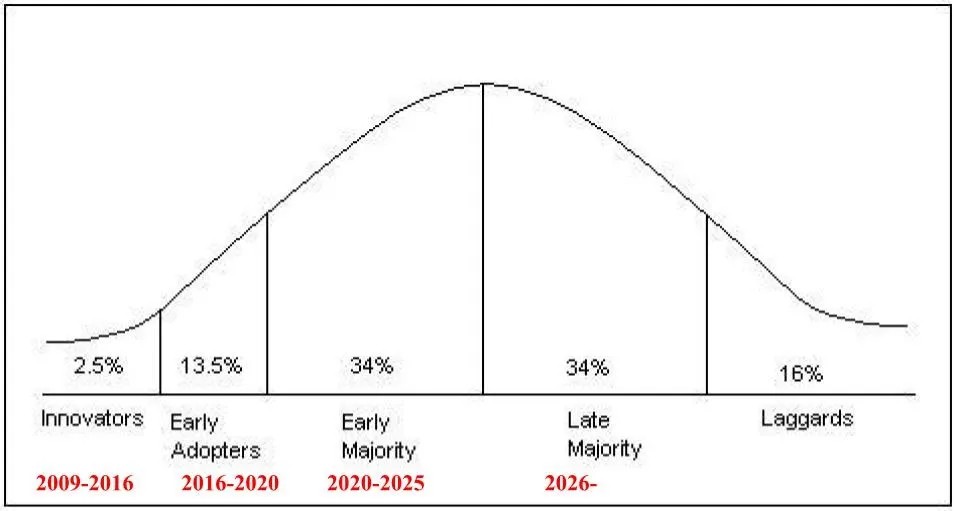
Behind the burst bubble is also a shift in industry culture. People are gradually recognizing a key reality: we are no longer in the early stages of the industry. But for excellent builders and investors, this is just a challenge, not an insurmountable obstacle.
If the Technology Adoption Curve is overlaid with the Hype Cycle, the Trough of Disillusionment falls exactly in the middle of the curve. And this position is precisely the turning point mentioned in Carlota Perez's theory.
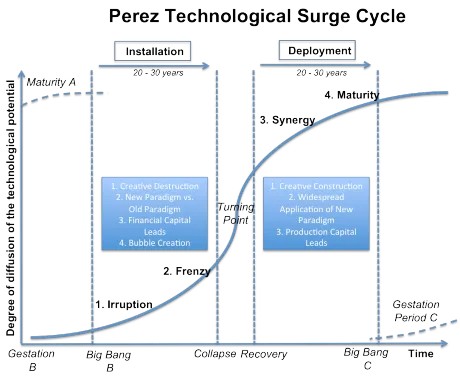
The core challenge has never changed: the crypto industry attempts to reconstruct the financial industry from scratch. This is by no means easy; the process inevitably accompanies multiple rounds of iteration, continuous failure, and constantly facing the tests of reality.
In a sense, we have returned to the starting point. But this does not mean all past efforts were worthless. Even if the industry is temporarily stagnant, asymmetric investment opportunities still exist. At the individual level, there is still an opportunity to shape the future.
The real risk now is abandoning the essence and taking the dregs, negating everything. Even the once most steadfast believers and preachers are choosing to leave. The market once envisioned a future of trillions in scale, but ultimately only a mere 200 digital asset treasury companies landed.
Talking About Crypto Venture Capital
Many viewpoints claim "Crypto VC is dead," or is dying. I do not agree. Venture capital itself is facing an industry crisis: Fund Return Multiple (DPI) falls short of expectations, and fundraising difficulty has increased sharply.
Focusing on the crypto track, those Limited Partners (LP) accustomed to "obtaining high returns in a four-year cycle" are leaving in disappointment. But it needs to be clarified: the ultra-high returns of the crypto industry from 2016 to 2021 were exceptions in the venture capital field, not the norm.
During that period, cryptocurrency was packaged as a revolution, a brand new asset class. Massive funds poured into the immature market, with capital scale far exceeding the industry's effective digestion capacity. Mania reached its peak in 2021, followed by a long clearance cycle, short-term speculative behavior dominated, until now, the industry enters the consolidation phase.
The book "Manias and Mimicry" discusses the essence of technology bubbles, writing in it: "Revolutions can still land — Britain is still covered in railway networks. But the utopia fantasized by manic participants will never come true."
More worthy of attention is the reversal of ideology. The original Cypherpunk subculture that spawned Bitcoin is now actively moving closer to Wall Street and regulatory agencies; the industry's fate is firmly tied to the hands of policymakers.
This is not purely irony, but a characteristic inherent to bubble cycles. One can refer to the Google case: this company once publicly warned that ads would damage search quality, but ultimately built a huge commercial empire relying on ads. Returning to the argument in "Manias and Mimicry":
"This is one of the most extreme cases of ideological reversal in history. To find similar phenomena, one can look back at Martin Luther, a devout Catholic priest who ultimately split the church; or Napoleon, who threw himself into the movement against monarchical absolutism, ultimately becoming a dictator himself. Such cases are very typical, not exceptions: if you are bent on destroying a powerful system, you will often end up building another stronger system. And this new system is similarly constrained by evolutionary laws, replicating many characteristics of the object it replaced."
It can be said with certainty that the industry has abandoned crypto utopian fantasies. The revolution did not arrive as expected. Instead, the industry was absorbed by the existing system (from different standpoints, it can also be called assimilation or corruption). The industry made many compromises, which is also the only viable path out after the industry became a speculative casino after 2021.
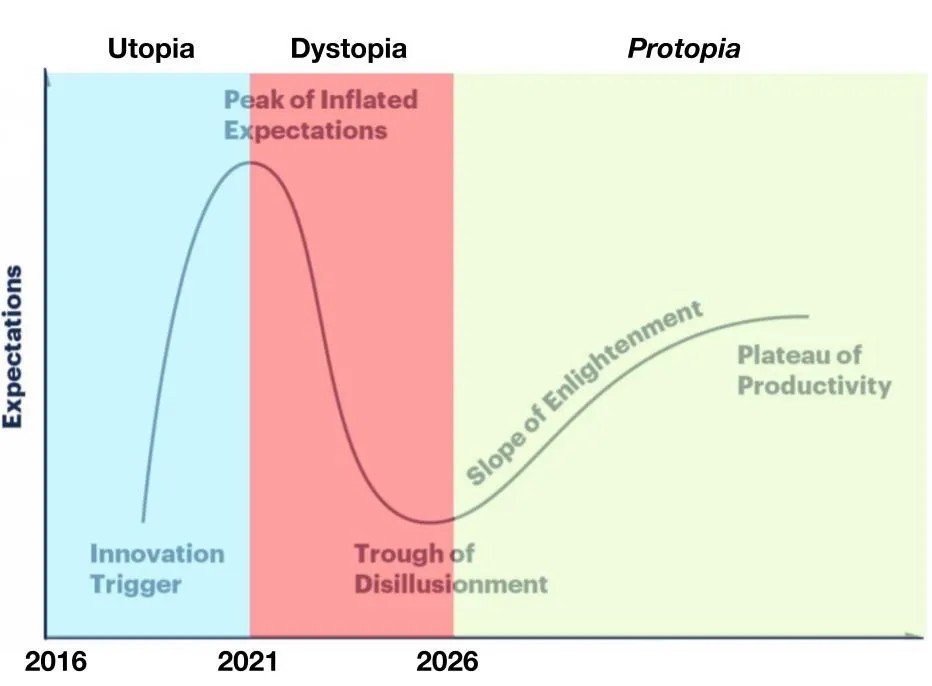
We can also use Carlota Perez's theory to understand this transformation: the utopian vision corresponds to the pre-deployment phase; the phase of disillusionment is the turning point, after which it will step into the rational deployment phase. In different phases, the applicable investment strategies are completely different.
The crypto industry no longer belongs to the frontier pioneering track; it is becoming a business. Whether good or bad doesn't matter, it is just the industry moving towards maturity. Current new crypto projects are roughly divided into five categories, each with different landing values:
- Stablecoins
- Prediction Markets
- Tokenized Assets / RWA
- Perpetual Contracts
- Artificial Intelligence and Intelligent Agents
To some extent, cryptocurrency is swallowing FinTech, or it can be said that FinTech is assimilating cryptocurrency. This is far from the DeFi revolution people envisioned. The crypto industry needs to find killer applications beyond stablecoins within the boundaries allowed by regulation.
Even so, we believe that in the coming years, the crypto track will still give birth to enterprises with long-term vitality. We will continue to seek top founders to build quality products.
Reconciliation
Two seemingly contradictory viewpoints coexist in my mind. First, cryptocurrency is changing the underlying way value is stored and transferred; second, cryptocurrency is evolving into a business track that complies with existing financial rules.
I try to reconcile the two like this: cryptocurrency may permeate daily life in an imperceptible way. When change happens, it is often silent, only becoming clear when looking back. The most profound transformations rarely debut with grand slogans like "trillions in market cap." They will only silently embed themselves into the existing system, integrating into public perception.
When in adversity, the crypto industry is more likely to burst with creativity; it is actually harder under the spotlight of everyone's attention. People who truly harbor curiosity will rethink and reconstruct everything. There are still a large number of things waiting to be built, and many goals worth persisting for. I still maintain my belief.
Join TechFlow official community to stay tuned
Telegram:https://t.me/TechFlowDaily
X (Twitter):https://x.com/TechFlowPost
X (Twitter) EN:https://x.com/BlockFlow_News
 @mattigags