The Eternal Fragments of Money: Third-Party Payment Has No First Principles
TechFlow Selected TechFlow Selected
The Eternal Fragments of Money: Third-Party Payment Has No First Principles
From PayPal to Stripe, From Stablecoins to Agents: Four Generations of the Payment Industry Coexist—Will This Time Be a Success?
 Navigating Web3 tides with focused insights
By: Zuo Ye
The wind fills the tower as the storm approaches; Stripe is attempting to acquire PayPal again. Fortune turns; the last time was 30 years ago, when Peter Thiel's PayPal merged with Elon Musk's first-generation X.com.
I don't understand why everyone is talking about PayPal's sluggish growth, as if this FinTech sector spells doom for us. Twenty years ago, Peter Thiel embarked on his journey from payments, starting his first venture, and the PayPal Mafia was unified. Wherever Musk went, the people welcomed him wholeheartedly; truly having all the odds in their favor, that kind of vigorous vitality and everything striving to thrive is still before my eyes. Is it possible that just twenty years later, Payment has suddenly become our burying place?
Growth is a Miracle, Stablecoins Are Not
Stripe not going public during the pandemic was a blunder in hindsight.
Stripe's various efforts were all for the distant dream of going public; against the backdrop of quantitative easing during the pandemic, Stripe touched a $100B valuation for the first time.
But failing to follow Coinbase and others to go public led to its valuation falling again and again. Mistaking era opportunities for personal effort, thus, after learning from the pain, Stripe embarked on the path of M&A.
Stripe started with a Dev-friendly model, one-click API access, which was undeniably tempting for developers. This is also the most unique strategy in the payment industry, not getting tangled in rates and scenarios, but reaching the people actually doing the work behind them.
Stripe hopes to reuse its experience time and again, entering the acquiring system from the B-side, entering stablecoins from the C-side, and even laying out ACP/MPP protocols for the Agent side, hoping to reshape the entire payment industry.
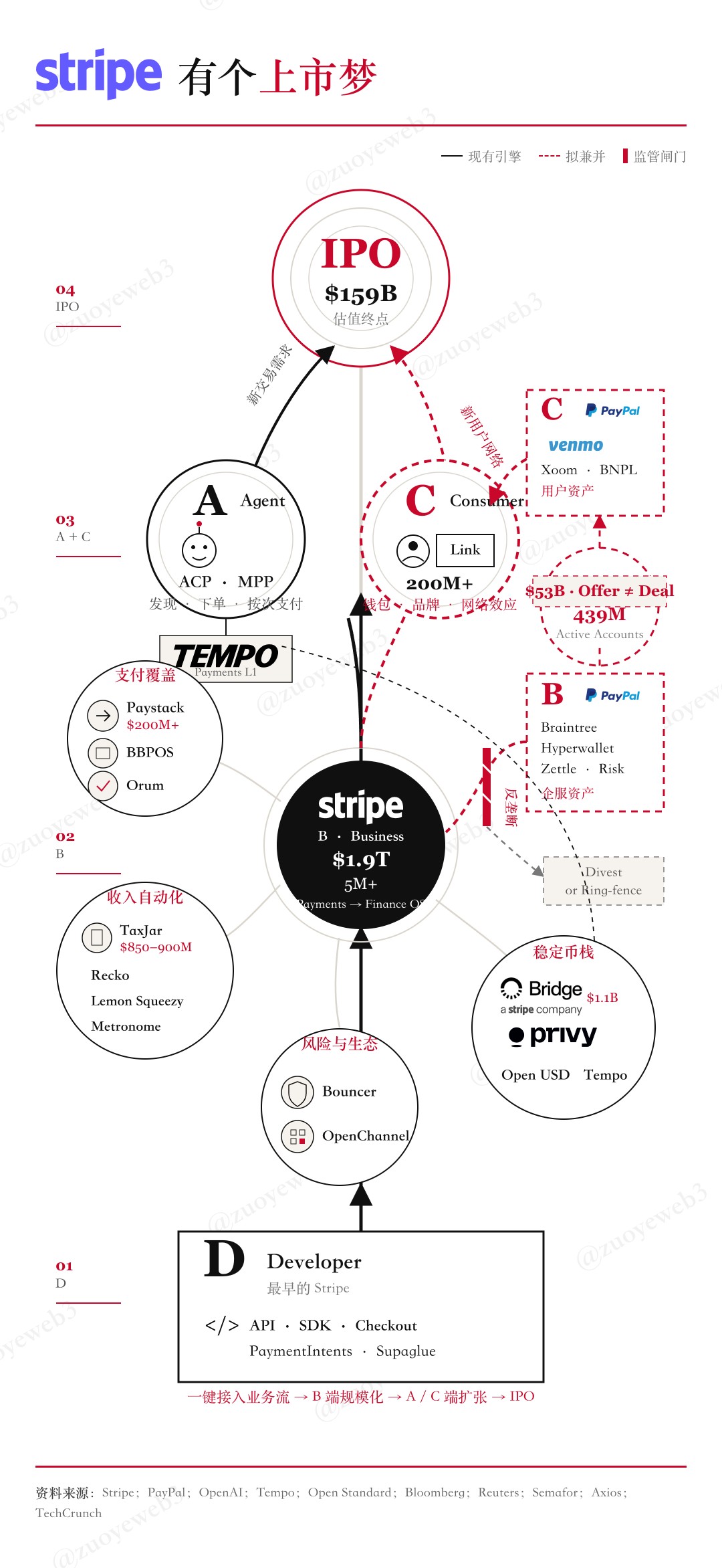
Image Caption: Stripe's Bumpy Road to IPO
Image Source: @zuoyeweb3
There are always two characteristics in the payment industry that also hinder Stripe's continued progress:
- The highly fragmented pattern of the payment industry remains unchanged; securing one country, one industry, or even a few companies allows for continued survival, unable to be directly eradicated by external forces;
- Payment is an accessory to the banking industry; developers and B/C-side enterprises are ultimately externalizations of bank processes, and stablecoins are eventually incorporated into the bank track.
Especially regarding the series of stablecoin acquisitions, from Bridge's issuance to Privy's wallet entry, and even Tempo and OpenUSD, it is difficult to repeat Stripe's past glory.
This acquisition proposal for PayPal is actually a phased result of Stripe's failed attempt to open the C-side with stablecoins, attempting to complement itself with PayPal's C-side business.
PayPal's problem does not lie in failing to keep up with the times; from Venmo to PYUSD, none have saved PayPal's downward trend.
In other words, PayPal is simply too old; the structural dysfunction of the entire enterprise cannot be revived just by doing new business.
Stripe, which started slightly later, still wants to add more narrative possibilities for itself before the IPO.
If Stripe wrapping the backend occupies the developer market, then the stablecoin market wrapping the frontend—the story of the issuance network—is likely over; Tempo and OpenUSD will impact Circle's stock price, but cannot touch Tether in the slightest.
If Stripe's ceiling is just Coinbase or Circle, then going public is destined for a fate of breaking issue price; compared to Adyen's market cap and Airwallex's valuation, Stripe's stablecoin narrative X Agent narrative is useful.
- Stablecoins are not the daily norm of the current payment system, but a visible trend;
- Agents still need to find an entry point for themselves to enter the current system.
On the surface of the news, Agents are already using stablecoins to frantically buy compute power and Tokens, but removing the suspicion of volume brushing, Agents still have not entered Web3 business, let alone more conservative companies and banking systems.
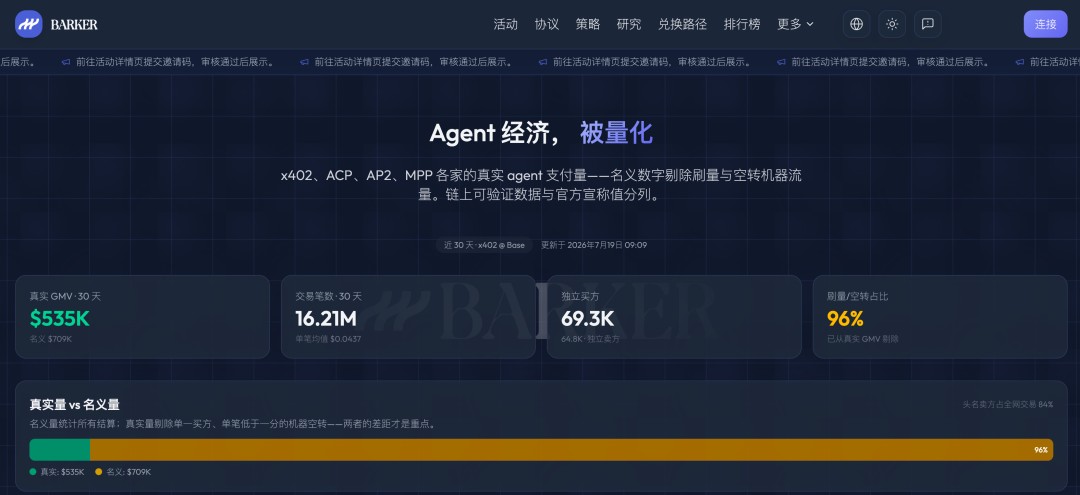
Image Caption: Agents Are Currently Mainly Used for Volume Brushing
Image Source: @BarkerMoneyX
A-side (Future), B-side, C-side, D-side (Making Fortune), but Stripe's valuation hardly escapes the reasonable value of the FinTech ceiling of 50 billion; 100 billion contains too much active imagination.
If unable to briefly reach the future, then expanding scale and ecosystem is the only point where Stripe can exert force; you can understand Stripe as an option product.
- Agents will use OUSD stablecoins, running on top of Tempo, Stripe should be at Visa's level;
- Agents will use stablecoins, but OUSD fails, Tempo seizes part of the market, Stripe should have a 100 billion valuation + Tempo public chain valuation;
- Agent economy is hard to come true, Agentic Payment is covered by new concepts, then Stripe at least still has its own business.
Investment losses are of course a blunder, but missing out will cause lifelong regret; starting from the difficult problems Stripe poses to the primary market, how the entire payment industry will evolve is also worth our further thinking.
Payment is Just an Entry Point, Value-Added Services Profit
Agents are a future visible to the naked eye, provided they can live until that day.
Standing in mid-2026, it is a very subtle node, the last time window for the Clarity Bill to pass; stablecoin yields might be decided definitively.
At the same time, the long-term future of the Agent economy, today's focus is concentrated on the substitution model for white-collar and blue-collar workers, as well as hardware fields such as new wearable devices and AIOS phones.
Regarding the transformation of payments by Agents, it has not triggered social attention; there is reason to believe this is a hidden opportunity for stablecoins, a β opportunity sent by the era.
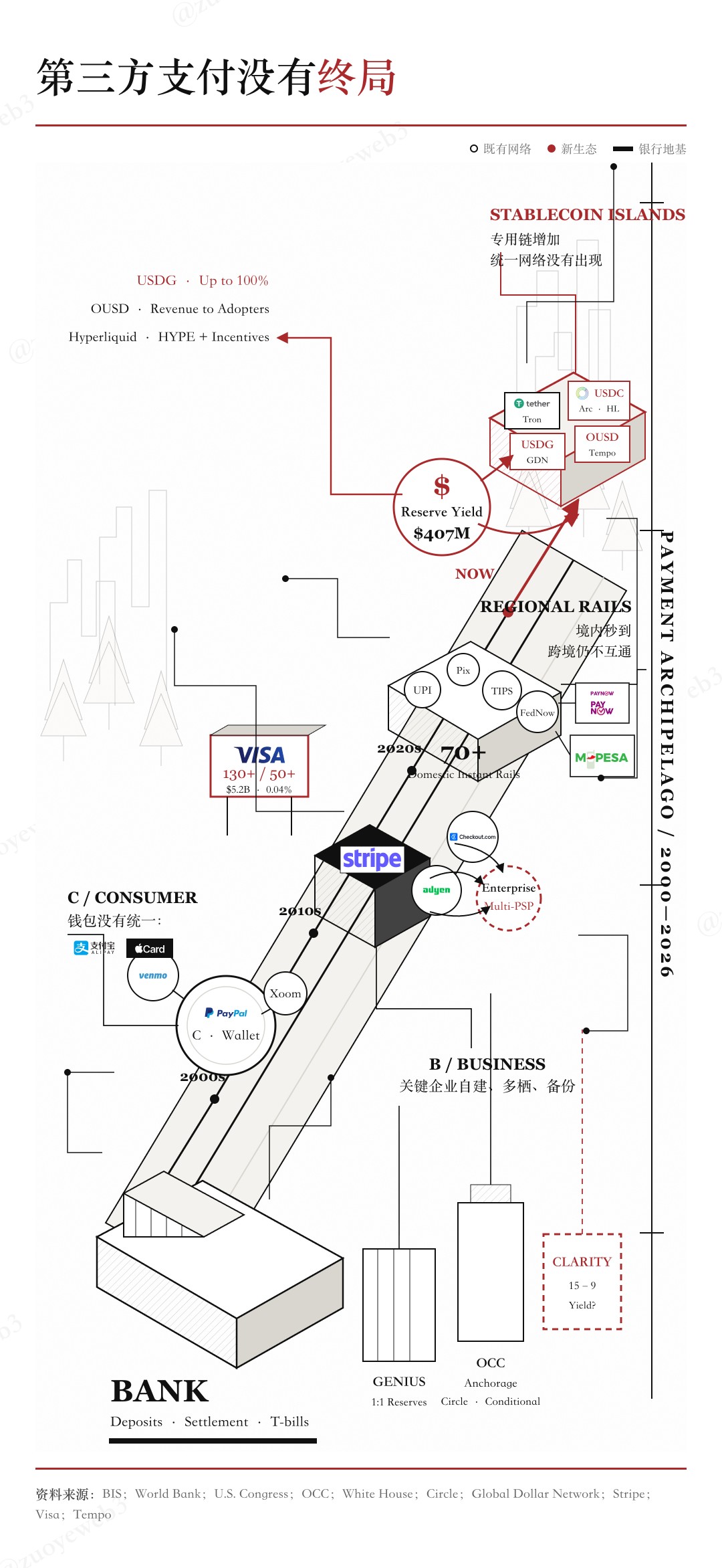
Image Caption: The Eternally Moving Payment Industry
Image Source: @zuoyeweb3
However, the operating model built by the payment industry in the past using "Licenses + Localization" may encounter continuous impact from clearing networks.
Stablecoins still need entries such as depositing funds at the frontend, as well as exits such as on-chain circulation and cashing out into accounts; this is also where the banking industry's compliance confidence lies.
In the FinTech wave facilitated by the internet over the past 30 years, it ultimately increased the banking industry's containment power over payments, and did not get directly transformed or even disappear like publishing, consumption, entertainment, and catering.
Under the technology wave, although banks have become increasingly transparent, they always hold the terminal tentacles of cash and account opening outlets; in a sense, the fragmentation of the payment industry can be attributed to the banks' blocks and regional segmentation, and licenses and sovereign boundaries are merely an admission of reality.
But in the moves of Stripe and Circle, there is another possibility hidden in payments: frontend stablecoin customer acquisition, backend clearing profitability.
Stripe and Circle are actually very similar, representing the future intersection form of FinTech and Crypto, both doing public chains (Tempo vs Arc), stablecoins (OUSD vs USDC), and clearing networks.
The reason it is not revenue sharing from stablecoin issuance is because Circle has already started subsidizing Hyperliquid channel parties, OUSD directly shares profits with partners; both sides have started involution, which is inevitably not the future.
But the clearing system, for the first time, allows both of their public chains to not force subsidies for partners, but purely rely on capital efficiency to earn payments and stablecoin network effect returns.
The clearing system is not complex; traditional fiat clearing relies on card organizations, SWIFT, central banks of various countries, and commercial banks, with redundant layers, already overwhelmed.
And emerging stablecoin public chains have no historical burden, can focus on improving clearing efficiency, and as Circle and Stripe secure OCC national bank charters (conditional approval), after stablecoin profit sharing, they will inevitably move towards clearing.
And the clearing network is possible to partially detach from the commercial banking system, and keep profits in their own hands.
Conclusion
Stripe missed the IPO window during the pandemic and stepped into the trench warfare of third-party payments; this battle is an eternal Verdun model, never able to crush small players in local regions and various industries by scale.
Must change the way of survival, face the banking industry with efficiency, from PayPal to Stripe, from stablecoins to Agents, four generations of the payment industry under one roof, will this time be victorious?
Join TechFlow official community to stay tuned
Telegram:https://t.me/TechFlowDaily
X (Twitter):https://x.com/TechFlowPost
X (Twitter) EN:https://x.com/BlockFlow_News
 @zuoyeweb3