Industry Insights: Examining the “Scenario-Based” and “Frictionless” Trends in Crypto Derivatives Platforms through Bitget CFD’s Latest Version Update
TechFlow Selected TechFlow Selected
Industry Insights: Examining the “Scenario-Based” and “Frictionless” Trends in Crypto Derivatives Platforms through Bitget CFD’s Latest Version Update
The true winners of the future will undoubtedly be long-termist platforms that consistently listen to market demands, continuously eliminate operational and financial friction at every detail, and deliver a truly seamless global asset trading experience.
 Navigating Web3 tides with focused insights
Author: MartinTalk
The boundaries of global financial markets are dissolving at an unprecedented pace. For top-tier cryptocurrency exchanges, competition has long transcended mere “speed of listing crypto assets” and shifted comprehensively toward multi-asset global expansion. Amid this grand transformation, eliminating cross-market trading barriers—and achieving “frictionless” and “contextualized” product experiences—has become the new focal point of competition among major platforms.
Against this backdrop, the “UEX Panoramic Exchange”—a single account for investing in global assets—has emerged as the core proposition to break through the status quo. Users no longer accept fragmented experiences—buying gold and U.S. equities via traditional brokers while purchasing Bitcoin on crypto exchanges. What they truly need is a unified, borderless, cross-asset platform. This demand has intensified recently, as certain traditional internet brokers—constrained by regional compliance policies—have repeatedly faced service adjustments, account restrictions, or even blocked fund channels. Consequently, traders’ desire for “absolute control over their assets” has reached its peak.
UEX’s architectural advantages now shine fully. It breaks free from the physical constraints imposed by traditional brokers, empowering users to freely navigate across diverse asset classes and macroeconomic cycles. Leveraging U.S. equities as its core competitive edge, the UEX ecosystem not only supports genuine “U.S. Equities 2.0 (Reality)”, enabling users to directly capture Wall Street’s tech-driven upside, but also allows traders to swiftly seize opportunities during macro commodity cycles. If you wish to hedge inflation risk—or are highly sensitive to global monetary policy—you can seamlessly switch to trading gold and forex at any time.
The most efficient vehicle for such frictionless cross-asset trading and macro-cycle capture is precisely CFDs (Contracts for Difference). As the central enabler of UEX’s vision, CFDs allow users to post crypto assets directly as margin—bypassing cumbersome traditional forex or futures account opening procedures. With flexible long/short mechanisms and leveraged tools, CFDs have naturally evolved into the sharpest bridge connecting the crypto world with traditional financial assets—and a strategic battleground for all platforms advancing into full-asset offerings.
I. The “Frictionless” Zero-Fee Model: No Forced Choices—Returning “Trading Choice” to the Market
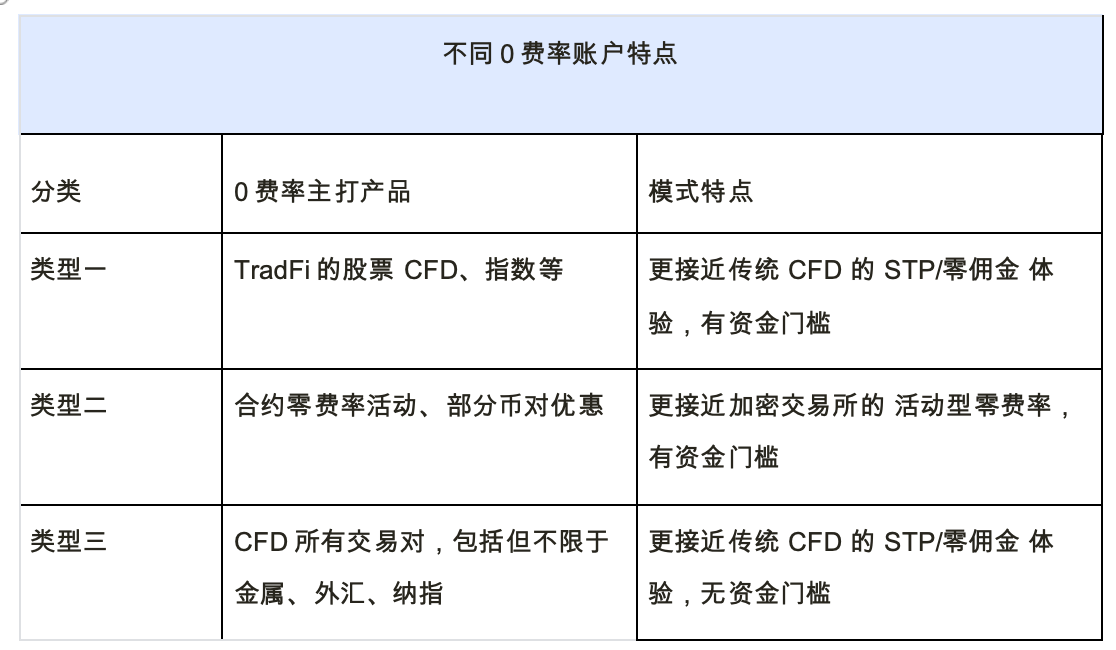
In traditional CFD brokerage, the vast majority of retail traders typically use the STP (Straight-Through Processing) model. Its key advantage lies in “zero commission”—all trading costs are bundled into the spread, meaning users pay no additional fixed fee upon opening or closing positions, making profit-and-loss calculations exceptionally intuitive. Yet when crypto-native exchanges enter the derivatives space, they often bring their native DNA and instead promote the ECN model (emphasizing ultra-low raw spreads + fixed commissions based on trading volume).
As competition intensifies, leading platforms have begun recognizing the habits of traditional CFD traders—and started introducing zero-fee STP-mode CFD services, gaining notable market share as a result.
So why has this feature resonated so strongly with users?
The answer strikes at human psychology: For the overwhelming majority of ordinary retail and swing traders, upfront per-trade commissions create significant “psychological friction.” The moment a position opens, the account balance drops instantly due to commission deduction—easily disrupting trading mindset. Moreover, bundling costs into the spread dramatically lowers the barrier to calculating one’s “break-even point,” delivering a purer, more transparent trading experience.
Bitget—a platform that consistently places “user experience” at the pinnacle of its priorities—did not simply follow trends. Instead, it engaged deeply with users before taking action. Through repeated face-to-face, in-depth conversations with traders at various stages and employing diverse strategies, Bitget’s team confirmed users’ strong desire for “what-you-see-is-what-you-get” transparency—and executed rapidly with exceptional efficiency.
In this industry trend, Bitget’s response offers an excellent case study for product observation.
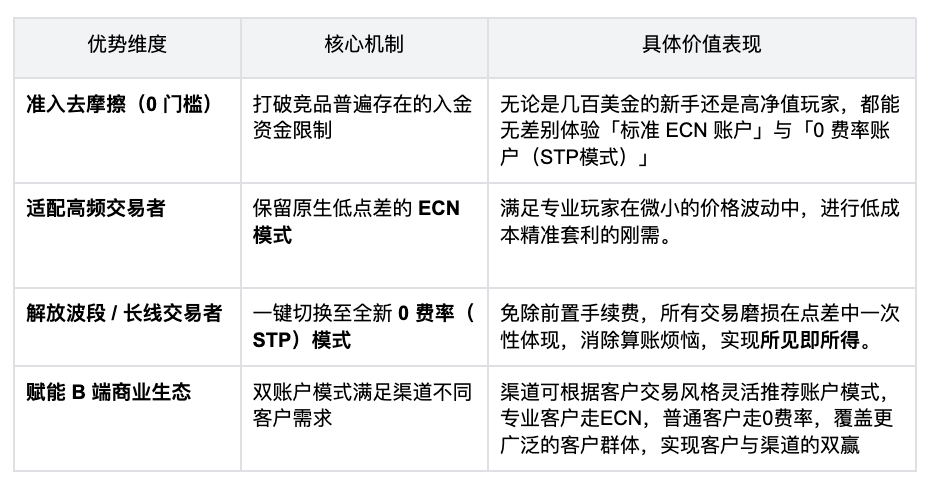
Examining Bitget’s late-May version update reveals it went far beyond merely “jumping on the zero-fee bandwagon.” Based on intensive prior consultations with traders across different experience levels, Bitget delivered a more mature, foundational solution. Research showed that although ordinary retail traders favor STP, professional institutions and high-frequency players still have rigid demand for ECN’s raw spreads.
In this update, Bitget officially launched a dual-track engine: the “Standard ECN Account” and the “Zero-Fee Account (STP Mode).”
Notably, while many cross-industry platforms offer new account types, they often impose “high-friction” capital barriers—most competitors set stringent minimum initial deposit requirements for special accounts (e.g., ultra-low-spread or zero-fee accounts), effectively reserving them as “VIP privileges” for high-net-worth clients.
To address this pain point, Bitget CFD announced an exceptionally potent rule: Zero Minimum Deposit for All Accounts.
The platform refuses to force users into binary choices—and refuses to segment users by capital size. Instead, it returns true choice to the market. This design delivers tangible advantages across four dimensions:
II. Social Trading Ecosystem Restructuring: From “Modular Copy-Trading” to Full-Platform “Contextualized” Integration
Social trading (Copy Trading) has long been a “must-have” feature for top-tier exchanges. At its core, copy-trading logic aims for win-win ecosystem dynamics: On one hand, it significantly lowers decision-making and execution barriers for ordinary users; on the other, it provides elite traders with proven strategies an ideal channel to monetize their expertise.
Yet as tradable instruments expand from pure crypto into forex, commodities, and other CFD domains, the traditional crypto copy-trading model begins revealing shortcomings: high data latency, slow profit-sharing settlements, inconsistent multi-platform experiences, and fragmented expert data across business lines (spot/derivatives/CFDs).
Observing Bitget CFD’s evolution of copy-trading, it did not simply replicate templates from pure-crypto platforms. Instead, it undertook deep, bottom-up restructuring—focused squarely on “contextualized experience” and “core incentive distribution.”
First, eliminating physical friction across terminals and operations. Bitget rolled out CFD copy-trading functionality on its Web platform. Comprehensive, cross-platform coverage fully satisfies professional traders’ hard requirements for large-screen analysis and granular operation—greatly enhancing user experience. Next, the App will embed a “copy-trading entry point” directly within the CFD K-line chart interface (enabling users to execute precise, one-tap copy trades based on the current instrument while analyzing price action).
A deeper moat lies in the robust underlying infrastructure and incentive distribution mechanism.
Looking beyond surface-level feature stacking, a horizontal comparison against mainstream industry platforms’ CFD copy-trading configurations reveals Bitget’s aggressive data advantage—powered by architectural optimization:
- Infrastructure & Data Efficiency Dominance: On traditional platforms, MT5 account creation and withdrawals typically take ~10 seconds; Bitget, leveraging its powerful technical middleware, achieves account creation and withdrawals in under 3 seconds. Additionally, industry-standard leaderboard data reporting suffers from T+1 delays, whereas Bitget updates leaderboard statistics hourly, allowing followers to track real-time win rates—eliminating information lag.
- Rewriting Commercial Profit-Sharing (The Magnet for Top-Tier VCs): High-quality signal providers are the core asset of any copy-trading ecosystem. While the industry standard caps profit sharing at 15%—with weekly payouts—Bitget raises the ceiling to 30% (and up to 50% under its upcoming Premium Tier), and implements daily settlement. This extreme generosity and accelerated cash flow directly addresses top signal providers’ core profitability pain points.
- Full-Ecosystem Integration & UI Cost Reduction: In UI design, Bitget avoids imposing unfamiliar operational logic—instead adopting the MT5-native interface familiar to forex traders. Crucially, unlike competitors whose business lines operate in silos, Bitget unifies traffic conversion across multiple verticals, consolidating signal provider data from derivatives, spot, and CFDs onto a single dashboard—maximizing top traders’ traffic value.
- Removing New-User Trial Friction: Complemented by the industry-rare “first-trade guaranteed” policy and ongoing copy-trading subsidies, Bitget eliminates psychological barriers for existing crypto users venturing into macro-asset copy-trading.
Bitget CFD’s holistic “combo” approach to copy-trading clearly goes well beyond feature-layer additions—it aims to retain the world’s top traders and deliver the smoothest possible copy-trading toolset.
III. Information Transparency & Investor Protection: Raising the Bar on Data Disclosure
Beyond lowering trading barriers and optimizing workflows, resolving “information asymmetry” remains a critical responsibility for exchanges. Historically, the industry often relied solely on high ROI (Return on Investment) metrics for marketing—frequently overlooking underlying risk management.
Exchanges approach trading-related data and content construction in several ways: Some recent brokers emphasize TradFi zero-commission models, copy-trading risk controls, and beginner-friendly learning rewards and protection programs—highlighting “lowered trial costs.” Others attract users primarily via zero-fee contract promotions, trading pair discounts, and low-cost positioning—centering their value proposition on “trading efficiency and fee competitiveness.” Against this backdrop, to differentiate itself, Bitget must go beyond matching peers’ baseline features—and prioritize integrating educational content, risk disclosure, copy-trading tools, and product experience into a sustainable investor protection framework.
In its new CFD trader interface, Bitget undertakes more objective data structuring:
Two-Way Transparency: Data & Risk Disclosure
The new trader interface mandates display of signal providers’ “average profit statistics” and significantly amplifies the visual prominence of copy-trading risk warnings. This effectively helps followers move beyond the narrow ROI blind spot—enabling holistic evaluation of a trader’s authentic risk management capability.
Building a “One-Stop Trader Mentorship” Education Ecosystem
To ensure new users possess comprehensive foundational knowledge before entering the derivatives market, Bitget integrates operational guidance, beginner-to-advanced trading knowledge, and strategy understanding into a unified education framework—leveraging its Help Center, Bitget Academy, market news, and analyst livestreams—to form a guided learning journey spanning account opening, execution, and strategic comprehension.
This approach contrasts sharply with competitors’ beginner protections, community-based learning, and education-incentive mechanisms—as well as those focused on trading products and event-driven acquisition: the former emphasizes a closed loop of “learning → practice → protection,” while the latter leans more heavily on low fees and product-driven user conversion.
Final Thoughts
As live traders operating across multiple platforms, we can clearly sense that whether it’s the industry’s continued push toward TradFi-style zero-commission models, the relentless pursuit of fee compression, or frictionless innovations centered on “dual-fee structures” and “contextualized copy-trading,” the entire sector is collectively moving past the era of brute-force feature stacking.
Ultimately, the evolution of financial tools must return to its core principle: “user-centricity.” In this UEX era—spanning crypto and macro assets—traders no longer need cold parameters or cumbersome barriers. The true winners of tomorrow will be long-termist platforms that persistently listen to market needs, relentlessly eliminate operational and capital friction at every detail—and genuinely deliver a globally seamless asset trading experience.
Join TechFlow official community to stay tuned
Telegram:https://t.me/TechFlowDaily
X (Twitter):https://x.com/TechFlowPost
X (Twitter) EN:https://x.com/BlockFlow_News