Decoding Unitree’s IPO Prospectus: The Real Landscape of the Robotics Market
TechFlow Selected TechFlow Selected
Decoding Unitree’s IPO Prospectus: The Real Landscape of the Robotics Market
The current reality of the robotics industry: Hardware has already been validated, but commercialization is still waiting for AI models to catch up.
 Navigating Web3 tides with focused insights
Author: Tanay Jaipuria
Translation & Editing: TechFlow
TechFlow Intro: Unitree Robotics is set to go public on the STAR Market of the Shanghai Stock Exchange, raising $620 million. Its prospectus—released for the first time—discloses complete financial data for a profitable robotics company. In 2025, Unitree shipped 5,500 humanoid robots—the highest volume globally—but 74% were sold to universities for research; only 9% entered real industrial applications. This is the current reality of the robotics industry: hardware has been validated, but commercialization awaits AI models to catch up.
Unitree Robotics recently filed an IPO application with the Shanghai Stock Exchange’s STAR Market, aiming to raise $620 million. The prospectus is particularly revealing—it offers a clear window into the true state of today’s robotics market.
Unitree is already profitable, growing rapidly, and leads the world in humanoid robot shipments.
This article covers:
- What Unitree manufactures
- The shift in revenue composition toward humanoid robots
- Who buys these robots—and why
- Its vertical integration strategy
- Financial performance
- Its ambitions at the model layer
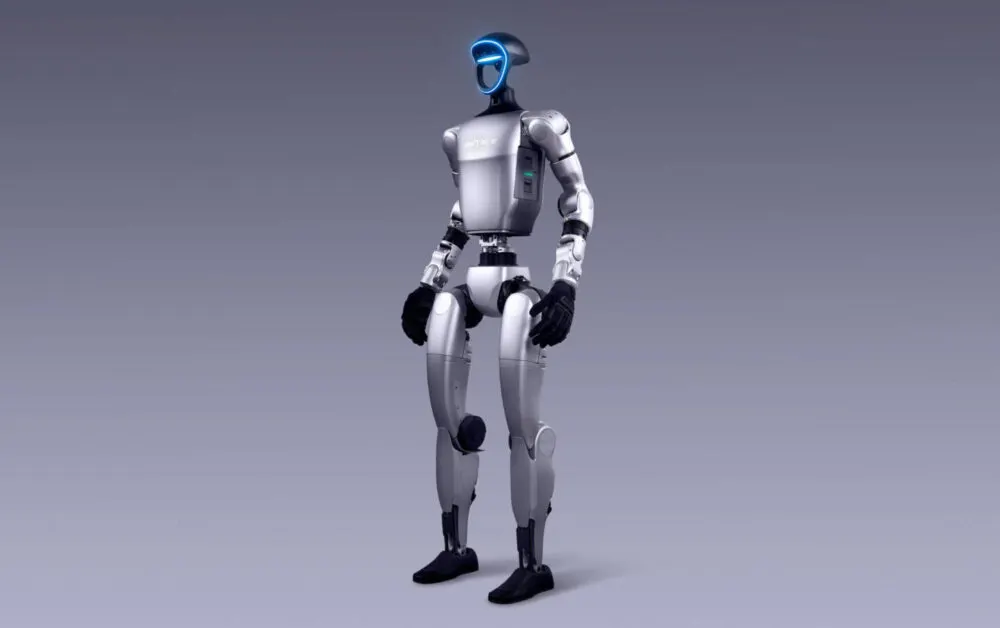
I. What Does Unitree Manufacture?
Founded in 2016 and headquartered in Hangzhou, Unitree was started by Wang Xingxing—a self-taught robotics expert who built his first quadruped robot inside his apartment. The company now employs 480 people, including approximately 175 engaged in R&D.
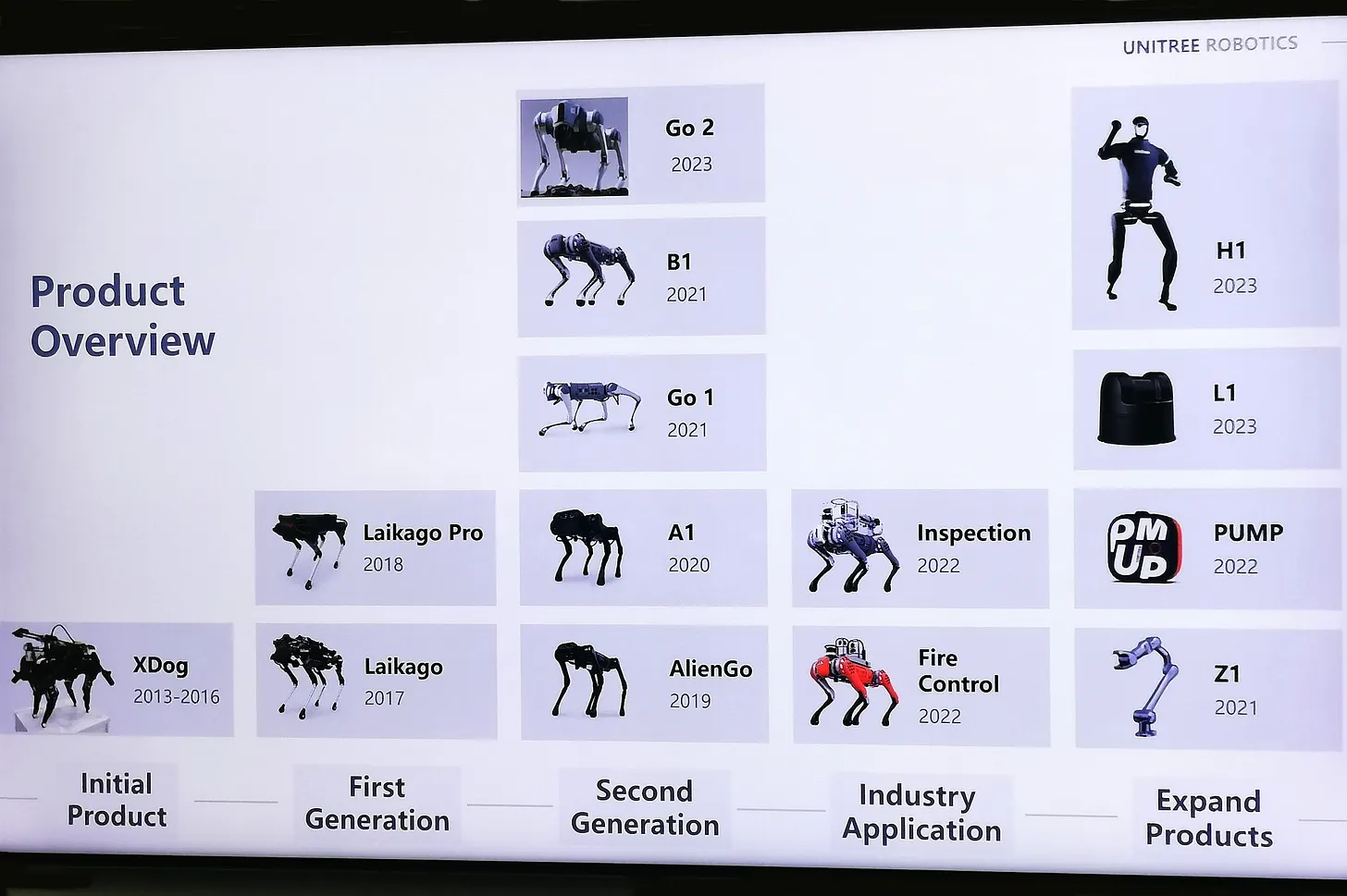
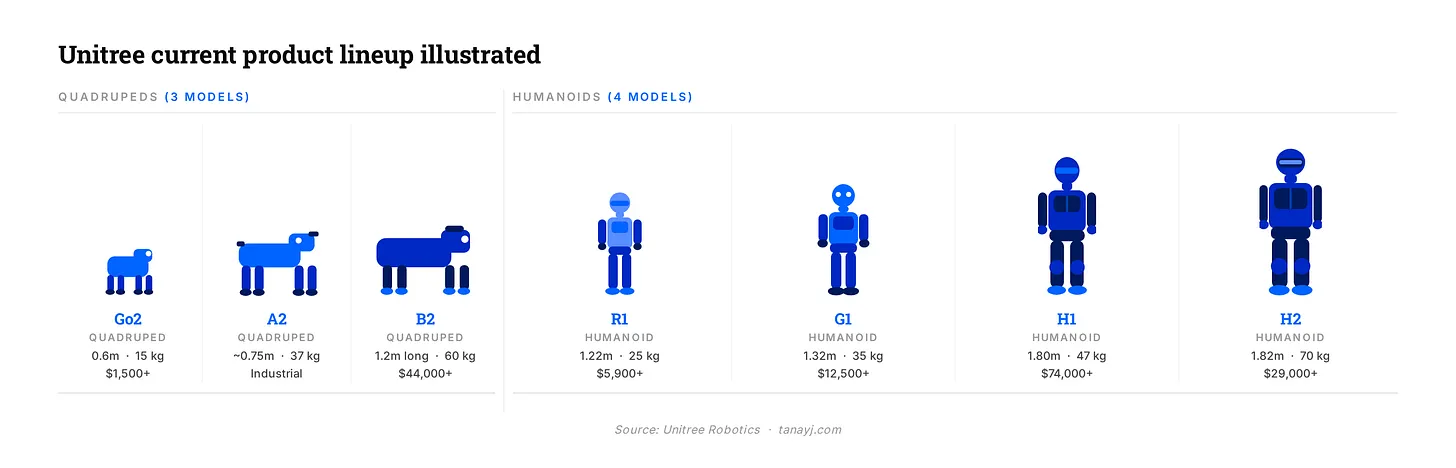
Unitree sells two product lines:
Quadruped robots: Go2 (consumer- and research-grade), B2 (industrial-grade), and A2
Humanoid robots: H1, H2, G1, and R1. G1—the one you may have seen in viral videos—is 1.32 meters tall and weighs 35 kg.
The company began international sales in 2018. Over 35% of its revenue comes from outside China—including a large number of academic customers in the U.S.
II. The Shift Toward Humanoid Robots in Revenue Composition
Two years ago, Unitree was essentially a quadruped robot company. In 2023, humanoid robots accounted for just 1.9% of its revenue.
By the first three quarters of 2025, humanoid robots contributed over half of its core revenue.
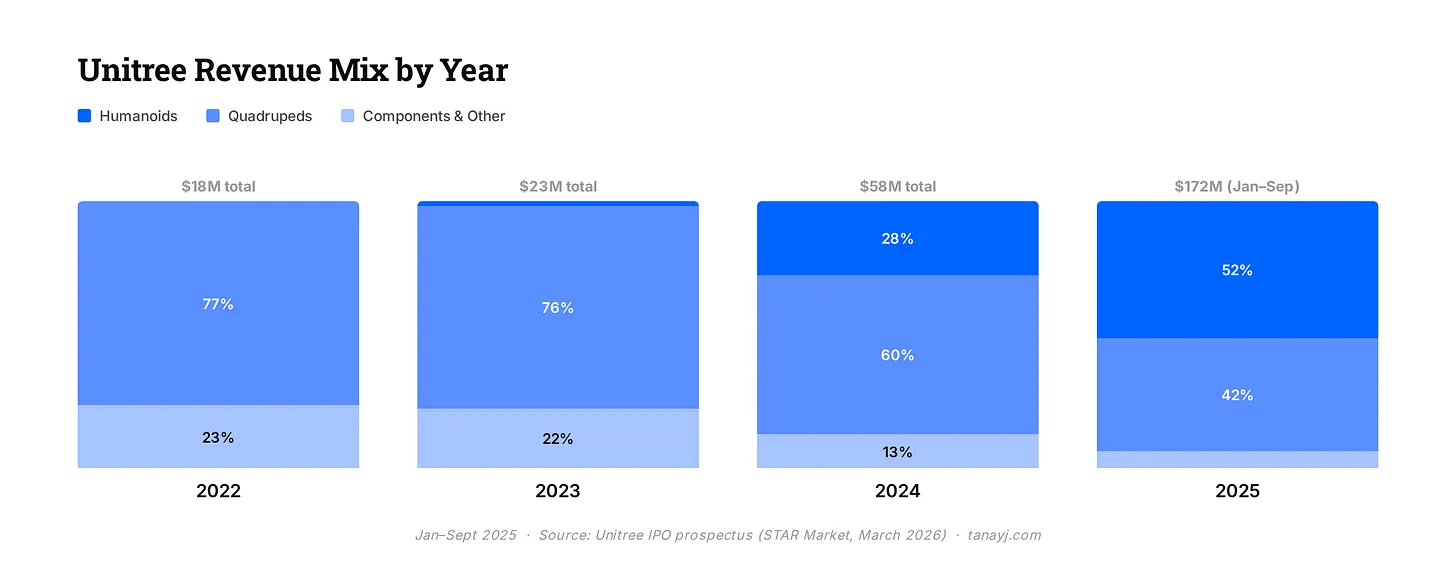
This shift has been driven by improved product-market fit and aggressive marketing. Unitree’s humanoid robots appeared on China Central Television’s (CCTV) Spring Festival Gala—among the most-watched TV programs globally—for two consecutive years. Jensen Huang even brought a Unitree robot onstage at NVIDIA’s GTC 2024 conference.
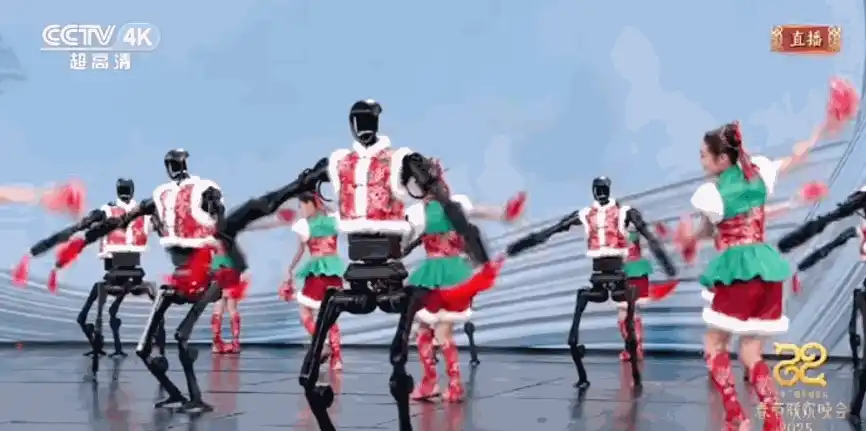
This brand exposure translated directly into commercial and research demand—an achievement few Chinese hardware companies have managed.
The shipment numbers for humanoid robots are especially impressive. Unitree shipped approximately 5,500 humanoid robots in 2025—making it the world’s largest humanoid robot manufacturer by volume. Zhiyuan Robotics in China comes closest. By contrast, prominent U.S. firms like Figure AI and Agility Robotics shipped only a few hundred units each.
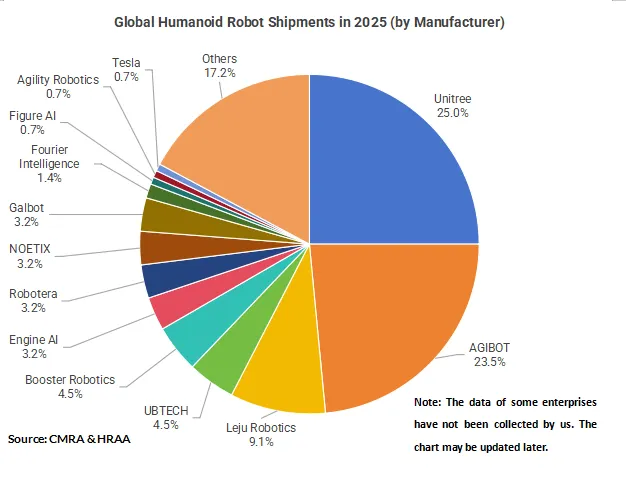
The prospectus outlines a five-year target: annual production of 75,000 humanoid robots and 115,000 quadruped robots—roughly 14 times Unitree’s 2025 humanoid shipment volume. Though ambitious, this target underscores how early-stage the industry still is.
III. Who Is Actually Buying These Robots?
The prospectus classifies buyers into three categories: research & education, commercial & consumer, and industrial applications.
In reality, most current demand for humanoid robots originates from research & education.
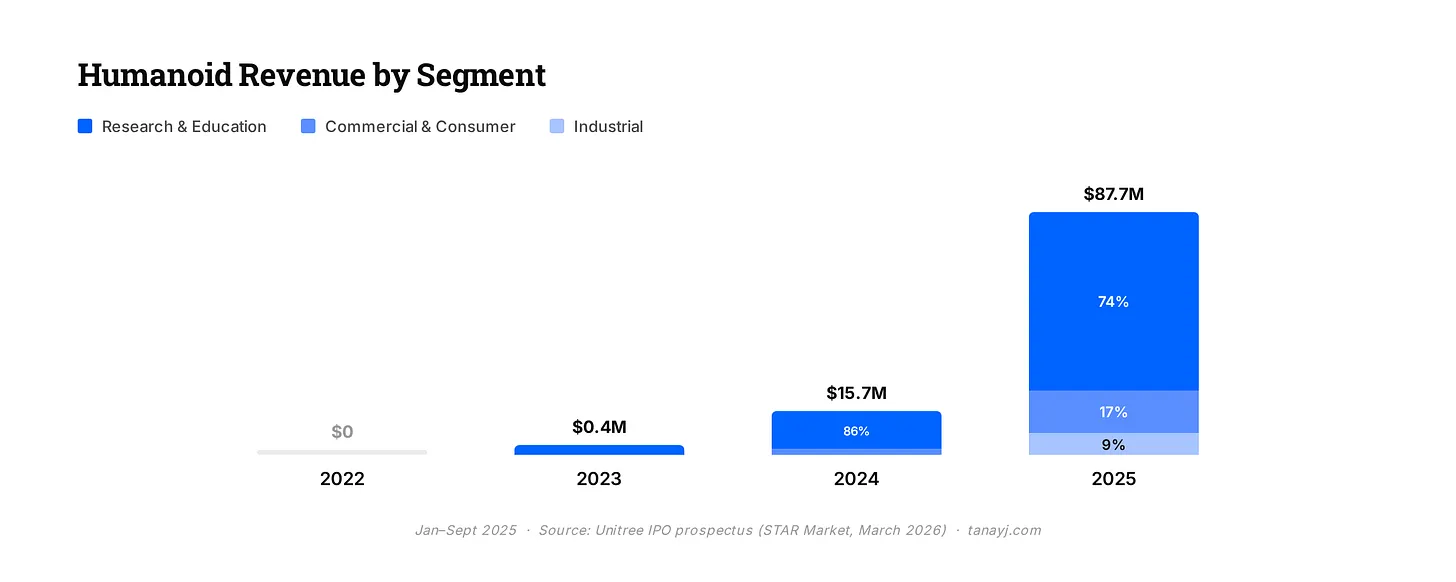
1/ Research & education accounts for 74% of humanoid robot revenue and shipments. Academic buyers have been Unitree’s core support since at least 2022—and remain its largest revenue source today.
2/ Commercial & consumer use accounts for 17% of humanoid robot shipments. Non-academic buyers primarily deploy these robots for “demonstration”: as eye-catching promotional agents in retail stores, tourist attractions, performances, and exhibitions. Consumer revenue grew nearly fourfold year-on-year in the first nine months of 2025—an impressive-sounding figure, though starting from a very small base. In practice, a $25,000 humanoid robot today might simply stand outside a store in Shenzhen to attract passersby.
3/ Industrial applications account for only 9% of humanoid robot shipments. Unitree acknowledges that industrial deployment remains limited due to immature technology—revealing the current technical reality. Within that 9%, roughly 50–70% are used for enterprise reception and guided tours; thus, only about 3–4% of total humanoid robot shipments serve actual operational tasks such as enterprise reception or inspection.
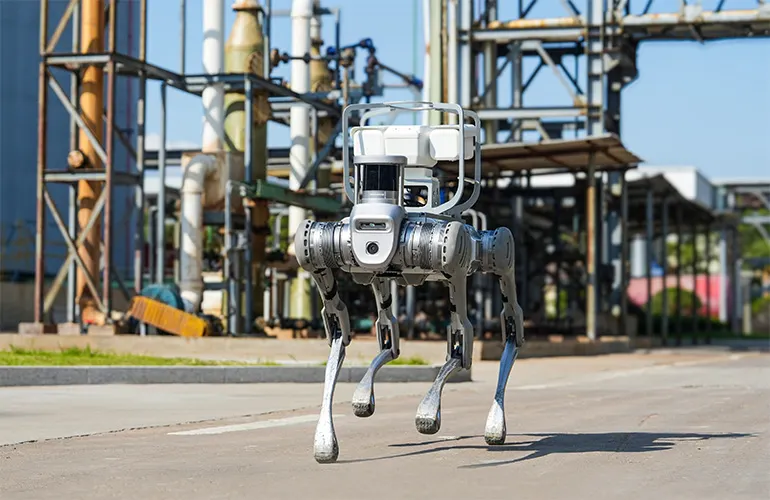
For quadruped robots, the picture is more favorable: only ~one-third of revenue comes from research, over 40% from commercial use, and the rest from industrial applications. Productive use cases here are relatively mature. Customers include State Grid Corporation of China, China Southern Power Grid, PetroChina, Sinopec, Baowu Group, and JD.com (Unitree’s largest customer). These enterprises deploy quadruped robots for real-world inspection tasks—in chemical plants, substations, coal mines, pipelines, and more.
IV. Vertical Integration Strategy
A distinguishing feature of Unitree is its in-house design and manufacturing of most critical components: high-torque motors, precision gear reducers, encoders, joint modules, intelligent controllers, high-precision sensors, dexterous hands, LiDARs, and cameras. According to McKinsey, the drive system—comprising motors, gear reducers, and the joint systems that actually move the robot—typically accounts for 40–60% of a humanoid robot’s total bill-of-materials (BOM) cost.
Most players in this space source these components externally, but Unitree manufactures them itself. Only ~14–18% of its total costs come from externally procured parts. It outsources only generic components (e.g., batteries, flash memory) and highly differentiated ones (e.g., core computing boards).
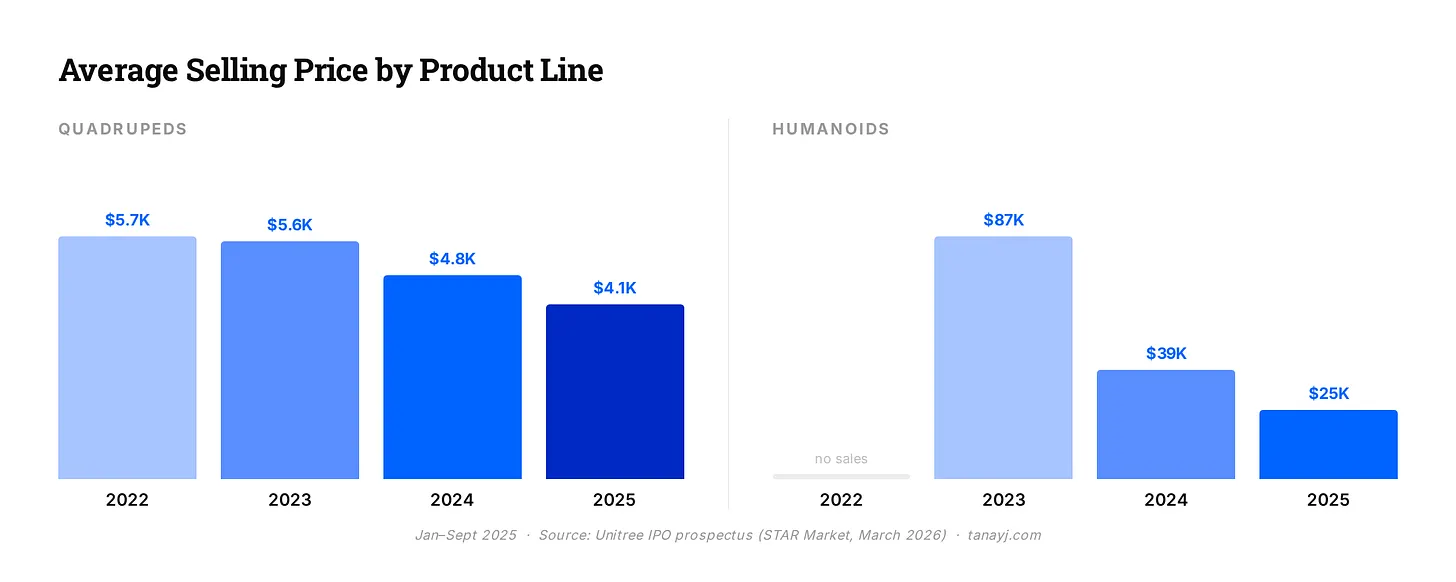
The unit manufacturing cost for quadruped robots dropped from ~$3,300 in 2022 to ~$1,800 in mid-2025—a 46% reduction. Humanoid robot costs also declined, falling from ~$10,800 to ~$9,200 over the same period.
Interestingly, as shown in the chart below, average selling prices for both quadruped and humanoid robots have fallen sharply year-on-year. Yet gross margin expanded across the period—from over 40% in 2022–2023 to nearly 60% in 2025—largely attributable to its vertical integration strategy.
V. Financial Performance
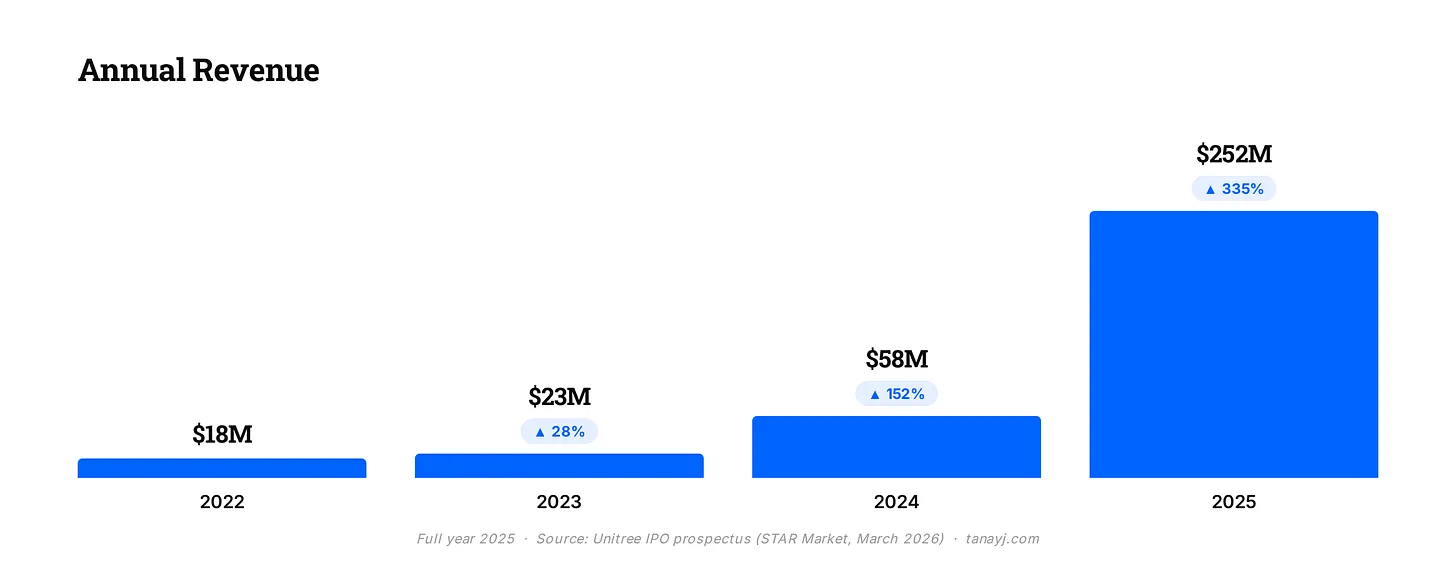
Revenue surged from $58 million in 2024 to an estimated $252 million in 2025—a 335% increase—driven primarily by strong performance in the humanoid robot segment. For most of its history, international sales accounted for over 55% of Unitree’s revenue. In 2025, however, domestic sales in China surpassed exports for the first time—though export revenue still grew more than twofold in absolute terms.
Gross margin stands near 60% and has consistently widened over time.
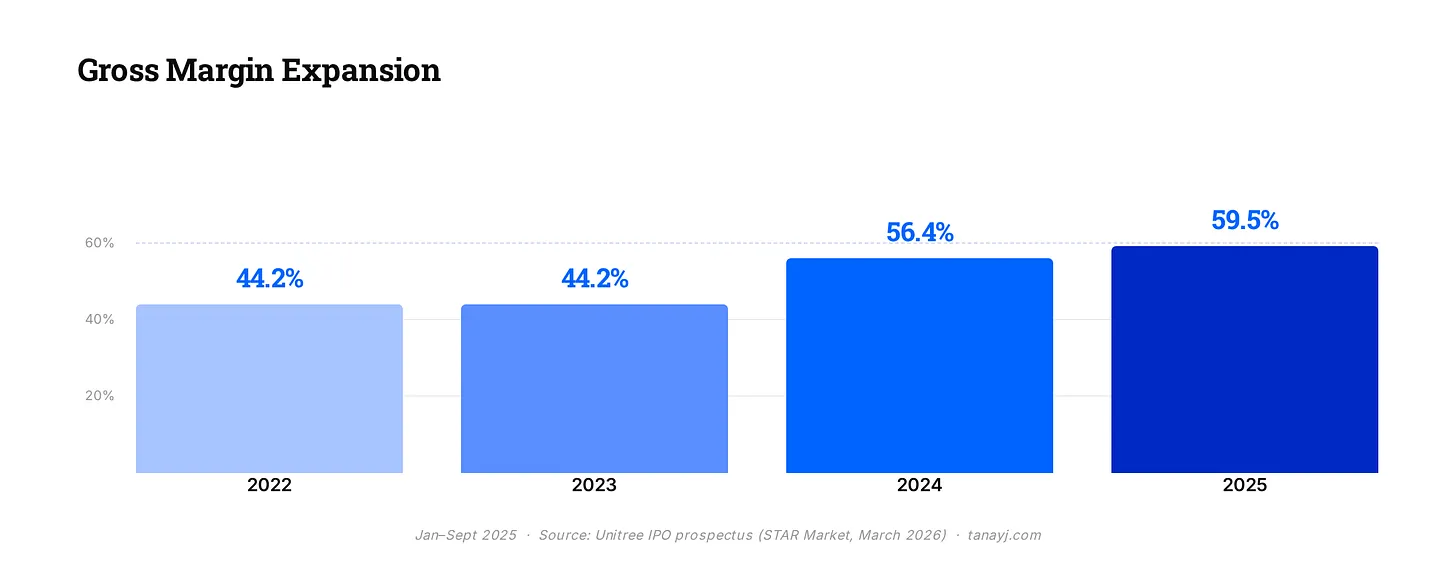
For context: most hardware companies operate with gross margins between 30–40%; software firms typically achieve 70–80%. Unitree’s relatively high gross margin—as a seller of physical robots—is enabled by its vertical integration strategy and current product differentiation.
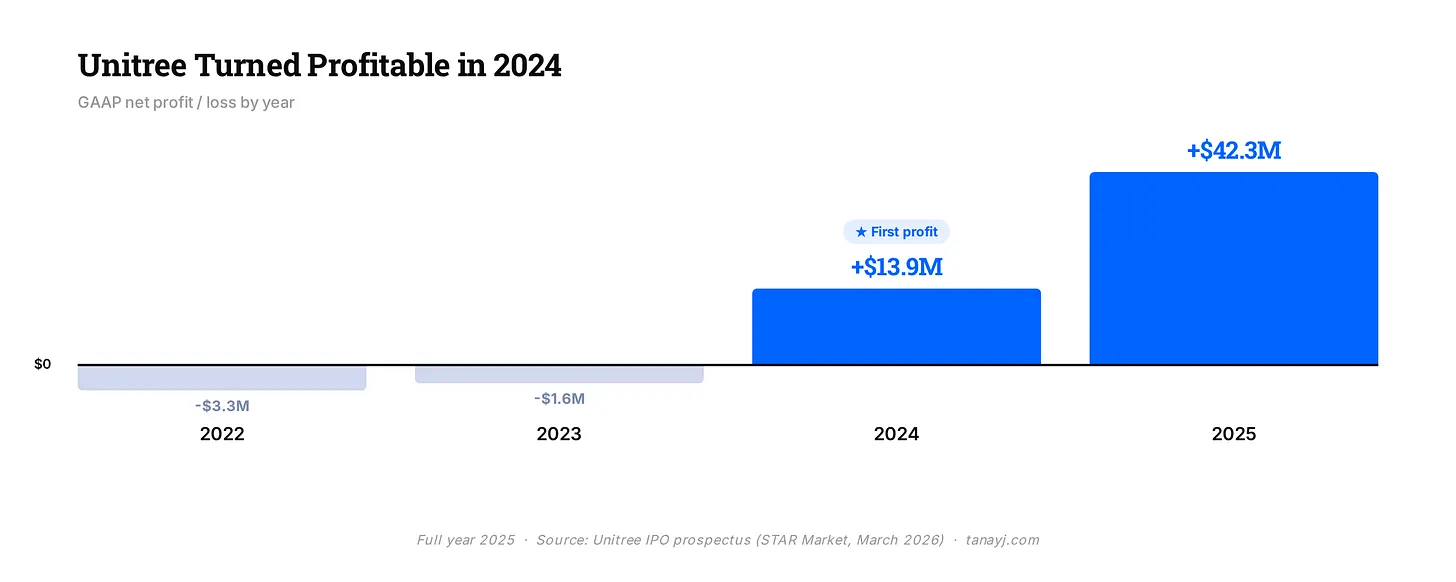
The company achieved profitability under GAAP in 2024, with a profit margin of ~18%—and ~35% on an adjusted basis.
Unitree’s IPO target valuation is approximately $6–7 billion.
VI. Ambitions at the Model Layer
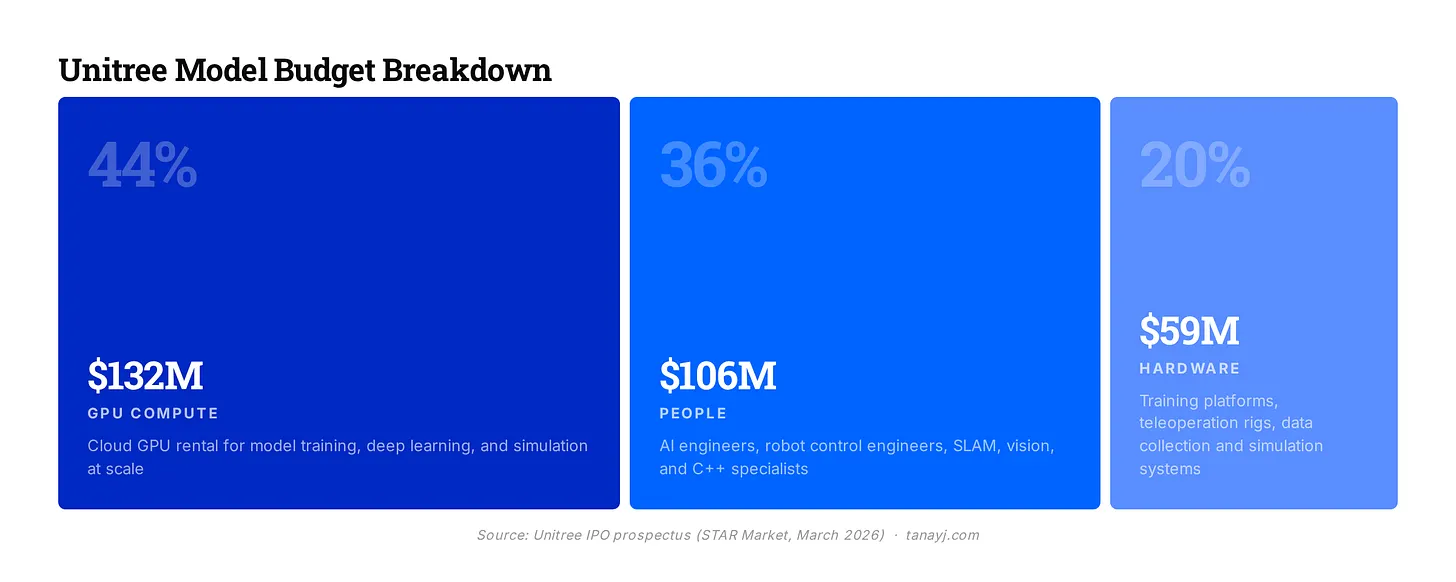
Unitree plans to allocate nearly half of its IPO proceeds to software development. Of the $620 million raised, ~$300 million will be spent over the next three years on AI model training—about $100 million per year—on what the company calls “embodied foundation models.”
The prospectus describes two parallel model architectures. The first is VLA (Vision-Language-Action): a model that maps directly from visual and linguistic inputs to motor commands, enabling robots to generalize across novel tasks without hand-coded instructions. The second is WMA (World Model + Action)—the direction Unitree favors more. WMA models build an internal simulation of physical reality; before acting, the robot predicts outcomes instead of relying purely on trial-and-error learning.
Initial versions of both models have already been released: UnifoLM-WMA-0 was open-sourced in September 2025; UnifoLM-VLA-0 launched in January 2026.
The prospectus also details approximate spending allocations for model-related activities, as shown below:
Unitree’s current hardware leadership is real—but the company recognizes that enduring advantage in robotics may ultimately depend on controlling the model layer: the system that determines what robots do and how they move. Its software ambitions also serve as a hedge against commoditization. Unitree has built a moat in hardware manufacturing.
Yet if actuators and joint modules eventually become standardized components—like batteries in electric vehicles—defensibility will shift decisively to the model layer.
VII. Summary
Unitree boasts a profitable hardware business, genuine manufacturing moats, and the highest humanoid robot shipment volume worldwide—at price points competitors cannot match. But as actual usage patterns reveal, broad commercial applications remain in their infancy. “Demonstration” use cases dominate consumer demand, while industrial deployments remain narrow.
Unitree gives us a clear snapshot of where the robotics market stands today—with much work remaining across models, hardware, and use cases. If you’re building in robotics or embodied AI, feel free to reach out to me at tanay at wing.vc.
Join TechFlow official community to stay tuned
Telegram:https://t.me/TechFlowDaily
X (Twitter):https://x.com/TechFlowPost
X (Twitter) EN:https://x.com/BlockFlow_News
 @tanayj