From Follower to Price Setter: Roles in the Crypto Market Are Reversing
TechFlow Selected TechFlow Selected
From Follower to Price Setter: Roles in the Crypto Market Are Reversing
Wall Street remains the world’s largest reservoir of global capital, but crypto is emerging as the “pricing hub” of this reservoir.
 Navigating Web3 tides with focused insights
By Gracy Chen
Last night, a college classmate working on Wall Street suddenly sent me two charts: the futures price movements of Cerebras (CBRS), an AI chip company, on Bitget and Hyperliquid.
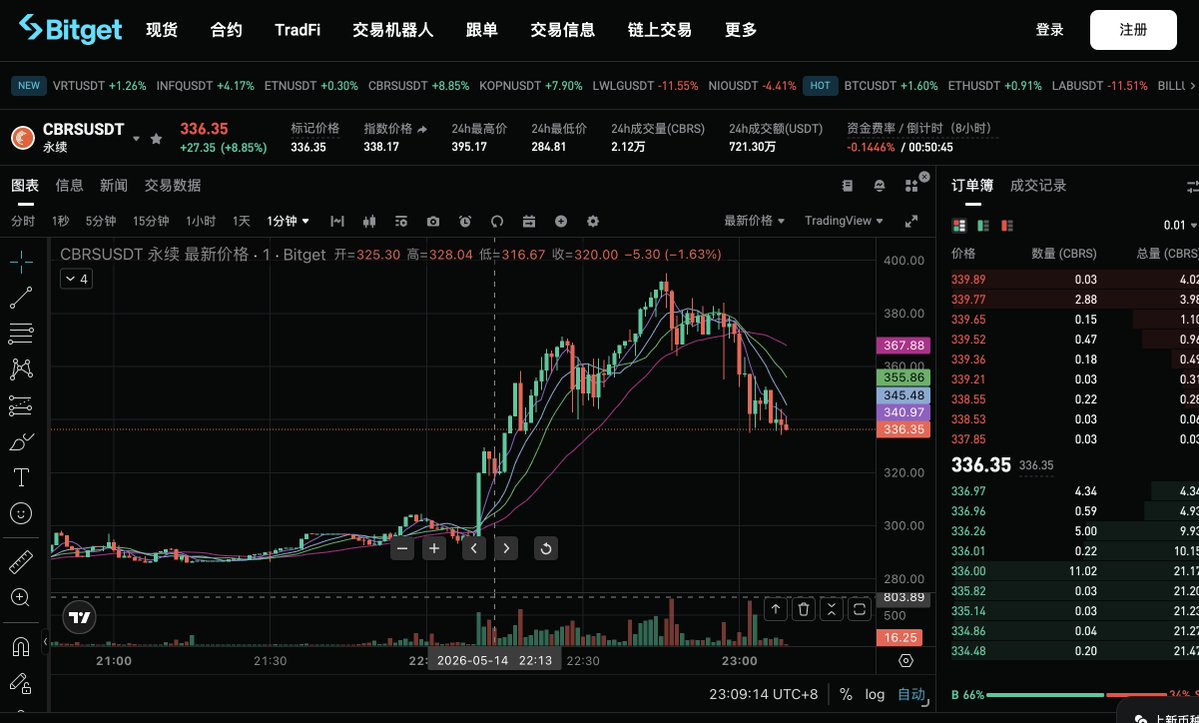
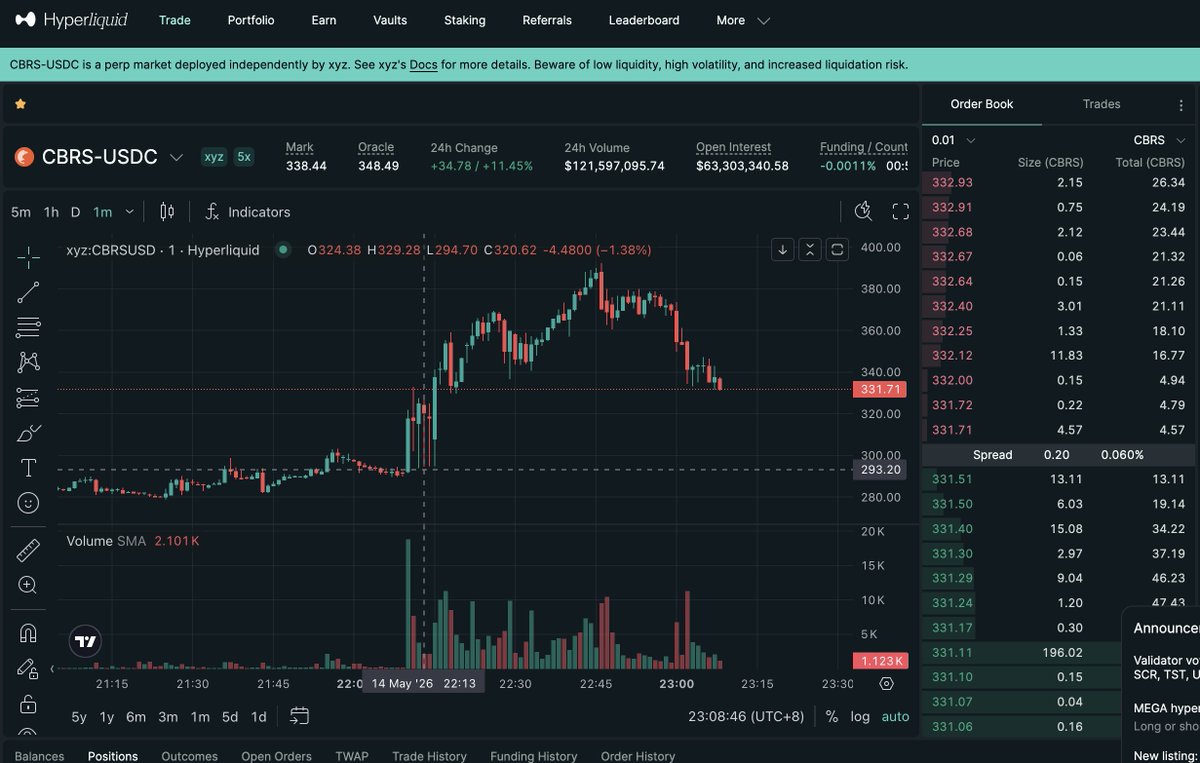
He said these charts appeared in an internal meeting at his firm. The topic under discussion was fascinating:
The crypto industry is delivering a unique value that Wall Street lacks—providing the opening price for IPO assets earlier than Wall Street does.
Take CBRS as an example. On May 14 (U.S. Eastern Time), just before the stock’s official listing on Nasdaq, the entire Wall Street community was waiting for its opening price. Yet on platforms like Bitget and Hyperliquid, the market had already sprung to life.
Around 10 a.m. U.S. Eastern Time that day—while Nasdaq was still conducting its pre-market opening auction—the two platforms displayed remarkably similar price action: CBRS futures surged rapidly from roughly $290 to near $380.
Later that day, CBRS officially listed on Nasdaq with an opening price of approximately $350 and reached an intraday high of $386.
In other words, in this CBRS case, the crypto market completed an exceptionally accurate price discovery ahead of traditional markets.
This is genuinely exciting.
For a long time, the crypto industry has been waiting for Wall Street’s validation, institutional adoption, and endorsement from traditional finance.
Now, however, the dynamic is reversing: Wall Street is beginning to pay serious attention to crypto’s price signals.
This is no coincidence—it reflects the structural advantages inherent to crypto markets. For pre-IPO futures, several exchanges have adopted similar mechanisms, such as:
Oracle-based internal pricing and smoothing mechanism: During the “black box” period—before U.S. equity markets open and without any external price reference—how does the system determine price? Our mechanism uses an endogenous oracle to extract large-trade price spreads from the order book and adjusts the price once per second. However, the current price is calculated as the exponential moving average (EMA) of the past minute’s prices, allowing the spot price to gradually converge toward the target price. Here’s an analogy: the oracle acts like radar, detecting large, real-money trades on the order book to calculate the true target price. To prevent erratic price spikes or drops that could harm retail traders, the system operates in “slow-motion” mode—adjusting incrementally each second, smoothly converging toward the target price and avoiding malicious liquidations triggered by sudden volatility.
Dynamic price band mechanism balancing risk and flexibility: The system sets an initial price fluctuation range of ±5%. Once price reaches 90% of either boundary, it automatically triggers re-anchoring—expanding the weekly maximum price discovery range to approximately ±25%, all without altering market makers’ single-trade risk models. Think of it like a retractable leash used while walking a dog. Initially, the system defines a safe trading range (e.g., ±5%). If buying pressure becomes overwhelming and price approaches the upper limit, the system doesn’t rigidly halt trading. Instead, it automatically raises the ceiling (to ±25%). This approach controls the risk of extreme short-term swings while granting the market ample room to discover the “true opening price.”
What truly matters here is that crypto markets are evolving—from “followers” into “pioneers” within the global asset pricing architecture.
A few days ago, during a CNBC interview, I introduced the “10% Vision”: By 2030, roughly 10% of global financial assets will exist in tokenized form. We’re now accelerating toward that vision.
Writing this, I recalled taking my son to visit Wall Street and seeing the “Fearless Girl”—the statue standing defiantly in front of the NYSE, hands on hips, head held high, staring resolutely at the massive, ancient, seemingly unshakable empire of traditional finance.
Early crypto was just like that girl—standing outside the gates of traditional giants, perceived as a rebellious outsider and challenger.
In the last cycle, we eagerly hoped Wall Street would turn around and embrace crypto. In the next cycle, Wall Street will realize it has no choice but to embrace crypto and tokenization.
Because the most cutting-edge market experiments, the fastest liquidity orchestration, and the most open price discovery are happening right here. In this irreversible convergence, the vast capital pools of traditional finance are actively integrating with Web3’s superior underlying infrastructure.
Wall Street remains the world’s largest reservoir of capital—but crypto is becoming its “pricing center.”
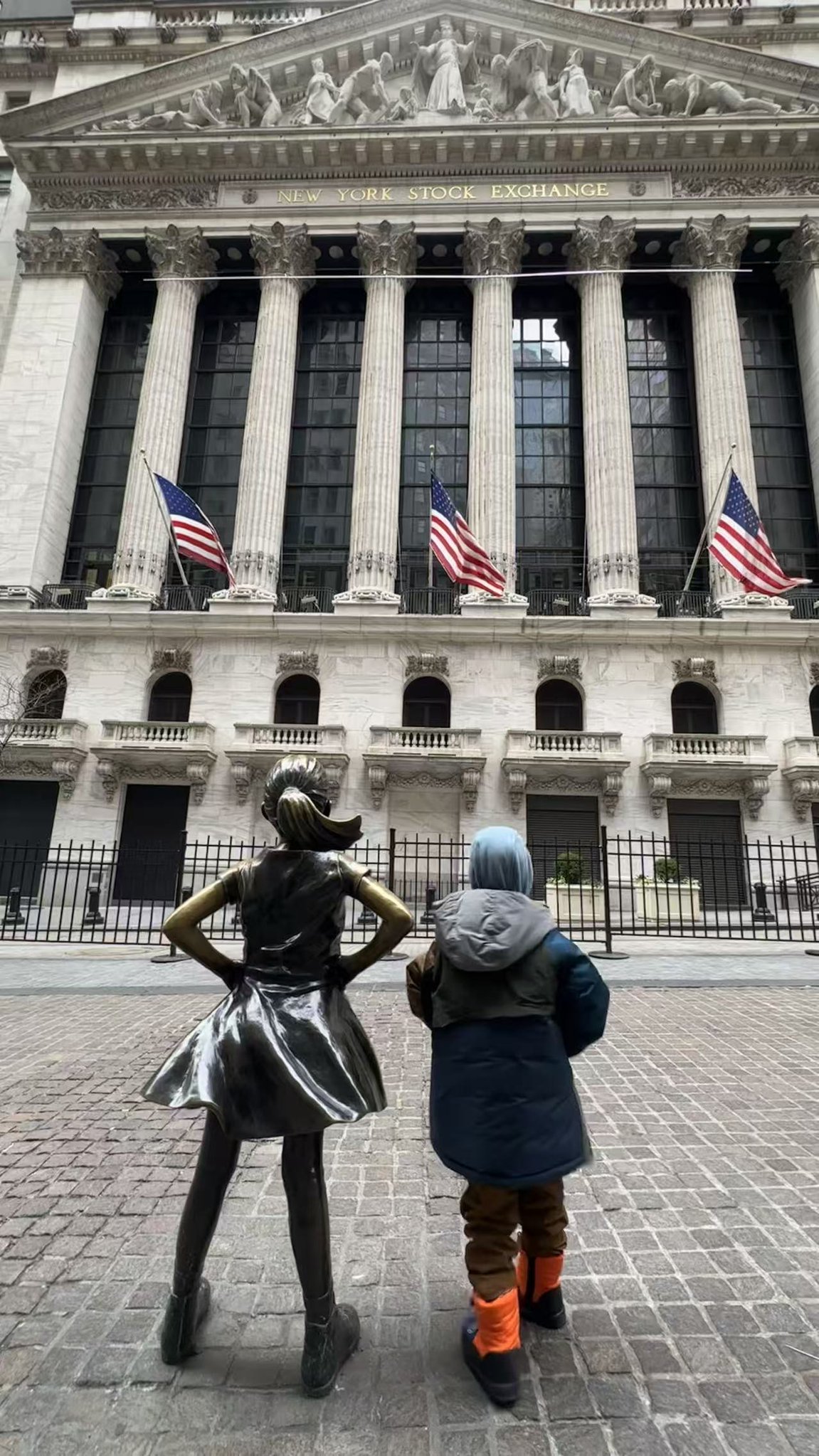
Wall Street brings the scale, but Crypto dictates the future of price discovery.
Join TechFlow official community to stay tuned
Telegram:https://t.me/TechFlowDaily
X (Twitter):https://x.com/TechFlowPost
X (Twitter) EN:https://x.com/BlockFlow_News
 @GracyBitget