L1 Is Dead; Appchains Shall Rise
TechFlow Selected TechFlow Selected
L1 Is Dead; Appchains Shall Rise
Halting staking rewards—a Ponzi scheme—cutting funding for foundations that don’t deliver real value, and refocusing on genuine user needs: this is the only viable path forward for public blockchains.
 Navigating Web3 tides with focused insights
Author: iwillpat
Translated by Jiahuan, ChainCatcher
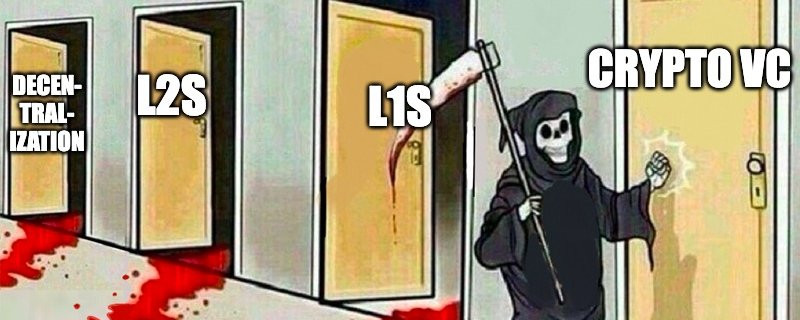
The outcome has been sealed since the dawn of the “Rollup-as-a-Service” (RaaS) era—a harbinger of execution layers spiraling into death and commoditization.
What I mean is: general-purpose L1 tokens will continue trending toward zero—likely without exception. I’ll try to explain why, and how I’d pivot if I were running an L1.
The primary drivers behind L1 failure are as follows: linear token unlocks, a failed value proposition, poor management, and industry “leadership.”
I’ll briefly unpack each—these are personal views, not definitive conclusions.
Linear staking rewards in their current form offer some benefits—e.g., distribution via liquid staking (“My 7% APY!”)—but they fail critically on several fronts.
Delegated Proof-of-Stake (DPoS) makes it easy for armchair “decentralization purists” to participate in network security—but it fails to meaningfully incentivize insiders, users, or developers. At best, it only encourages token holding, contributing nothing to real value creation.
I’ve heard the classic PoS argument: “Large validators have economic incentives not to dump on you.” Yet that hasn’t stopped them from selling every possible unlock and block reward.
Which brings me to my next point: they sell because L1 tokens lack a long-term value proposition.
The “Paper Towel” Illusion
The “gas token” and “governance” narratives are stale, unconvincing—like two Bounty paper towels: soak them, and they fall apart. A network’s token value depends on what you can buy with it.
So every blockchain team’s goal should be to drive its token’s adoption as widely as possible—as money. In chasing higher TPS and lower block times, the industry seems to have lost sight of its original vision of “peer-to-peer electronic cash.”
Let’s be blunt: throughput, TVL, and low latency confer no intrinsic value to a token. Liquidity and usage do.
Next—and this is the most concrete, most painful point—blockchain “labs” (and their foundations).
Immediate dumping upon vesting expiry, steeply discounted OTC sales, exorbitant operating expenses, hot-money incentive programs, hiring “KOLs”… we could all rattle off a few examples.
At the end of the day, every dollar spent by a lab is a tax levied on token holders. Unless that lab generates revenue—via a service, first-party wallet, or app—it’s surviving solely by selling tokens.
That isn’t inherently bad—they deliver valuable engineering resources, explorers, and APIs. But if a lab isn’t generating net new buying pressure for the token while expenses climb unsustainably, it bleeds to death.
One top priority for any lab should be building the network into a permissionless, self-sustaining system—passing the “hands-off test.” Ultimately, business development should be community-driven; the network should develop its own spiritual “CTO.”
That doesn’t require 400 employees—30–40 exceptional people, plus those building first-party apps and services, would suffice.
Finally—after laying all this out, I’ll share my “solution”—crypto has been steered badly off course by many large capital allocators and advisors.
Setting aside FTX, Celsius, and Luna, we’ve been force-fed industry’s biggest players’ narratives: short-term hype, excessive leverage, “maximal extraction”—like cram-feeding a sad, bloated retail turkey.

Championing TPS over smart-contract security, funding the 10th general-purpose L1, raising at absurd valuations, securing far more capital than needed, claiming non-existent security advantages—all hallmarks of severe crypto brain damage.
Placing bold bets on industry direction is one thing—e.g., privacy coins, MoveVM, tokenized IP, decentralized social.
But burning money on yet another idiotic fad—or short-term cash grab—is entirely different: RaaS, data availability, any L1 launching with unicorn valuations before shipping a product, infrastructure solutions for crypto problems that don’t exist—or generate no revenue…
(Disclaimer: I don’t claim to be an investing genius—but I do know basic math. Buy pressure must exceed sell pressure.)
Where Do We Go From Here?
Next, I’ll briefly outline where the industry should head.
We need new L1 token models—and a radically different approach to crypto VC. The current “low float, high FDV” paradigm works only when valuations are low and fresh capital flows in.
But retail investors won’t pay seed-round 1000x valuations at TGE—and certainly won’t shoulder massive unlocks and insider staking rewards 12 months later.
L1s don’t need hundreds of millions to launch mainnet—unless I’m missing something. Raise just enough to build and go to market; raise again later, and everyone wins.
Token unlocks should tie to milestones like CEX liquidity, payments, and DeFi lending. On-chain governance deserves higher priority. Foundations must uphold baseline transparency around balance sheets, spending, and investments.
Retail doesn’t want to fund network security (i.e., validator rewards). Ultimately, the network should sustain itself without any staking rewards.

Perhaps staking rewards shouldn’t exist at all—and instead, validators should receive direct revenue from the network or the lab. Then watch how hard they hustle.
Less and less value flows to base layers—we shouldn’t pour so much into their development. Gas fees across all chains trend toward zero; successful apps are migrating to dedicated chains; cross-chain bridging has never been easier.
So the conclusion is clear: build an app (or appchain) first, then vertically integrate—Hyperliquid, Pump, and others are doing exactly that.
I’m not saying stop investing in general-purpose blockchains—but I do believe the core function of a network token should ultimately be a genuinely useful medium of exchange. Permissionless L1s should serve as DeFi’s liquidity hub—and as sandboxes for new applications.
These aren’t novel ideas. Many L1 teams already realize they must build their own apps and services to survive. The foundation treadmill—funding operations solely by selling tokens—is slowing down.
If your role in one of these teams doesn’t generate revenue, it may be time to ask: what value can you actually create?
Interestingly, heavy usage—by retail or institutions—matters far less than cultivating a strong, happy holder community. When in doubt, ask the community.
Even if their suggestions are terrible, at least ask who on your team they like—and dislike—the most.
I hesitated for weeks before publishing this. It’s not a polished essay—it’s more like a shower-thought dump.
My view: All L1s are making the same serious mistakes—differing only in luck and timing. The strongest performers survive thanks to better leadership and faster delivery—but the question of sustainable value propositions remains unanswered.
We can keep trudging down this long, painful path of value extraction—watching Bitcoin maximalists and HODLers continue outperforming the market. Or we can acknowledge the flaws in today’s L1 model—and start building toward a slightly fairer outcome.
Join TechFlow official community to stay tuned
Telegram:https://t.me/TechFlowDaily
X (Twitter):https://x.com/TechFlowPost
X (Twitter) EN:https://x.com/BlockFlow_News
 @iwillpat