








Crypto Morning Brief: Second round of U.S.-Iran negotiations may take place before next week; Hyperbridge gateway contract attacked
TechFlow Selected TechFlow Selected
Crypto Morning Brief: Second round of U.S.-Iran negotiations may take place before next week; Hyperbridge gateway contract attacked
Strategy repurchased 13,927 BTC, increasing its total holdings to 780,897 BTC.
 Navigating Web3 tides with focused insights
Author: TechFlow
Yesterday’s Market Highlights
U.S. and Iran Explore “Longer-Term” Agreement; Second Round of Talks May Occur Before Next Week
According to Bloomberg, sources familiar with the matter report that the U.S. and Iran are discussing holding a new round of face-to-face negotiations, aiming to reach a longer-term ceasefire agreement before the two-week truce announced on April 7 expires next week. Potential venues under discussion include Islamabad or other alternative locations for the second round of talks, with Turkish and Egyptian officials also involved in mediation efforts. U.S. Vice President Vance stated that negotiations have made substantial progress but emphasized that “the ball is in Tehran’s court”; President Trump noted that Iran has proactively contacted the U.S., expressing its desire to reach an agreement. Iran denies any intention to build nuclear weapons but insists on its right to uranium enrichment, stating that differences cannot be resolved within a single round of talks—leaving room for further dialogue.
American Bankers Association Criticizes White House Stablecoin Report, Warns Paying Interest on Stablecoins Would Threaten Community Banks
According to reporter Eleanor Terrett, the American Bankers Association (ABA) has publicly criticized the recent stablecoin report issued by the White House Council of Economic Advisers (CEA), arguing that the report misdirects its analysis and overlooks more critical policy risks. The ABA warns that permitting interest-bearing stablecoins could trigger massive deposit outflows from community banks, raise funding costs, and thereby tighten local credit supply. The ABA notes: “The CEA report focuses narrowly on the implications of banning interest payments, inadvertently creating a false sense of security while sidestepping the far more disruptive scenario—the rapid, large-scale adoption of interest-bearing payment stablecoins.”
Hong Kong’s Innovation, Technology and Industry Bureau Signs MOU with China’s Cyberspace Administration, Covering Blockchain and Other Key Areas
The Hong Kong Special Administrative Region (HKSAR) Government’s Innovation, Technology and Industry Bureau and China’s Cyberspace Administration signed the “Memorandum of Understanding on Innovation and Technology Development” to advance high-quality development of the digital economy through technological innovation. The MOU covers priority areas including artificial intelligence, cross-border data flows, and blockchain, aligning closely with China’s 15th Five-Year Plan. Its objectives include supporting Hong Kong’s development as an international innovation and technology hub and fostering a new real economy centered on technological innovation. HKSAR Chief Executive John Lee stated that Hong Kong will continue deepening cooperation with China’s Cyberspace Administration to further promote cross-border data flows within the Guangdong-Hong Kong-Macao Greater Bay Area.
Ondo Finance Submits No-Action Request to SEC to Advance On-Chain Operations of OGM Product
According to Ondo Finance’s official blog, Ondo Finance recently submitted a no-action request to the U.S. Securities and Exchange Commission (SEC), seeking confirmation that the SEC would not take enforcement action against its model for recording and managing certain securities interests in tokenized form on the Ethereum mainnet.
The request concerns Ondo Global Markets (OGM), a tokenized note product currently offering non-U.S. investors exposure to U.S. equities and ETFs. Under this model, underlying securities remain held within existing legal, custodial, and recordkeeping frameworks, with official books and records unchanged. Only in limited circumstances are relevant securities interests mapped onto the Ethereum mainnet in tokenized form—held by custodian BitGo—to support recordkeeping and operational processes.
Hyperbridge Contract Exploited via MMR Proof Replay Vulnerability, Resulting in ~$242,000 Loss
According to BlockSec Phalcon, Hyperbridge’s HandlerV1 contract on Ethereum suffered a Merkle Mountain Range (MMR) proof replay vulnerability, resulting in approximately $242,000 in losses. The vulnerability stemmed from unbound proofs and requests, enabling attackers to replay historical valid proofs alongside newly forged requests to perform operations such as changing administrator permissions. In one specific instance, the attacker changed the Polkadot (DOT) token administrator and then minted additional DOT tokens to profit. Observed attack transactions include: DOT token admin change and minting (~$237,400 loss), ARGN token admin change and minting (~$3,800 loss), and host withdrawals. The vulnerability was discovered by PhalconSecurity and analyzed using PhalconExplorer.
Earlier reports indicated that Hyperbridge’s gateway contract was compromised, leading to the unauthorized minting and subsequent sale of 1 billion DOT tokens on Ethereum.
Genius Responds to Airdrop Controversy: Adds “Refund” Feature to Airdrop Scheme Following Community Feedback
The Genius team, having prioritized and actively listened to community feedback in collaboration with core team members and advisors, has added a “refund” option to its latest airdrop documentation, enabling users to perform related actions during the airdrop process.
Per the official announcement, users may opt to burn their entire GENIUS airdrop allocation within 48 hours after the Token Generation Event (TGE) to receive a refund of net fees collected by the platform. Genius emphasizes that refunds are calculated based on net—not gross—fees. To date, the platform has distributed over $7 million in trading rebates and over $1.3 million in referral rewards—both amounts already deducted from the refundable balance. Furthermore, refunds cover only fees directly collected by Genius; fees charged by third-party protocols (e.g., PancakeSwap) fall outside the refund scope.
The official statement affirms that users retain full autonomy in choosing either to hold GENIUS tokens or apply for a refund—and warns that it will act immediately against any misinformation claiming “incomplete refunds.”
Aave Community Votes to Approve Funding for Aave Labs
The Aave DAO has approved a governance proposal authorizing total funding of $25,000,000 in stablecoins and 75,000 AAVE tokens for Aave Labs, with the AAVE tokens subject to four-year linear vesting.
The funding structure includes: $5 million in aEthLidoGHO disbursed from the Collector Contract within six months; $15 million in aEthLidoGHO disbursed within twelve months; and 75,000 AAVE tokens disbursed from the Ecosystem Reserve over 48 months.
The proposal stipulates that any unused funds remaining after the 12-month funding period will be returned to the DAO treasury or handled per subsequent governance decisions.
Circle Signs MOU with Dunamu, Parent Company of Upbit
According to News1, USDC issuer Circle and Dunamu—the operator of South Korea’s largest virtual asset exchange, Upbit—have signed a comprehensive cooperation Memorandum of Understanding (MOU). The two parties will jointly advance digital asset education initiatives—including stablecoins—to enhance market participants’ access to information and strengthen public trust in South Korea’s digital asset ecosystem. Dunamu representative Oh Kyung-seok stated, “Collaborating with Circle—a firm with proven compliance expertise—is highly significant”; Circle co-founder and CEO Jeremy Allaire emphasized, “South Korea is an exceptionally important market for digital asset innovation.”
Bitcoin Mining Giant Foundry Launches Zcash Mining Pool, Captures Nearly One-Third of New Supply
According to Fortune, Bitcoin mining pool giant Foundry officially launched a new mining pool dedicated to privacy coin Zcash on April 13. Foundry CEO Mike Colyer stated the move responds to growing institutional demand for privacy coins. The pool has already attracted multiple institutional miners, accounting for nearly one-third of newly minted Zcash across the network.
Zcash leverages zero-knowledge proof technology to ensure transaction privacy while supporting selective disclosure to meet compliance requirements—making it more institutionally favored than rival Monero. Boosted by this news, Zcash’s price has surged over 75% in the past 30 days, reaching a current market capitalization of approximately $6.3 billion. Foundry currently controls roughly 31% of the global Bitcoin hashrate, making it the world’s largest Bitcoin mining pool operator.
Strategy Purchases Additional 13,927 BTC, Total Holdings Rise to 780,897 BTC
According to Strategy’s official announcement, the company purchased another 13,927 BTC at an average price of approximately $71,900 per coin, spending roughly $1 billion. Its BTC yield year-to-date (YTD) in 2026 stands at 5.6%. As of April 12, 2026, Strategy holds a cumulative total of 780,897 BTC, with a total acquisition cost of approximately $59.02 billion and an average purchase price of roughly $75,577 per BTC.
Bitmine ETH Holdings Surpass 4.87 Million Tokens, Total Asset Value Reaches $11.8 Billion
According to PR Newswire, Bitmine Immersion Technologies (NYSE: BMNR) announced that, as of April 12, 2026, it holds 4.875 million ETH (valued at approximately $10.75 billion), representing 4.04% of ETH’s total supply—achieving 81% of its “5% Alchemy” target. Concurrently, the company holds 198 BTC, $719 million in cash, and other investments, bringing its total crypto assets and cash to $11.8 billion.
In staking, the company utilizes its proprietary MAVAN (Made-in-America Verified Network) platform to stake 3.335 million ETH (valued at approximately $7.36 billion), projecting annual staking revenue of $310 million. Its 7-day annualized staking yield stands at 2.89%, exceeding the industry benchmark CESR rate of 2.73%.
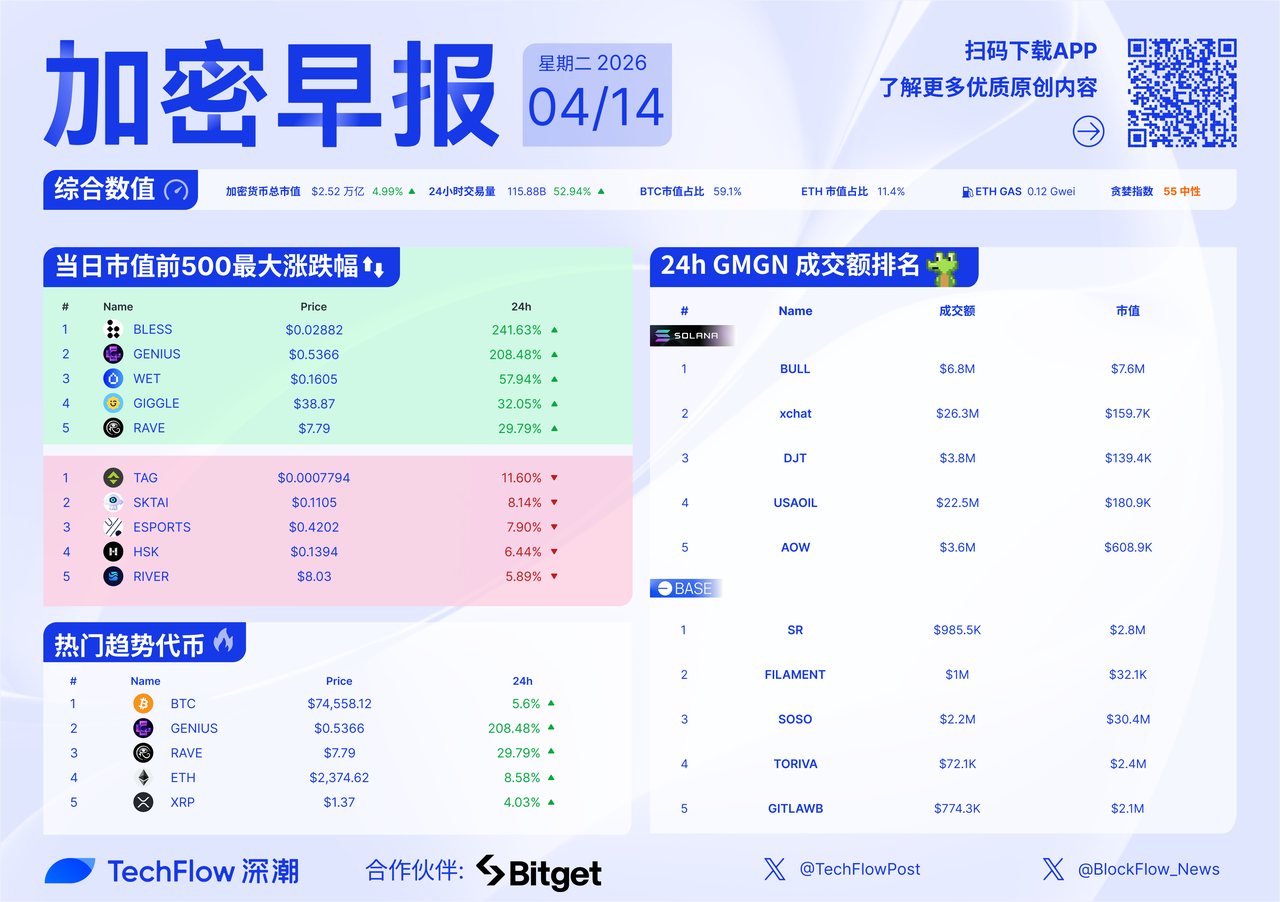
Market Data
Recommended Reading
Tech Stock Valuations Return to Pre-AI Boom Levels! Apollo Chief Economist: Forward P/E Ratio Shrinks from 40x to 20x
https://www.techflowpost.com/zh-CN/article/31088
This article details how tech stock valuations have reverted to pre-AI boom levels, with the S&P 500 Information Technology sector’s forward P/E ratio falling from 40x to 20x. Three converging pressures—Middle East conflict, uncertain ROI on AI capital expenditures, and slowing earnings growth—are driving this valuation compression. Investors are now scrutinizing whether capital expenditures can translate into profitable returns within a reasonable timeframe.
Eight Months After Returning from Space, Sun Yuchen Clashes with the Presidential Family
https://www.techflowpost.com/zh-CN/article/31090
This article discusses Sun Yuchen’s allegations that DeFi project WLFI—operated by the Trump family—contains a hidden freeze-backdoor in its token smart contract, freezing over $100 million worth of his tokens. The dispute is intense: Sun has publicly asserted his rights and sought to pressure the project via community sentiment. The article also explores the “overview effect” on cognition but argues Sun’s actions stem more from rational calculation than altered perception due to space travel. Finally, it notes that public advocacy represents a strategic choice after silence proved ineffective.
CoinGecko Report: Panoramic View of Spot Markets Across 12 Major CEXs—Only 32% of Newly Listed Tokens Outperform Launch Price in Short Term
https://www.techflowpost.com/zh-CN/article/31094
This article reveals spot market trends across 12 major CEXs, including capital shifting from institutional platforms to retail-driven exchanges. USDT and USDC account for nearly 98% of stablecoin trading pairs, effectively monopolizing spot markets. Retail-focused exchanges exhibit significantly higher turnover rates than institutional ones—MEXC’s turnover is 20 times that of Coinbase.
Why Does Iran Prefer Stablecoins as the Strait of Hormuz Toll Currency?
https://www.techflowpost.com/zh-CN/article/31097
This article primarily examines the Islamic Revolutionary Guard Corps’ (IRGC) latest move to levy cryptocurrency tolls on vessels transiting the Strait of Hormuz, analyzing why stablecoins were selected—and the potential international ramifications. It also explores the Iranian regime’s growing dependence on cryptocurrencies and their broader implications for global trade and sanctions evasion.
TechFlow Intelligence Brief: Cross-Chain Bridge Hacker Mints 1 Billion Fake DOT Tokens But Cashes Out Only $250,000; Microsoft Says AI Agents Require Software Licenses
https://www.techflowpost.com/zh-CN/article/31102
This article covers dynamic developments across cryptocurrency markets, cross-chain bridge attacks, AI technology advancements and societal impacts, and emerging trends involving tech firms and geopolitics. Polkadot’s third-party cross-chain bridge Hyperbridge was compromised: hackers forged cross-chain state proofs to mint 1 billion fake DOT tokens—but ultimately cashed out only $250,000, exposing flaws in third-party trust models. Sun Yuchen accused WLFI’s smart contract of containing a backdoor allowing project administrators to freeze token holders’ assets—sparking broad discussions about DeFi governance and transparency.
Join TechFlow official community to stay tuned
Telegram:https://t.me/TechFlowDaily
X (Twitter):https://x.com/TechFlowPost
X (Twitter) EN:https://x.com/BlockFlow_News
 深潮TechFlow











