If you have broad interests, don't waste the next two to three years
TechFlow Selected TechFlow Selected
If you have broad interests, don't waste the next two to three years
You are living in the midst of a second Renaissance—make the most of it.
 Navigating Web3 tides with focused insights
Author: @thedankoe
Translation: @frankyleon725
Society makes you believe that having multiple interests is a weakness.
Go to school, get a degree, find a job, retire someday.
But there are too many problems with this sequence of steps.
We no longer live in the industrial age. Specializing in just one skill is almost like slow death. I think most people now understand how dangerous mechanical living and isolated learning can be for your mind and soul. People also sense that we're experiencing a second Renaissance.
Your curiosity and love for learning are your advantages in today’s world—but something crucial is missing:
For a long time, I kept learning, learning, and learning again. I was stuck in “tutorial hell.” Some might point to your lack of focus through “Shiny Object Syndrome” (SOS). I got dopamine from feeling smart, but my life didn’t change much. Honestly, I felt myself falling further behind. In college, I tried too many different things. I dreamed of starting my own business… earning income from creative work… but after five years of “learning,” reality forced me to take a job just to survive.
The missing piece is a vehicle.
A vehicle that allows you to channel all your interests into meaningful work and earn a decent income from it.
If you've ever felt guilty for not being able to pick just one thing; if you’re told to “niche down” while your mind wants to expand; if you’ve wondered whether there’s a path that could spare you from the kind of suffering you see in others—then now is the best time in history.
Below are the seven most compelling points I can think of. We’ll start by understanding why multiple interests are superpowers in today’s world, then move on to practical steps to turn them into your life's work. There’s a lot to cover—hope you’re ready to go.
I The Three Pillars of Individual Success and the Death of the Expert
“The man whose whole life is spent performing a few simple operations… generally becomes as stupid and ignorant as it is possible for a human creature to become.”
— Adam Smith
Funny, Mr. Smith—you created these people, and we’re still dealing with the consequences.
Specialization emerged during industrialization—for example, in a pin factory, one worker completing all steps could make only 20 pins a day. But when each worker does just one step, they produce 48,000.
So we built the entire world around this model.
Humans became 9-to-5 assembly line workers because governments serve their own interests, not national ones. Companies serve bosses, not employees.
Schools were designed to serve this system. Their sole purpose is to produce punctual, obedient factory workers.
But this is absolutely not the right way to live.
If you gain expertise but can never independently run any business—especially your own—you remain dependent on school for education and jobs for income. You’re sold the lie that specialization equals human value.
The truth is: the system doesn’t need *you* to perform that task.
That’s the difference.
If pure specialization makes people stupid and dependent, what makes someone intelligent and independent?
Three pillars: self-education, self-interest, self-sufficiency.
(Original: Self-education, self-interest, self-sufficiency)
Self-education is obvious—if you want results different from traditional education, you must take charge of your own learning.
Self-interest may sound unappealing—it feels selfish and short-sighted. Many instantly dismiss it as a flaw. But it simply means “caring about your own interests,” because the alternative is serving the interests of organizations that make up current society—we’ve already discussed that. In other words, follow your interests, because they may very well benefit others in selfless ways—depending on your awareness and moral level.
By the way, chasing fleeting pleasures (cheap dopamine) usually isn’t pursuing your interests—it’s serving companies that profit from your ignorance.
In Ayn Rand’s view, truly selfish people are self-respecting and self-reliant—neither sacrificing others nor themselves. This rejects both predators and doormats.
Self-sufficiency means refusing to outsource your judgment, learning ability, and autonomy. If self-education is the engine, and self-interest the compass, then self-sufficiency is the foundation—preventing external forces from hijacking your life direction. All three work together, but not completely dependent on each other.
The generalist embodies these three pillars.
Self-interest drives self-education.
You learn because it truly serves your growth—not because someone assigned it.
Self-education enables self-sufficiency.
You can only have sovereignty over what you understand.
Self-sufficiency clarifies self-interest.
When you stop relying on others’ interpretations, you can finally perceive what truly benefits you. Most people treat multiple interests as an escape from work. When your interests become work—or a life mission—most will naturally fall away.
Look back at every CEO, founder, or creator we truly admire—they’re all generalists.
They know marketing well enough to guide it, product well enough to build it, and human nature deeply enough to lead teams. Yet they remain in control, constantly learning and adapting when environments shift.
More importantly, they understand ideas from different fields can complement each other, creating a unique worldview that lets them pull novel ideas from nothingness and turn them into market value.
Look at the world today—if you realize the opportunities available to individuals (not just leaders), being a natural polymath offers vast choices. That should excite you immensely.
II You’re Living in the Second Renaissance—Seize It
Study the science of art; study the art of science. Develop your senses—especially learn how to see. Realize everything connects.
— Leonardo da Vinci
To me, the ultimate moat—or the only competitive advantage worth pursuing—is a perspective.
It’s a viewpoint only you can see, born from your unique life experiences. Something truly irreplicable.
Since this has always been true, why not prioritize developing it now—especially with automation approaching?
How do you set priorities? How do you develop it?
By pursuing multiple interests and combining them to create things.
Every interest you pursue leaves a trace; each adds more connections you can form; each expands and increases the complexity of how you construct and interpret reality. The more complex your mental model, the more problems you can solve, opportunities you can spot, and value you can create. Specialization completely blocks this process—and your “shiny object syndrome” has been trying to tell you this all along.
From birth until now, you’ve cultivated a perspective others cannot grasp—a perspective AI can only think with once you tell it how.
Someone who studied psychology and design sees user behavior differently than a pure designer. Someone who knows sales and philosophy closes deals unlike a typical salesperson. Someone who understands fitness and business builds health companies even MBAs can’t comprehend.
Your edge lies more in cross-domain knowledge than in specialized depth.
This is exactly the pattern we saw in the Renaissance—and it’s making a comeback.
Think about what made it possible…
Before the printing press, knowledge was scarce.
Books were hand-copied—one could take months. Libraries were rare, literacy rarer. If you wanted to learn outside your trade, you either went to monasteries or gave up.
Then Gutenberg changed everything.
Within fifty years, twenty million books flooded Europe. Ideas that once took generations to spread now traveled in months. Literacy exploded; knowledge costs plummeted.
For the first time in history, a person could realistically master multiple fields within one lifetime.
Thus came the Renaissance.
Da Vinci didn’t pick one thing. He painted, sculpted, engineered, studied anatomy, designed war machines, drew human figures. Michelangelo was painter, sculptor, architect, poet.
Unique minds could finally operate freely, as they were meant to.
They were supposed to transcend disciplines, integrate knowledge, and follow curiosity into unknown territories—but most of us never realized this.
The printing press was the catalyst for a new kind of human—one who could learn anything, combine anything, and create things experts could never imagine.
III Turning Broad Interests into a Lucrative Livelihood
Here’s what we currently know:
- You have multiple interests, but can’t keep learning forever without practice
- You love interest-driven self-education, but only have time outside work
- You understand the need for self-interest, but don’t feel valuable enough to charge yet
- You need rapid adaptability—we can’t predict future work models
The question is: how do you fuse these into a lifestyle?
How do you combine learning and earning so you can sustain yourself?
Let me lay out the logic clearly:
To monetize your interests, you need others to care—this is simple: if you’re interested in something, others likely are too. You just need to learn how to convince them.
Also, you need a way for them to pay. In this context, that usually means selling products—because you’re unlikely to find a job allowing full expression of your interests, and investing in stocks or real estate (at effective levels) requires significant capital.
In other words, you need attention.
Attention is one of the last remaining moats.
When anyone can write any code or build any software, who wins? Those with visibility. You can have the best product in the world—if no one knows about it, those who capture and retain user attention will dominate.
By the way, if you follow tech, you know—I don’t think everyone will “build their own software.” Most won’t spend 20 minutes cooking, preferring to spend extra on delivery. Everyone has things they’d rather spend time on.
Back to the point:
You need to become a creator.
Before you recoil and leave, I don’t mean “content creator” specifically (well… it’s complicated).
I mean: stop creating for others (because you need their paycheck), and start creating for yourself.
Be a creator and create for yourself.
Humans are natural creators, yet once believed machines would deliver the American Dream. We’re fundamentally toolmakers. We thrive in niches because we can solve problems. Put a lion in Alaska—it won’t build shelter or clothes, it’ll die. Lions have their own ecosystem.
Reality: every company is a media company. But remember—you need attention! Where does attention come from? Currently, mostly social media—until the next platform emerges (then you’ll need to pivot). So if you have broad interests, becoming a “content creator” makes sense. Simpler: treat social media as an institution to showcase your interests to others. It’s one piece of the puzzle for independent work.
And it covers all our needs.
Love learning? Great—redefine it as “research.” Now it’s your main job. Most of what I write is just “public notes” I take while learning on social media.
(You’re already spending time learning—now just do it publicly on social platforms, and you’ve laid the foundation for entrepreneurship.)
Need self-sufficiency? Then you need a business. Every business needs customers. You probably don’t care about paid ads, SEO, or other marketing. This is where many fail—they’re used to being employees doing one specific task in a company.
Need adaptability? Great—you can iterate quickly and launch new products to your audience. I have a stable following; if my next product fails, people still invest, join teams, or support the next one. You can build a small SaaS, but without distribution, you’ll waste huge effort fundraising, hiring, launching.
No other job or business model gives this much freedom.
But how do you actually begin?
How do you connect all this?
IV Turning Yourself Into a Business
Sadly, “entrepreneurship” and “doing business” have become dirty words—making people feel unqualified, so they miss opportunities when they appear.
If you’ve ever helped someone using your interests, you’re qualified to start a business.
They no longer require upfront capital. They’re not just for unethical elites. They’re not only for those wanting massive profits, nor only for the talented or special.
The truth is: entrepreneurship is our nature and modern survival. We’re born to create value and share it with like-minded people. We’re born to explore the unknown, seek novelty, never stop. Psychologically, this is the most fulfilling lifestyle—even with its lows, because those lows give rise to (organic) peaks.
And entry barriers have collapsed.
All you need is a laptop and internet.
Today, social media makes content distribution free (well, not free—but based on skill, which takes time and effort). Anyone can reach millions with an idea. If they have a product, that attention can become millions in revenue—provided you know how to use these skills. But that’s a big unknown. Most just obsess over interests or skills unrelated to their success—perhaps because they fear failure.
Now, tools and technology handle tasks once requiring teams. Use AI and abundant practical software.
There are now two paths to start.
Path One: Skill-Based
This long dominated the internet: learn a market-recognized skill, teach it via content, then sell products or services around it.
The limitation? It’s expert-style, narrow. You limit yourself! You niche down—because others say it’s more profitable. You chase profit over passion, often recreating another 9-to-5 doing work you don’t care about for people you don’t care about.
Path Two: Growth-Based
Now, emerging creators don’t have fixed niches. Usually focused on one of four timeless markets: health, wealth, relationships, happiness—or all. Strictly speaking, everyone’s positioning is self-actualization—their paths differ wildly.
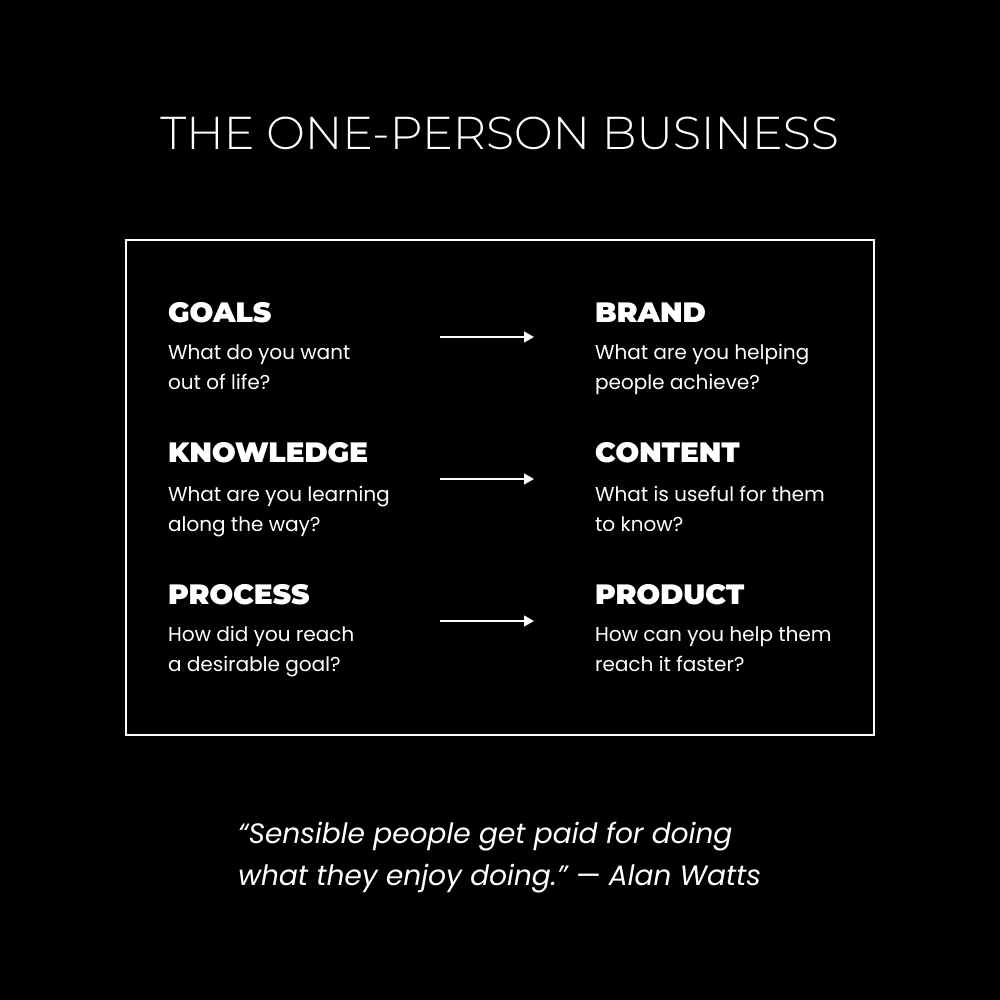
- They help you achieve goals (brand).
- They teach what they’ve learned (content).
- They help others reach goals faster (product).
For multidisciplinary people, I clearly recommend this path—it goes deeper.
First, while taking this path, you’re also on the first one. Building your brand, content, and product requires mastering relevant market skills—so even if you fail, you still have valuable offerings. You’re building your own business, and if skilled in an area, you can help others solve specific problems in theirs.
Second, it flips the traditional model.
Instead of creating customer personas to narrow your market and niche down, you become the persona.
This makes things easier to understand:
You pursue life goals and grow → you validate the value of what you offer → you help your past self achieve the same.
Don’t be a YouTube creator;
Don’t build a personal brand;
Just be yourself. But you need to be somewhere your work can be discovered, followed, and supported. For now and foreseeable future—that’s the internet.
Jordan Peterson (or similar figures) aren’t really “content creators” on the surface.
He tours, writes books, uses social media as base—deploying every tool to spread his life mission. He doesn’t chase viral trends; his thinking surpasses short-term growth hacks; what truly sets him apart and changes lives is the quality of his ideas (regardless of your opinion on Peterson).
So I want to offer a fresh perspective on brand, content, and product—so you can use it as the vehicle for your life’s work.
V – Brand Is an Environment
Stop seeing your brand as just a profile picture and bio.
Brand is an environment where people come for transformation;
Brand is the little world you invite others into;
Brand isn’t what readers see when first visiting your homepage;
Brand is the sum of impressions built in readers’ minds after following you for 3–6 months.
At every touchpoint, you express your worldview, story, and life philosophy—banners, avatars, bios, links, landing pages, pinned posts, threads, newsletters, videos, etc.
In other words, your brand is this:
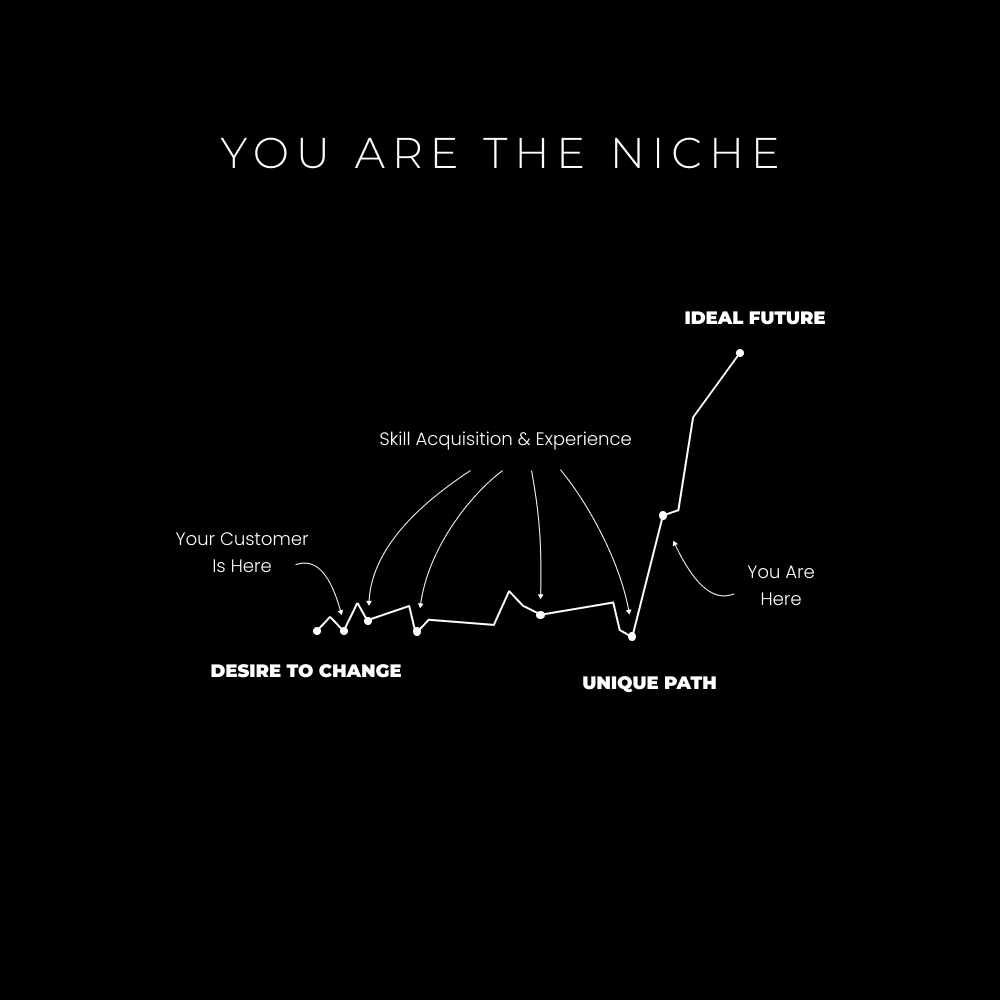
Your brand is your story.
Spend a day writing down your journey, lowest points, experiences, skills gained, and how they helped you—it’ll help immensely.
When brainstorming ideas, content, or products, filter them through your story. Not that you must talk about yourself constantly—but adjust your expression to maintain brand consistency.
The hardest part? Realizing your story is worth telling—even if you think it’s boring or haven’t reflected on your growth.
Key points:
Bio and avatar don’t matter. Some have one-word bios, color-only avatars.
My advice:
- List 5–10 people you respect online
- Look at their avatars, bios, content
- Notice patterns
- Start designing your own brand with your unique style
Honestly, I don’t think it needs to be overcomplicated. Start writing content—your brand will form naturally. We could even say brand *is* content—so focus on content first.
VI – Content Is a Novel Perspective
The internet is an information firehose.
AI only adds more noise.
This means trust and signals matter more than ever.
To me, content should gather the highest-quality ideas in one place. Your brand is the collection of ideas you value—presented as one account on the internet.
If you plan podcasts or public speaking, note: top speakers always memorize 5–10 powerful arguments or ideas. They repeat them—that’s how they build influence. Without these 5–10 ideas, your impact won’t reach its potential.
Creating massive content is how you discover these ideas.
Over time and effort, your content’s “idea density” increases—this creates a brand worth following and paying for.
The goal of curating brand-aligned ideas should reflect in two aspects:
- Resonance—ideas have potential to “go viral.” Measures how much others care.
- Excitement—ideas ignite your passion to write. Reflects how much you value them.
Art and commerce.
Metrics shouldn’t rule everything—but they do matter.
Step One: Build an Idea Museum
The secret of most admired creative minds? They meticulously organize notes, ideas, and inspirations.
In other words, they have a “content bank”—marketers call it an “asset library.”
Use Eden (if you have access), Apple Notes, Notion, or any tool you like—but one thing is clear:
You need a place to jot down ideas anytime.
This is a critical habit.
Whenever you have a useful idea—now or soon—write it down. No need for content pillars or 2–3 topics. Just collect what matters to you. You can create a content map if you wish.
I don’t care how you organize. It can be neat documents or chaotic scribbles—habit beats format.
Judge resonance by post likes, views, or engagement—see if it resonates. If an idea falls flat or underperforms compared to others, it might not work for you.
Judge excitement by whether you feel compelled to write it down or risk losing something valuable.
Step Two: Filter by Idea Concentration
How to start filling your idea museum?
You need 3–5 high-concentration information sources.
By “idea concentration,” I mean persuasive insights.
Hard to explain how to find high-concentration sources—it’s subjective. Depends on your development level (what helps you), your audience’s (what helps them), and how you blend both.
Basic advice might be the world’s most valuable thing to someone, but common sense to you.
Over time, you’ll adjust your signal-to-noise ratio by observing which ideas resonate with your audience and which don’t.
Best sources:
Old or obscure books—I reread five books repeatedly because their ideas are brilliant. These contain timeless truths, immune to trends.
Curated blogs, accounts, or books—like Farnam Street, which compiles精华 thoughts from contemporary intellectuals. Accounts like Navalism compile Naval’s best ideas. Books like Maxwell Daily Reader feature one great Maxwell insight per day for a year. These save you grunt work—letting you extract the best.
Influential social accounts—I have about five accounts that consistently share great insights. If I’m out of content ideas, I browse them, find something interesting, and write about it.
Finding these sources takes months of exploration, but maintaining a rich “inspiration bank” eventually produces equally inspiring content.
Your inspiration bank becomes a manifestation of the mindset you aim to cultivate.
That’s the ultimate goal.
Have such high-quality content that people eagerly open your emails, enable notifications, share your ideas, and frequently ponder your views.
You become a curator of brilliant ideas—selecting inspirations no one ever thought to ask AI about, and ones rarely encountered in daily life.
This reduces dependence on algorithms—and leads to success.
Step Three: Write the Same Idea 1000 Ways
Being a great writer or speaker isn’t just about having ideas—but how you express them.
An idea alone can fuel much work—but its structure makes it engaging, distinctive, impactful.
Let me explain.
Take this post:
I noticed one trait happy people share: they fiercely protect mental clarity.
The core idea: happy people maintain clearer minds.
Structure: observation opener + elaboration.
Simple, but structural differences create massive impact.
Now, same idea, different structure—using a list:
Happy people have clear minds:
– They schedule rest
– They focus on one goal
– They ruthlessly eliminate distractions
In short, happy people fiercely protect mental clarity.
Same meaning, different structure, different impact.
You can practice rewriting the same idea in every structure you encounter.
Here’s how:
First, deconstruct 3 ideas into their structures.
Pick 3 posts from your idea bank that resonate. Analyze each component and explain why it works.
No need for content psychology background—you can learn by doing.
Now is the perfect time to use AI. Try this prompt for each post:
Please conduct a comprehensive analysis of this social media post, including overall idea, sentence structure, word choice. Explain why people engage, why it’s effective, what psychological strategies it uses, and how I can gradually combine this style with my own ideas.
Then paste the post below the prompt.
I recommend using Claude as a template, not ChatGPT or Gemini.
Keep doing this, recording any stylistic elements you want to adopt. Works for videos too.
Second, rewrite three ideas in different structures.
Return to your idea bank, pick an unused idea.
Rewrite it using the three structures you just analyzed.
This expands your thinking.
This ends blank-screen paralysis.
This turns one idea into a week’s content.
Why do this?
Because now you possess all secrets to creating standout content and generating good ideas.
Seriously, this is the secret. Whether it leads anywhere depends on practice.
VII Systems Are the New Product
OK, this article is already long—we’ll speed up.
We’re now in a systems economy.
People don’t want generic solutions.
They want *your* solution to *their* problem.
Many writing tools exist—what makes my 2 Hour Writer different? Or my Eden software—according to super-smart YouTube commenters, “easily replaceable by Google Drive or Dropbox”?
These systems were built from my own successful practices.
2HW won’t teach you meaningless academic writing fluff that doesn’t help us achieve our shared vision—living a creative, meaningful life.
I had problems:
- I constantly struggled with idea droughts.
- I didn’t want to waste hours creating platform-specific content.
So I started building my own system.
Goal: complete all needed content writing in under two hours daily. Solve audience growth, focus on better products, enjoy life.
I tested methods to generate more content ideas.
Built an asset library, idea-generation steps, templates (in case I still draw blanks).
Planned weekly writing: three blog posts daily, one thread weekly, one newsletter weekly.
Then realized I could syndicate articles across all platforms (it’s public—check it).
Realized threads could become carousels, newsletters could become YouTube videos.
If the system failed, I’d try new approaches next week.
Realized I could copy-paste newsletter content to blogs, embed YouTube videos in blogs, promote products in blogs, turn blog content into more inspiration.
Then add blog links under daily posts.
This brought more newsletter subscribers, YouTube followers, and product sales.
Realized if everything centered on the newsletter, growing audience and promoting products would simplify drastically.
This is how you stand out in an era of copy-paste products.
Yes, it takes time and experience—but the result is absolutely worth it.
That’s all for this letter.
Thank you for reading.
Best regards,
-Dan
-Franky
Join TechFlow official community to stay tuned
Telegram:https://t.me/TechFlowDaily
X (Twitter):https://x.com/TechFlowPost
X (Twitter) EN:https://x.com/BlockFlow_News
 @thedankoe