








Forbes: Why Are Billionaires Flocking to Prediction Markets?
TechFlow Selected TechFlow Selected
Forbes: Why Are Billionaires Flocking to Prediction Markets?
From the Trump camp to Wall Street, billionaires are rushing into the trillion-dollar prediction markets.
 Navigating Web3 tides with focused insights
Author: Alicia Park
Translation: TechFlow
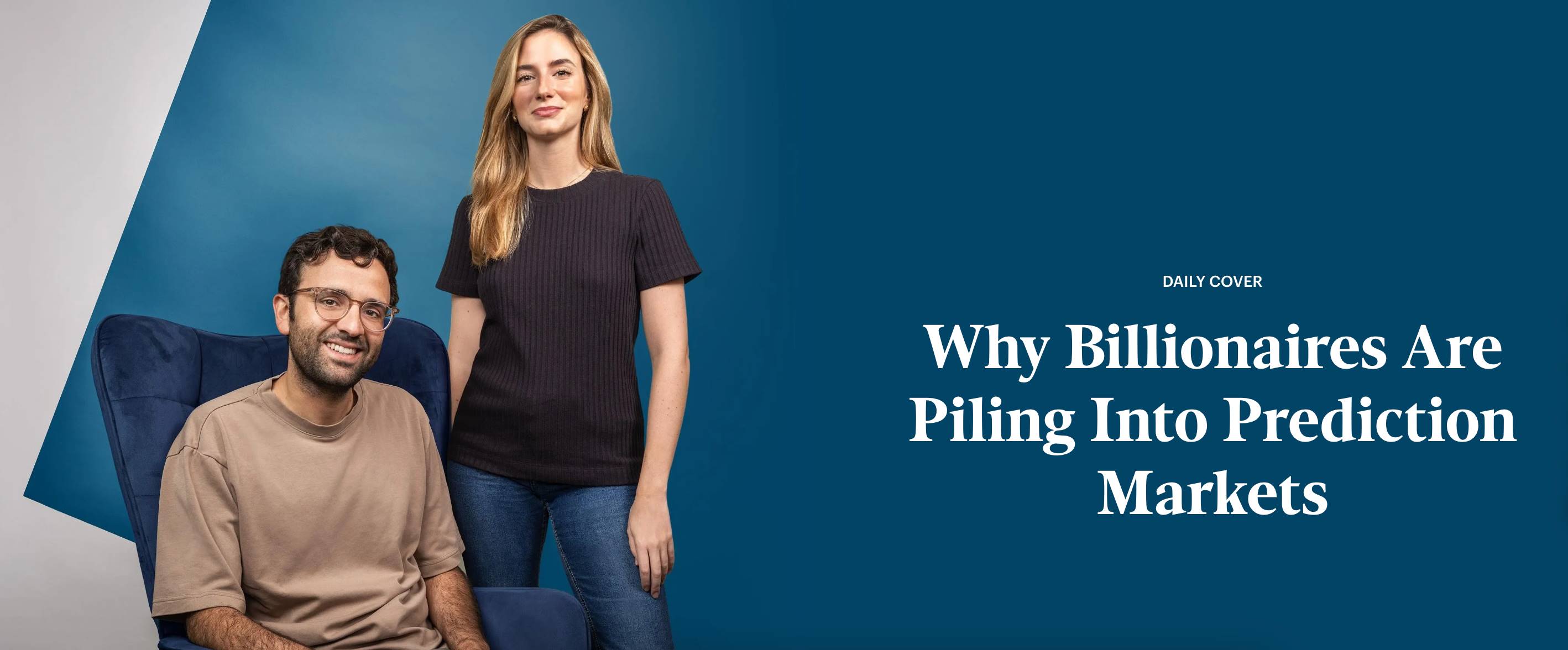
The shrewdest billionaire traders are betting on emerging prediction markets. Kalshi, with its ties to the Trump camp, has taken an early lead in what could be a trillion-dollar opportunity.
On a cold winter morning in 2023, discount brokerage billionaire Charles Schwab arrived at the SoHo offices of the little-known prediction market startup Kalshi.
Carrying several folders that appeared already stuffed full, the Wall Street legend spending time to deeply understand this small company stunned Kalshi’s two 27-year-old co-founders, Tarek Mansour and Luana Lopes Lara.
Two years earlier, Schwab and another Wall Street titan, Henry Kravis, had made angel investments in Mansour’s company, participating in a $30 million funding round that valued Kalshi at $120 million.
"Within minutes of my first call with Chuck, he said, 'I want to invest,'" said 29-year-old Mansour. "He said it reminded him of when he founded Charles Schwab—the first time in a long while he’d seen a company capable of fundamentally transforming financial markets."
Today, Kalshi is one of Chuck Schwab’s largest investments outside his namesake $176 billion brokerage firm. In June, the startup reached a $2 billion valuation during a funding round that attracted another Wall Street billionaire, Citadel Securities’ veteran CEO Peng Zhao.
Schwab, Kravis, and Zhao aren’t alone. Prediction markets are becoming a hotspot for the financial world’s smartest billionaires.
Thomas Peterffy, founder of Interactive Brokers (net worth $72 billion), told Forbes he attempted to acquire Kalshi after its 2021 angel round. Though rebuffed, Peterffy didn’t give up—his Interactive Brokers launched ForecastEx, a subsidiary competing with Kalshi, about a year ago, offering predictions ranging from New York City mayoral elections to Bitcoin’s price by the end of 2025.
In April 2024, Jeff Yass’s $65 billion quantitative hedge fund Susquehanna International Group partnered with Kalshi as one of its primary market makers, providing liquidity. More recently, Kalshi teamed up with Vlad Tenev’s $6.4 billion Robinhood to add event contract trading to its growing suite of retail investment products.
To avoid being outpaced by rivals, blockchain-based prediction market Polymarket has drawn investments from numerous billionaires, including Palantir co-founder Peter Thiel ($25.3 billion), Ethereum founder Vitalik Buterin, and Airbnb co-founder Joe Gebbia ($7.7 billion). According to Pitchbook, Polymarket reached a $1 billion valuation in August following a $135 million round led by Thiel’s Founders Fund. Coinbase founder Brian Armstrong ($13.7 billion) also announced in July plans to launch an “Everything Exchange,” offering prediction market services to his millions of customers.
Kalshi and Polymarket are both currently seeking new funding rounds that could value them at $5 billion and $9 billion respectively, according to The Information.
Betting on elections and sports isn’t new—it existed in the U.S. as early as the 19th century—and modern prediction markets, which allow users to bet on future outcomes by buying “yes” or “no” contracts, were first proposed at the University of Iowa in 1988.
Early prediction markets like Intrade and PredictIt went public in the 2010s but were limited by regulatory issues and lack of appeal. While not the first, Kalshi made history last October when a federal court ruling authorized it to offer presidential election contracts—something that had been illegal for over a century.
The presidential election changed everything: after gaining regulatory approval for election betting, Kalshi’s user base grew tenfold in less than a month, surpassing 2 million users and $1 billion in wagers by election eve. Polymarket users placed as much as $3.6 billion betting on Trump or Harris. The election momentum made prediction markets culturally relevant, unlocking endless betting opportunities—from next year’s Oscar nominees to whether Astronomer’s CEO will divorce after embracing someone on Coldplay’s giant concert screen.
If you ask billionaire traders why they’re entering the prediction market industry, you might get many noble answers:
"Throughout my career, I’ve always been troubled by how people don’t think probabilistically about the future," said Peterffy, whose $100 billion brokerage was originally founded in 1977 to make options trading more accessible. "To me, prediction markets are a way to teach the public how to think probabilistically about future outcomes."
Jeff Yass runs a hedge fund where mastering poker is almost a job requirement. He sent Forbes this message: "Prediction markets can allow parties to more efficiently share risk on a parametric basis.
For example, homeowners in Florida facing hurricane risks. Instead of buying annual insurance, they could purchase a 'yes' contract when a storm approaches, hedging against potential property damage based on the latest meteorological data predicting wind speeds in their town will exceed a threshold."
Tenev, writing on X about Robinhood’s March 2024 partnership with Kalshi, said: "At its most fundamental level, [prediction markets] represent capitalism applied to the pursuit of truth. Market incentives and collective wisdom sift through all available information to determine the answer to a specific question or the outcome of important events." A month earlier, Coinbase’s Armstrong told CNBC that prediction markets might one day replace The New York Times.
Mansour, an MIT-trained engineer who previously traded stock options at Goldman Sachs and Citadel Securities, put it bluntly:
"If you're a trader on Wall Street, prediction markets have long been your holy grail."
Speaking about an industry with infinitely tradable products: "We want to build the largest marketplace in the world."
Today, Kalshi in New York City employs 75 people—nearly double its pre-November 2024 election headcount—and offers around 2,000 active markets at any given time.
From a financial services perspective, it makes money the traditional way: charging commissions or fees on every contract bought or sold. Contract prices are tied to the market’s perceived probability of an event occurring, priced between one cent and 99 cents. For example, buying a 10-cent contract betting Peter Hegseth will be the first to leave Trump’s cabinet costs one cent—a 10% commission. Buying 100 “yes” contracts betting the U.S. government will shut down by 2026 earns Kalshi $1.75 under its variable fee formula, a 3.5% commission. Kalshi also charges a 2% fee on all debit card deposits and a flat $2 fee for withdrawals from your account.
But variable fees aren’t the only reason Kalshi attracts billionaire backers. Unlike interchangeable stocks—which can be traded and settled across any number of brokerages—contracts in prediction markets are proprietary, effectively creating a moat that locks users into the platform that created the market.
Kalshi currently processes around $1 billion in monthly trading volume and has handled $6.9 billion in total volume since inception, $6.4 billion of which came in October 2024. The startup draws speculators directly through its website and mobile app and also white-labels its markets to brokers like Robinhood and Webull, boosting liquidity and scale. Mansour says the company will add a dozen more brokers next year.
"We found prediction markets to be a great engagement tool," said JB Mackenzie, Robinhood’s futures lead. With 27 million customers, Robinhood aims to become the next-generation one-stop financial services company. "It helps cross-promote other businesses within our company."
Matt Huang, founding partner at crypto venture firm Paradigm, led Kalshi’s $185 million funding round in June. He believes low operating costs could help prediction markets gradually eat into other established markets. "Prediction markets are a superset of all other markets: you can reclassify sports betting, stock markets, and nearly any other market as a prediction market," Huang said. "In that sense, prediction markets could grow to be as big as—or even bigger than—the largest financial markets. I truly believe their potential is infinite." For Mansour, the size of the opportunity is "trillions of dollars."
If the prediction market boom gains further momentum, it will likely come from the Trump camp. Donald Trump Jr., the president’s eldest son, joined Kalshi in January as a strategic advisor. Eliezer Mishory, who served as Kalshi’s chief regulatory officer for four years, was appointed head of the Trump administration’s Department of Government Efficiency. Brian Quintenz, a Kalshi board member who served as a commissioner at the Commodity Futures Trading Commission (CFTC) during Trump’s first term, was named CFTC chair by Trump earlier this year.
In his application for Forbes’ 2022 “30 Under 30” list, Mansour listed Kalshi angel investor Emil Michael—Trump’s nominee for DoD Chief Technology Officer—as his sole professional reference. Meanwhile, Samantha Schwab, Charles Schwab’s granddaughter, had no prior professional experience beyond working in the Trump administration. According to her LinkedIn, she spent a year on Kalshi’s business development team before joining the U.S. Treasury in January as deputy chief of staff.
Despite Kalshi’s leadership position in prediction markets, the competition remains fierce.
At the end of August, Donald Trump Jr. invested in Kalshi’s rival Polymarket and joined its advisory board. Days later, Polymarket received approval from the U.S. Commodity Futures Trading Commission (CFTC) to operate in the U.S., putting it on par with Kalshi in terms of access to Wall Street. America’s largest sports betting platforms, FanDuel and DraftKings, are also developing their own prediction markets, while state regulators continue litigation over the legality of Kalshi’s sports contracts—its largest market to date. Stay tuned.
Join TechFlow official community to stay tuned
Telegram:https://t.me/TechFlowDaily
X (Twitter):https://x.com/TechFlowPost
X (Twitter) EN:https://x.com/BlockFlow_News
 Forbes


