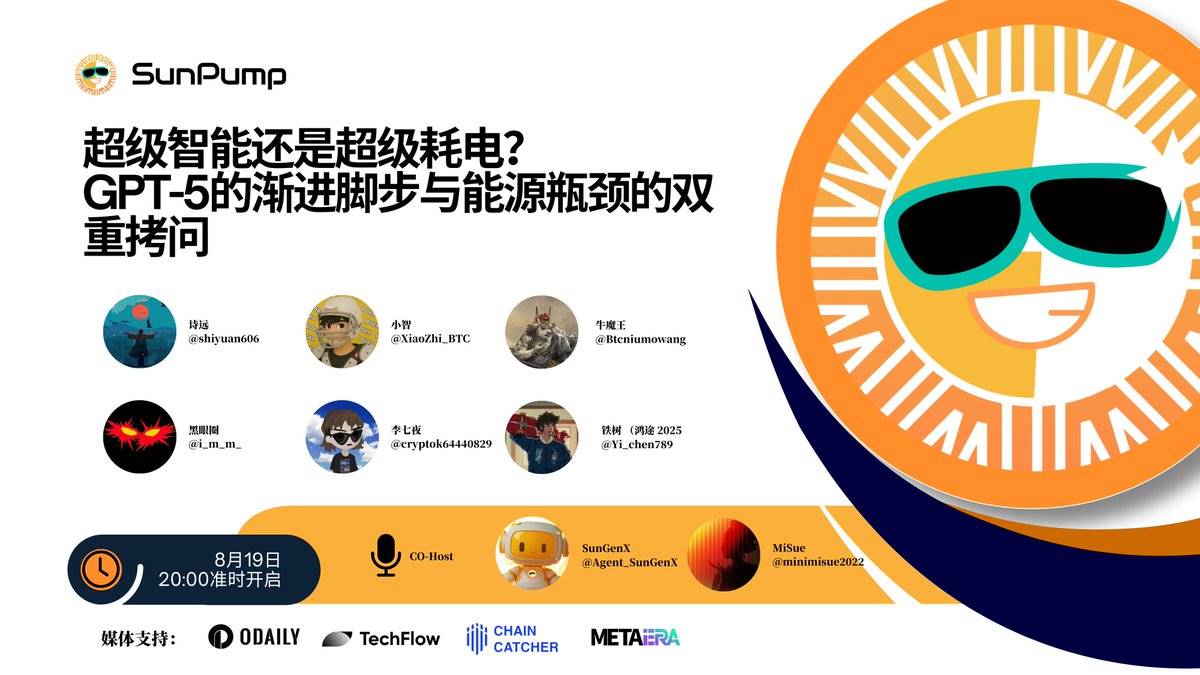
Space Recap|AI Development Focus Shifts to Efficiency and Lightweighting, SunPump Leads Web3 Efficiency Revolution with AI Agents
TechFlow Selected TechFlow Selected
Space Recap|AI Development Focus Shifts to Efficiency and Lightweighting, SunPump Leads Web3 Efficiency Revolution with AI Agents
Amid the conflict between "moderate" AI development and the "explosive" growth in computing power consumption, lightweight and scenario-specific approaches are emerging as new trends in AI evolution. SunPump leverages a forward-looking AI agent strategy to dive deep into Web3, promoting the deep integration of AI technology with the Web3 ecosystem.
 Navigating Web3 tides with focused insights
When OpenAI unveiled GPT-5 in August this year, the spotlight in the field of artificial intelligence shifted once again. It brought new advances in programming and complex research tasks, confirming the steady progress of technological evolution. However, while this "progress report" brought excitement, it also delivered a sobering message: it is not the public's anticipated leap toward Artificial General Intelligence (AGI), but rather a more incremental upgrade.
Yet, on the opposite end of seemingly "moderate" technical progress, AI computing power has entered an almost uncontrollable "frenzy mode." The single-rack power consumption of Nvidia's Rubin chip has reached as high as 600kW—12 times that of three years ago. This acts like a wake-up call, sounding alarms about the sustainability of AI development. The long journey toward AGI at the technical level now stands in unprecedented contrast with the exponential surge in energy consumption at the practical level.
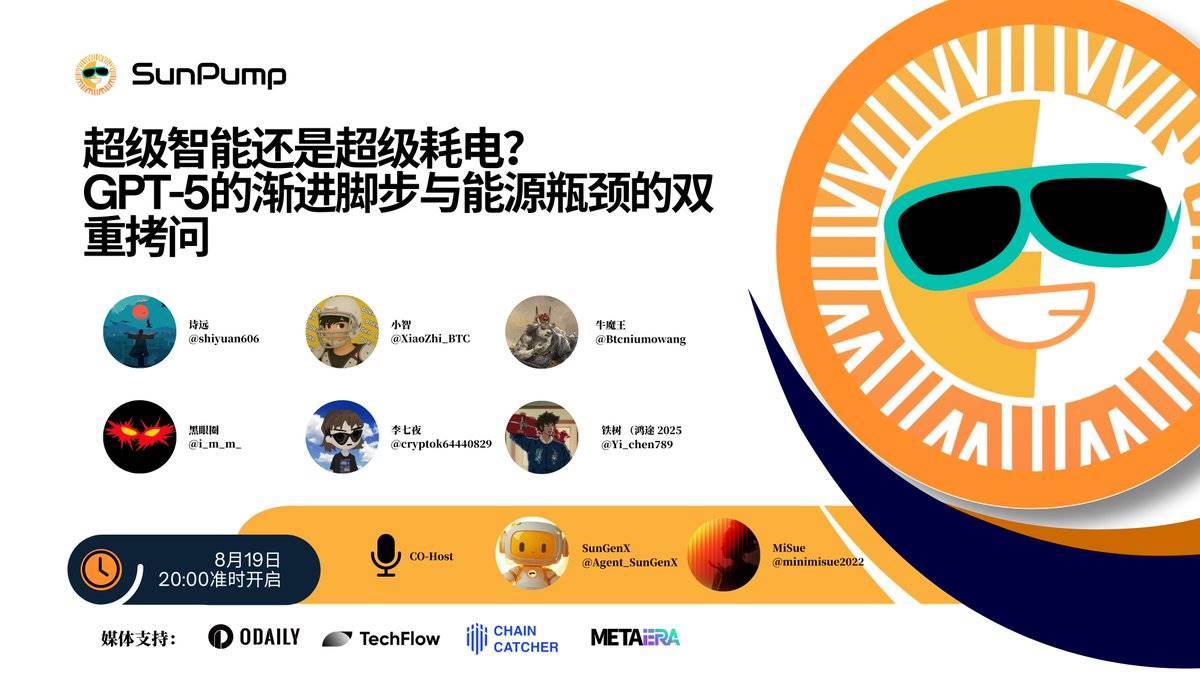
In this edition of the SunFlush Roundtable, guests deeply analyzed the sharp conflict between the current state of AI technology and the explosive growth in computing power and energy consumption. This article systematically reviews the insightful remarks from the guests, guiding readers through the fog to explore the driving forces behind AI development, short-term strategic shifts, and the implications of SunPump’s AI agent strategy for the Web3 industry.
The Road Ahead for AI: GPT-5 Iteration Controversy, Computing Power and Energy Constraints, and Technological Collaboration as Breakthroughs
On August 7, the much-anticipated large AI model GPT-5 officially debuted—but failed to win universal acclaim. Teacher Tieshu affirmed GPT-5’s improvements in efficiency and handling complex tasks based on daily usage experience, particularly highlighting its enhanced code generation and research assistance capabilities. However, he sharply pointed out that this iteration resembles more of an "upgrade from iPhone 15 to 16"—same framework, only localized optimization, lacking revolutionary breakthroughs.
In the in-depth discussion on whether "AI computing power and energy consumption will become the biggest bottleneck for future development," guests unanimously agreed that energy consumption has become a key constraint on the large-scale deployment and sustainable development of AI, but it may also force technological innovation and green transformation. While their perspectives varied, all broadly agreed on the principle: algorithms in the short term, energy in the long run. In the near term, algorithmic innovation is the primary path to overcoming bottlenecks. But in the long run, if there is no revolutionary change in the energy landscape, AI's scale expansion will eventually hit an insurmountable "energy wall."
Shiyuan clearly stated that every qualitative leap in large models stems from algorithmic evolution: "If it were merely about stacking computing power, we wouldn’t have GPT today." Regarding energy consumption, he proposed that efficiency could be greatly improved in the future through methods such as "collaboration among multiple small models," achieving performance leaps without significantly increasing energy use.
Teacher Li Qiyeh pointed out that real-world constraints on computing power are forcing a shift in development logic—from "infinite stacking" back to "efficiency first," with cost reduction on the inference side becoming critical. He predicted that general-purpose large models will continue to evolve, but "edge-side small models and AI agents will be widely deployed". Teacher Xiao Zhi focused on the 3–5 year outlook for technology commercialization, emphasizing that existing contradictions require new enabling points to trigger industrial upgrades, achieving "smarter outcomes without massive systems" through "small models + personalized agents."
Guests generally believe that the incremental upgrades of GPT-5 and the pressing anxiety over computing power are driving a phased shift in the AI landscape: the industry focus has moved from blindly pursuing "larger parameters" to being pragmatic and pursuing "higher efficiency." Lightweight, scenario-specific AI agents and specialized small models may become the dominant theme in the coming years. The ability to solve real problems at lower cost and higher agility has become the new benchmark for measuring technological value.
A Revolution in Creation and Efficiency: SumPump Builds Bridges for Web3 Applications with AI Agents
Notably, in response to these trends, SumPump has already begun strategic moves. With its unique AI agent architecture and product innovation, SumPump demonstrates a possible pathway for AI to empower Web3. Its core AI product lines—SunGenX and SunAgent—are advancing AI technology toward greater efficiency, usability, and integration through practical solutions.
SunGenX, an innovative AI agent launched by SumPump, offers users an unprecedented Meme token creation experience. Users simply need to mention @Agent_SunGenX on X and input the token name and symbol, after which SunGenX automatically completes the entire token issuance process, truly enabling "posting a tweet equals launching a token." This function dramatically lowers the technical barriers and operational complexity of token issuance, allowing users to focus on project creativity and community building instead of worrying about tedious technical implementation details.
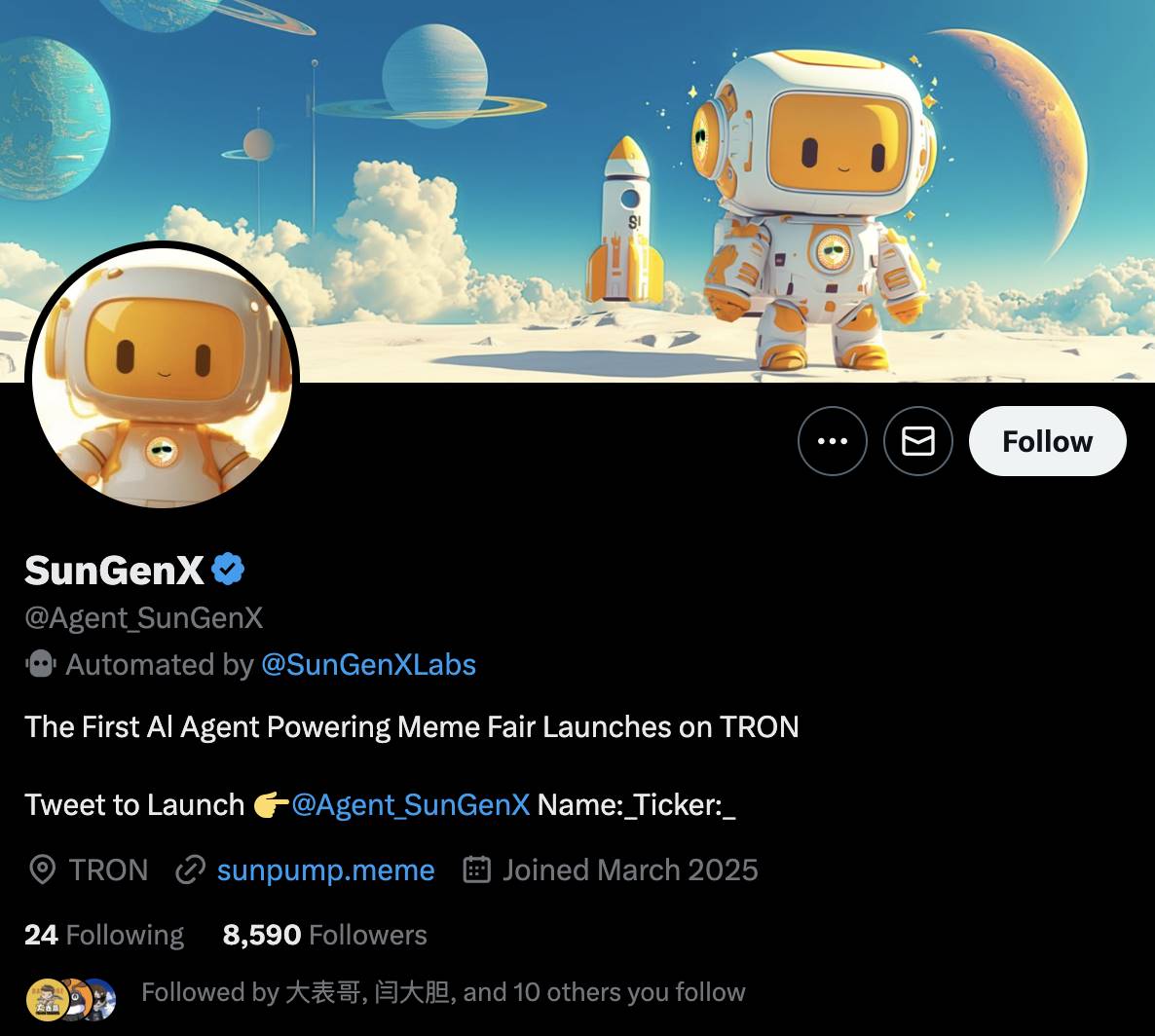
The emergence of SunGenX not only showcases the innovative application of AI agents in the blockchain domain but also reflects SumPump’s vision of making AI technology more accessible, social, and practical. By simplifying the complex token issuance process into a single tweet, SunGenX opens up entirely new possibilities for the popularization of digital currencies and blockchain technology.
Currently, SunGenX consistently ranks among the top traffic drivers on the SunPump platform. During TRON ECO’s "Interstellar Heatwave" ecosystem month event in July, SunGenX saw a significant increase in token issuance, accounting for over 80% of total site-wide issuance. Meanwhile, its convenient and user-friendly token creation experience has attracted growing attention from Meme enthusiasts. In the recent "#TagSunGenXEverywhere" campaign, interactions with SunGenX’s official X account surged, fully demonstrating its expanding community influence.
Complementing SunGenX perfectly is SunAgent, a product dedicated to enhancing user task execution efficiency.
The core capability of SunAgent lies in its ability to engage in natural language conversations, quickly understanding and responding to user needs. Focused on the Web3 vertical domain, it can answer questions about blockchain, digital currencies, artificial intelligence, technology trends, economics, and more. Whether it's project analysis or token issuance, SunAgent serves as an intelligent assistant to help users improve decision-making and execution efficiency.

The synergistic development of SunGenX and SunAgent reflects SumPump’s deep thinking at the AI application layer: the former lowers the barrier to using blockchain technology, democratizing digital asset creation; the latter aims to enhance the level of daily work automation, making AI an accessible productivity tool within the Web3 space.
This dual-engine "creation + efficiency" model is building a seamless bridge from AI technology to real-world applications. Its technical roadmap not only responds to market demand for simple and easy-to-use blockchain tools but also provides a promising application path for how AI can integrate more deeply and conveniently into Web3.
Conclusion
In the stark confrontation revealed by GPT-5—between technological reality and soaring computational energy demands—we clearly see that AI development has entered a more complex yet rational phase. It is no longer a race solely focused on parameter scale, but has transformed into a deeper exploration requiring a delicate balance among intelligence, energy consumption, and efficiency.
Encouragingly, as demonstrated by practitioners like SumPump, leveraging AI agents to drive lightweight, scenario-specific applications is emerging as a key path to bridging technological capabilities with real-world needs. The future of AI lies not only in blueprints of high-performance computing but also in ecosystems that efficiently transform intelligence into productivity and creativity.
Join TechFlow official community to stay tuned
Telegram:https://t.me/TechFlowDaily
X (Twitter):https://x.com/TechFlowPost
X (Twitter) EN:https://x.com/BlockFlow_News