From Leading to Following: Why Can't SOL Resist ETH's Offensive?
TechFlow Selected TechFlow Selected
From Leading to Following: Why Can't SOL Resist ETH's Offensive?
The real reason SOL lags behind ETH: treasury strategy, ETFs, and narrative gap.
 Navigating Web3 tides with focused insights
Author: kkk
On August 13, ETH surged past $4,700, marking a four-year high, while SOL during the same period appeared lackluster, lingering around $200. In 2024, Pump.fun ignited a full-chain Meme frenzy on Solana; early in the year, Trump even launched $TRUMP on it, pushing SOL's price near $300 and fueling widespread talk of "Solana replacing ETH."
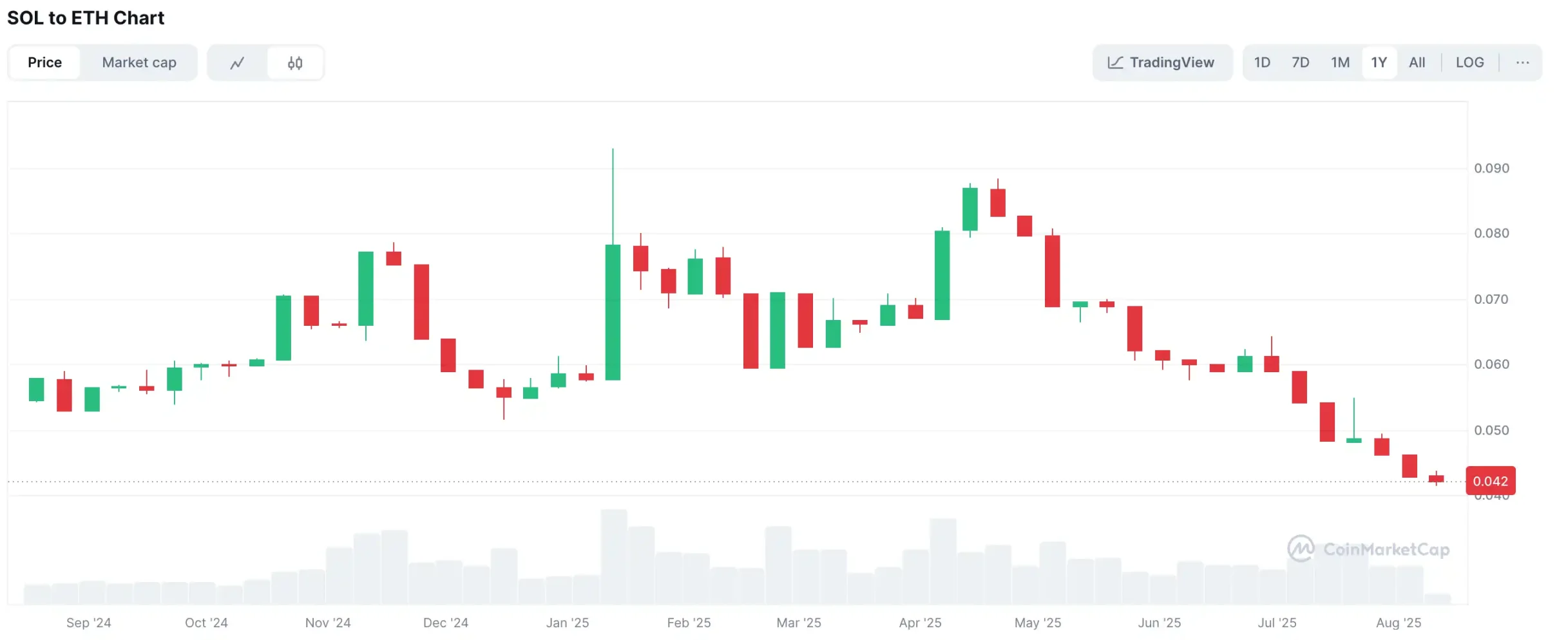
However, market reality delivered a sobering response. Despite both ETH and SOL advancing treasury strategies to accumulate "ammunition" for their ecosystems, their performances sharply diverged—SOL/ETH exchange rate fell from 0.09 at the start of the year to 0.042, reflecting a weak trend throughout the year. The underlying reasons may not just be price volatility, but a combination of differences in narrative热度, ecosystem structure, and capital expectations.
Treasury Strategy: A Dual Gap in Leadership and Capital Scale
On June 30, Tom Lee, Wall Street’s "contrarian bull," joined BitMine as chairman, when ETH was still hovering around $2,500. Just one and a half months later, ETH skyrocketed to $4,700, an 88% gain. Lee has long appeared on top-tier financial programs like CNBC and Bloomberg. Back in 2022, during the U.S. stock market crash, his accurate "bottom-fishing" commentary reversed bearish sentiment. Now, this influencer with massive visibility has become the ideal ambassador for ETH’s treasury strategy. Meanwhile, ARK Invest led by "Cathie Wood" invested $182 million in BMNR stock, further boosting confidence in the ETH camp.
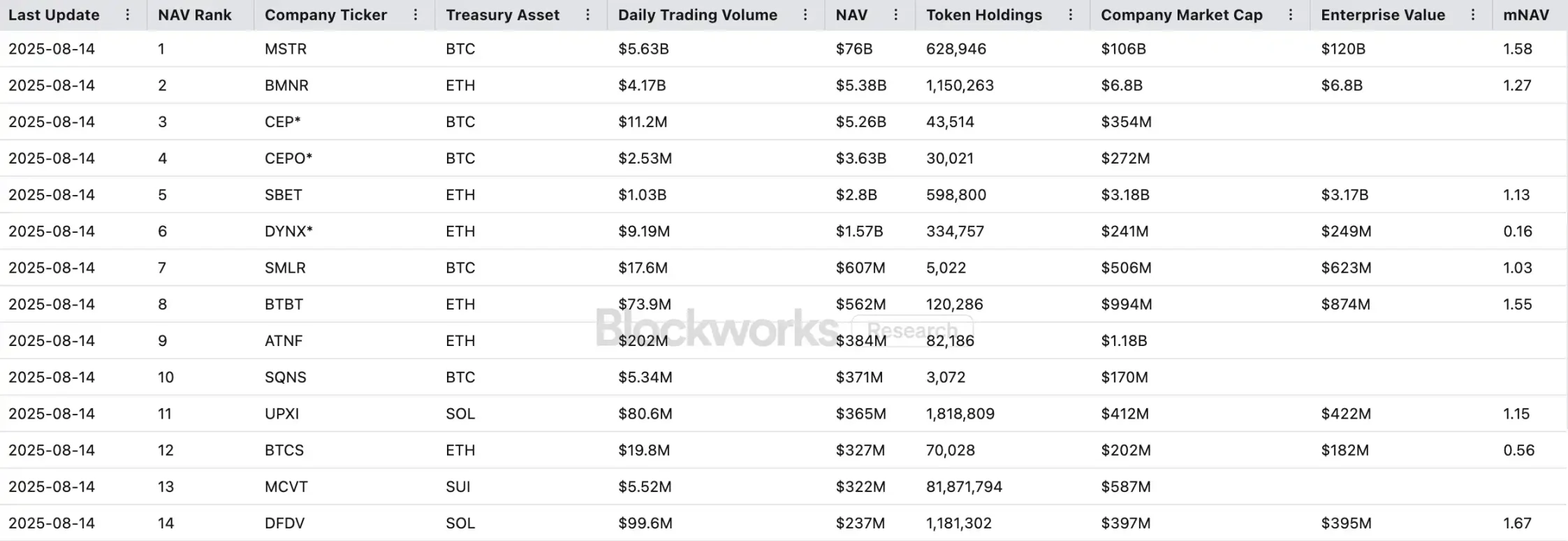
Moreover, although both ETH and SOL have treasury strategy companies within their respective camps, their scales differ greatly. In terms of holdings, BTC and ETH treasury strategy firms dominate the top ten. "ETH MicroStrategy" leader BitMine Immersion (BMNR) recently plans to raise its funding target to $200 billion to buy more ETH, and currently holds a NAV (net asset value) of $5.3 billion, second only to MSTR. This level of capital means greater firepower during market volatility and stronger ability to shape market trends. In contrast, the current leader of the "SOL MicroStrategy" model has a NAV of only $365 million, ranking 11th—over ten times smaller than BMNR. Without a globally influential spokesperson like Tom Lee or capital firepower of comparable scale, SOL naturally appears underpowered in this rally.
However, recent moves by Solona are gradually closing this gap. On August 12, Upexi, the "SOL MicroStrategy" firm, established a new advisory committee and appointed Arthur Hayes as its first member. Hayes is co-founder of BitMEX, pioneer of perpetual contracts, formerly a trader at Deutsche Bank and Citigroup, and now heads the digital asset investment fund Maelstrom. With deep roots in traditional finance and profound understanding of crypto market structures, he can provide实战-level guidance on institutional fundraising and digital asset strategy.

Upexi’s strategic goal is clear: leverage Solona’s scalability and efficiency to expand its SOL footprint. According to public filings, the company currently holds over 1.8 million SOL (worth approximately $365 million), and stakes part of its holdings to earn 7%–9% returns, ensuring long-term ownership while generating stable cash flow. Notably, the company acquires locked SOL at a discount, creating additional shareholder returns. Upexi plans to recruit more members for its advisory committee, bringing expertise in cryptocurrency and finance.
Meanwhile, other public companies are also increasing SOL holdings—for example, DFDV expanded its SOL position to over 1 million tokens; BTCM disclosed a purchase of about 27,190 SOL and plans to convert some of its crypto assets into Solana. This institutional demand could reduce circulating supply in the secondary market, offering support on the supply-demand front.
ETH ETF Leads, SOL ETF Awaits Breakthrough
ETH spot ETFs have surpassed $22 billion in AUM, validating strong institutional recognition and quickly establishing ETH’s absolute advantage in liquidity and market depth. Amid continuous institutional inflows, BlackRock filed last month for ETH ETF staking approval. If cleared, it would offer stable staking yields to holders and attract more long-term capital.
In contrast, despite REX-Osprey launching a staking-enabled Solana ETF (SSK) in July, market enthusiasm has remained low, with zero net inflows on most trading days and cumulative inflows of only about $150 million since launch. Moreover, it is not a standard SEC-registered spot ETF, but indirectly holds SOL through alternative vehicles. This structure combines staking mechanisms with offshore ETF setups, increasing complexity and keeping some institutions cautious. Issuer REX also lacks the brand power and distribution reach of Wall Street giants like BlackRock and Fidelity, and has no backing from heavyweight institutions.
Market focus is now shifting to expected approvals in October for SOL spot ETF applications from VanEck and Grayscale. Once regulatory clearance is granted, combined with treasury-driven capital momentum, if institutional investors begin diversifying from BTC and ETH into other quality assets, SOL ETFs could become a new growth catalyst for the Solona ecosystem.
Diverging Application Narratives
From an application narrative perspective, ETH and Solana are currently traveling down two entirely different paths.
Ethereum is steadily building a compliant, sustainable on-chain financial infrastructure. The stablecoin boom has been described by Tom Lee as crypto’s "ChatGPT moment." Currently, global stablecoin market cap exceeds $250 billion, with over half of issuance and about 30% of gas fees occurring on Ethereum. This further solidifies ETH’s central role in payment and settlement systems and provides steady cash flow for staking, DeFi yields, and on-chain infrastructure.
Additionally, Robinhood issuing tokenized stocks on Ethereum Layer2, and Coinbase aggressively expanding the Base chain ecosystem, have brought more use cases to ETH. Today, Ethereum has almost become the only mainnet capable of meeting regulatory adaptability, ecosystem maturity, and economies of scale simultaneously. Should ETH secure key roles in stablecoin payments and RWA settlements, its strategic position will be prioritized by financial institutions akin to a "structural call option."
Solana, on the other hand, continues to center its main narrative around high-volatility areas like meme coins and Launchpad battles—topics often revisited without substantial evolution. Although it made multiple attempts this year to enter the RWA space under the slogan "Internet Capital Market," supporting tokens like $IBRL and the Believe ecosystem, all efforts ended in failure. However, a turning point emerged recently. On August 8, CMB International—the investment arm of China Merchants Bank—partnered with Singapore-based DigiFT and Solana blockchain service provider OnChain to tokenize a USD money market fund recognized in both Hong Kong and Singapore, launching it on-chain as CMBMINT. This set a benchmark for cross-border, compliant RWA collaboration. On that day, SOL broke above $200, and the market immediately viewed this as a potential new narrative starting point, hoping this new use case could open broader institutional funding channels for Solana.
Conclusion
Currently, while Solana still lags behind ETH in key metrics such as market热度 and exchange rate performance, its underlying competitiveness and potential remain intact. As the "American chain," it inherently enjoys higher regulatory compatibility and capital recognition. At present, ETH has gained institutional favor first through treasury strategies, ETF momentum, and applications in RWA and stablecoins—but this also leaves room for SOL to catch up and shift its narrative.
Structurally, anticipated approval of spot ETFs could open a new institutional funding gateway for SOL. Once products from giants like VanEck and Grayscale are approved, market liquidity and trading depth could leap forward. Furthermore, cross-border RWA implementation proves Solana’s high-performance public chain capabilities extend beyond memes and Launchpads. Its penetration in DeFi, payments, and asset tokenization still holds significant room for growth. The current pullback appears more like a蓄力 phase rather than an ending.
Join TechFlow official community to stay tuned
Telegram:https://t.me/TechFlowDaily
X (Twitter):https://x.com/TechFlowPost
X (Twitter) EN:https://x.com/BlockFlow_News
 BlockBeats