The Outlaw's Landing
TechFlow Selected TechFlow Selected
The Outlaw's Landing
If Tether can demonstrate to the industry that it can comply with regulations without sacrificing profit margins, it will solidify its position as an indispensable leader in the stablecoin sector.
 Navigating Web3 tides with focused insights
Written by: Prathik Desai
Translated by: Block unicorn
On Friday, July 18, in the United States, the CEOs of the world's two largest stablecoin issuers—Tether’s Paolo Ardoino and Circle’s Jeremy Allaire—sat side by side in the audience at the White House East Hall. Before them, U.S. President Donald Trump had just signed the GENIUS Act, marking America's first federal regulatory framework for stablecoins.
A few years ago, this moment would have been unimaginable.
Because once upon a time, Tether was crypto’s “problem child.” Traders loved it, regulators loathed it, and investigations followed it like shadows. It paid fines, avoided audits, and rarely engaged with U.S. regulators. But on this July afternoon, its CEO received public recognition from the President of the United States.
This is a signal that this “outlaw” stablecoin is preparing to become a lawful citizen.
The GENIUS Act represents the long-awaited U.S. attempt to regulate stablecoins. The law requires issuers to maintain full reserves, conduct monthly audits, provide redemption guarantees, and establishes a licensing regime called "Permitted Payment Stablecoin Issuer" (PPSI). To qualify, issuers must hold highly liquid reserves primarily composed of U.S. Treasuries, undergo attestation by qualified accounting firms regularly, and be subject to U.S. anti-money laundering (AML) and compliance oversight.
Foreign issuers like Tether can participate as long as they meet equivalent standards and accept supervision from the U.S. Office of the Comptroller of the Currency (OCC). The law provides a lenient but limited three-year transition period to meet these requirements. This transitional window is crucial—it gives Tether time to adjust its structure, reserves, and bring its flagship product USDT into alignment alongside a new U.S.-compliant token.
For El Salvador-based Tether, this public commitment marks a significant shift. After years of evading regulation and operating in offshore jurisdictions, the company is finally stepping into the most scrutinized market in the world—not out of desperation, but in pursuit of dominance.
Despite being locked out of the heavily regulated U.S. market, Tether has consistently outperformed globally. Its token USDT dominates trading pairs, is used for real-world payments in emerging markets, and circulates across more than 12 blockchains with unmatched liquidity. With over $160 billion in circulation and $13 billion in net profit last year alone, USDT is not only the largest stablecoin but also one of the most profitable financial institutions globally.
This is precisely why Tether’s entry into the U.S. matters.
Paolo Ardoino has made it clear: Tether will comply. It plans to restructure its reserves, seek audits from one of the Big Four accounting firms, and work with the OCC to become a licensed foreign issuer under the new law. At the same time, Tether will launch a second, U.S.-only version of USDT, designed specifically for efficiency-focused institutions. This strategy aims to dominate both ends of the market: global crypto liquidity and the regulated institutional track within the world’s largest economy.
This new chapter in American finance focuses on big money—fund issuers, banks, fintech companies, and hedge funds. For Tether, entering this market isn’t about survival; it’s about determining who will lead the next wave of global finance.
If Tether can prove to the industry that it can follow rules without sacrificing profitability, it will solidify its position as an indispensable leader in the stablecoin space.
Yet, the cost of compliance remains the elephant in the room.
Monthly audits conducted by major firms could cost tens of millions annually. AML systems require dedicated staff and technology. Reporting obligations under U.S. law will expose the company to greater scrutiny—and potentially future political risks. There’s also opportunity cost: higher-yielding but riskier instruments may need to be removed from reserves to meet liquidity and transparency requirements. But given its scale and profits, Tether has the capacity to absorb these costs.
For Tether, transformation brings cultural and operational challenges. The company has long positioned itself as an anti-establishment alternative, especially in markets with high distrust toward traditional institutions. Committing to U.S. regulation risks alienating this user base. In the past, Tether faced criticism for freezing funds. Will users in Nigeria or Argentina trust a Tether that now responds to U.S. subpoenas? And if so, what replaces the sense of freedom USDT once offered?
Besides, compliance may not eliminate criticism.
Transparency advocates and financial regulators still question Tether’s historical record. Its past refusal to provide full audits, opaque ownership structure, and alleged involvement in shadow banking remain concerns. Regulatory compliance might reassure institutions, but it won’t immediately rebuild trust among skeptical segments of the public.
Meanwhile, Tether risks ceding more market share to its closest competitor, Circle.
As of July 25, Tether’s dominance in the stablecoin sector has dropped to 61.76%, down eight percentage points from 69.69% in November 2024. Over the same period, Circle’s market share increased by four percentage points to 24.44%.
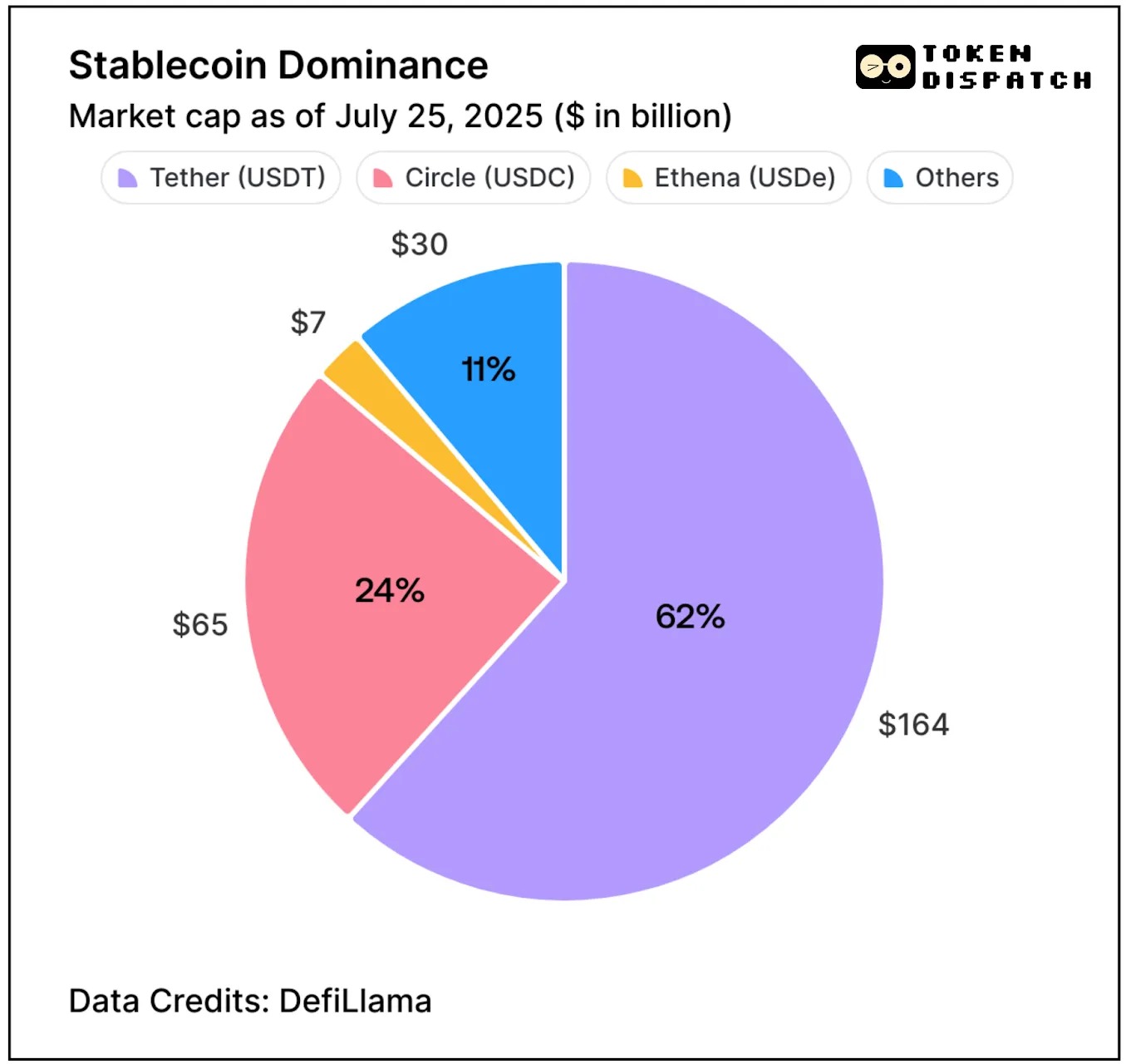
The U.S.-based USDC issuer already holds a compliance advantage. It has long undergone audits and maintains full regulatory coverage across 48 U.S. states, recently making headlines with a Wall Street debut. CEO Jeremy Allaire sees the GENIUS Act as a green light, noting it effectively formalizes the model Circle has followed for years. Despite recent gains in market share, the company still has a long way to go, especially after its recent Wall Street entrance.
In 2024, Tether reported $13 billion in profit. By year-end, it held $113 billion in U.S. Treasuries, $7 billion in reserve buffers, and over $20 billion in equity. As of March 31, 2025, Tether held $98 billion in U.S. Treasuries. At a conservative 4.4% yield, its annual income exceeds $4 billion. Even if compliance cuts yields by 10–15%, its business model remains viable.
Compliance could also unlock future revenue. A compliant Tether is a trustworthy Tether—which could attract more business. For institutions that have stayed on the sidelines, this might be all the incentive they need.
For years, USDC held the trust advantage—transparent, regulated, audited. Yet its market cap growth has stagnated. Meanwhile, Tether thrived in the shadows—growing faster, expanding into more regions, becoming essential in markets where U.S. firms are unwilling to tread.
White House Support
With political backing from Commerce Secretary Howard Lutnick (former Cantor Fitzgerald, now manager of Tether’s reserves), Tether has protection in Washington.
Additionally, there are ties to Bitcoin reserve companies. Lutnick’s son runs Cantor Equity Partners (CEP), a special purpose acquisition company that merged with Twenty One Capital—an entity backed by Tether, SoftBank, and Cantor, focused on Bitcoin-native ventures. This deal further entwines Tether’s interests with U.S. capital markets and policy circles.
With a law granting Tether a three-year transition period, it has sufficient time. Backed by its global transaction volume advantage, it clearly holds leverage.
The U.S. market landscape hinges on scale. If Tether can manage cost-effectively, it may solidify its leading position—one even Circle would struggle to match, let alone other lagging stablecoin issuers or new entrants.
But it’s a double-edged sword. The U.S. has just provided a blueprint for stablecoins. If Tether executes well, it will stay ahead. But if it falters on compliance, disclosure, or regulation, it may find legitimacy revoked as quickly as it was granted.
Throughout cryptocurrency history, Tether has been the stablecoin most users rely on—even when they don’t trust it.
Now, it asks to become the one they do trust.
Join TechFlow official community to stay tuned
Telegram:https://t.me/TechFlowDaily
X (Twitter):https://x.com/TechFlowPost
X (Twitter) EN:https://x.com/BlockFlow_News