








Why is the Trump family project WLFI partnering with Kernel DAO?
TechFlow Selected TechFlow Selected
Why is the Trump family project WLFI partnering with Kernel DAO?
According to community voting, the WLFI tradable proposal has over 99.9% support, while KERNEL has surged more than 30%. What is the connection between these two projects?
 Navigating Web3 tides with focused insights
Author: Nicky, ForesightNews
On July 10, the official page of World Liberty Financial (WLFI), the Trump family's cryptocurrency project, showed that the community vote on its token transferability proposal had entered the final stage—with a support rate of 99.93% and only 0.07% opposition. The voting will conclude on July 17. If approved, WLFI will officially activate "transferability."
On May 28 this year, WLFI announced integration between its USD1 stablecoin and Kernel DAO, making it a restakable asset. At the heart of this collaboration is upgrading stablecoins from traditional "static lending tools" to "dynamic infrastructure supporters." For WLFI, this means its stablecoin can provide economic security for third-party applications; for Kernel DAO, it represents a critical opportunity to validate the feasibility of its restaking model.
Following this news, KERNEL surged over 23% on that day before falling from $0.206 to $0.999 by June 22. As of this writing, today’s price of KERNEL has pulled back from a post-surge high of $0.146 to around $0.115, highlighting the need to remain cautious about investment risks.
WLFI×Kernel DAO: The "Third-Party Security Empowerment" Experiment with USD1
Previously, WLFI's USD1 stablecoin primarily served as a medium of exchange within its ecosystem. According to WLFI's official description, the integration with Kernel DAO now allows users to stake USD1 into the Kernel network, turning it into a "restakable asset." These staked assets not only provide economic security for applications within the Kernel ecosystem but also earn Kernel Points as rewards.
The essence of this mechanism is transforming stablecoins from "idle assets sitting in funding pools" into "energy units supporting decentralized infrastructure." In traditional lending models, stablecoin yields come mainly from borrowing demand (annual yields of approximately 2%–4%), with funds locked and limited in use. Through Kernel DAO, however, the yield sources for USD1 expand to include supporting rollup sequencers, decentralized oracles, data availability networks, and other types of infrastructure. Since these infrastructures require stable financial backing, USD1 holders effectively become "distributed security nodes," earning dynamically adjusted returns based on demand.
For users, the appeal of restaking lies in "upgraded yields" and "expanded functionality." Restaked USD1 maintains high liquidity—users can deposit it into stablecoin pools on platforms like Curve to earn additional yields, or use it as collateral for lending and structured products. This means USD1's "operational mode" has evolved from "single-tasking" to "multi-task coordination," supporting network operations while generating staking rewards for users.
Kernel DAO: Infrastructure Provider for Cross-Chain Restaking
To understand why WLFI chose to partner with Kernel DAO, one must first grasp what Kernel DAO is.
Kernel DAO is a DeFi protocol focused on restaking technology, aiming to unlock the utility of existing assets through the "restaking" model. "Restaking" refers to users re-deploying already-staked assets—such as stablecoins—into decentralized networks to simultaneously support multiple protocols or infrastructures, thereby overcoming the limitations of traditional staking, where assets are locked and generate only single-source returns.
Kernel DAO operates across multiple blockchains, with core products including:
- Kernel: A cross-chain restaking protocol running on BNB Chain that enables users to stake assets such as BNB and BUSD, which are then algorithmically allocated to different Decentralized Validator Networks (DVNs), providing security for infrastructure like rollup sequencers, oracles, and data availability layers;
- Kelp: A liquid restaking protocol on Ethereum focused on unlocking liquidity for staked assets in the Ethereum ecosystem, allowing users to earn extra yields by restaking LP (liquidity provider) tokens;
- Gain: An RWA tokenized yield protocol that converts real-world assets such as real estate and corporate bonds into on-chain yields through compliant mechanisms, bridging DeFi with the traditional economy.
All three products are governed by the KERNEL token, with early supporters and ecosystem contributors eligible for incentives via staking or participation. Currently, the KERNEL token is listed on major exchanges including Binance, Coinbase, Upbit (BTC/USDT pairs), and Bithumb (KRW pairs).
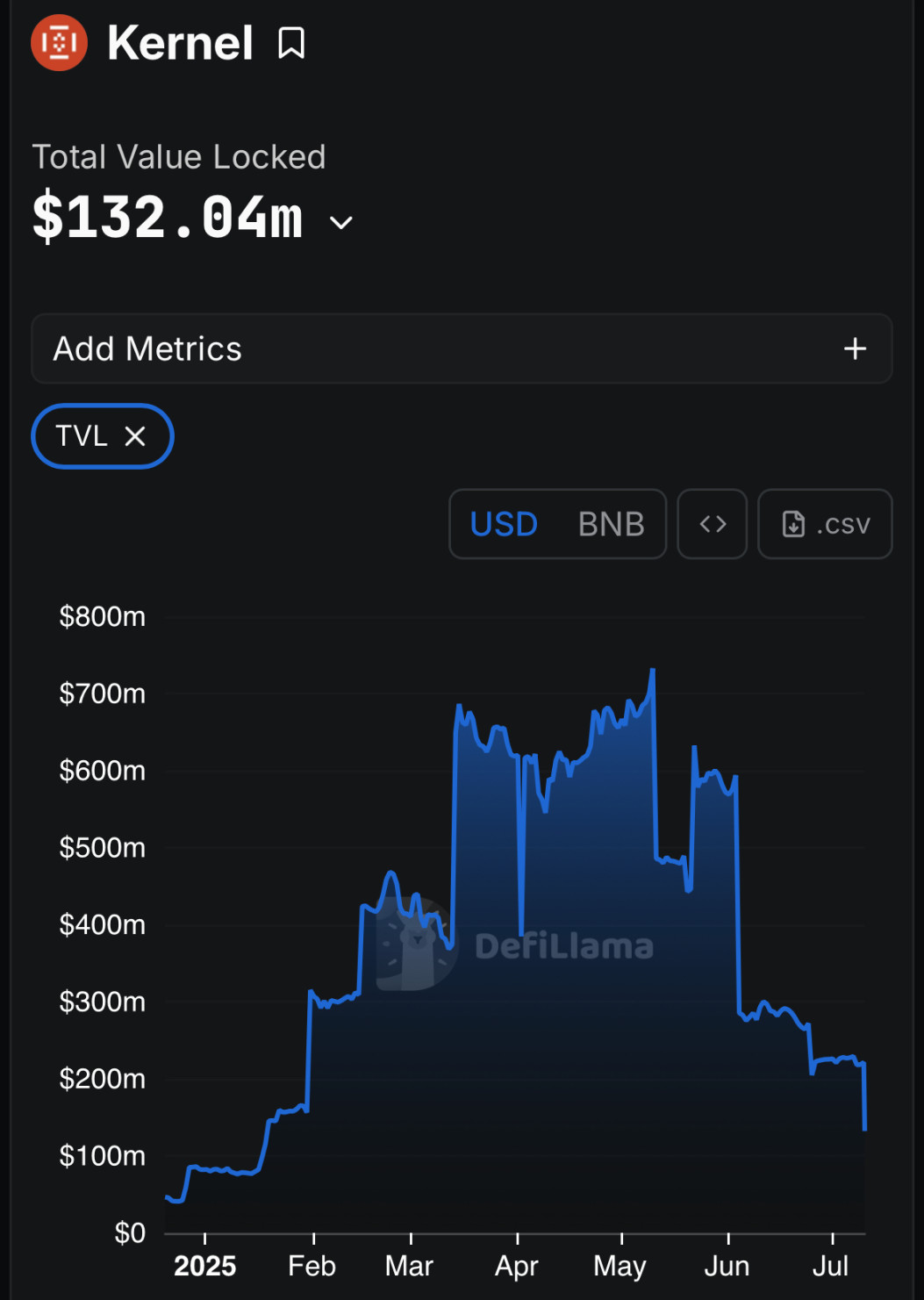
According to DefiLlama data, as of July 10, 2025, Kernel DAO’s total value locked (TVL) reached $1.47 billion, with Kernel accounting for approximately $132 million in TVL.
Status and Potential: The “Early-Stage” Traits Behind $6,370
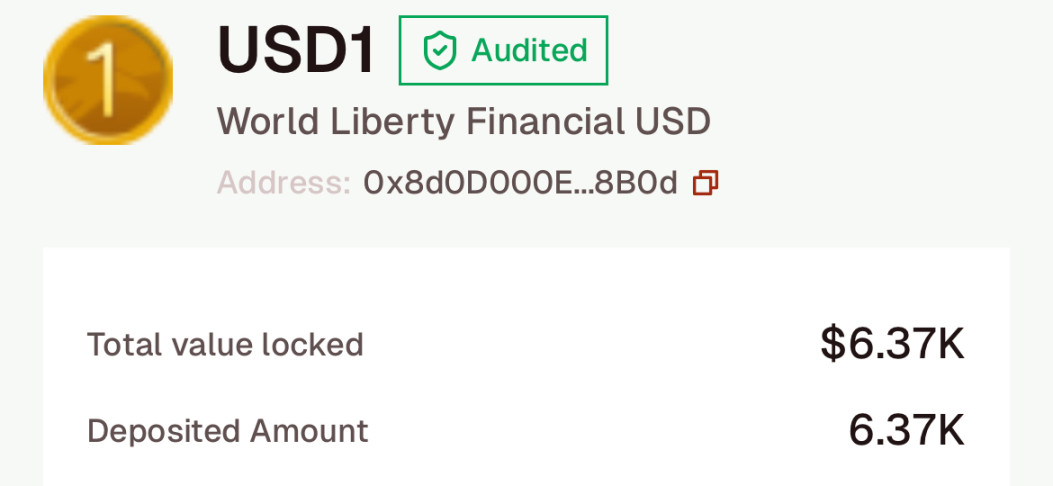
Although the WLFI and Kernel DAO partnership is seen as an experiment in "stablecoin restaking," current figures remain modest. According to Kernel’s official website, as of today, the total amount of USD1 restaked on Kernel is just $6,370. Against Kernel DAO’s total TVL of $1.47 billion and Kernel’s own TVL of $132 million, this figure is negligible.
However, a small base also implies significant growth potential. From an industry trend perspective, the restaking model for stablecoins is gaining traction: the low yields of traditional lending (~3% APY) contrast sharply with higher restaking returns (~5% APY, exceeding 10% when combined with liquidity strategies). More users are beginning to pay attention to this new paradigm of enabling stablecoins to support infrastructure.
If WLFI’s community vote passes smoothly, the "restaking gateway" for USD1 will be further opened, encouraging more users to shift from passive holding to active participation. In the future, WLFI itself may join the restaking ecosystem, injecting incremental capital into Kernel DAO.
Conclusion: The "Second Curve" Experiment for Stablecoins
The collaboration between WLFI and Kernel DAO is not merely a functional upgrade for a single stablecoin—it represents a re-empowerment of stablecoin value, redefining their value dimensions. Traditional stablecoins are valued solely as "media of exchange" or "stores of value," whereas the restaking model transforms them into "co-builders of infrastructure"—potentially marking the "second curve" for stablecoins.
For investors, the Kernel DAO story has only just begun: the $6,370 restaking volume is a starting point, not the end. With momentum from WLFI, its growth potential warrants close attention. Of course, risks remain—restaking depends heavily on infrastructure stability. Should validator nodes fail or smart contracts contain vulnerabilities, both yields and even principal safety could be compromised.
Join TechFlow official community to stay tuned
Telegram:https://t.me/TechFlowDaily
X (Twitter):https://x.com/TechFlowPost
X (Twitter) EN:https://x.com/BlockFlow_News
 Foresight News






