








The trend of public companies buying cryptocurrencies has now reached AI meme coins
TechFlow Selected TechFlow Selected
The trend of public companies buying cryptocurrencies has now reached AI meme coins
For listed companies, allocating funds to meme coins resembles a high-risk, high-reward gamble.
 Navigating Web3 tides with focused insights
By TechFlow

Doubt MicroStrategy, understand MicroStrategy, become MicroStrategy.
Since 2020, when MicroStrategy became the first to add Bitcoin (BTC) to its corporate treasury, an increasing number of U.S.-listed companies—and enterprises worldwide—have followed suit. Holding crypto assets has evolved into a visible trend of "tokenization" in the stock market.
By 2025, the number of companies holding digital assets has surged from just a few to dozens.
However, this corporate treasury movement has now split into multiple distinct trends:
Bitcoin remains the safest choice due to its strongest consensus; Ethereum (ETH) and Solana (SOL), backed by broad recognition as foundational platforms, have also attracted many followers;
Now, this wave of corporate crypto buying has even reached smaller-cap altcoins—such as AI-focused tokens like Fetch.ai’s $FET and Bittensor’s $TAO.
Looking back, ETH dropped about 26.7% in a single day in June 2022, while SOL fell 43% in November 2022 following FTX's collapse. The fragility of AI tokens is even more apparent—for instance, the launch of DeepSeek’s open-source AI model triggered a broad pullback among on-chain AI Agent tokens. Larger-cap AI tokens like FET and TAO still exhibit high volatility, with 30-day volatilities of approximately 15% and 18%, respectively.
Is it viable for public companies to allocate capital into these highly volatile altcoins?
Who Is Investing in AI Coins?
To answer this question, let’s examine which companies are already investing in these AI tokens, along with their strategic rationale and associated risks.
-
Interactive Strength (TRNR): Buying FET for a Fitness + AI Leap
Interactive Strength is a Nasdaq-listed company primarily selling professional fitness equipment and related digital fitness services, operating under the CLMBR and FORME brands.
In simple terms, it sells hardware such as fitness mirrors and climbing machines, paired with digital platforms offering workout programs.

Latest data shows the company has a market cap of around $8.4 million.
On June 11, the company announced plans to invest $500 million in purchasing $FET tokens as part of its crypto treasury strategy, aiming to use these tokens to support AI-powered fitness products.
CEO Ward stated that choosing FET over more widely held assets like Bitcoin reflects the company’s plan to integrate Fetch.ai’s technology into its product offerings.
So far, Interactive Strength has secured $55 million in initial funding from ATW Partners and DWF Labs.
This capital comes from a "share purchase agreement," meaning the company issued shares to these investors in exchange for cash. The acquired FET tokens will be custodied by BitGo, a professional custodian. Additionally, the tokens will be purchased directly from the open market rather than via OTC (over-the-counter) deals.
Why would ATW Partners—a major private equity firm—and DWF Labs, a seasoned crypto market maker, commit funds?
The answer may lie in aligned interests.
ATW sees potential in TRNR’s fitness-plus-AI narrative, while DWF Labs itself has a vested interest in providing liquidity for $FET.
DWF Labs received 10 million FET from Fetch.ai in September 2024 and has since deposited them onto exchanges to provide market making.
With $500 million potentially deployed, the company could buy approximately 6.41 million FET tokens (at $0.78 per token), which could positively impact the token price in the short term if executed in the open market.
The market responded favorably upon announcement.
On June 11, TRNR’s stock rose 15%, while $FET gained 7%, though both have since pulled back.
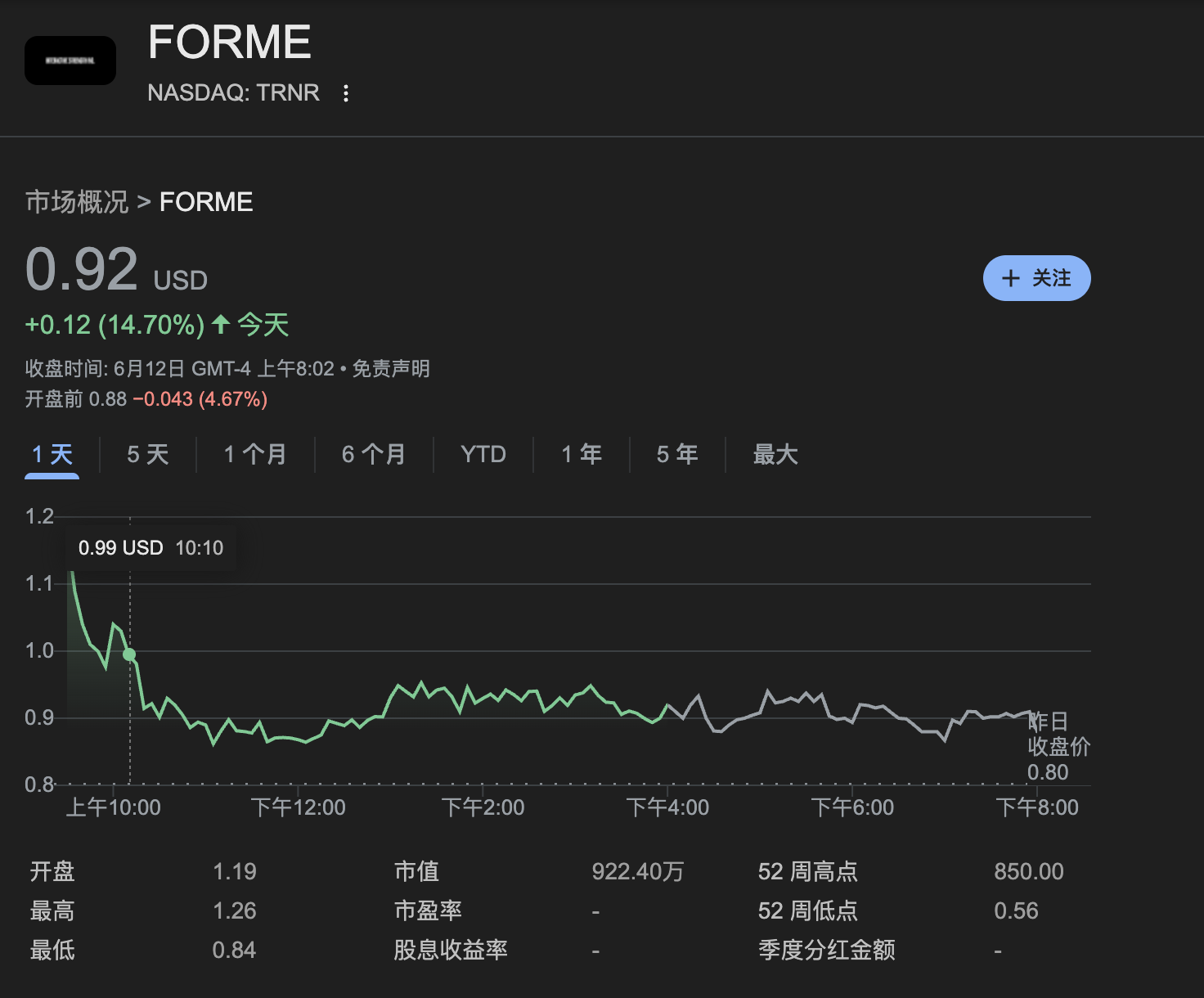
But similar to earlier companies buying ETH, TRNR’s current market cap of just $8.4 million makes raising $500 million extremely challenging—it will need to gradually increase its valuation. If market sentiment cools or the FET ecosystem fails to deliver, this investment could easily go to waste.
In the short term, this move looks like a high-stakes gamble; long-term success hinges on whether its AI-driven fitness business can achieve real-world adoption.
-
Synaptogenix (SNPX): Buying TAO, a Biotech Firm’s Turnaround via High-Profile Backing
Synaptogenix is a biopharmaceutical company focused on developing products based on Bryostatin-1, primarily targeting neurodegenerative diseases such as Alzheimer’s. The company has a market cap of only $5 million.
On June 9, it announced an initial commitment of $10 million to purchase Bittensor’s $TAO token, with plans to scale up to $100 million over time.
Funding will initially come from existing cash reserves, with future capital expected through a $550 million Series D private placement of convertible preferred shares. Similar to MicroStrategy’s approach, investors receive preferred shares (with fixed dividends), which convert into common stock once certain conditions are met—such as reaching a specified share price—helping SNPX attract institutional capital (e.g., hedge funds or family offices).
The mastermind behind this treasury strategy is well-known investor James Altucher.

James is a prominent entrepreneur, investor, and bestselling author who has founded or invested in over 20 companies across tech, finance, and media. He was formerly a hedge fund manager and participated in early-stage investments in numerous startups.
Long before Bitcoin gained mainstream traction, James publicly advocated for blockchain technology and became one of its earliest proponents. During the 2017 crypto boom, he earned the nickname “Bitcoin Prophet” due to his extensive online advertising campaigns.
In SNPX’s case, he leads the formulation and execution of the $TAO investment strategy. This includes overseeing the phased market purchases to optimize entry prices and selecting Bittensor subnets—such as Subnet 1, focused on machine learning tasks—for staking to generate yield.
Recently, he has been actively sharing insights on X about SNPX’s TAO purchase logic, openly stating that buying SNPX stock is effectively acquiring TAO at half price.
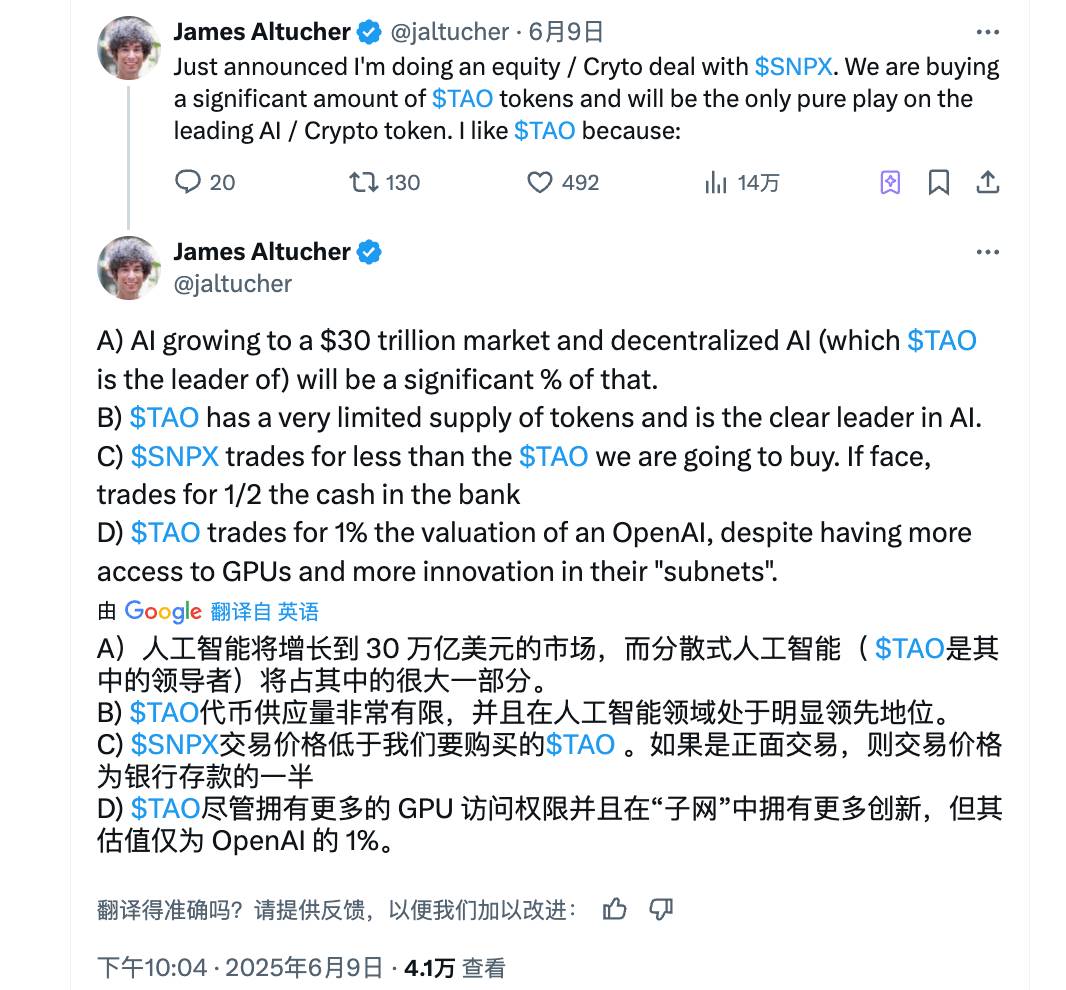
The involvement of a high-profile figure like James is crucial—it helps attract private capital and draws institutional attention to SNPX’s transformation from a struggling biotech firm.
From a strategic standpoint, this pivot stems from stagnation in its core business. Clinical data for Bryostatin-1 therapy has fallen short of expectations, FDA approval remains uncertain, and the stock has languished for years.
By holding $TAO and earning staking rewards, SNPX aims to grow its asset value. Public reports even suggest plans to rename the company and ticker symbol to reinforce its new AI-token identity.
Following the June 9 announcement, SNPX’s stock surged 40%, reflecting short-term market optimism.
However, the initial $10 million investment already exceeds twice the company’s market cap. If $TAO falls below $300, the asset value could shrink by over 25%, posing significant financial risk.
Whether the planned $550 million private placement succeeds depends heavily on James Altucher’s influence and prevailing market sentiment. Without sufficient funding, the turnaround plan could stall. Meanwhile, staking yields appear unstable compared to $TAO’s 18% 30-day volatility.
This is clearly a high-risk, high-reward bet on survival and reinvention.
-
Oblong (OBLG): A Cautious Move into TAO by an IT Player
Oblong, Inc. (Nasdaq: OBLG) is a technology service provider specializing in IT solutions and video collaboration tools. Its flagship product, Mezzanine, is a multi-user, multi-device visual collaboration platform widely used in enterprise meetings and remote teamwork. The company has a market cap of approximately $5.3 million.
On June 6, Oblong announced it raised $7.5 million through a private placement to purchase Bittensor’s $TAO tokens and participate in staking on Subnet 0.
After the announcement, Oblong’s stock briefly rose 12%, but had declined to $4.04 by the time of writing.
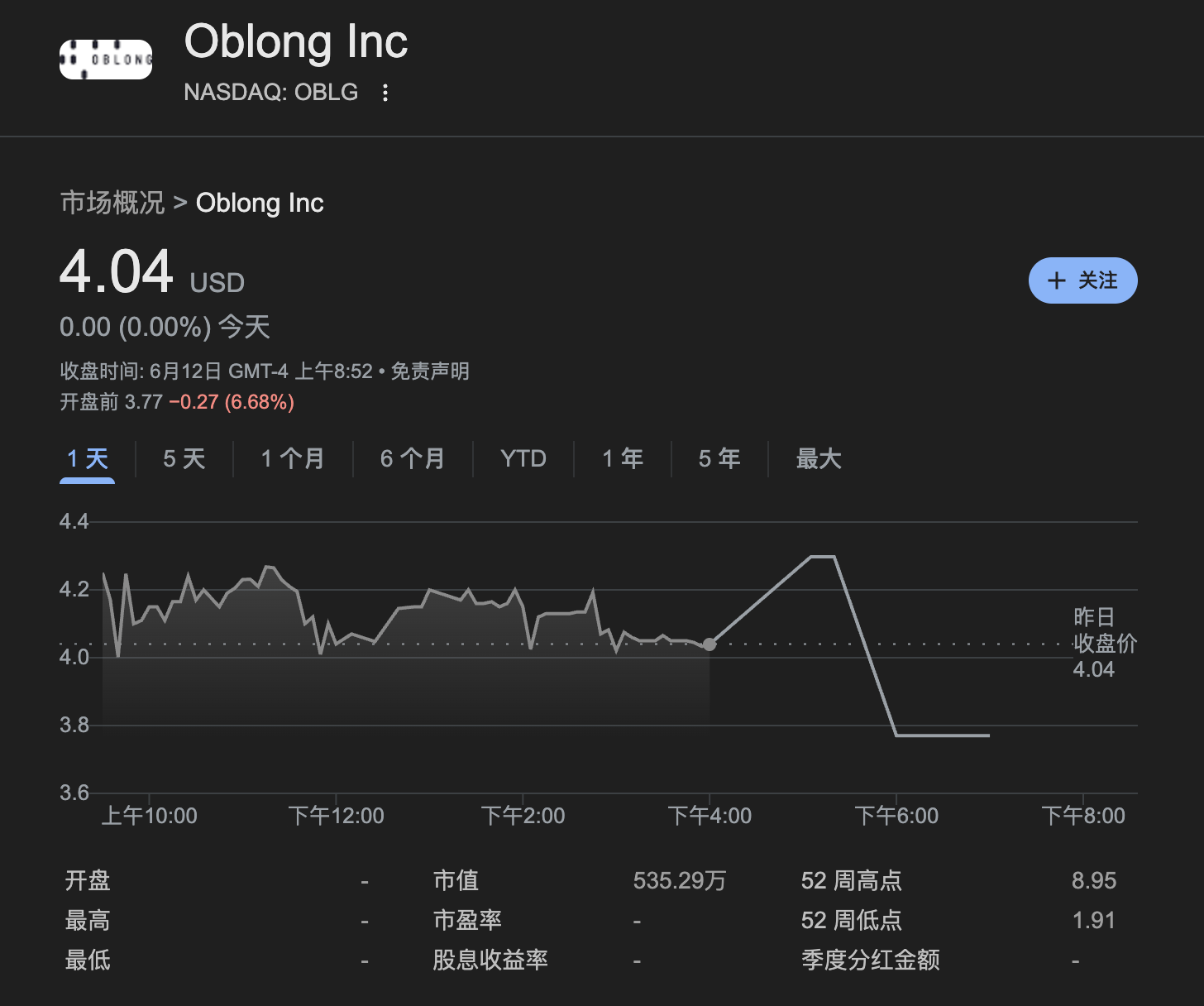
The offering involved selling about 1.98 million shares or equivalent securities at $3.77 per share—below the prevailing market price—indicating a discounted equity issuance to attract investors.
At current prices, this amount can acquire roughly 1,890 $TAO tokens, which is relatively small in scale.
Nonetheless, this purchase can be seen as a strategic step toward shifting from traditional IT services to AI and digital assets.
The video conferencing space is highly competitive. While Mezzanine holds some niche presence, revenue growth has slowed to about 5% since 2023, largely due to competition from Zoom and Microsoft Teams.
CEO Peter Holst stated that the intersection of AI and blockchain represents a key frontier for innovation, and $TAO is viewed as a promising asset in crypto-based AI infrastructure—akin to Bitcoin’s early institutional adoption phase.
The company plans to grow its treasury through $TAO holdings and staking rewards, while exploring software tools built on Bittensor, such as AI-assisted meeting features.
However, Bittensor’s Subnet 0 primarily focuses on text-based AI tasks like natural language processing. Choosing this subnet for staking isn’t strongly aligned with Oblong’s video conferencing business—it appears driven more by yield considerations and symbolic positioning.
This move is best understood as a cautious pilot test of AI tokens’ long-term potential.
Risk and Reward Go Hand in Hand
The corporate treasury trend has expanded beyond single-asset strategies to include diversified crypto allocations.
Yet, aside from BTC, altcoins exhibit significantly higher volatility. Take TRNR: planning to raise $500 million despite an $8.4 million market cap means leveraged financing to buy volatile assets like FET creates immense financial pressure if prices drop sharply.
Regulatory risks are equally critical. For public companies, compliance is paramount. The SEC has previously classified SOL as a security, and the regulatory status of AI tokens remains unclear. Should regulators tighten oversight, could these firms face penalties or forced liquidations?
Yet where laws do not explicitly prohibit, capital seeks opportunity. In this current window, companies are rushing to replicate crypto reserve strategies, likely calculating their own favorable odds:
These are mostly small-cap firms leveraging the growing acceptance of crypto in capital markets to take a swing at higher-volatility altcoins. With the AI narrative enduring, the potential ROI—if successful—is enormous.
Overall, public companies investing in altcoins resemble players in a high-stakes game.
For small-cap firms, this is a capital-intensive bet on the future—its outcome dependent on market sentiment, narrative sustainability, and actual execution.
As altcoins become securitized, both companies and investors should remember:
Risk is inherent in high-volatility assets; returns come from seizing the right narrative at the right time.
Join TechFlow official community to stay tuned
Telegram:https://t.me/TechFlowDaily
X (Twitter):https://x.com/TechFlowPost
X (Twitter) EN:https://x.com/BlockFlow_News
 深潮TechFlow


