








Interview with RockFlow Founder Vakee: Killing All Apps, From Stock God Girl to AI Gambler | 100 AI Creators
TechFlow Selected TechFlow Selected
Interview with RockFlow Founder Vakee: Killing All Apps, From Stock God Girl to AI Gambler | 100 AI Creators
In Vakee's view, an Agent is not an upgraded version of an app, but rather the next-generation user interface. She even asserts: "All apps will eventually disappear and be replaced by Agents."
 Navigating Web3 tides with focused insights
01
Vakee had been trading stocks for over 20 years before developing Bobby.
She started trading at age 9 (three years later than Buffett), and could intuitively execute all kinds of trades. After graduating from Imperial College London, Vakee first joined a quant fund, using machine learning to trade futures and derivatives. In her twenties, she earned her first $10 million by shorting a U.S. stock.
The numbers in her account swelled like game points. For Vakee, making money was too easy—and therefore a bit boring. She has little interest in effortless pleasures, such as buying handbags, traveling, or hoarding luxury goods. She usually shops on Pinduoduo, never flies business class unless it can somehow get her there faster.
When trading becomes as simple as breathing, you must find a crazier game.
After several years working in product R&D at big tech firms and five years doing VC investing in the primary market, Vakee officially launched her startup. Her first product was RockFlow (Chinese name: Qiyun Securities), an AI-powered brokerage platform targeting global users.
RockFlow uses AI to simplify investing, offering features like daily trading opportunity recommendations, auto-follow trading, and minimalist options—turning a traditionally complex financial platform into something as fun as a game.
But this product, launched in 2021, is still essentially a “smarter tool.” It cannot understand *why* a user wants to trade at a given moment, let alone place trades autonomously.
Now, Vakee is about to launch a new project: an AI Agent named Bobby.
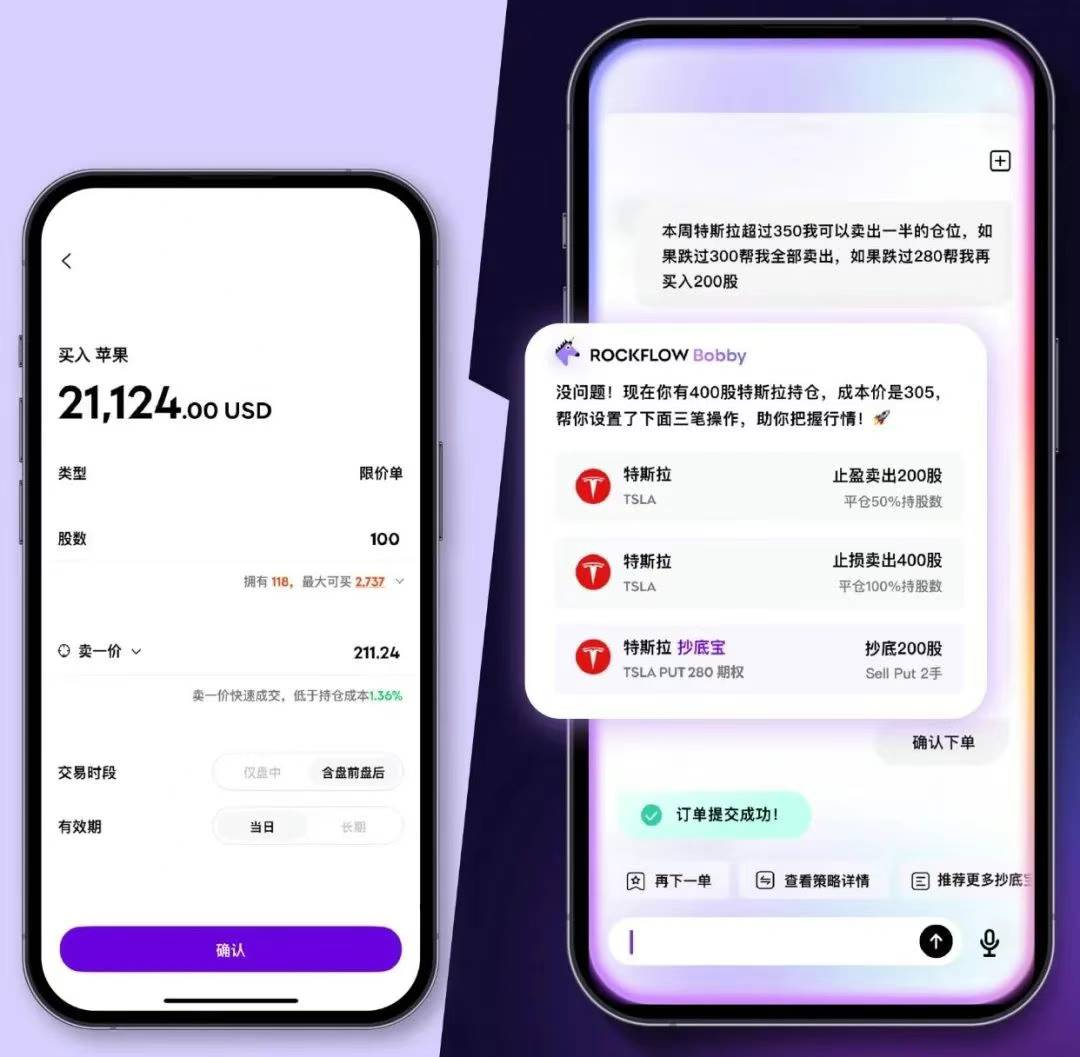
Bobby aims to completely replace apps. Ordinary users need only express their thoughts in natural language, and Bobby will handle the entire process—from intent parsing → strategy generation → order execution—closing the loop on trading.
-
RockFlow app order interface vs. Bobby’s natural language order page
For example: while browsing Pop Mart’s website, Bobby might pop up and say, "You’ve spent $2,000 on Pop Mart this month. Labubu just trended on TikTok. The secondary market premium for Labubu x Vans collabs reached 1,284%. Should we increase your position in the trendy toy sector?"
This creates a generational leap from chatbots that merely answer questions (like BloombergGPT or Morgan Stanley’s GPT under development) or smart tools requiring manual input (like the original RockFlow).
In Vakee’s view, Agents aren’t app upgrades—they’re the next-generation user interface.
She even declares: "All apps will eventually disappear, replaced entirely by Agents."
Take it further: if you tell Bobby, “I hate Trump,” Bobby could infer your negative sentiment toward Trump and suggest avoiding or shorting Trump-related stocks (like DJT), while also recommending long positions in clean energy sectors based on his pro-fossil fuel policies. It would then ask about your investment expectations and help select assets matching your risk profile and return goals.
A person’s emotions and values are becoming trading instructions.
This is exactly where Vakee’s vision for Bobby began.
02
Vakee’s passion for “trading” feels as natural as others’ love for food or travel. To most people, investing is complicated and intimidating. But for her, every morning opens into a world brimming with trading opportunities—effortless, spontaneous, everywhere.
For instance, during this year’s Spring Festival, when DeepSeek exploded in popularity and even relatives back home were chatting with AI, RockFlow’s team quickly applied for DeepSeek-related services from cloud providers. Vakee immediately bought Alibaba stock, knowing cloud computing businesses would benefit from increased compute demand driven by open-source models.
On one trip to Japan, she noticed Sagami’s ultra-thin condoms sold out instantly at every convenience store. She promptly researched the company, discovering its earlier and more aggressive pursuit of ultra-thin polyurethane technology compared to Okamoto, and that it topped China’s cross-border e-commerce sales charts. This stock ultimately delivered a 4x return for her that year.
Trading is a lifestyle—Vakee believes this without doubt.
She dislikes indulgence, shopping almost exclusively on Pinduoduo. Conversely, she’s nearly obsessed with anything requiring training, challenge, and peak performance. She loves the rush of tackling a project intensely in a short time—once passing China’s judicial exam in just nine days, and earning a top-scored, highly respected American ACE fitness trainer certification.
Later, she channeled her passion into AI. Over the past decade, she’s either built AI products, invested in AI startups, or founded AI companies.
Now, Vakee has finally found a sufficiently compelling new boss: Bobby.

-
Most RockFlow team members are introverts; team-building means sitting silently staring at the sky
03
When we met Vakee, the tariff war had just begun. In the café, panic coursed through everyone’s phone screens like electricity.
“What can Bobby do right now?” I asked.
“Bobby, find companies least affected by tariffs and with potential for above-expectation growth over the next three months,” said Vakee.
Seconds later, Bobby responded:
“Consider sectors eligible for tariff exemptions, such as AI infrastructure, data centers, and semiconductor manufacturing equipment—areas of strategic competitiveness likely to receive partial waivers or delayed enforcement. Leading U.S.-based production firms may also exceed expectations, as domestic manufacturing avoids import tariffs.”
“Additionally, consider allocating to leading companies in rigid-demand and defensive industries. Please refer to the list of tariff-resilient stocks.”
And proactively asked: “Would you like me to automatically place orders if these companies’ share prices drop more than 10% within a week?”
In the AI era, some use large models to make videos and PPTs, others replace dating with chatting to DeepSeek, and some want to raise an immortal AI cat.
But Vakee believes the future of trading is AI versus AI—and everyone needs a Bobby.
Interview with Vakee
Part01
About Bobby
AI lacks humanity—that’s why it profits
AI NOW!: Many financial products today integrate large models—Bloomberg has BloombergGPT, Morgan Stanley is developing its AI assistant GPT Copilot. How is Bobby different? Is it just a chatbot that can place orders?
Vakee: If Bobby were just a chat-enabled ordering tool, I wouldn’t have built it. Have you ever asked financial chatbots, “What should I buy now?”
AI NOW!: They analyze the market, give suggestions, and always end with “Investing involves risks.”
Vakee: Exactly—because they’re answering, not deciding. Bobby is different. If you say “I hate Trump,” it won’t give you a summary titled “Trump’s Policy Impact on Markets.” Instead, it’ll ask: “Should I remove Republican-linked stocks from your portfolio? Clean energy sectors may benefit—here are specific tickers. Want me to adjust your positions?”
AI NOW!: Is this just advanced semantic understanding?
Vakee: No, it’s a fundamentally different logic. Chatbots answer what you ask. Bobby anticipates what you haven’t even asked yet. For example, if it notices you keep reading semiconductor news but don’t hold chip stocks, it might proactively ask: “Should I monitor TSMC’s earnings? If results beat expectations, would you consider buying?”
You can also teach Bobby your own analytical logic.
AI NOW!: So Bobby solves the key problem of turning someone’s “intention” into actual trading execution. Is this hard for regular users?
Vakee: Yes, very hard. Take the recent U.S. stock plunge: everyone knew tariffs would likely cause a crash. But pinpointing the exact timing, and deciding which stocks to sell and how much—that requires diligent tracking of market details. Most people have ideas but fail to act, due to laziness or uncertainty about execution.
Or take the simplest strategy—buy low, sell high. Most people can’t do it. When a stock rises 30%, they hesitate to sell, hoping it’ll go to 50%. Missing profit-taking windows often leads to sharp reversals, followed by panic selling.
But AI doesn’t do that—because AI has no human nature.
AI NOW!: Can you not profit from markets if you’re human?
Vakee: Human nature is full of greed, anger, and delusion. You profit by going against human nature—so AI naturally performs better.
AI NOW!: What if I say to Bobby, “Can you adjust my portfolio to zero risk and 100% return?”
Vakee: See? That’s greed, haha. Bobby will honestly say “Impossible,” then translate your get-rich-quick fantasy into an executable plan targeting 20% annualized returns.
AI NOW!: But isn’t the trust barrier too high for trading Agents? A PPT-making Agent making a mistake is fixable, or negligible. Won’t users fear losing money due to Agent errors?
Vakee: We’ve set safety words. You can say “Bobby, monitor only, no trading,” “Call me if Nvidia drops to $98,” or “No single trade over $10,000.” In fact, most users feel safer after trying it—again, because AI lacks human weaknesses.
Part02
About Entrepreneurship
Day One of Startup: Training an AI Trader
AI NOW!: Your initial startup project was RockFlow, a Gen-Z brokerage platform. Was building Bobby inevitable from RockFlow, or did you jump on the AI Agent bandwagon because everyone else is doing it?
Vakee: From day one, RockFlow’s mission was “making investing simpler.” Over the past two years, we’ve tried many approaches—extreme app simplification, etc.—but realized it wasn’t enough.
By 2025, I believe a new generation of users—true natives of the AI era—can transact purely through natural language. Just speak, and Bobby instantly parses your intent, generates strategies, and executes orders.

-
Early NFT avatar design sketches for RockFlow’s founding
AI NOW!: Many brokerages now integrate general-purpose large models for investment advice. Why didn’t you first add a chatbox to RockFlow, say, integrating DeepSeek for stock-picking chats? That seems like the most natural upgrade path.
Vakee: General-purpose LLMs can deliver standardized analysis, but that’s far from sufficient for real trading. When we need precise research tailored to individual users’ preferences, meeting real-time demands and guiding immediate execution, general models fall short. They merely batch-deliver search results, unable to close the decision loop.
Bobby uses a workflow + LLM/Agent architecture, maximizing AI creativity while controlling cost and risk.
Critically, all information fed into our workflows—user data, market price-volume data, capital market sentiment—is secondarily processed using our proprietary financial know-how. Only then can we generate responses that are both logical and truly user-understanding, culminating in trade execution.
AI NOW!: Many general Agents now integrate vertical knowledge bases—Kouzi Space, for example, claims integration with expert systems. Why do you insist vertical Agents like Bobby represent the future, rather than waiting for general Agents to become stronger?
Vakee: This comes down to a fundamental question: there are two types of needs.
First, life-or-death needs—financial trading, medical diagnosis. For most people, failing to reach 70% proficiency here equals total failure, because consequences are severe. These tasks have extremely high expertise barriers and near-zero error tolerance—but crucially, achieving 70% is methodologically feasible.
Second, nice-to-have needs—making PPTs, planning trips. Falling short of 70% isn’t catastrophic; things are just less perfect.
General Agents suit the second type. But for life-or-death needs like financial trading, only vertical Agents can deliver. Reasons include:
Different data dimensions: We handle millisecond-level market data, real-time user positions, and other specialized inputs.
Different accountability levels: A wrong investment suggestion could cause major user losses.
Different decision mechanisms: We don’t offer “maybe possibly” advice—we must make executable judgments.
AI NOW!: Like you wouldn’t let a general practitioner perform heart surgery?
Vakee: Exactly—you wouldn’t dare. Bobby is born a “finance major,” trained from day one at the level of a professional trader.
AI NOW!: Many think workflows are only good for narrow query tasks. How do you make Bobby truly “understand finance”?
Vakee: Workflows are just tools—the magic lies in how you use them.
Industry knowledge is foundational. The real breakthrough: our workflows dynamically generate transactionally relevant information—risk preferences, real-time holdings, trading intent, market sentiment—combined with our team’s financial know-how, instantly orchestrating thousands of dynamic nodes. This isn’t simple retrieval—it’s real-time market signal interpretation and response, like a professional trader. In RockFlow-validated scenarios, this system outperforms general LLMs by orders of magnitude.
Our ideal model: a data-driven, self-evolving world model enabling financial decisions to continuously learn and adapt amid changing markets—achieving true intelligence and efficiency.
AI NOW!: And on the “understanding users” side? How does Bobby know who you are and what you want?
Vakee: Bobby integrates RockFlow’s trading system, real-time market data, and user data—like a hedge fund manager on 24-hour standby.
For example, if a user says, “I just lost my job, want conservative investments,” Bobby automatically lowers risk tolerance, recommends a mix of government bonds and high-dividend stocks, and sets dynamic stop-losses. During market volatility, it might proactively ask: “Detected possible Fed rate hike—adjust your bond exposure?”
AI NOW!: If financial vertical Agents are the future, why haven’t Robinhood or Futu moved in this direction yet?
Vakee: An AI-native investment platform requires a fundamentally different technical architecture from mobile-internet brokerages. The more successful legacy players are, the harder it is for them to abandon existing infrastructure and user experience to achieve AI-era self-revolution.
The mission of last-gen mobile brokerages was superior mobile client experiences—massive improvements over old PC-era platforms like Interactive Brokers. They succeeded, serving 70s and 80s generations well. But in the AI era, GenZ and younger users demand new trading experiences.
RockFlow is different: from day one, we committed to building an AI-native wealth platform for the next generation, constructing our own AI infrastructure and a trading system designed for AI training. We’re the only ones doing this globally.
AI NOW!: Wait—what does building our own trading system actually mean?
Vakee: For brokerages, the trading system is like TikTok’s recommendation algorithm. Using third-party systems means black boxes—not every module is open for model training. So we had to build our own. Only then can we obtain structured, continuous user behavior data at the foundational level, understand real decision paths, and iteratively optimize.
From the start of designing RockFlow’s trading system, we already planned how each module would support machine learning. This data isn’t static—it’s raw material for training personalized Bobbies.
Part03
About AI
Killing Apps: Agent is the Ultimate Evolution of All Services
AI NOW!: Sounds like you’ve been preparing for Agents from day one.
Vakee: I checked our earliest meeting notes on Bobby—it was September 2023. From RockFlow’s inception, we designed everything—trading systems, data, product architecture—with AI-native goals in mind. Our thinking evolved gradually, and we made mistakes in Agent architecture—but those were valuable lessons.
Each generation of user-facing products has its historical mission. In the AI era, your product’s purpose can’t just be slightly richer features, slightly simpler UI, adding or removing a button.
AI NOW!: What is the mission of AI-era products?
Vakee: I believe it’s the first real chance to understand users and serve them proactively. Great mobile internet products help users “operate more efficiently.” AI-era products let users stop operating altogether—just get served.
Previously, apps guided you step-by-step: “how to buy options,” “how to find suitable options.” Now, AI directly recognizes your intent: “I want 20% ROI,” “I want to survive this market crash.” This is a fundamental paradigm shift.
That’s why I believe Agents aren’t app upgrades—they’re the next-generation user interface.
AI NOW!: Specifically for Bobby, what’s its mission?
Vakee: My初心 is this: I believe investing is deeply personal—it reflects one’s values and worldview.
As we discussed, many people have insights and interpretations of daily events, but get stuck on details and fail to act correctly or timely. People say trading is monetizing cognition—but for most, the biggest hurdle is translating cognition into action. Bobby exists to solve that.
AI NOW!: Whether I hate or love Trump—I can trade on it.
Vakee: Anything can be traded. Anything can make money.
AI NOW!: From operating a tool to being served by an agent.
Vakee: Exactly. In this sense, all apps will vanish, replaced by Agents.
AI NOW!: I believe in this future too. But aren’t you worried about being too early—becoming a pioneer only to die first?
Vakee: I don’t think that way. For the past decade, I’ve either invested in AI or built AI startups. My entire journey led me here—to build Bobby. The brave enjoy the world first.

• The greatest shock AI has given you since 2025
Vakee: When DeepSeek visualized deep reasoning for everyone to see.
• Any AI trend you initially doubted but later changed your mind on?
Vakee: Text-to-image. Accurately generating images—consistent character poses, meaningful text—was extremely hard at first. I thought commercialization was far off. But new technologies and products starting with Diffusion Transformers proved incredibly effective, far exceeding expectations. Now, image generation is fully usable across production scenarios.
• If you could shut down one AI product or trend—because it’s purely fake demand or headed in the wrong direction—which would it be?
Vakee: Building generic functionalities atop companies like OpenAI, or creating products that don’t deeply integrate into closed-loop business scenarios—these are fragile. Whenever OpenAI releases a new model, many startups collapse. Like when GPT-4o launched one-click Studio Ghibli-style generation, countless companies died overnight, having failed to build sustainable moats.
So for me, the key isn’t “am I using AI,” but “what problem am I solving”—can I abstract real needs within verticals, and build long-term commercial value and defensible advantages? The industry still lacks enough great AI product managers.
Back to Bobby: building Bobby isn’t about showcasing AI tech, but about simplifying investing and creating value. If someday I find Bobby fails at this, it can be scrapped—no need to cling to it.
• At this stage of AI development, what’s underestimated? What’s overestimated?
Vakee: Compute demand is underestimated. AGI arrival is overestimated. Everyone thinks piling more GPUs and training larger models gets us closer to AGI, but the real bottleneck is at the application layer. I believe the next few years will see an explosion of vertical Agents—and this will be a long-term process. Each niche needs customized compute optimization. Just like after EVs went mainstream, charging stations became the real bottleneck.
• What are you most excited about in 2025?
Vakee: A “Cambrian explosion” in vertical applications. In complex domains like finance, healthcare, education, travel, and supply chains, we’ll see Agents that truly reinvent user experiences—not just simple chatbots.
Imagine a travel Agent that automatically plans personalized trips, negotiates prices, and makes payments. Or an education Agent that designs custom learning paths based on ability and preferences. None of this requires waiting for AGI—existing tech plus vertical data can already deliver.
• Finally, recommend three books you love!
Vakee: Feynman’s *The Pleasure of Finding Things Out*, Dzongsar Khyentse Rinpoche’s *Introduction to Buddhism*, and Ezra Vogel’s *Deng Xiaoping: The Man Who Made Modern China*.
Image Source | Provided by interviewee, Unsplash
Join TechFlow official community to stay tuned
Telegram:https://t.me/TechFlowDaily
X (Twitter):https://x.com/TechFlowPost
X (Twitter) EN:https://x.com/BlockFlow_News


