From General-Purpose Robot Models to AI Computers: A Quick Overview of NVIDIA GTC's Latest Product Launch
TechFlow Selected TechFlow Selected
From General-Purpose Robot Models to AI Computers: A Quick Overview of NVIDIA GTC's Latest Product Launch
In this two-hour and 20-minute keynote address, Huang Renxun shared his vision on the evolution of AI technology and the future of computing demand, while unveiling NVIDIA's latest generation products based on the Blackwell architecture.
 Navigating Web3 tides with focused insights
Author: Liu Rui, CaiLian She
On Tuesday, March 18 local time, NVIDIA CEO Jensen Huang delivered a keynote address at GTC 2025, NVIDIA's AI flagship event held in San Jose, California.
During the two-hour-and-20-minute presentation, Huang outlined the evolution of AI technology and future computing demands. He unveiled details about NVIDIA’s latest Blackwell architecture products, provided timelines for upcoming generations, and shared progress on collaborations with major tech companies in autonomous driving, AI networking, and robotics.
Despite the extensive announcements, Wall Street reacted relatively flatly. By market close on Tuesday, NVIDIA's stock fell 3.43%, followed by an additional 0.56% decline in after-hours trading.
Vision for the Future: Vast Room for Growth in Computing Demand
Kicking off his keynote, Huang laid out his vision for artificial intelligence based on its current development timeline. He described four waves of AI advancement:
-
Perception AI: Initiated around ten years ago, focusing on speech recognition and other simple tasks.
-
Generative AI: The focus of the past five years, involving text and image generation through predictive modeling.
-
Agentic AI: The current phase where AI interacts digitally and autonomously performs tasks, characterized by reasoning models.
-
Physical AI: The future of AI, powering humanoid robots and real-world applications.
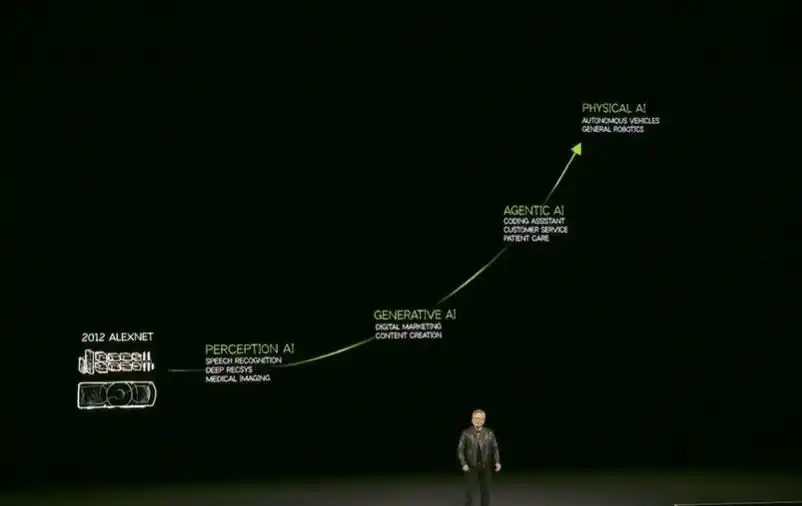
Huang highlighted a "massive challenge" facing the AI industry in terms of computing power, stating that current generative AI requires 100 times more tokens and computational resources than initially anticipated. This is due to the fact that reasoning models require tokens across numerous steps during inference.
Nonetheless, Huang emphasized strong industry feedback and growing demand for greater computing capacity. He noted that within just one year, the AI infrastructure market has already demonstrated remarkable growth.
He revealed that in 2024, the top four U.S. cloud service providers (CSPs), also known as hyperscalers, purchased 1.3 million of NVIDIA’s Hopper architecture chips. In 2025, they acquired another 3.6 million Blackwell architecture chips.
Huang projected rapid expansion of data center infrastructure, forecasting that capital expenditures will exceed $1 trillion by the end of 2028**, driven by demand for AI and accelerated computing.
Product Roadmap Revealed for Coming Years
As widely expected, Huang confirmed during the keynote that NVIDIA will launch Blackwell Ultra—the successor to the current-generation Blackwell GPU—in the second half of 2025.
"Blackwell is now in full production, with incredible yield ramp-up. Customer demand is extraordinary... We will smoothly transition to the upgraded version—Blackwell Ultra," said Huang.
In addition to the Blackwell Ultra chip, NVIDIA introduced the GB300 superchip, which integrates two Blackwell Ultra chips with one Grace CPU.
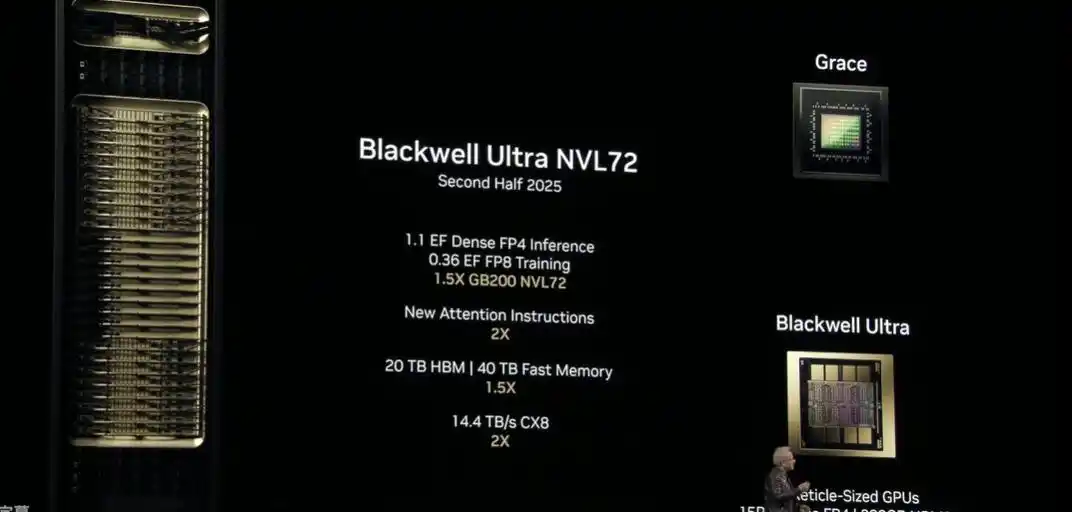
Huang also announced that NVIDIA plans to release its next-generation AI superchip, Vera Rubin, in the second half of 2026, followed by Vera Rubin Ultra in the second half of 2027—aligning with prior expectations.
Moreover, Huang disclosed that the generation after Rubin will be named after physicist Richard Feynman, continuing NVIDIA’s tradition of naming chip series after scientists. According to the slide presented by Huang, the Feynman chip is expected to launch in 2028.
New AI-Powered Computers Unveiled
Beyond chips, Huang announced new laptops and desktops powered by NVIDIA technology, including two AI-focused systems named DGX Spark and DGX Station, capable of running large AI models such as Llama or DeepSeek.
DGX Spark was previously known as Project Digits, first shown at CES, while DGX Station is a larger workstation-class desktop system.
Huang dubbed DGX Spark “the world’s smallest supercomputer.” Packing the GB10 Grace Blackwell superchip into a chassis no larger than a Mac mini, it delivers up to 1,000 TOPS of AI performance. Designed for “AI developers, researchers, data scientists, and students to develop and fine-tune large AI models offline,” the Spark is expected to retail around $3,000. Pre-orders open today, with shipments beginning in summer. Dell, Lenovo, HP, and others are expected to offer Spark-based products.
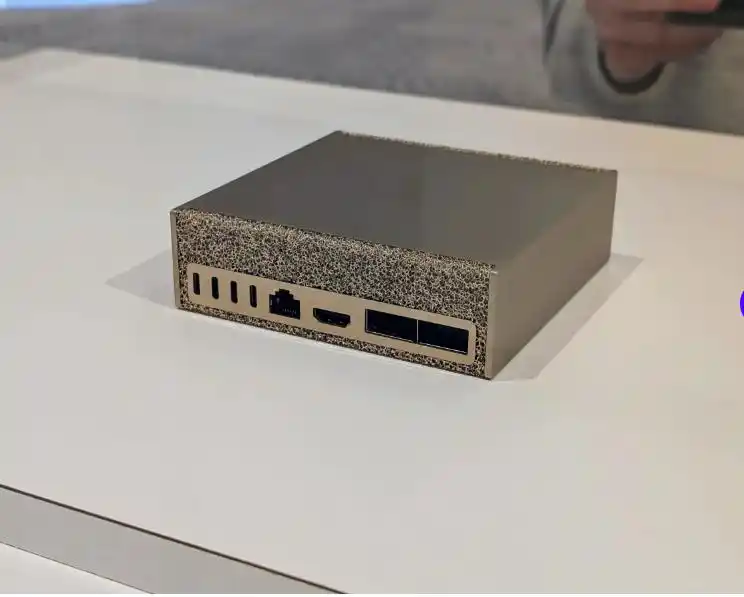
DGX Spark
The more powerful DGX Station uses the GB300 Grace Blackwell Ultra, delivering 20,000 TOPS of AI performance and up to 784GB of memory. Pricing for DGX Station has not yet been announced, with availability expected later this year.
Dynamo: The Operating System for AI Factories
To further accelerate large-scale inference, Huang introduced NVIDIA Dynamo—an open-source software platform designed to scale and optimize AI inference models within AI factories.
"It's essentially the operating system for AI factories," Huang said. Named after the instrument that launched the previous industrial revolution, Dynamo signals its pivotal role in the next wave of AI transformation.
With Dynamo, inference models like DeepSeek can achieve up to 30x higher performance under the same architecture and using the same number of GPUs.
Launch of the World’s First Open, Customizable Universal Robot Model
Huang stated that labor shortages are a pressing global challenge and that robotics offers a solution, representing immense potential. As we enter the era of Agentic AI, the path ahead leads toward Physical AI.
To this end, NVIDIA introduced GR00T N1, a universal foundation model specifically designed for robotics. It is the world’s first open, fully customizable foundational model for humanoid reasoning and skills.
NVIDIA is also collaborating with Google DeepMind and Disney to develop a robotics platform called Newton. Huang invited a robot named "Blue" onstage—a product developed on the Newton platform—to demonstrate its capabilities.
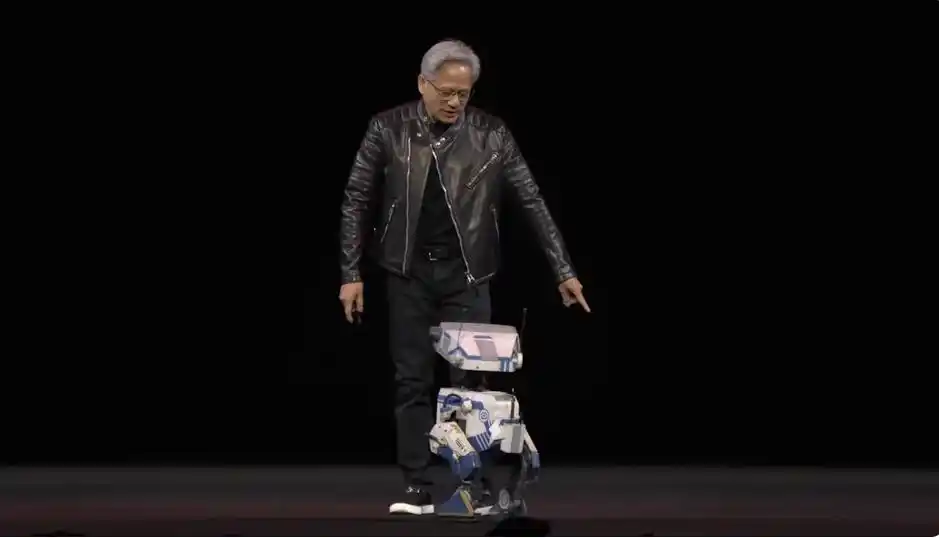
Robots created through collaboration between NVIDIA, Disney Research, and Google DeepMind appeared on stage
Partnership with General Motors for AI-Driven Autonomous Driving and Smart Factories
Huang also announced that General Motors (GM) will expand its partnership with NVIDIA to drive innovation via accelerated computing and simulation.
GM will use NVIDIA’s computing platforms—including Omniverse and Cosmos—to build custom AI systems that optimize factory planning and robotics.
In addition, GM will adopt NVIDIA DRIVE AGX as in-vehicle hardware to enable advanced driver-assistance systems (ADAS) and enhanced in-cabin safety experiences. DRIVE AGX is a scalable open platform serving as the AI brain for autonomous vehicles.
Collaboration on AI-Native 6G Networks
Huang announced that NVIDIA will partner with T-Mobile, Mitre, Cisco, ODC, and Booz Allen Hamilton to co-develop hardware, software, and architectures for AI-native 6G wireless networks.
For more details, read: “NVIDIA Announces Major Collaboration with Telecom Giants on AI 6G Wireless Technology”
Establishment of Quantum Computing Research Center
In addition to the above, NVIDIA announced on Tuesday the establishment of a research center in Boston dedicated to advancing quantum computing with cutting-edge technologies.
According to NVIDIA’s official website, the NVIDIA Accelerated Quantum Computing Center (NVAQC) will integrate leading quantum hardware with AI supercomputers to realize what it calls accelerated quantum supercomputing. NVAQC aims to tackle some of the most challenging problems in quantum computing—from qubit noise mitigation to transforming experimental quantum processors into practical devices.
Leading quantum innovators, including Quantinuum, Quantum Machines, and QuEra Computing, will leverage NVAQC in collaboration with researchers from top academic institutions such as the Harvard Quantum Initiative (HQI) and MIT’s Engineering Quantum Systems (EQuS) group.
Huang stated: “Quantum computing will enhance AI supercomputers to solve some of the world’s most critical challenges—from drug discovery to materials development.” “By collaborating with the broader quantum research community to advance CUDA-quantum hybrid computing, the NVIDIA Accelerated Quantum Computing Center will make breakthroughs in creating large-scale, useful accelerated quantum supercomputers.”
Introduction of World Foundation Models
NVIDIA also announced the launch of its new NVIDIA Cosmos™ World Foundation Models (WFMs), introducing an open, fully customizable reasoning model for Physical AI development and giving developers unprecedented control over world generation.
NVIDIA also released two new blueprints powered by NVIDIA Omniverse™ and the Cosmos platform, providing developers with a large-scale, controllable synthetic data generation engine for training robots and autonomous vehicles.
Industry leaders including 1X, Agility Robotics, Figure AI, Foretellix, skillai, and Uber are among the first to adopt Cosmos, enabling richer training data generation for Physical AI at faster speeds and larger scales.
Huang said: “Just as large language models revolutionized generative and agentic AI, Cosmos World Foundation Models represent a breakthrough for physical AI… Cosmos introduces an open, fully customizable reasoning model for physical AI and creates opportunities for step-function advancements in robotics and physical industries.”
Join TechFlow official community to stay tuned
Telegram:https://t.me/TechFlowDaily
X (Twitter):https://x.com/TechFlowPost
X (Twitter) EN:https://x.com/BlockFlow_News