
Nankai University President Chen Yulu: The Rise and Challenges of Cryptocurrencies
TechFlow Selected TechFlow Selected
Nankai University President Chen Yulu: The Rise and Challenges of Cryptocurrencies
Recent developments across the cryptocurrency sector indicate that the strategic intent behind shifting positions from both U.S. political and business circles may be to establish a "trinity" system for dollar hegemony in the digital era.
 Navigating Web3 tides with focused insights
Source: Institute for Service Economy and Digital Governance, Tsinghua University
On February 22, 2025, the Annual Academic Conference on China's Digital Economy Development and Governance was held at Nankai University. Themed "Artificial Intelligence, Digital Economy, and New Quality Productivity," the conference积极响应 to the strategic call in the report of the 20th Party Congress for "accelerating the building of a strong cyber nation and digital China," bringing together intellectual strengths from academia and industry to jointly explore future directions for the digital economy. The event invited over 40 experts, scholars, and institutional representatives who engaged in in-depth discussions on core topics including the digital economy, digital finance, digital trade, data elements, and AI innovation. Chen Yulu, President of Nankai University, delivered a keynote speech titled “The Rise and Challenges of Cryptocurrencies.”

Chen Yulu delivering his keynote speech
The topic I would like to share today is "The Rise and Challenges of Cryptocurrencies." Cryptocurrencies are digital currencies that operate via computer networks, with ownership of each unit recorded and stored in a digital ledger or blockchain. Blockchain serves as the foundational technology for cryptocurrencies, whose core lies in consensus mechanisms such as Proof-of-Work (PoW). Cryptocurrencies mainly fall into three categories: first, payment-type cryptocurrencies such as Bitcoin and Ether; second, stablecoins, most notably the U.S. dollar-backed stablecoins USDT and USDC; third, central bank digital currencies (CBDCs), also known as sovereign digital currencies, with large-scale examples including China’s digital RMB. Cryptocurrencies exhibit seven main characteristics: decentralization; security; scarcity; anonymity; high price volatility; significant energy consumption during mining; and global immediacy, enabling instant cross-border transactions without currency conversion costs or international transfer delays.
Since Satoshi Nakamoto (or team) mined the first Bitcoin block—the Genesis Block—in January 2009, cryptocurrencies have evolved from niche virtual currency experiments to occupy a growing space within the financial ecosystem. Currently, more than 130 countries and regions have begun discussing various forms of cryptocurrency integration into mainstream financial systems. Against the backdrop of intensifying geopolitical instability, persistently high U.S. fiscal deficits, and rapidly rising U.S. national debt, crypto assets represented by Bitcoin are receiving increasing attention. Recent developments indicate that the U.S. government is accelerating efforts to build a trilateral "digital dollar hegemony system" through strategic reserves, cryptocurrency legislation, and crypto-financial infrastructure—aiming to extend its traditional financial dominance into the era of the digital economy. Based on this context, I will focus on the global landscape and associated risks and challenges of cryptocurrency development.
Cryptocurrency markets are undergoing breakthrough progress
In January 2024, spot Bitcoin exchange-traded funds (ETFs) were officially approved—a landmark event marking the convergence of crypto assets with traditional financial assets. By December of the same year, Bitcoin prices surpassed $100,000 per coin, driving the total market capitalization of cryptocurrencies to surge from $800 billion to $3.4 trillion within just two years. Meanwhile, the ratio of total crypto asset market cap to liquidity across the six major central banks globally (G6) rose sharply from less than 1% in 2009 to 12% by the end of 2024. In mainstream markets, Bitcoin's investment profile is transitioning from a niche risk asset to a mainstream asset class. The new Trump administration’s proposal to establish a Strategic Bitcoin Reserve (SBR) has further stimulated and reinforced this transformation.
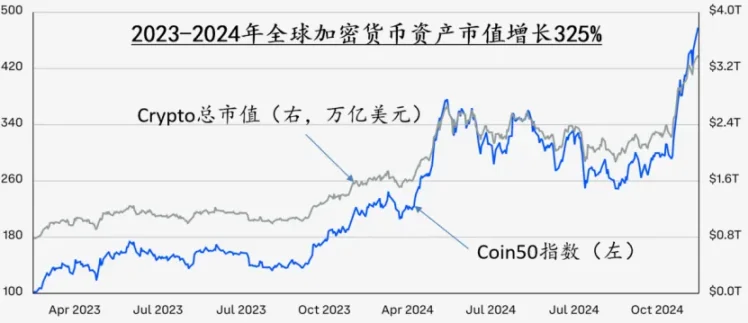
Figure 1: Since the second half of 2023, global capital has surged into the cryptocurrency market. Data source: Coinbase: Crypto Market Outlook 2025.
Since the second half of 2023, the U.S. government’s regulatory stance toward cryptocurrencies has undergone a notable shift—likely reflecting a strategic intent to extend America’s traditional financial hegemony into digital finance. Amid soaring government debt and persistent inflation, this strategy could help ensure the centrality of the U.S. dollar in the wave of digital financial transformation while simultaneously alleviating mounting federal debt pressures. This strategy may consist of short-, medium-, and long-term goals: in the short term, the U.S. aims to lay the initial framework for global digital currency dominance through three approaches—establishing a strategic cryptocurrency reserve, encouraging the expansion of dollar-backed stablecoins, and controlling key crypto trading infrastructure; in the medium term, it seeks to attract (or coerce) leading global crypto firms to relocate to the U.S. or submit to U.S. regulatory oversight through lenient regulations, tax incentives, and long-arm financial sanctions—promoting industrial agglomeration, employment, and economic growth, while maintaining leadership in blockchain R&D; in the long run, the U.S. intends to dominate the development of global digital financial infrastructure and rule-making, ensuring continued centralized control amid the decentralized trends of the digital economy, and preserving the dollar’s central role in global digital investments and transactions.
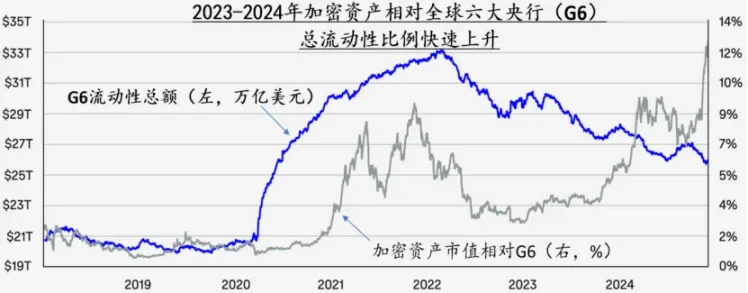
Figure 2: After mid-2023, cryptocurrency scale surged and entered the mainstream asset market. Data source: Coinbase: Crypto Market Outlook 2025.
Shifts in U.S. government and business attitudes toward cryptocurrencies and their strategic implications
1. Since the second half of 2023, five标志性 shifts have emerged in the U.S. government and industry regarding cryptocurrencies
First, U.S. financial regulators have shifted from "strict crackdowns" to "guidance-based regulation." Paul Atkins, newly appointed chair under the Trump administration, is a long-time supporter of cryptocurrencies. Since taking office, he has actively promoted compliance pathways for crypto assets. His close relationship with the new Treasury Secretary Scott Bessent reflects the new administration’s proactive support for digital assets and its attempt to strike a new balance between financial innovation and investor protection. In December 2024, the SEC approved Franklin Templeton’s crypto index ETF (EZPZ) for listing on Nasdaq—an important signal of a comprehensive turnaround in U.S. financial regulation.
Second, legislative attitude has shifted from suppression to support. The U.S. Congress is advancing two pillars of crypto regulation: the Financial Innovation and Technology for the 21st Century Act (FIT21) and the Guiding and Establishing National Innovation for U.S. Stablecoin Act (GENIUS). FIT21 will establish a foundational regulatory framework, resolve classification and jurisdictional issues, clarify the regulatory boundaries between the SEC and CFTC (Commodity Futures Trading Commission), define criteria for determining whether digital assets are commodities or securities, and create a legal basis for institutional custody of digital assets. GENIUS focuses on establishing a comprehensive regulatory framework for stablecoins, bringing the two dominant stablecoins—USDT and USDC, which account for 90% of the global stablecoin market cap—under supervision. FIT21 passed the House of Representatives in May 2024 with bipartisan support and is expected to be approved by the Senate and signed into law in 2025. GENIUS is scheduled for a Senate vote in March this year. Once enacted, these two bills will establish the world’s most comprehensive crypto regulatory system, significantly shaping the direction of industry innovation and market structure.
Third, policy has shifted from strict enforcement to strategic assetization. The Trump administration plans to launch a strategic Bitcoin reserve of one million BTC, integrated into the Treasury’s foreign exchange stabilization fund. In January this year, Trump signed an executive order titled "Strengthening U.S. Leadership in Digital Financial Technologies," which includes preparing for a Strategic Bitcoin Reserve (SBR) and banning the establishment, issuance, or promotion of any form of central bank digital currency (CBDC) within or outside U.S. territory—aimed at eliminating potential competitors to dollar-backed stablecoins.
Fourth, the private sector has moved from hesitation to active engagement. Major companies such as Apple, Tesla, and MicroStrategy have already included or plan to include crypto assets in their corporate balance sheets. Traditional financial giants—including BlackRock, the world’s largest asset management group—are accelerating their accumulation of Bitcoin-related assets. Global Bitcoin ETF holdings have exceeded 1.1 million BTC, with BlackRock’s Bitcoin ETF (IBIT) accounting for 45% (market value around $153 billion as of February 2025). Spot Bitcoin ETFs attracted over $108 billion in capital inflows in 2024 alone, signaling an accelerating convergence between crypto and traditional financial markets.
Fifth, adjustments in tax policy. The IRS’s 2025 interim tax relief allows taxpayers flexible accounting methods for crypto assets, temporarily easing tax burdens for CEX users—but potentially channeling crypto investments toward platforms under U.S. regulatory control in the long run.
2. Latest developments across crypto sectors suggest that the strategic goal behind these U.S. government and industry shifts may be to build a “trilateral” dollar hegemony system in the digital age
This system rests on three pillars: the Strategic Bitcoin Reserve (SBR), dollar-pegged stablecoins, and U.S.-controlled digital financial infrastructure. Within this framework, the SBR could play a role analogous to gold reserves under the 1944 Bretton Woods Agreement. As “digital gold,” Bitcoin would serve as a core value anchor, offering the U.S. five potential strategic advantages.
First, first-mover advantage. As the most widely recognized cryptocurrency globally, Bitcoin’s unique status enables it to act as a safe haven during periods of geopolitical turmoil and high inflation. By being the first to incorporate Bitcoin—accounting for over 60% of the total crypto market cap—into its national strategy, the U.S. gains a first-mover edge, attracting international capital to both on-chain and off-chain dollar-denominated assets.
Second, a new tool for financial stability. Due to Bitcoin’s low correlation with traditional assets, a Bitcoin reserve could serve as a secondary financial stabilization instrument for the U.S. government beyond conventional dollar quantitative easing—helping shore up balance sheets of systemic financial institutions during emergencies and protecting the dollar’s international standing.
Third, enhancing the competitiveness of the dollar system in the digital era. Dollar-linked stablecoins currently represent 95% of the global stablecoin market cap. Combined with crypto transactions denominated in dollars even when not directly pegged, this reinforces the dollar’s central position in the digital age—extending its dominance from traditional to digital finance.
Fourth, strengthening U.S.话语权 in digital finance standards. Once the U.S. dominates the crypto market via strategic reserves and dollar stablecoins, it will lead global rule-setting for crypto assets and export the dual-pillar U.S. standard based on FIT21 and GENIUS through international platforms such as G7, IMF, and BIS—shaping a global regulatory framework aligned with American interests and securing top-level influence in international digital asset governance.
Fifth, curbing the development of rival nations’ crypto assets. Through financial sanctions and legislative restrictions, the U.S. can hinder competing countries’ digital asset initiatives. Executive orders and legislation ban any entity from launching, issuing, or promoting CBDCs within U.S. jurisdiction. Additionally, technical assistance programs aim to draw emerging markets into U.S.-led payment systems, thereby constraining the international reach of rival digital currencies.
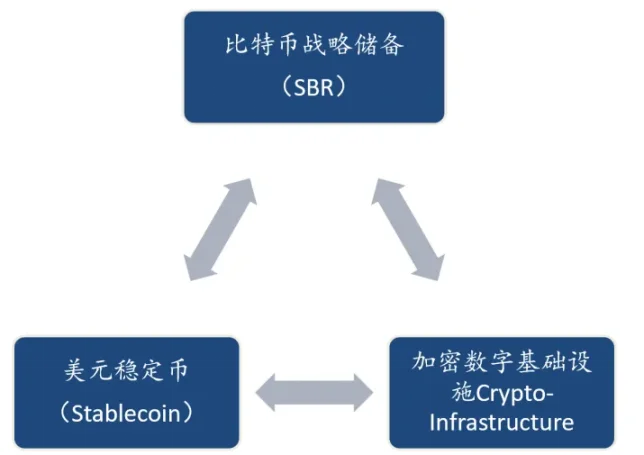
Figure 3: The “Trilateral” U.S. Digital Currency Hegemony System
3. The EU’s policy direction in cryptocurrencies centers on unified market regulation and green financial transition
This is reflected in three aspects: First, the EU’s Markets in Crypto-Assets Regulation (MiCA) fully came into effect on December 31, 2024, aiming to establish a clear, unified regulatory framework across all EU member states. MiCA categorizes all crypto assets into three types subject to differentiated regulation, while strengthening compliance requirements for stablecoin issuers and crypto exchanges. It balances risk management with innovation, safeguarding consumer rights and financial stability. Second, this unified framework lays the foundation for the EU to gain initiative and influence in the global crypto market competition. Third, MiCA guides the green development path of cryptocurrencies—for example, imposing higher carbon taxes on energy-intensive blockchains, pushing the industry from PoW to low-carbon consensus mechanisms like PoS, thus reshaping the regional landscape of mining operations.
4. Other global economies face competitive dynamics between stablecoins and sovereign digital currencies
This manifests in three ways. First, an increasing number of economies are exploring or advancing CBDCs. Around 130 countries and regions worldwide are now researching or piloting CBDCs. China’s digital RMB has expanded steadily in domestic and cross-border trials, making it the largest sovereign digital currency globally. Eighteen G20 members—including Japan, South Korea, India, and Russia—are accelerating CBDC development or considering strategic Bitcoin reserves to assert digital financial sovereignty and rule-setting influence. Second, there is growing competition between sovereign digital currencies and stablecoins. While CBDCs enjoy sovereign backing, dollar stablecoins have gained significant scale advantages: from 2020 to 2024, USDT’s market cap increased 5.52-fold, and USDC rose 11.35-fold, together capturing 90% of the global stablecoin market. Their settlement volume reached $15.6 trillion in 2024. Third, the future of digital currencies faces risks of regional fragmentation. The U.S. seeks to strengthen digital dollar hegemony through SBR, stablecoin legislation, and CBDC restrictions. The EU’s MiCA framework objectively limits non-euro stablecoins. Escalating competition implies a potential split and fragmentation of the global digital payment system.
5. Stablecoins are becoming the frontier of convergence between crypto and traditional financial assets
Two facts stand out. On one hand, stablecoins enhance the resilience of off-chain dollar assets. From 2023 to 2024, stablecoin market caps grew faster than U.S. M2, providing strong support for demand for dollars and U.S. Treasuries amid ongoing high deficits and financial uncertainty. On the other hand, stablecoins are increasingly entering mainstream payment channels. In the first 11 months of 2024, stablecoins facilitated $27.1 trillion in transactions—including substantial P2P and cross-border B2B payments—indicating growing commercial use by enterprises and individuals under regulatory compliance, and closer integration with traditional payment platforms like VISA and Stripe.
New Trends in Cryptocurrency Development Pose Risks and Challenges to China
1. Objectively assessing China’s current strengths and weaknesses in blockchain and cryptocurrency
China's strengths lie in three areas: First, leading deployment in digital RMB and blockchain industries. In the field of central bank digital currencies, the digital RMB is currently the world’s largest CBDC project, backed by national-level strategic support. Since its initiation in 2014, it has steadily advanced, covering retail, wholesale payments, and cross-border settlements. Since 2021, progress in the mBridge (multi-central bank digital currency bridge) project has also been globally pioneering. These foundations position digital RMB as a potential competitor to dollar stablecoins in financial transactions and asset storage. In blockchain, China incorporated the technology into its national strategy early in the industry’s development, clearly advocating its integration with the real economy. The market size and growth potential are substantial—China’s blockchain market is projected to exceed 100 billion RMB by 2025, with widespread applications in finance, supply chains, e-government, and other sectors. Enterprise registrations continue to grow, reaching 63,300 by the end of 2023.
Second, rich application scenarios. Digital currency use cases have expanded from initial domains like retail, transportation, and public services to broader fields including wholesale, dining, entertainment, education, healthcare, social governance, public services, rural revitalization, and green finance. The blockchain industry has mature implementations in supply chain finance, cross-border trade, and e-government.
Third, strict risk prevention. China maintains tight regulation over cryptocurrency trading and initial coin offerings (ICOs), effectively containing virtual economy risks and creating a more controlled and stable environment for compliant digital currency development.
Current weaknesses mainly involve insufficient international competitiveness in certain areas. First, limited influence over technical standards. Regulatory differences have allowed the U.S. to take the lead in core technologies such as zero-knowledge proofs (ZKP) and Layer2 scaling solutions, while the EU has set technological barriers through MiCA—leaving China with relatively weak voice in core protocols and global standard setting. Second, lagging development of public blockchain ecosystems. China’s blockchain industry is dominated by consortium and private chains, lacking robust public chains—resulting in gaps in innovation capacity compared to the West in decentralized finance (DeFi) and Web3.0.
2. The U.S.-led crypto-asset hegemony strategy poses multiple threats to China’s financial security
First, capital outflows and exchange rate pressure. The long-term appreciation trend of crypto assets like Bitcoin against major currencies such as the dollar, combined with the rapid expansion of dollar stablecoin transaction volumes, strengthens the dollar’s dominance in the global monetary system through convenient cross-border payments and value storage functions—thereby squeezing RMB valuation and internationalization space. Moreover, dollar-dominated crypto channels have become a new route for capital flight. The large-scale adoption of Bitcoin by major U.S. corporations and the massive fundraising wave driven by spot crypto ETFs have created a strong “demonstration effect,” potentially enticing some domestic capital to flow abroad through gray-market channels.
Second, DeFi regulatory arbitrage accumulating industrial advantages. The relatively relaxed regulatory and tax environment in the U.S. attracts global DeFi innovation resources, allowing it to capture full-stack technological benefits—from foundational standards to application layers. Over time, this could translate into a competitive edge over China in digital financial infrastructure.
Third, competition over foundational technical standards and innovative resources. On one hand, the U.S. leads in ZKP and Layer2 innovations, while the EU leverages MiCA to consolidate regulatory power and gain network effects from its single market, erecting technical barriers. China must guard against losing influence in global crypto standard-setting. On the other hand, Chinese blockchain innovators face outward migration pressure: favorable carbon policies in the EU and tax incentives for miners in the U.S. are prompting Chinese mining firms and blockchain startups to shift operations to Central Asia, the Middle East, and the U.S.—objectively weakening domestic innovation capacity and computing power security.
Fourth, the threat of U.S. crypto-asset hegemony. First, the U.S. is rapidly integrating mainstream crypto assets into its financial hegemony. If this trend solidifies, it will inevitably constrain China’s strategic room for maneuver in digital finance. Second, following the Russia-Ukraine conflict, the U.S. coordinated with allies including the UK and UAE to impose extensive long-arm financial sanctions on Russian government entities, organizations, and individuals in the crypto space—seizing large amounts of crypto assets and arresting related personnel—demonstrating the emerging power of digital financial dominance. Third, the Trump administration’s push for a Bitcoin strategic reserve and resistance to foreign sovereign digital currencies exacerbates strategic confrontation between China and the U.S. in the digital currency arena.
Of course, crypto assets like Bitcoin currently exhibit severe market bubbles, and sustained price increases are unsustainable. Once the bubble bursts, it could deliver a major blow to the U.S. crypto hegemony strategy. We must remain clear-eyed and strategically resolute, uphold the principle of finance serving the real economy, and stay committed to building a strong financial nation with Chinese characteristics.
Join TechFlow official community to stay tuned
Telegram:https://t.me/TechFlowDaily
X (Twitter):https://x.com/TechFlowPost
X (Twitter) EN:https://x.com/BlockFlow_News