Beyond Trends, Between Cycles: Cold Reflections on Bitcoin's "Pullback Moment"
TechFlow Selected TechFlow Selected
Beyond Trends, Between Cycles: Cold Reflections on Bitcoin's "Pullback Moment"
Every pullback at this moment is a ticket reserved by history for the clear-minded.
 Navigating Web3 tides with focused insights
By: Daii
This morning, Bitcoin's price fluctuated again, dropping below the $77,000 mark and currently oscillating around $80,000. The market appears to have entered another "correction phase." Amid such price swings, many of you are likely pondering the same question:
Should you now "get off to avoid risk" or "buy the dip"?
This question seems simple but is actually complex. Especially in the cryptocurrency market, where short-term volatility is intense and information noise abounds, it’s easy to lose direction. During these “correction moments,” we need calm reflection—shifting our focus away from immediate price movements and placing it within a broader framework of “trends” and “cycles.”
Certainly, whether Bitcoin can continue moving forward remains a shared concern among all its “passengers.” But as we will explore today, the key clues to answering this lie precisely in being “above the trend, between the cycles.”
Today, using the framework of “trend and cycle,” I’ll guide you through the fog for a cool-headed analysis of Bitcoin’s current “correction moment.” First, let’s begin by understanding the basic concepts of “trend” and “cycle.”
A picture is worth a thousand words. The chart below quickly gives us an intuitive grasp of “trend” versus “cycle.” Note that the vertical axis uses a logarithmic scale—where the height from 0 to 1 equals that from 1 to 10—to better visualize early price changes.
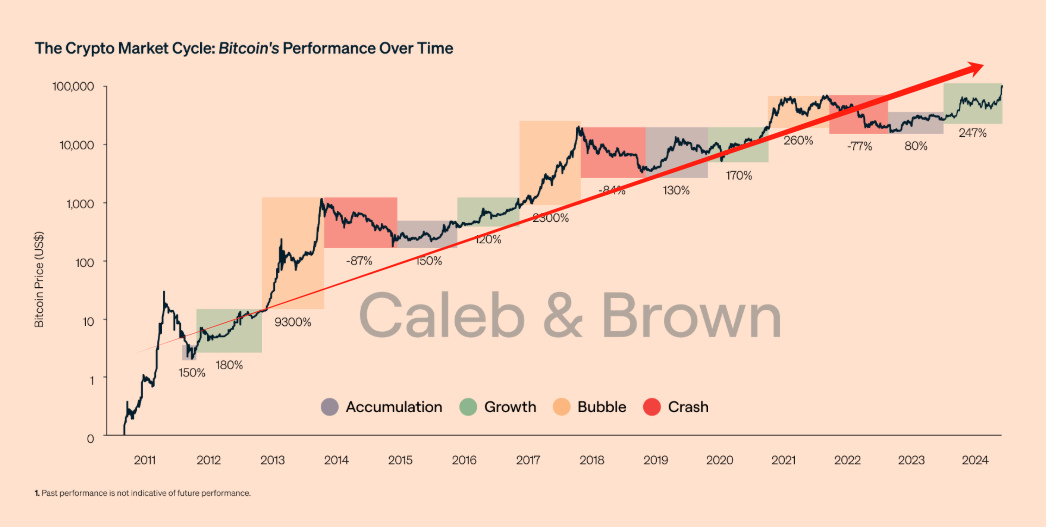
Trend: The red arrow pointing upward represents Bitcoin’s long-term rising trajectory. Will this trend continue? This is the central question we aim to answer today—we'll dive into details shortly. Several key long-term indicators will leave you confident about Bitcoin’s future.
Cycle: The four color-coded blocks represent different stages of a cycle. The phase divisions of the first three cycles are relatively clear. However, the fourth phase starting from 2023 has neither concluded nor reached consensus—this ambiguity is what we need to clarify today. An important contrarian indicator should make your decision to “get on board” much easier.
With this visual aid, you should now have an intuitive sense of trends and cycles. Let’s now take a closer look at exactly what they mean.
1. What Are Trend and Cycle?
To understand any market, one must first distinguish between two fundamental concepts: “trend” and “cycle”—and the crypto market is no exception.
Trend: A trend is the long-term direction of development—a powerful, enduring force reflecting the core essence of change, like a mighty river flowing ceaselessly forward once set in motion.
Cycle: A cycle refers to short-term fluctuations along the path of development—rhythmic oscillations around the trend line.
In short, cycles exist within trends. But mere inclusion doesn’t fully capture their intricate relationship. If we liken the “trend” to a tree trunk, then the “cycle” resembles the concentric growth rings on that trunk.

Just as a tree trunk determines how tall and far a tree can grow, Bitcoin’s long-term trend is shaped by macro forces such as technological innovation, global adoption, institutional participation, and policy evolution. Once established, this trend resembles a relentless river—despite twists and turns, its ultimate destination remains unchanged.
Bitcoin’s short-term cycles, influenced by market sentiment, macroeconomic shifts, sudden events, and capital flows, resemble waves rolling across this river—dramatic and eye-catching, yet transient phenomena within the broader current. In Bitcoin markets, alternating bull and bear phases, as well as daily price swings, fall under cyclical behavior.
Yet often, we struggle to differentiate between trend and cycle. Why is that?
2. Why Is It So Hard to Distinguish Between Trend and Cycle?
The reason is simple—but deeply rooted in human nature and market complexity.
The human brain is naturally more sensitive to change, especially short-term, dramatic shifts. Imagine standing in a forest: your eyes are drawn first to fluttering leaves or a leaping squirrel—not the silent, centuries-old tree towering above. Similarly, in the “digital forest” of cryptocurrencies, our attention is easily captured by daily price moves—the fleeting “waves”—while overlooking the underlying, long-flowing “river” of long-term trend.
Especially in Bitcoin’s case, volatility is so extreme it resembles a “stormy sea.” Daily swings of 10% or even 20% are common. Under such turbulence, investors’ minds feel like small boats tossed by towering waves—how could they possibly perceive the vast ocean currents beneath?

Moreover, humans are inherently loss-averse—driven to seek gains and avoid pain. When prices drop and portfolios shrink, our instinctive fear drives us toward panic selling, leaving little room to consider long-term trends. Conversely, when prices surge, greed kicks in; FOMO (Fear of Missing Out) pushes us to buy high, chasing quick riches—without pausing to ask: Is this driven by structural trend or just temporary cycle?
Even trickier, Bitcoin’s cyclical movements often disguise themselves convincingly as “trend reversals,” making truth hard to discern.
Adding to the confusion, the Bitcoin market is flooded with informational “noise”—like thick fog obscuring our vision and preventing us from detecting the true “signal”: the guiding hand of long-term trend.
Worse still, much of this “noise” is deliberately manufactured—“smoke screens” released by market “whales” or institutions to manipulate perception, mislead retail investors, and serve hidden agendas. For example, during downturns, they spread FUD (Fear, Uncertainty, Doubt) to amplify panic and induce retail holders to sell low. During rallies, they broadcast bullish narratives to lure latecomers into buying at peaks.
Thus, it’s understandable why we sometimes cannot tell whether a decline reflects a “cyclical correction” or a “trend reversal.”
So, where does Bitcoin stand today?
A cyclical correction.
But this answer assumes a critical premise: Bitcoin’s overarching upward trend remains intact. Is that really true? That may be your biggest doubt. And rightly so—we must resolve this first. Because only after determining which way the “ship” is sailing can you decide whether to board it.
3. Why Hasn’t Bitcoin’s Upward Trend Changed?
The answer lies in the grand, persistent forces—the foundational pillars shaping Bitcoin’s long-term trend. Even amid short-term correctionary fog, these pillars remain solid, shining as beacons guiding the trend forward.
3.1 Global Adoption Rate: 96% “Uncharted Territory” Signals Vast Growth Potential
As of 2025, only 4% of the world’s population holds Bitcoin.
At first glance, this number may seem disappointing. But viewed differently, it reveals staggering potential!
Imagine a market of billions, currently penetrated by just 4%, with 96% still unexplored—an untouched frontier ripe for cultivation. Isn’t this an exhilarating “blue ocean” opportunity?
A research report from River confirms this: Bitcoin has achieved less than 4% of its maximum adoption potential. This means Bitcoin’s journey toward global ubiquity is still in its “infancy.” The road ahead is long, and the growth runway exceptionally wide.
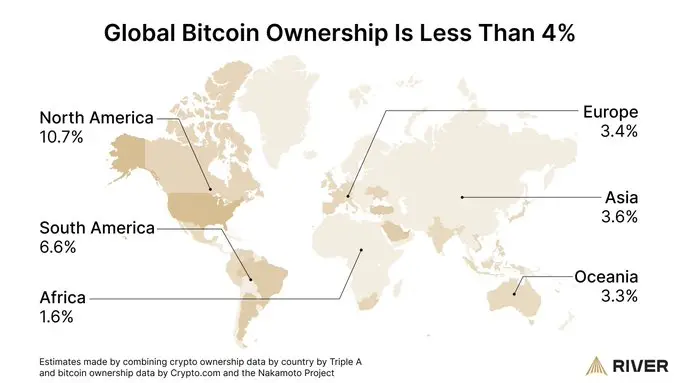
Notably, developing nations and regions will drive future adoption growth. While North America leads in current adoption rates, Africa lags at just 1.6%. This gap highlights immense untapped potential in economically disadvantaged areas.
What does this ~3% global adoption rate actually mean? River’s report offers historical parallels—see the chart below.
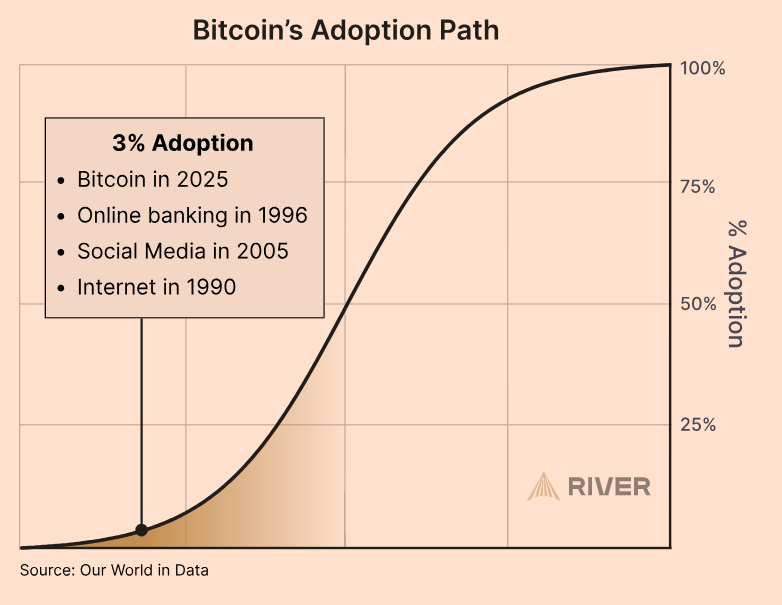
Such low penetration mirrors the internet in 1990, online banking in 1996, or social media in 2005—a time brimming with opportunity. Even if you haven’t boarded yet, there’s still time. Taobao wasn’t the first e-commerce platform, Google wasn’t the first search engine, and Netflix wasn’t the first streaming service.
It’s all just beginning. That 96% “uncharted territory” represents the strongest demographic dividend underpinning Bitcoin’s long-term upward trend!
3.2 The Three Engines: Institutional Entry + Regulatory Clarity + National Reserves
Once dismissed by traditional finance, Bitcoin is now a prized asset eagerly pursued by major institutions.
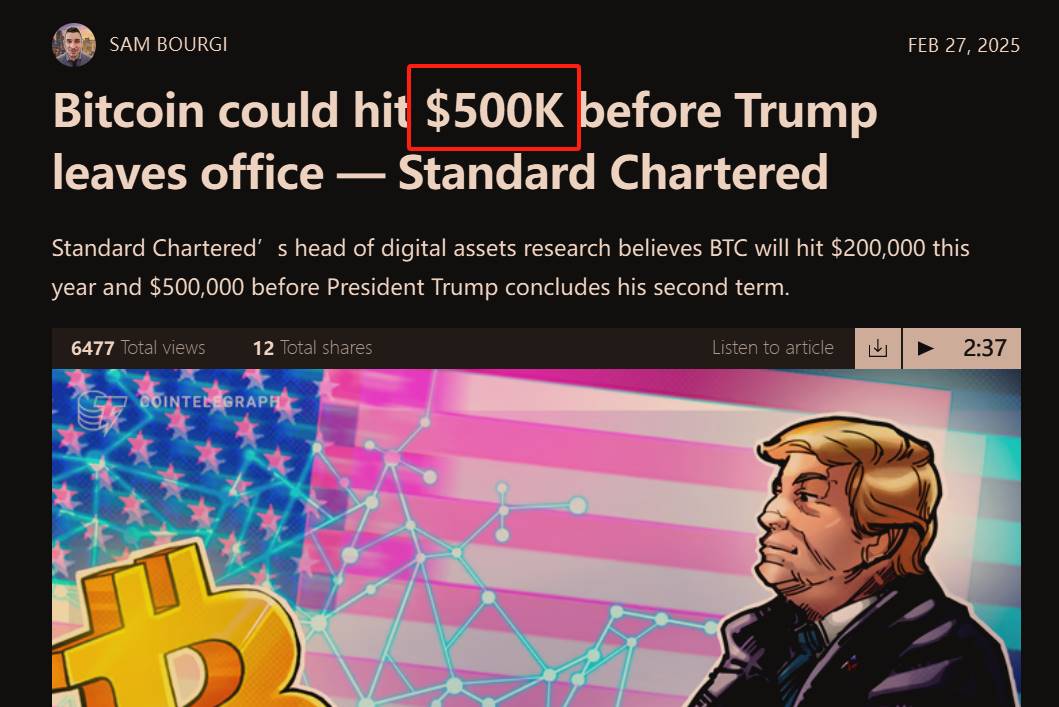
Standard Chartered forecasts Bitcoin reaching $500,000 during Trump’s presidency, citing “growing institutional adoption” as a key driver. Geoffrey Kendrick, Head of Digital Asset Research at Standard Chartered, believes institutional involvement will not only reduce market volatility but also enhance security. Notably, Standard Chartered was the only institution to accurately predict Bitcoin’s current bottom range—$69,000–$76,500.
They also identify clearer U.S. regulatory frameworks as another catalyst.
The Trump administration has not only proposed establishing a “Strategic Bitcoin Reserve” but is actively advancing stablecoin legislation. U.S. Representative Bryan Steil publicly stated that America has significant legislative opportunities in blockchain technology, Web3, and digital assets. Steil currently chairs the House Subcommittee on Digital Assets, Financial Technology, and Artificial Intelligence.
CoinShares’ research report argues that creating a strategic national Bitcoin reserve in the U.S. would have a far deeper long-term impact on Bitcoin adoption than ETF approvals. The market currently undervalues this initiative, overly focused instead on short-term liquidity issues. For a deeper analysis, see Digital Fort Knox: The White House’s Strategic Lockup of 190,000 Bitcoins.
In Europe, banks like DekaBank are enabling crypto trading, while Boerse Stuttgart Digital advances institutional-grade crypto applications. All signs point to accelerating institutional inflows—traditional financial giants are sprinting into the Bitcoin arena.
As regulations become clearer, both institutions and nation-states will hold increasing shares of Bitcoin, becoming dominant forces behind its long-term price appreciation.
3.3 Macro Tailwinds: PMI and M2 Signal “Positive Reversal”
In the short term, Trump’s tariff policies and a strengthening dollar index pose headwinds for Bitcoin. Yet from a broader economic and policy perspective, the long-term bullish trend remains strongly supported.
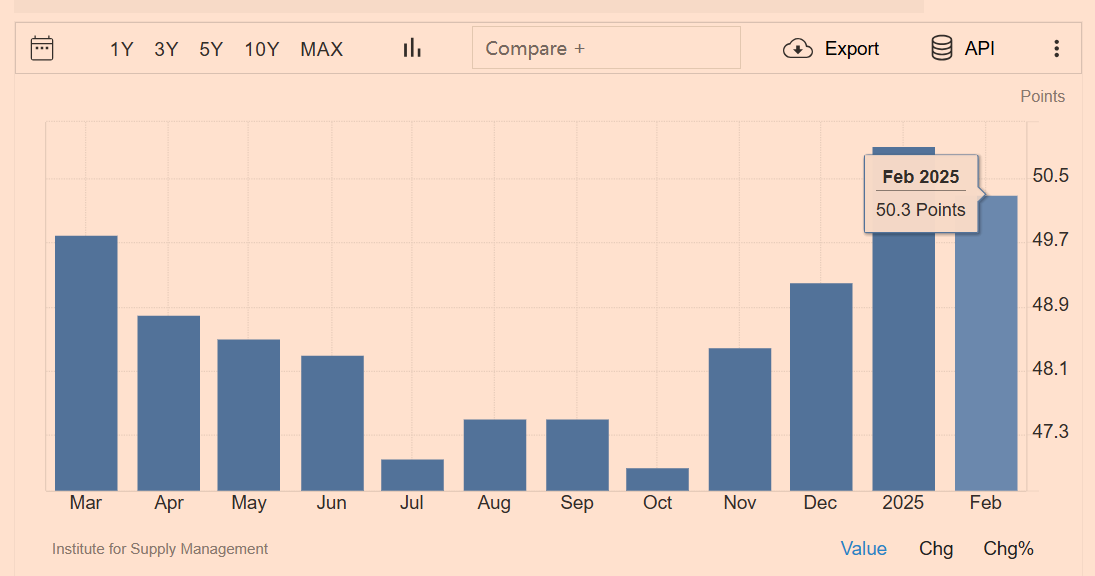
U.S. Manufacturing PMI has now been in expansion mode (above 50) for two consecutive months—an indicator seen as signaling a “positive reversal in the business cycle.” Raoul Pal, founder of Real Vision, notes that PMI leads the economy by about a month—and not just the economy, but all asset classes. He believes that as the business cycle turns upward, Bitcoin could peak by late 2025 or early 2026.
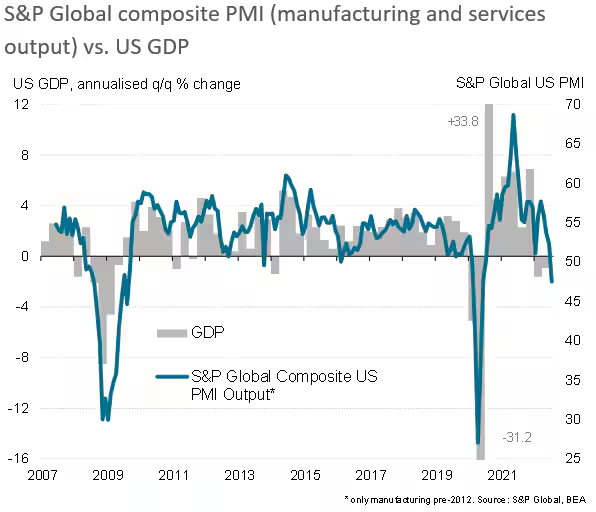
S&P Global Market Intelligence supports Pal’s view (see chart below). You’ll notice that whenever PMI exceeds 50 on the right, GDP experiences varying degrees of growth. Their study claims PMI has predicted “every turning point in returns over the past 14 years.”
Another key metric—the global M2 money supply—is showing a sharp uptick. Real Vision’s research shows Bitcoin prices typically reflect changes in global M2 within about 10 weeks.
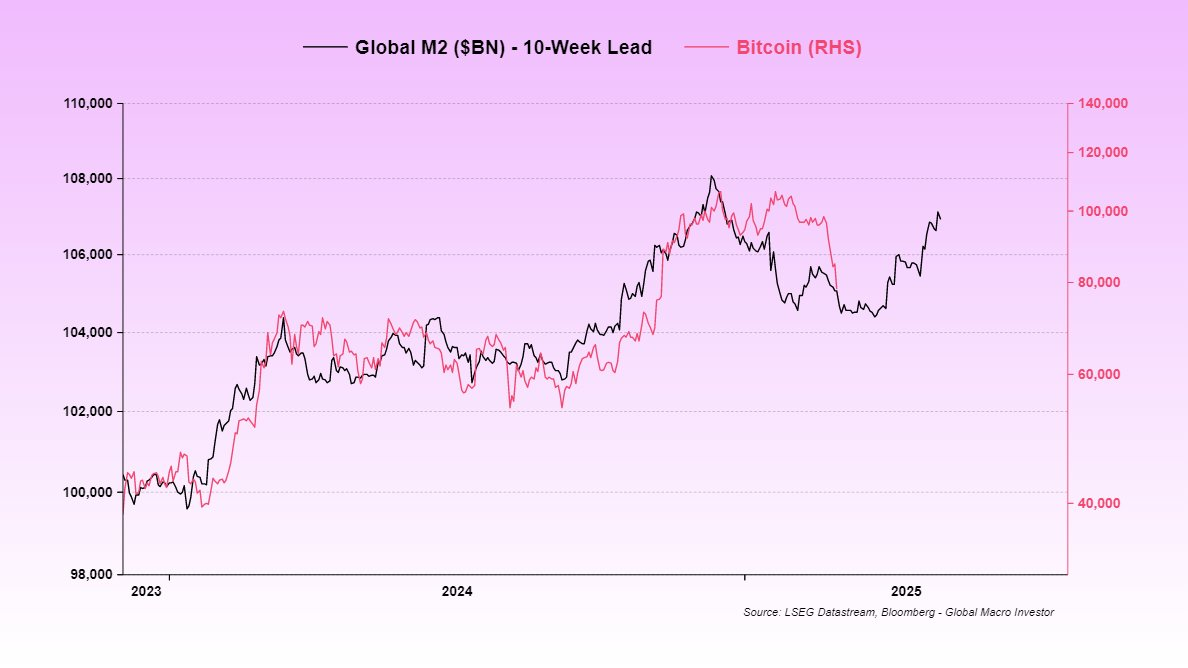
Analyst Colin Talks Crypto even calculated precise lags—46 and 72 days—between global M2 changes and Bitcoin price reactions. Lyn Alden adds: “Bitcoin moves in tandem with global liquidity 83% of the time over any given 12-month period, making it a powerful barometer of liquidity conditions.”
This implies improving global macro liquidity will provide strong tailwinds for Bitcoin’s price ascent.
3.4 Summary: The Three Pillars of Bitcoin’s Long-Term Bullish Trend
Bitcoin’s long-term upward trend remains unchanged, supported by three irreversible macro forces:
- 96% Blue Ocean Market: Only 4% of the global population holds Bitcoin today, with adoption below 2% in developing countries—equivalent to the internet in the 1990s. Its growth potential vastly outweighs short-term volatility.
- Institutional & National Strategy Onboarding: Standard Chartered predicts Bitcoin could reach $500,000 under Trump, as the U.S. establishes a “Strategic Bitcoin Reserve” and accelerates stablecoin regulation. European banks like DekaBank now offer crypto trading—forming a triple engine of “institutions + regulation + sovereign reserves.”
- Macro Cycle Synchronization: Expanding U.S. PMI signals a business cycle turnaround. Global M2 growth correlates with Bitcoin prices at 46–72 day lags. Easing liquidity aligns perfectly with Bitcoin’s “digital gold” narrative, creating long-term synergy.
Therefore, the recent pullback to $77,000 is merely a cyclical ripple—the river of trend continues to surge forward. So, has the $77,000 level bottomed out? Is now a good time to enter?
If you accept the arguments above regarding the enduring trend, the answer becomes self-evident. You may not buy at the absolute bottom, but neither will you buy at the top. The only thing you need to manage is your own desire—avoid excessive leverage.
Conclusion: Be Friends With Time, Dance With the Trend
History doesn’t repeat itself, but it rhymes. Just as gold flowed from the Americas to Europe, fueling the wealth myths of the Age of Exploration; just as the internet moved from labs into homes, reshaping human connectivity—today, we stand at the forefront of a digital asset revolution, witnessing Bitcoin’s epic transformation from code to global value carrier.
When 96% of humanity still doesn’t own Bitcoin, when sovereign funds are adding crypto to their balance sheets, when blockchain becomes a new front in geopolitical competition—this speeding “digital ark” has only just left its dock.
The secret to dancing with the trend isn’t predicting the shape of each wave, but sensing the rhythm of the tide. Investors who held Amazon through the dot-com crash, or bet big on Apple during the dawn of mobile internet, know one timeless truth: trends are never smooth lines—they’re ascending spirals built from countless cycles of volatility. Today’s $77,000 wobble? Merely a brief chord in the symphony of crypto civilization. The main melody continues climbing steadily toward higher ground forged by hash power and trust.
True dancers don’t need spotlights to illuminate the entire path. When 96% of the audience remains seated, when sovereign funds begin adjusting their steps, the wise have already marked their notes on the blockchain score—perhaps stumbling occasionally, perhaps missing a beat, but as long as their feet remain planted on the tectonic shift of technological revolution, they will ultimately witness the reassembly of financial continents.
Trend is the sea; cycle is the boat. Fools measure wave heights. The wise adjust sail angles. Trend sets the overall course; cycles are short-term ripples riding that current. As fiat systems fade into twilight and crypto economies greet the dawn, rather than chasing shadows in the maze of candlestick charts, leap into the torrent of digital civilization—board the ark lifted by the tides of history.
Every correction is a ticket reserved by history—for those who remain awake.
Join TechFlow official community to stay tuned
Telegram:https://t.me/TechFlowDaily
X (Twitter):https://x.com/TechFlowPost
X (Twitter) EN:https://x.com/BlockFlow_News
 @yzdxs8