"Hype brings scrutiny" — Hyperliquid sparks new controversy, raising challenges for public chain ecosystem development
TechFlow Selected TechFlow Selected
"Hype brings scrutiny" — Hyperliquid sparks new controversy, raising challenges for public chain ecosystem development
As a Layer1, Hyperliquid has performed less than satisfactory in terms of decentralized governance and attracting more developers.
 Navigating Web3 tides with focused insights
Author: Frank, PANews
With great popularity comes greater scrutiny. As the most talked-about new Layer1 blockchain in the current market, Hyperliquid has seen its token market cap surpass $11 billion post-airdrop, with fully diluted valuation briefly approaching $35 billion, and exponential growth in ecosystem metrics. While receiving immense market optimism, it has recently sparked considerable controversy.
The criticism mainly centers on Hyperliquid's underwhelming performance as a Layer1 in terms of decentralized governance and attracting developers. Particularly regarding node participation, the network appears heavily centralized, reinforcing skeptics' long-standing perception of Hyperliquid as a "solo-chain." The team has largely acknowledged these issues in their response, stating they will be gradually addressed moving forward.
A Public Letter Triggers Governance Debate
On January 8, Kam, an employee at node operator Chorus One, published an open letter on social media highlighting multiple concerns about Hyperliquid, including closed-source code, black-market trading of testnet tokens, and limited decentralization. This quickly ignited widespread community discussion around Hyperliquid’s governance model.
In the letter, Kam pointed out difficulties in operating testnet nodes due to closed-source software, lack of documentation, and excessive reliance on centralized APIs. He also criticized flaws in the testnet incentive design that led to a black market for test tokens, along with over-concentration among mainnet validators and insufficient decentralization.
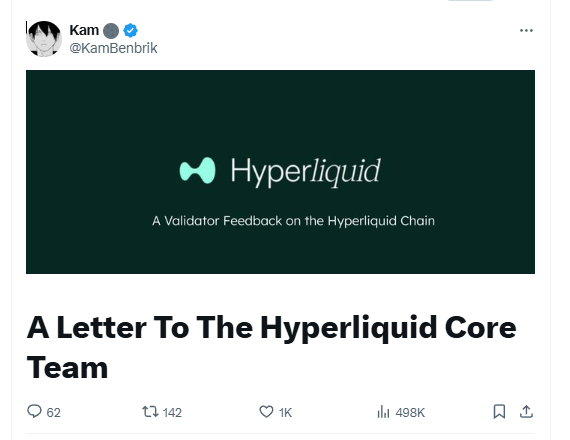
The letter directly accused Hyperliquid of low decentralization, with the official team and foundation maintaining absolute control over nodes and staking. Second, it highlighted opaque technical and operational information—a major obstacle for ecosystem expansion. Third, the economic incentives are inadequate, making it difficult for external operators to cover costs. Fourth, communication between the core team and node operators is poor, leaving operators without timely guidance or effective channels to report issues.
These points align closely with broader industry criticisms of Hyperliquid. In a December research report, prominent asset manager VanEck noted that while Hyperliquid was valued at approximately $28 billion, it had failed to attract a substantial developer community. If developer growth fails to meet expectations, VanEck warned, HYPE’s token price may struggle to sustain its level. Research firm Messari also published commentary on New Year’s Day suggesting Hyperliquid’s strong performance might already be over.
Following Kam’s letter, several figures across the industry joined the debate. Charles d'Haussy, CEO of rival protocol dYdX Foundation, commented: “Closed source + limited number of validators + majority of stake weight under one entity + unclear and insecure bridge multisig setup. The token price trend shouldn’t blind so many people.”
Others countered: “I don’t think a black market for testnet hype is a big issue—we’ve seen this happen on many other protocols.”
Official Acknowledges Issues—Long Road Ahead for Governance
Nonetheless, most voices expressed skepticism toward the extreme centralization. Facing these critiques, Hyperliquid responded swiftly the same day, addressing six key points: 1. All validators were selected based on testnet performance; seats cannot be purchased, and the validator set will expand as the blockchain matures. 2. The network will continue progressing toward greater decentralization. 3. Anyone can run API servers pointing to any node. Example client code sends requests to specific API endpoints, but this is not a fundamental network requirement. 4. A black market for testnet HYPE tokens is unacceptable, and improvements to the testnet onboarding process are ongoing. 5. Node code is currently closed-source. Open-sourcing is important and will occur once development reaches a stable phase. Hyperliquid develops at speeds and scales multiple orders of magnitude beyond most projects, and code will be open-sourced when security allows. 6. Currently there is only one binary. Even highly mature networks like Solana see the vast majority of validators running a single client.
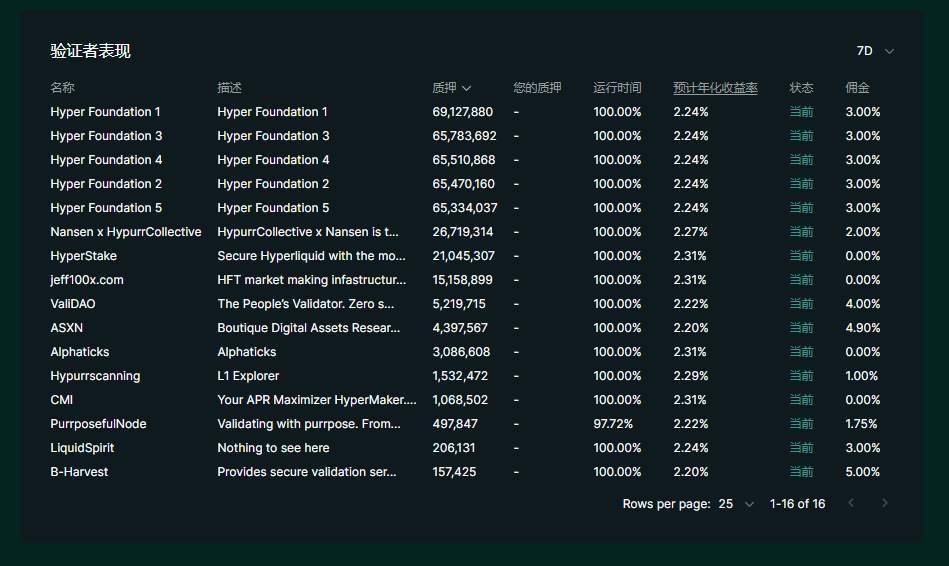
In summary, Hyperliquid did not deny the issues raised by Kam, instead broadly acknowledging their existence while committing to gradual resolution. Current validator data shows the top five staking nodes are all operated by the official team, collectively holding 330 million tokens—more than the combined total of all other nodes. Additionally, although a foundation has been established, no governance voting mechanisms have been launched yet. From these perspectives, Hyperliquid still has a long journey ahead in achieving open governance.
Valuation Game: Layer1 Narrative Helps DEX Outpace Peers
Since its airdrop, Hyperliquid’s ecosystem metrics have surged. As of January 8, cumulative users reached 300,000—an increase of 100,000 in just over a month. TVL peaked at $2.8 billion in December, a 14x monthly increase. According to VanEck, dYdX—the primary competitor—took 15 months to build its ecosystem but never exceeded $600 million in TVL. Hyperliquid’s market cap even exceeds the combined valuations of all competing DEXs.
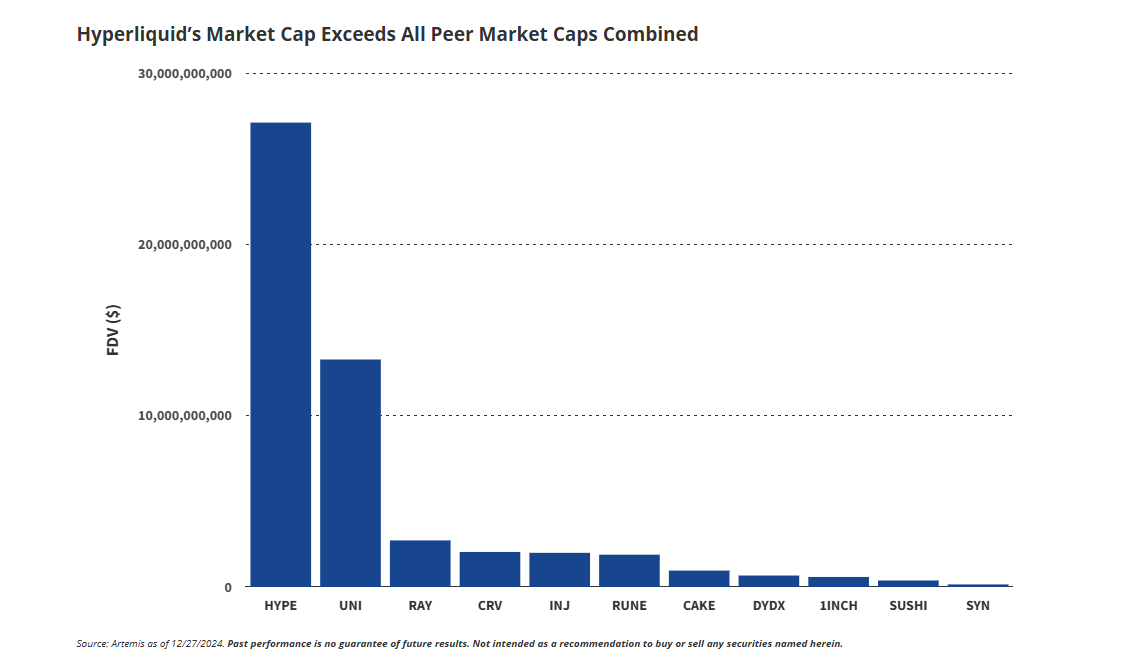
Hyperliquid’s impressive market performance is closely tied to its dual identity as both a Layer1 and a DEX. However, as a Layer1, it remains incomplete. Decentralized governance still lags significantly behind mainstream Layer1s. Moreover, ecosystem diversity needs improvement, with nearly all major applications currently developed and operated by the core team.
As a DEX, however, Hyperliquid offers clear advantages—its independent blockchain infrastructure enables user experience supported by 100,000+ TPS performance.
Thus, if positioned solely as a DEX, Hyperliquid is undeniably successful. But as a Layer1, it still has a long way to go.
Positioning May Be Key to Future Market Valuation
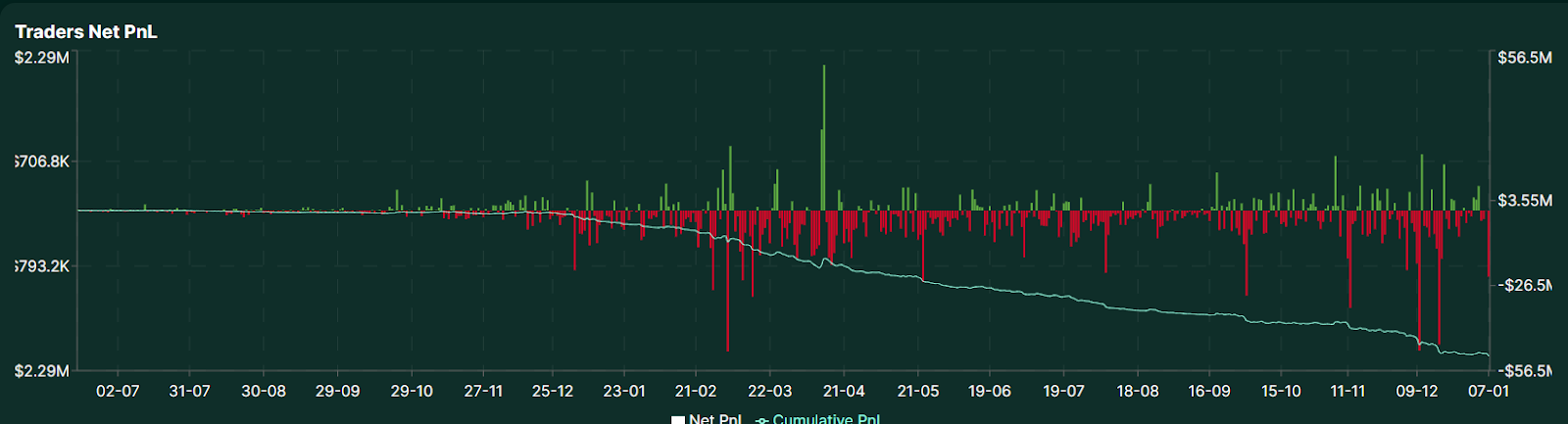
It's also worth noting that many believe Hyperliquid could become the next gold rush after Solana. However, PANews’ analysis of on-chain data reveals a different picture: the net profit and loss curve for traders on Hyperliquid has remained negative over the long term. As trading activity increases, total losses continue expanding. By January 7, 2025, cumulative trader losses reached $51.3 million—nearly 25 times higher than the same period a year earlier. Total liquidation volume hit $6.69 billion, while open interest rose to $3.78 billion. From this perspective, Hyperliquid resembles less a financial platform and more a new on-chain casino.
On January 6, Hyperliquid announced a partnership with Router Protocol to launch a new cross-chain bridge, enabling deposits from over 30 networks including Solana, Sui, Tron, Base, and Ethereum. Compared to the previous limitation of transferring funds only via Arbitrum, this collaboration provides Hyperliquid with more flexible capital inflow channels.
Overall, the controversies surrounding Hyperliquid stem from the same root as the reasons many support it. As an exchange primarily built around a DEX product, its Layer1 functions more as underlying infrastructure supporting that exchange. Critics argue that as a Layer1, Hyperliquid lacks transparency and a decentralized governance framework. Supporters emphasize it is the only DEX equipped with a full-fledged Layer1. For Hyperliquid itself, the path forward will likely remain defined by the tension between these two identities.
If Hyperliquid aims to evolve primarily into a Layer1, its valuation still holds significant upside—but so do the challenges it must overcome. If it remains positioned as a high-performance DEX, its sky-high valuation relative to peers invites skepticism about overpricing. Furthermore, as the ecosystem opens up further and HYPE enters more markets, shedding the “solo-chain” label will bring new layers of market uncertainty. For the Hyperliquid team, navigating this balance is an art. For investors watching closely, it demands meticulous scrutiny.
Join TechFlow official community to stay tuned
Telegram:https://t.me/TechFlowDaily
X (Twitter):https://x.com/TechFlowPost
X (Twitter) EN:https://x.com/BlockFlow_News
 PANews