
Check the BTC National Strategic Reserve Ranking: Who Holds More, China or the US?
TechFlow Selected TechFlow Selected
Check the BTC National Strategic Reserve Ranking: Who Holds More, China or the US?
Bulgaria and Germany become the "clowns selling BTC," four-tier格局 already formed.
 Navigating Web3 tides with focused insights
Author: Wenser, Odaily Planet Daily
With less than two weeks remaining before Trump takes office as U.S. President, speculation is mounting over a series of policy announcements expected on January 20—his first day in office. Among the most discussed topics is whether Trump will push for the United States to establish a national strategic bitcoin reserve. In this article, Odaily Planet Daily compiles data on countries currently holding bitcoin, offering readers an early look at the current landscape of national bitcoin reserve strategies.
Bitcoin National Reserve Rankings: Four Tiers, Total Holdings Exceeding 510,000 BTC
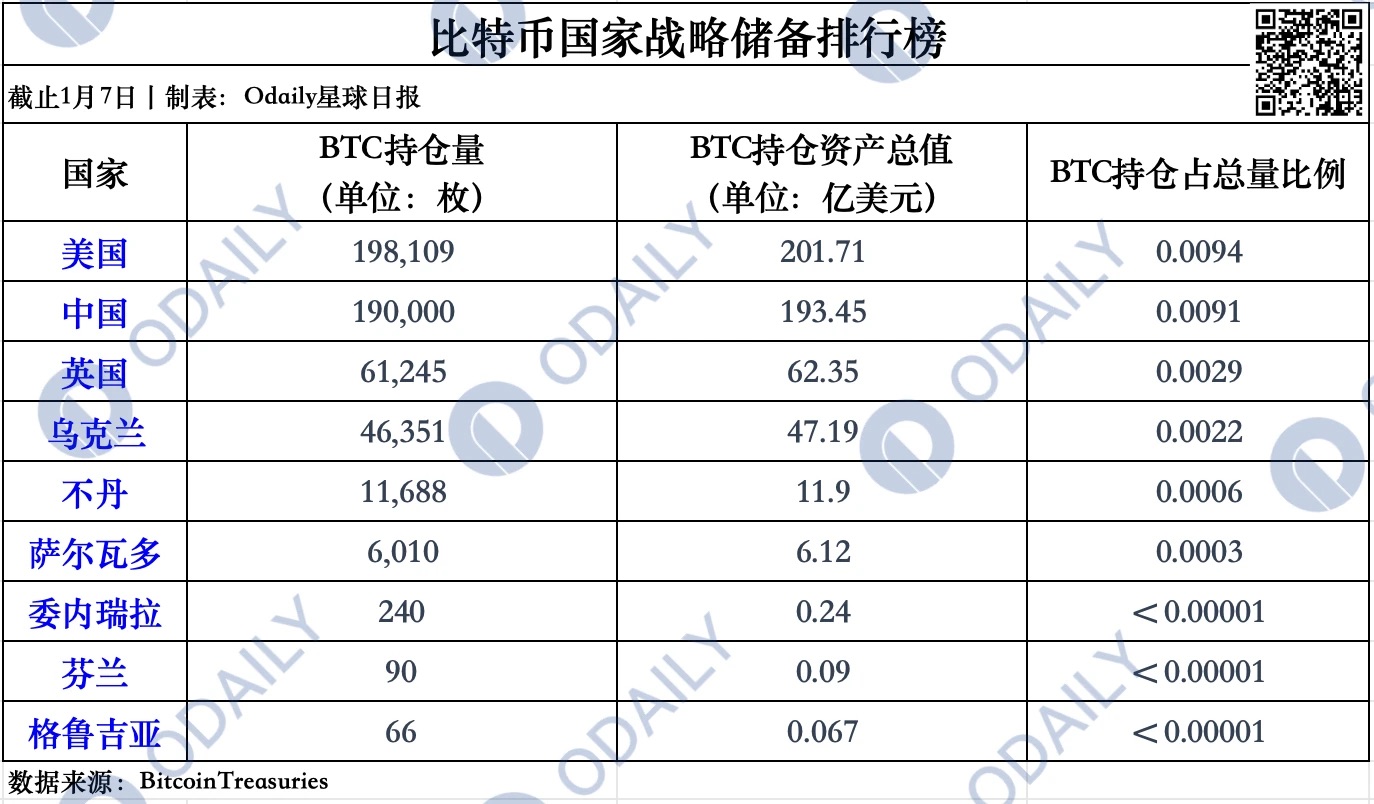
Overview of National BTC Reserves
First Tier: The U.S. and China Lead by a Wide Margin
The largest holders are undoubtedly the United States and China. The U.S. currently holds 198,109 BTC, valued at $20.171 billion, accounting for approximately 0.94% of the total BTC supply. China holds 190,000 BTC, worth $19.345 billion, representing about 0.91% of the total supply.
According to BitcoinTreasuries.org, all of the U.S. government’s BTC holdings were seized from assets related to the Silk Road marketplace. Notably, Trump previously pledged to release Silk Road founder Ross Ulbricht upon taking office—an announcement that could become a major talking point. As for China, sources suggest its BTC holdings likely stem primarily from the 2020 PlusToken hacker incident, during which authorities confiscated around 194,000 BTC. Some analysts believe China's actual holdings may exceed this figure.
Second Tier: United Kingdom and Ukraine Follow Behind
Compared to the top tier, the UK and Ukraine hold significantly smaller amounts.
The UK possesses 61,245 BTC, valued at approximately $6.24 billion. According to reports, these bitcoins were also obtained through asset seizures originating from China. In January 2024, Skynews reported that a woman who once worked as a food delivery driver at a Chinese restaurant was investigated after attempting to purchase a £23.5 million mansion in Hampstead. Police subsequently seized bitcoins worth over £1.4 billion. The 42-year-old woman, identified as "Ms. Wen," allegedly acted as a front for Qian Zhimin, helping launder proceeds from a £5 billion investment fraud scheme carried out in China between 2014 and 2017. At the time, British authorities confiscated around 61,000 BTC. Later, according to on-chain data from Arkham Intelligence, the UK government purchased an additional 245 BTC in September 2024 at an average price of $59,376, bringing its total holdings to 61,245 BTC.
Ukraine holds 46,351 BTC, worth about $4.72 billion. There is no definitive public information on how Ukraine acquired its BTC, but aggregated data indicates it began accumulating on September 14, 2022, when BTC was priced at just $20,185—less than a fifth of its current value above $100,000, implying gains exceeding 400%. Given the outbreak of the Russia-Ukraine war earlier that year, it is widely speculated that part of Ukraine’s holdings came from cryptocurrency donations made in support of the country.
Third Tier: Bhutan and El Salvador Emerge as Committed Holders
Bhutan and El Salvador stand out as nations actively embracing long-term bitcoin holding.
Bhutan’s BTC holdings originate largely from royal family mining operations. It currently holds over 11,000 BTC, valued at $1.19 billion. However, the Bhutanese monarchy has not been a strict “diamond hand” holder; it has periodically sold small amounts. For example, in December last year, it sold 420 BTC at around $98,000 each and another 103 BTC at approximately $97,000.
In contrast, El Salvador exemplifies unwavering commitment. It was the first country to adopt bitcoin as part of its national strategy and has consistently followed through with its pledge to buy one BTC per day. Additional purchases have further increased its holdings. Latest on-chain data shows El Salvador now holds around 6,010 BTC, worth $612 million.
Fourth Tier: Venezuela, Finland, and Georgia Hold Minimal Amounts
Countries in the fourth tier hold only hundreds or even dozens of BTC.
Venezuela, long plagued by hyperinflation, has seen various crypto-related developments—including the president using cryptocurrencies to circumvent U.S. sanctions, state oil companies adopting USDT, and authorities seizing over 11,000 bitcoin miners while cutting power to multiple mining sites. In September last year, opposition leader María Corina Machado proposed adopting bitcoin as a national reserve asset. Current figures come from Forbes magazine.
Finland once held up to 1,981 BTC, valued at nearly €75 million, mostly seized by Finnish customs during anti-drug raids prior to 2018. After the outbreak of the Russia-Ukraine war in 2022, Finland sold 1,891 BTC for $47.35 million at an average price of around $23,000.
Georgia’s BTC holdings remain shrouded in mystery. According to BitcoinTreasuries.org, the country owns 66 BTC, purchased in September 2022 at an average price of $20,185—but no further details are publicly available.
Other Nations: Bulgaria and Germany, the Ultimate “Sold Too Early” Cases
Beyond the ranked tiers, Bulgaria and Germany warrant special mention due to their high-profile BTC sales.
Media reports indicate Bulgaria once seized over 200,000 BTC from criminals. The Southeast European Law Enforcement Center (SELEC), a regional body comprising 12 member states including Bulgaria, announced the confiscation of 213,519 BTC following the arrest of 23 Bulgarian nationals linked to a customs fraud investigation. At the time, BTC traded around $15,524, giving the haul a market value of roughly $3.3 billion. A 2022 media report revealed that the Bulgarian government secretly sold the entire stash to Asian investors and sovereign wealth funds at an average price of $16,900, raising about $3.6 billion—funds reportedly used to equip a new air squadron for the Bulgarian military. With BTC now trading well above $100,000, that decision represents an opportunity cost of nearly $17 billion—possibly the most expensive sale in history.
Germany offers another striking case of selling too early—and a much more recent one. In June 2024, the German government liquidated all 50,000 BTC seized from the pirated movie site Movie2k, selling at an average price of around $60,000. The massive sell-off caused BTC’s price to drop sharply by about 15%, triggering market panic. Just months later, following Trump’s successful election as U.S. president, bitcoin surged past new highs, reaching approximately $108,000. To many in the crypto community, Germany became the “biggest clown in crypto history”—having missed out on over $2.5 billion in potential gains in less than six months.
It’s a sobering reminder that even nation-states can struggle to hold onto windfall gains—sometimes, timing and fate matter most.
Conclusion: The Era of National Bitcoin Reserves Has Yet to Begin
Recent developments suggest momentum is building. Dennis Porter, co-founder of the Satoshi Action Fund—a group advocating for a U.S. national bitcoin reserve—announced that the 14th U.S. state is now preparing to introduce legislation for a strategic bitcoin reserve. Meanwhile, Simon Gerovich, CEO of Japanese-listed company Metaplanet—which saw its stock surge after emulating MicroStrategy’s BTC-buying strategy—previously stated that if Trump adopts a national bitcoin reserve, other Asian nations might follow suit.
On Kalshi, a prominent U.S. prediction market, the probability that Trump will push for a national bitcoin reserve by January 2026 currently stands at 53%, down from a peak of 67.6%, indicating waning confidence amid political uncertainties.
Clearly, fulfilling Trump’s promise made at the Nashville Bitcoin Conference will require overcoming significant hurdles. Nevertheless, the continuous inflow of capital into spot BTC ETFs is undeniable, and the mainstream adoption of cryptocurrencies continues to accelerate. 2025 is poised to be another pivotal year for expanding crypto penetration.
Will U.S. BTC holdings grow further? Will a U.S. strategic bitcoin reserve finally materialize? And if so, what form will it take?
Only time will reveal the final answers.
Join TechFlow official community to stay tuned
Telegram:https://t.me/TechFlowDaily
X (Twitter):https://x.com/TechFlowPost
X (Twitter) EN:https://x.com/BlockFlow_News
 Odaily