
Liquidity fund, the key driver of success for crypto projects
TechFlow Selected TechFlow Selected
Liquidity fund, the key driver of success for crypto projects
Collaborating with liquidity fund managers can significantly enhance a project's success rate and market impact.
 Navigating Web3 tides with focused insights
Author: Ray
Translation: TechFlow
Liquid funds are regaining prominence: November is expected to be the strongest month for liquid funds in this cycle, and the fourth-best performing month since @L1D_xyz began tracking allocations back in November 2018!
(TechFlow note: A liquid fund refers to capital that can be readily deployed to meet withdrawal demands from investors, characterized by high liquidity and safety.)
This performance data could attract significant institutional inflows. As asset under management (AUM) between venture capital (VC) and liquid funds gradually rebalances, let’s explore why an increasing number of crypto project founders are partnering with liquid funds, and how they leverage such capital.
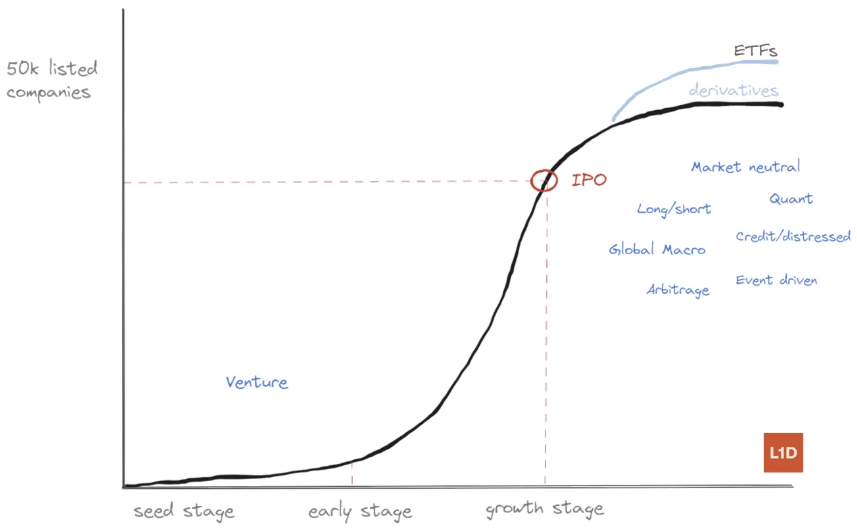
In traditional finance (TradFi), alternative asset managers support companies across different growth stages via a classic S-curve framework.
-
Venture stage: From seed to Series A, companies typically focus on validating product-market fit (PMF), scale operations between Series B-D, and eventually move toward an initial public offering (IPO).
-
Public markets stage: During IPOs, investment banks guide price discovery, while hedge funds manage ongoing price discovery post-listing and handle complex matters like corporate actions and restructurings.
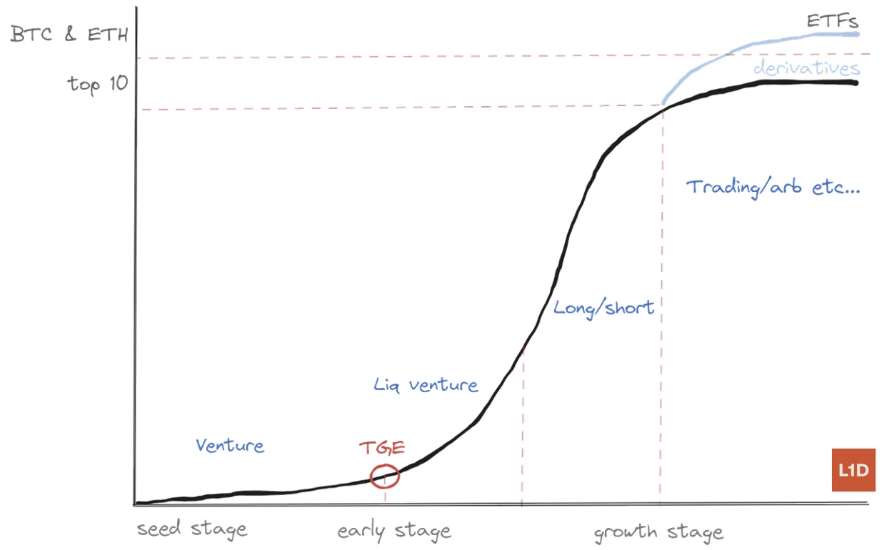
Similarly, in crypto, although many networks often start with venture funding, they achieve liquidity through token generation events (TGEs). This mechanism marks a fundamental shift in capital market dynamics.
Given that crypto projects gain access to liquidity at early stages, liquid funds become especially critical for founders.
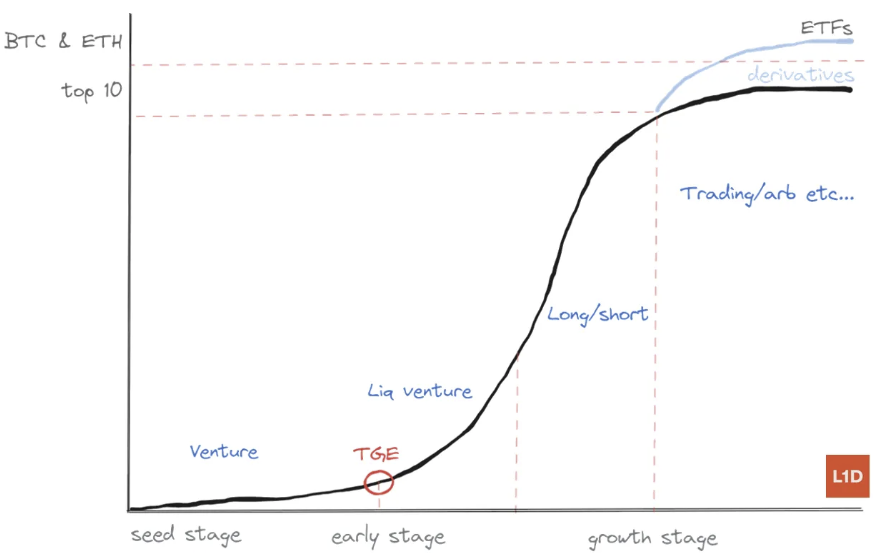
Understanding the transition process as projects move from private rounds into liquid phases is crucial. At this point, tokens are not just fundraising instruments—they are integral components of the core product. The quality of token issuance profoundly impacts a project's market performance and long-term viability.
Many new founders require assistance during this phase—such as establishing exchange relationships or designing tokenomics and product structures appealing to active investors and crypto degens.
In these ways, liquid funds not only provide early-stage capital but also serve as essential tools enabling founders to achieve project success.
Collaborations with seasoned liquid fund managers highlight the importance of expertise in navigating the complex crypto landscape. Figures like @leptokurtic_ (from Ethena) exemplify this trend.
Liquid venture and long-short funds play vital roles in price discovery during token generation events (TGEs) and risk management over subsequent years. Below are key forms of support provided by liquid funds:
-
Raise visibility and market awareness: @multicoincap actively participates across multiple ecosystems and sectors (e.g., Solana, decentralized physical infrastructure networks DePIN, fully homomorphic encryption FHE), frequently sharing public insights into their investment thesis and views on liquid tokens.
@Arthur_0x (from DeFiance) recently introduced the narrative of a "DeFi Renaissance," which successfully inspired many founders and revitalized interest in decentralized finance.
-
Introduce aligned investors: Fair-launch projects like Aerodrome have recently leveraged introductions from respected investors to build bridges into crypto capital markets, accelerating development.
-
Support narrative pivots and rebranding:
Many founders from the previous cycle achieved successful pivots with help from liquid funds. For example, Kevin Hu and his Nova Fund (BH Digital) team were early supporters of TON, helping it regain market attention.
-
Optimize capital structure:
Liquid funds can help maintain a healthy cap table by providing liquidity to early, fatigued investors. For instance, locked SOL from the FTX estate was effectively managed through such mechanisms.
-
Provide locked total value locked (TVL) at protocol launch:
In the early days of a protocol launch, liquid funds can boost market confidence by supplying initial TVL. For example, Kevin and his Nova Fund (BH Digital) team, along with @CryptoHayes, provided critical early TVL support for Ethena.
-
Develop product strategy and roadmap:
Liquid fund managers offer more than capital—they assist founders in crafting clear product strategies and future development plans.
-
Token design and economic model restructuring:
For example, @TheiaResearch assisted HoudiniSwap (a fair-launch project) in redesigning its tokenomics to better align with market demand and investor appeal.
Partnering with liquid fund managers can significantly increase a project’s chances of success and market impact. Founders should fully leverage this valuable resource to navigate the complexities of crypto capital markets.
Some active liquid fund managers in the crypto space (non-exhaustive list):
-
Liquid venture funds: @multicoincap, @1kxnetwork, @paraficapital, @DeFianceCapital, @TheiaResearch, @SyncracyCapital, @Modular_Capital
-
Long-short funds: Republic Digital (Joe, @dim_ss, Armaan and Gabriel), Nova Fund (BH Digital) (Kevin and @ashwinrz team), BLC...
Disclaimer: @L1D_xyz has invested in many of the funds mentioned above.
Join TechFlow official community to stay tuned
Telegram:https://t.me/TechFlowDaily
X (Twitter):https://x.com/TechFlowPost
X (Twitter) EN:https://x.com/BlockFlow_News
 @Ray_L1D