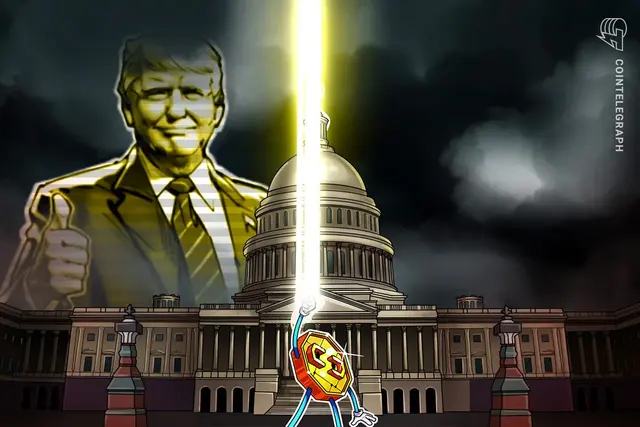
Trump's Commerce Secretary Teams Up with Tether, U.S. Bitcoin Strategic Reserve Begins to Take Shape
TechFlow Selected TechFlow Selected
Trump's Commerce Secretary Teams Up with Tether, U.S. Bitcoin Strategic Reserve Begins to Take Shape
Can 1 million BTC absorb $36 trillion in national debt after a dream collaboration between crypto and traditional finance?
 Navigating Web3 tides with focused insights
Author: Wenser, Odaily Planet Daily
Breaking news: Howard Lutnick, President-elect Trump's nominee for Secretary of Commerce, is currently in talks with Tether, the world’s largest stablecoin operator, to launch a project that would use bitcoin as collateral to provide dollar loans to clients, with an initial funding of $2 billion. According to sources, Lutnick’s financial services firm, Cantor Fitzgerald, is seeking support from Tether, and the final scale of the project could reach tens of billions of dollars.
Previously, it was reported that over half of Tether’s stablecoin reserves—approximately $39.2 billion—are managed by Cantor Fitzgerald. As one of only 25 primary U.S. Treasury dealers authorized to trade directly with the Federal Reserve and a well-known Wall Street bond trader, the company earns tens of millions of dollars annually from these operations.
Meanwhile, the total U.S. national debt has hit a record high, surpassing $36 trillion. Combined with Trump’s previous statements about creating a “strategic bitcoin reserve” to address the national debt crisis, market observers believe this may signal the imminent start of America’s strategic bitcoin reserve initiative.
Odaily Planet Daily will provide an in-depth analysis of the history, current developments, challenges, and potential implications of the U.S. strategic bitcoin reserve plan for readers’ reference.
Dreaming Back to the Beginning of the “Strategic Bitcoin Reserve”: Campaign Rhetoric or Policy Blueprint?
Looking back, the idea of a “strategic bitcoin reserve” first emerged around July this year:
In early July, German MP Joana Cotar strongly criticized her government’s decision to sell large amounts of bitcoin, urging Germany to reconsider its strategy and compare it with “discussing the use of bitcoin as a strategic reserve currency with the United States.” As we now know, based on recent all-time high bitcoin prices, the missed profit from Germany’s premature sales has ballooned to $2.03 billion.
Late in the same month, Ari Paul, founder and CIO of BlockTower Capital, said the prospect of the U.S. government holding bitcoin as part of its strategic reserves could be “bullish” for the price, but achieving this in the short term was unrealistic. He noted, “While the next president might say they ‘won’t sell’ any of the government’s current bitcoin holdings, that doesn’t mean they’re actually establishing a ‘strategic bitcoin reserve.’” This reflected the prevailing market sentiment at the time—many believed Trump’s comments were primarily aimed at signaling pro-crypto sentiment to win votes from crypto investors, rather than a genuine plan to build a national bitcoin reserve.
But soon after, the narrative shifted dramatically—Trump’s clear remarks at the Nashville Bitcoin Conference at the end of July proved many market analysts wrong.
As quoted from Trump’s Full Speech at the Bitcoin Conference: Establishing a Strategic Bitcoin Reserve and Firing Gary Gensler:
If cryptocurrency defines the future, I want it mined, minted, and produced in the United States—not elsewhere. If Bitcoin is going ‘To Da Moon,’ I want America to lead that trend... I’m proud to be the first major-party candidate in American history to accept Bitcoin and cryptocurrency donations.
Bitcoin represents freedom, sovereignty, and independence from government coercion and control. The Biden-Harris administration’s suppression of cryptocurrency and Bitcoin is wrong and deeply harmful to our nation. We will keep every single job related to Bitcoin in America. That’s what we’ll do. Immediately upon taking office, I will establish a Presidential Advisory Committee on Bitcoin and Cryptocurrency.
Bitcoin does not threaten the dollar. What truly threatens the dollar is the behavior of the current U.S. government. The danger to our financial future does not come from cryptocurrency, but from Washington, D.C.—from trillions of dollars in waste, rampant inflation, open borders, and providing benefits and free healthcare to millions of illegal immigrants flooding into our country. The absurd trillions approved by our opponents (referring to the Democratic administration) have led to the inflation disaster long predicted by Bitcoin supporters. Every dollar has rapidly lost 20%, 30%, even 40% of its value. You understand this, but many others don’t. Millions of Americans’ life savings are being destroyed rapidly. Uncontrolled inflation is a hidden tax on the middle class. Indeed, it is a stealth tax. I call it the ‘Biden tax.’
With low energy costs, America will become the world’s recognized leader in Bitcoin mining.
The federal government holds nearly 210,000 bitcoins—about 1% of the total supply. But for years, our government has violated the most basic principle known to every Bitcoin enthusiast: ‘HODL, don’t sell.’ Am I right? How can I possibly understand this? Never sell your Bitcoin.
The federal government holds nearly 210,000 bitcoins—about 1% of the total supply. If I am elected, my administration’s policy will be that the United States will retain 100% of all Bitcoin it currently holds or acquires in the future—effectively forming the core of a national strategic Bitcoin reserve. We will take steps to transform this immense wealth into a permanent national asset that benefits all Americans.
Now, following Trump’s victory, the formation of a crypto advisory committee is already underway, and numerous figures in the crypto industry have begun engaging with the incoming administration. Naturally, the previously confirmed “national strategic bitcoin reserve” remains a focal point for countless participants in the crypto sector.
Later in July, Senator Cynthia Lummis introduced the “BITCOIN Act of 2024,” calling for the annual purchase of 200,000 bitcoins, aiming to accumulate 1 million bitcoins within five years—approximately 5% of Bitcoin’s total supply. The bill proposes using existing U.S. Treasury funds, allocating amounts equivalent to those used for gold purchases. Within less than 48 hours, U.S. senators supporting the bill received over 2,200 letters urging them to co-sponsor and support Senator Lummis’s “Strategic Bitcoin Reserve Act.” Lummis previously stated: “U.S. national debt has reached $35 trillion. A strategic bitcoin reserve could stop this runaway train and help future generations pay off the national debt.”
In early August, Trump mentioned in an interview that Bitcoin could be used to repay the U.S. government’s $35 trillion national debt and avoid an impending debt crisis. His exact words were: “Maybe we’ll repay the $35 trillion—we’ll give them a little crypto check, right? We’ll give them some Bitcoin and wipe out our $35 trillion.”
Clearly, Trump had already laid out a preliminary vision for the “purpose” of the strategic bitcoin reserve—using appreciating Bitcoin to repay accumulated massive debts.
OKX CEO Star and MicroStrategy founder Michael Saylor also shared their views on the U.S. strategic bitcoin reserve plan. The former believes “every central bank in the future will hold substantial Bitcoin reserves”; the latter likened the move to another “Louisiana Purchase moment” for America (Odaily note: Thomas Jefferson’s 1803 acquisition of the Louisiana Territory for $15 million nearly doubled the size of the U.S., suggesting this reserve plan is a pivotal step toward securing Bitcoin dominance), elevating its historical significance.
After Trump won the presidential election in early November, Cynthia Lummis posted: “The future is ₿right,” adding, “We will build a strategic Bitcoin reserve,” accompanied by the iconic “laser eyes Bitcoin to $100k” profile picture—an image that now appears remarkably prescient as Bitcoin approaches $100,000.

Laser eye avatar posted by Cynthia Lummis
Taken together with Trump’s approval of Elon Musk’s creation of the Department of Government Efficiency (DOGE), the U.S. strategic bitcoin reserve plan was never merely campaign rhetoric to win votes—it is also a policy measure designed to alleviate growing national debt pressures and curb inflation. At this point, action is inevitable.
Undoubtedly, this move is now on Trump’s official agenda. The next question is: how exactly will the strategic bitcoin reserve be implemented?
The Strategic Bitcoin Reserve in Motion: Covert Advancement or Open Declaration?
According to Senator Cynthia Lummis’s proposed “BITCOIN Act of 2024,” the legislation is primarily defined as a “Bitcoin Purchase Program”:
The plan calls for purchasing up to 200,000 bitcoins annually for five years, totaling 1 million bitcoins—about 5% of Bitcoin’s total supply. Purchases will be conducted transparently and strategically to minimize market disruption. The goal is to ensure the U.S. government holds a significant Bitcoin position over the next two decades, serving as a long-term financial hedge. The bill proposes using existing Federal Reserve and Treasury funds to buy Bitcoin. Specific mechanisms include revaluing the Federal Reserve’s gold certificates to reflect current market prices and using the surplus for Bitcoin purchases. Additionally, the bill aims to reduce excess capital held by Federal Reserve banks, redirecting those savings toward the Bitcoin purchase program.
Under the bill, government-purchased bitcoins must be held for at least 20 years. During this period, they cannot be sold, exchanged, or auctioned unless used to repay national debt. After the initial holding period, no more than 10% of the reserve may be sold every two years. This rule ensures long-term stability while allowing flexibility to meet future economic needs.
On November 14, FOX News reported that Pennsylvania Republican Congressman Mike Cabell introduced the “Pennsylvania Strategic Bitcoin Reserve Act” (Odaily Planet Daily note: Notably, Pennsylvania became the first state to pass legislation allowing direct Bitcoin purchases; earlier laws focused on individual rights via the “Bitcoin Bill of Rights”). The bill would allow the state treasury to allocate 10% of its approximately $7 billion in state funds to Bitcoin to combat inflation and diversify investments beyond traditional assets like bonds and cash. Media reports indicate the bill would permit investing 10% of certain funds—including the general fund, rainy-day fund, and state investment fund—in Bitcoin. According to Pennsylvania’s 2023 Treasury Annual Investment Report, these funds manage roughly $51 billion, meaning a 10% allocation would represent about $5.1 billion in Bitcoin investment.
On November 17, Dennis Porter, CEO of the U.S.-based Bitcoin advocacy group Satoshi Action Fund (SAF), announced the organization had “open-sourced” its Strategic Bitcoin Reserve policy model, stating:
Inflation has severely eroded the purchasing power of state finances and retirement funds across the U.S., impacting citizens’ economic well-being. While state governments cannot control federal monetary supply or macroeconomic policy, they have a duty to protect their states’ fiscal health.
As an anti-inflation asset, Bitcoin has surged in market value to over $1 trillion in the past 16 years. It is increasingly accepted as money and can be considered an inflation hedge. The proposal urges states to adopt Bitcoin as protection against inflation.
State treasurers may invest public funds from the following accounts in Bitcoin: 1) State General Fund; 2) Budget Stabilization Reserve Fund; 3) State Investment Fund; 4) Other state funds deemed appropriate by the legislature.
Investments in Bitcoin must not exceed 10% of the account’s total funds.
Acquired digital assets should be held through one of the following methods: A. Direct custody by the state treasurer using secure custodial solutions; B. Held on behalf of the state by qualified custodians; C. Held via exchange-traded products issued by registered investment companies; D. Under rules that do not increase state financial risk and comply with regulations, the treasurer may use digital assets for lending to generate additional yield.
Combining this with the ongoing discussions between Trump’s nominee Howard Lutnick and Tether, we can summarize the likely implementation paths for the U.S. strategic bitcoin reserve as follows:
-
Federal government direct intervention: Using funds from the Federal Reserve and Treasury for large-scale market purchases. This approach is the most aggressive and therefore least likely;
-
State-by-state adoption: Following Pennsylvania’s lead in allowing state-level fund investments, with SAF currently negotiating similar legislation in 10 other states—placing this option at moderate likelihood;
-
Hybrid model combining existing government holdings and crypto industry collaboration: This path leverages the government’s current holdings of over 210,000 bitcoins as a foundation while fostering a pro-crypto regulatory environment and industry growth—making it the most plausible route.
Nonetheless, Trump still faces tangible challenges in turning the strategic bitcoin reserve into reality.
Obstacles on the Path to a “Strategic Bitcoin Reserve”: Time, Law, and Market
In short, the road forward for a strategic bitcoin reserve involves addressing several key issues:
Time Constraints: 100 Days or More?
Republican Senator Cynthia Lummis expressed hope to push her reserve bill nationwide within the first 100 days of Trump’s presidency (Odaily Planet Daily note: Trump is set to officially assume office on January 20; 100 days brings us to late April 2025).
Analyst PlanB shared his forecast for Bitcoin’s price trajectory in the coming years back in September, stating:
November: Trump wins the election, ending Democratic suppression under Biden/Harris/Warren/Gensler; Bitcoin rises to $100,000… April 2025: Trump and the U.S. begin building a strategic Bitcoin reserve, pushing Bitcoin to $400,000; May: Other countries (except the EU) join the race, driving Bitcoin to $500,000; July–December: FOMO drives Bitcoin to a new all-time high of $1 million.
It’s worth noting that the earlier “Bitcoin Bill of Rights” was expected to be submitted for review in the Republican-led Senate within weeks. If passed, it would then go to Pennsylvania Governor Josh Shapiro for signature. Scaling this up to national legislation and implementation would undoubtedly take much longer.
Legal Hurdles: Power Struggle Between the President and the Federal Reserve
Unquestionably, the ongoing power struggle between Trump and Federal Reserve Chair Jerome Powell could impact the feasibility of the strategic bitcoin reserve. After all, the Fed holds extraordinary influence as “America’s wallet.”
This tension dates back to Trump’s previous term, when he threatened to demote Powell if he didn’t cut interest rates. In February this year, Trump reiterated in an interview: “If I win in November, I will not reappoint Jerome Powell as Fed Chair.” Powell’s current term ends in May 2026. After Trump’s election win, the Wall Street Journal reported that Powell is prepared to mount a legal battle if Trump attempts to remove him.
Market Skepticism: Doubt Mixed with Hope
Mike Novogratz, CEO of Galaxy Digital, expressed skepticism about Trump’s proposal for a U.S. strategic bitcoin reserve, saying he doesn’t believe the dollar needs backing from assets like Bitcoin. However, he acknowledged that the U.S. should strengthen its Bitcoin holdings to demonstrate commitment to becoming a technology-driven nation.
Jennifer J. Schulp, Director of Financial Regulation Studies at the Cato Institute’s Center for Monetary and Financial Alternatives, added: “This still amounts to putting government money on a bet. Bitcoin has not proven itself to be a particularly stable asset. The bill requires senators and congressmen to make a greater leap of faith regarding its long-term viability—one they may not be fully comfortable making, given their limited understanding of cryptocurrency.”
Anthony Pompliano, founder and CEO of Professional Capital Management, countered: “Trump’s level of support for Bitcoin is enough to redefine how America approaches cryptocurrency and digital asset markets. We have a president who is very pro-Bitcoin, promising to protect users’ rights—a groundbreaking shift that will reshape White House economic policy. Trump owns Bitcoin and intends to build a strategic reserve for America. That’s a banner moment.” He predicts the reserve will be established within 100 days.
For further analysis of these challenges, see Economic Daily’s earlier article: “Multiple Hurdles Remain Before Bitcoin Becomes a True National Reserve Asset.”
Of course, the strategic bitcoin reserve isn’t facing unanimous opposition. Asset manager VanEck has voiced support. Matthew Sigel, VanEck’s Head of Digital Asset Research, wrote: “VanEck supports a strategic Bitcoin reserve. No need to cite anonymous sources—we’re announcing it ourselves.”
Regardless of when the U.S. acts, the starting gun for a global “strategic bitcoin reserve race” has already been fired.
The Future of the Strategic Bitcoin Reserve: A National “Crypto Arms Race”?
In early November, Bitcoin Magazine reported that German MP Joana Cotar said: “If the U.S. buys Bitcoin as a strategic reserve, I think all European countries will experience FOMO.”
Around November 12, Dennis Porter, founder of Satoshi Action Fund, revealed he had received calls from five countries regarding strategic bitcoin reserves.
On November 16, investor and asset manager Anthony Pompliano declared that a global “arms race” in Bitcoin among sovereign nations and governments has already begun. He added: “Market participants believe President-elect Trump will fulfill his campaign promise to establish a strategic Bitcoin reserve—a move in America’s best interest to prevent falling behind. A global Bitcoin race is underway. Whether you’re a local, state, or federal official, you should figure out how to get as much Bitcoin onto your balance sheet as possible. Unlike gold, we can’t dig up more Bitcoin.” He explained that the race is primarily driven by currency devaluation, noting that U.S. residents have lost about 25% of their purchasing power over the past five years.
On November 18, Polish presidential candidate Sławomir Mentzen pledged that, if elected, he would implement a strategic Bitcoin reserve.
On November 19, Binance founder CZ praised MicroStrategy CEO Michael Saylor’s speech and commented: “Great talk, worth watching. Thanks also for the shout-out to Binance in the video. Countries will compete to print money to buy Bitcoin—that’s the Bitcoin Strategic Reserve. No one wants to be left behind.”
On November 21, macroeconomic expert and host of the Bitcoin podcast “The Mark Moss Show,” Mark Moss, said Trump has positioned himself as the “Bitcoin President,” potentially driving the U.S. toward a strategic Bitcoin reserve—and triggering a “game theory” effect that leads to “sovereign-level FOMO” worldwide. He noted that Senator Cynthia Lummis has already proposed legislation to build a strategic reserve, aiming to add 200,000 bitcoins annually until reaching 1 million. Under Trump’s leadership, this plan is “very likely” to materialize. “If the U.S. does this, G7 and G20 nations will follow… Other countries are already paying attention and beginning to buy Bitcoin, creating massive upward momentum for the price.”
Clearly, amid dual pressures of inflation and interest rate cuts undermining the dollar, Bitcoin is now seen as a potential solution akin to the historic Bretton Woods system. And just like then, this is a race where “fall behind once, fall behind forever.”
Conclusion: Bitcoin Is Not the Goal—Debt Transformation Is the Key
As of November 25, Polymarket, the crypto prediction market that successfully foresaw Trump’s presidential victory, has seen $845,000 wagered on the event “Trump will establish a strategic Bitcoin reserve within 100 days of taking office.” The current implied probability stands at 30%, down about 30 percentage points from its peak shortly after Trump’s election on November 7—reflecting a cooling of market enthusiasm.
Yet in closing, I want to emphasize again the true essence of the strategic bitcoin reserve: it is not simply about hoarding Bitcoin. Accumulating more coins alone won’t quickly resolve America’s $36 trillion national debt. Like “distant water that cannot quench immediate thirst,” slow appreciation cannot cure urgent fiscal ailments. But once Bitcoin is integrated into national fiscal planning—transforming debt through cryptocurrency (“debt tokenization”)—using gradually appreciating digital assets to repay medium- and long-term obligations could become the “miracle cure” Trump and his cabinet prepare for the U.S. economy.
Whether this remedy brings swift recovery or proves too little too late remains to be seen—with time as the ultimate judge.
Join TechFlow official community to stay tuned
Telegram:https://t.me/TechFlowDaily
X (Twitter):https://x.com/TechFlowPost
X (Twitter) EN:https://x.com/BlockFlow_News
 Odaily