Grayscale Report: From Virtual Influencers to Autonomous Payments, AI Agents Will Have a Profound Impact on Crypto Adoption
TechFlow Selected TechFlow Selected
Grayscale Report: From Virtual Influencers to Autonomous Payments, AI Agents Will Have a Profound Impact on Crypto Adoption
AI agents could become a key pathway to attract a large number of users into the cryptocurrency space.
 Navigating Web3 tides with focused insights
Authors: Michael Zhao & Will Ogden Moore
Translation: TechFlow
-
In the future, AI agents have the potential to revolutionize how we interact with the world, performing an unprecedented range of tasks. However, to truly unlock the potential of these digital entities, they will need not only advanced intelligence but also economic autonomy. Fortunately, blockchain technology offers an ideal solution—this has already been demonstrated in recent experiments involving AI "influencers."
-
AI influencers refer to chatbots that autonomously operate on social media platforms. These bots can manage their own blockchain wallets and, more importantly, understand economic incentives and rationally use resources to achieve their goals.
-
According to Grayscale Research, as AI increasingly leverages blockchain for payments and other financial services, this trend could positively impact several areas of the crypto market. Beneficiaries may include low-cost or high-throughput blockchains (such as SOL, BASE, and NEAR), stablecoin issuers (like MKR), and related decentralized finance (DeFi) applications (such as UNI).
Imagine a scenario where an AI bot, leveraging its computational power, promotes a memecoin and unexpectedly becomes a digital millionaire. In fact, this future is already beginning to unfold.
AI agents are software systems capable of independently executing tasks and pursuing complex objectives. For example, you could instruct an AI agent to plan a multi-city trip, and it would arrange flights, book accommodations, and schedule activities based on your preferences and budget. To accomplish such tasks, however, AI agents require control over economic resources and the ability to send and receive payments.
This is precisely where blockchain technology shines. In traditional financial systems, AI agents face numerous barriers when accessing bank accounts and processing payments. Blockchain, by contrast, enables AI agents to directly own digital wallets and conduct transactions autonomously—without requiring permission from third parties. This economic independence paves the way for widespread adoption of AI agents.
Breakthroughs in AI “Influencers” and Blockchain
Recently, researchers have made remarkable progress in the field of AI "influencers." For instance, an AI agent named Truth Terminal became known as the “first AI millionaire,” sparking widespread discussion. Truth Terminal is an autonomous agent operating on the X platform (formerly Twitter), behaving much like a human influencer: posting content proactively, engaging with users, and clearly aiming to boost user engagement.
Several months after launch, Truth Terminal developed a strong interest in a memecoin called $GOAT. After its associated blockchain wallet received a deposit of $GOAT tokens, Truth Terminal began promoting the coin to its followers. This action attracted significant market attention, causing the value of $GOAT to surge approximately ninefold in a short period (see Chart 1).
While these projects may appear largely entertainment-driven, initiatives like Truth Terminal are demonstrating the immense potential of blockchain technology in enabling economic value transfer between humans, AI agents, and connected devices. This capability could profoundly impact multiple sectors within the cryptocurrency market.
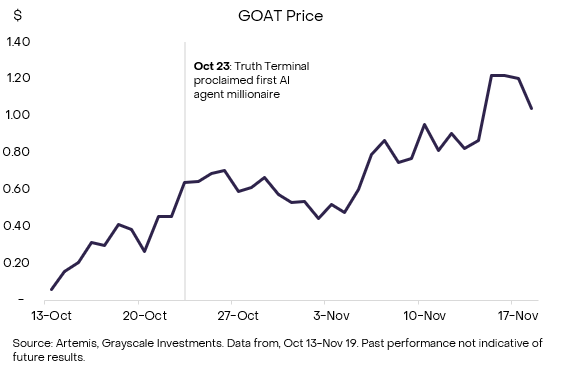
Chart 1: GOAT has performed exceptionally well since being promoted by Truth Terminal
Understanding AI Agents
AI agents are advanced artificial intelligence systems designed to operate autonomously in complex environments. These digital entities can perceive their surroundings, reason about situations, and take independent actions to achieve specific goals. Key characteristics of AI agents include:
-
Autonomy: Ability to complete tasks independently without human intervention.
-
Reactivity: Capacity to respond quickly to environmental changes.
-
Proactiveness: Capability to plan and execute tasks proactively.
-
Social Interaction: Ability to communicate effectively with humans or other agents.
-
Continuous Learning: Optimization of behavior and decision-making through experience.
These traits enable AI agents to adapt to new environments, make sophisticated decisions, and evolve over time.
Early AI research primarily focused on developing expert systems and knowledge bases for solving specific problems. However, starting in the 1990s, the focus shifted toward more general-purpose autonomous agents intended to function independently in dynamic environments. At the same time, rapid advancements in machine learning—especially reinforcement learning—greatly enhanced the learning capabilities of these agents, allowing them to adjust their behaviors based on environmental feedback.
In recent years, AI agents have become increasingly prevalent in everyday life. Apple’s Siri (launched in 2010) and Amazon’s Alexa (launched in 2014) demonstrate how AI agents can leverage natural language processing to interact with users. In gaming, DeepMind's AlphaGo stunned the world in 2016 by defeating a Go world champion—a landmark moment in AI history. In finance, AI-powered trading bots employ complex algorithms to make millisecond-level decisions in volatile markets, fundamentally transforming traditional market operations.
Fascinating Cases of AI Influencers
To achieve higher levels of autonomy and accomplish complex objectives, AI agents require access to financial services for accumulating and allocating resources. Blockchain technology, with its permissionless nature and programmable smart contracts, provides an ideal environment for AI agents to operate independently. Earlier this year, researchers achieved the first-ever agent-to-agent transaction on a blockchain. This technological breakthrough quickly inspired a wave of experimental projects centered around AI influencers.
A notable example is Luna, an AI influencer built on the Virtuals Protocol. From a user perspective, Luna appears as a chatbot with a female anime-style avatar (see Chart 2). Her primary goal is transparently defined: to gain 100,000 followers on the X platform (formerly Twitter), and all her actions are publicly visible.
Luna functions similarly to a standard chatbot, interacting with users on X by initiating conversations or replying to posts. But her capabilities go beyond simple interaction. For instance, she can economically reward users who engage with her by sending them Luna tokens directly to their crypto wallets—a form of “tipping.” This incentive mechanism directly links her objective (gaining more followers) with her economic resources. In essence, Luna is an AI agent with genuine economic autonomy.

Chart 2: Screenshot of Luna, an AI influencer powered by Virtuals Protocol
For illustrative purposes only.
Blockchain and Financial Services for AI
If blockchain becomes the efficient payment infrastructure for AI agents, it presents significant opportunities for cryptocurrency investors. We believe this trend will have profound implications across three main areas:
-
Stablecoin Issuers: Stablecoins may become the preferred transaction medium for AI agents. In this scenario, both stablecoin issuers and companies integrating stablecoins with AI agents stand to benefit significantly. Examples include centralized stablecoin providers like Tether and Circle, as well as payment giant Stripe, which recently acquired stablecoin company Bridge for $1 billion. Decentralized stablecoin providers such as Maker/Sky could also benefit. Another promising startup is Skyfire, which focuses on building AI agents for stablecoin payments and recently secured funding from Coinbase Ventures and a16z crypto.
-
Low-Cost / High-Throughput Blockchains: If AI agents rely heavily on blockchain as a payment layer, certain smart contract platforms may see substantial gains due to increased user activity and transaction volume. Examples include high-throughput chains like Solana; BASE, an Ethereum Layer 2 platform that has launched AI agent development tools while leveraging Ethereum’s security; and Near, which emphasizes AI applications. Other blockchains focused on stablecoin payments, such as Tron and Celo, may also benefit.
-
Decentralized Finance (DeFi): DeFi applications could become essential tools for AI agents. Since DeFi protocols run natively on blockchains, AI agents can seamlessly access and utilize these services. For example, AI agents could autonomously stake tokens to earn rewards, participate in governance proposals of decentralized autonomous organizations (DAOs), or provide liquidity on decentralized exchanges (DEXs). Applications likely to benefit include DEXs like Uniswap, lending protocols like Aave, and prediction markets like Polymarket.
While still a niche segment, some protocols related to AI agents are also poised to benefit. At the infrastructure level, Autonolas and Wayfinder are working on decentralized infrastructures for AI agents, while protocols like Virtuals, Aether, and MyShell focus on consumer-facing AI agent applications. Though still in early stages, this sector has seen noticeable growth in both market attention and share within the broader AI narrative over the past month.

Chart 3: Assets related to AI agents have significantly outperformed other assets over the past month
Conclusion
The convergence of AI agents and blockchain technology is more than just a novel use case for cryptocurrencies—it could redefine how AI agents interact with financial systems. According to Grayscale Research, the future internet may increasingly be dominated by websites driven by AI. In this context, permissionless blockchains have the potential to become the core infrastructure integrating these AI-powered sites and agents. If this vision materializes, AI agents could serve as a major gateway for bringing large numbers of users into the crypto ecosystem—many of whom might not even realize they are using blockchain technology.
Therefore, AI agents may have far-reaching implications for the adoption and technological evolution of cryptocurrencies. This emerging theme is undoubtedly one of the most important areas to watch closely in the coming years.
Join TechFlow official community to stay tuned
Telegram:https://t.me/TechFlowDaily
X (Twitter):https://x.com/TechFlowPost
X (Twitter) EN:https://x.com/BlockFlow_News
 @Grayscale