









The next DeFi Summer could still be a DeFi Summer
TechFlow Selected TechFlow Selected
The next DeFi Summer could still be a DeFi Summer
Seemingly insignificant innovations could become the spark that triggers the next wave of DeFi prosperity.
 Navigating Web3 tides with focused insights
Author: NingNing
In the crypto world, we often hear the saying, "History doesn't repeat itself, but it rhymes." While many believe DeFi is outdated, in reality, this sector is merely at the early stages of the "plateau of productivity" on the Gartner Hype Cycle—continuous iteration and innovation are still unfolding.
With the emergence of new narratives like PayFi (e.g., Huma) and CeDeFi (e.g., Trump family's World Liberty Financial), along with foundational primitives such as chain abstraction and intent-centric architectures gradually entering productization phases, DeFi’s product architecture and UX layer may undergo a qualitative transformation in the near future (within 6–12 months).
Against this backdrop, Pyth Network’s recent launches—Oracle Integrity Staking (OIS) and its MEV-resistant Solver network, Express Relay—have captured market attention.
As a critical component of DeFi infrastructure, the importance of oracles is self-evident. Through these innovations, Pyth is redefining oracle security, reliability, and efficiency, potentially becoming one of the key drivers behind the next wave of DeFi growth.
Let’s examine some of Pyth’s key metrics:
-
Number of data providers: 114+ (up 2.70% MoM)
-
Trading volume: $794B+ (up 9.88% MoM)
-
Number of price feeds: 507+ (up 1.00% MoM)
-
Number of integration partners: 410+ (up 7.18% MoM)
-
TVL (Total Value Locked): $8.1B+ (down 7.27% MoM)
These figures highlight Pyth’s significant role within the DeFi ecosystem. Notably, while TVL has declined slightly—likely reflecting broader market trends—other key indicators such as trading volume and integration partner count continue to grow steadily.
Beyond its stronghold on Solana, Pyth is expanding its penetration across DeFi applications and consolidating dominance in the oracle markets of new L1s and L2s.
Recently, it partnered with Morpho and Gauntlet to enhance lending experiences on Ethereum and Base, and collaborated with Starknet, where it—alongside Chainlink—is now a default-integrated oracle.
Before diving into Pyth’s latest features, let’s quickly review its core architecture:
-
Data source model: Utilizes a first-party network of data providers, sourcing data directly from primary entities such as exchanges and market makers.
-
Data update mechanism: On Solana, uses a push model updating every 400ms; on other chains, employs a pull model.
-
Cross-chain strategy: Supports multiple chains via Pythnet appchain and the Wormhole cross-chain messaging protocol.
-
Data transparency: Each data point is traceable to the public key of an individual provider.
-
Scalability: The pull model combined with centralized aggregation enables easier expansion to new price feeds and blockchains.
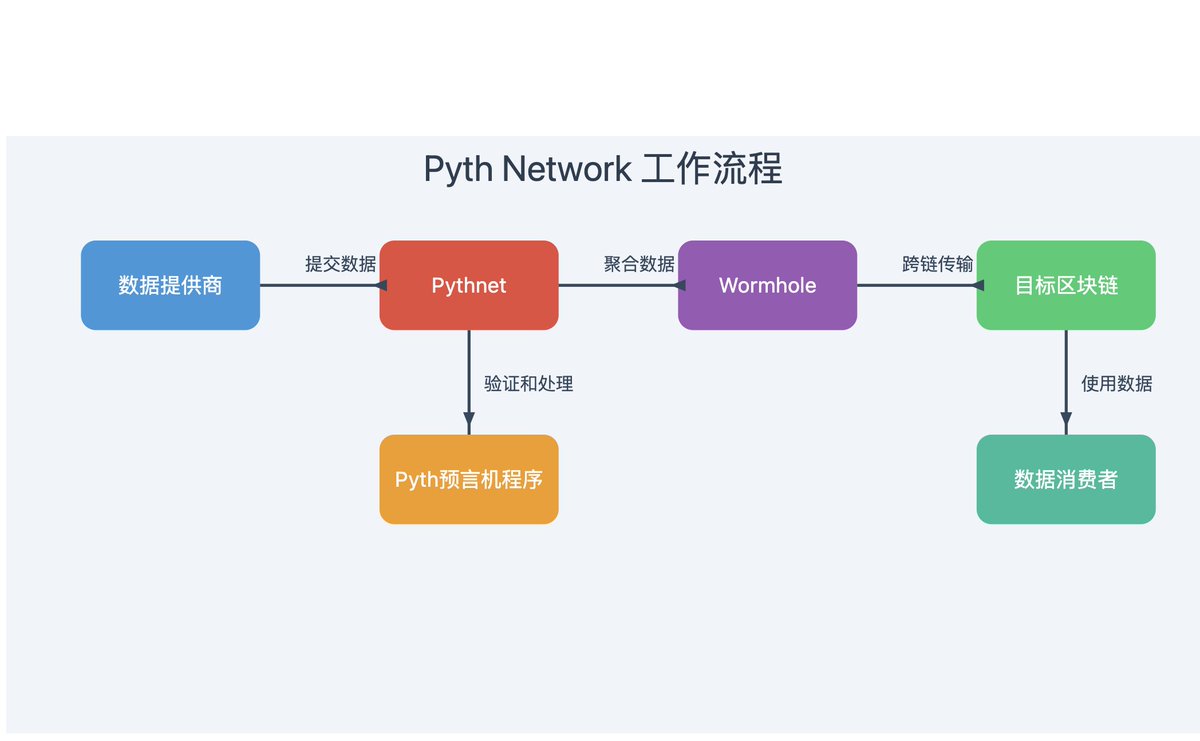
Pyth’s architecture gives it unique advantages over Chainlink in terms of data freshness, transparency, and cross-chain scalability.
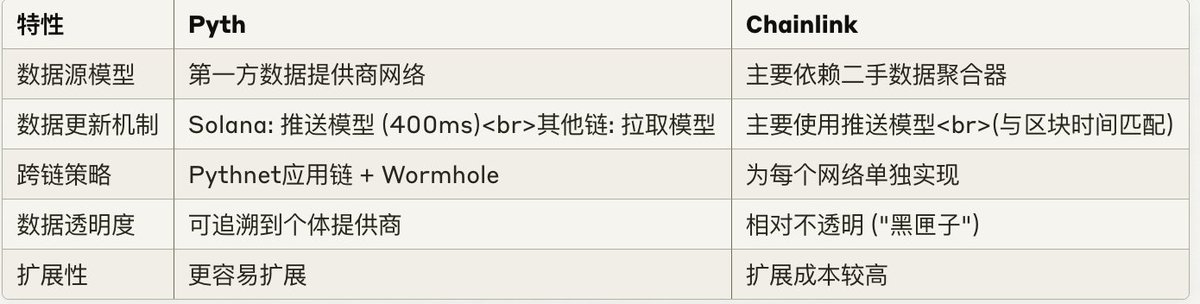
However, as a relative newcomer, Pyth still lags behind Chainlink in areas such as data trustlessness, incentive alignment among network participants, and breadth of product offerings.
The Oracle Integrity Staking (OIS) and the MEV-resistant Solver network Express Relay represent Pyth’s strategic moves to complete its oracle network.
The core idea behind OIS is to ensure data trustlessness through tokenomic-driven free-market game theory, improving upon mechanisms previously reliant solely on reputation and algorithms.
OIS isn’t overly complex—it introduces minor innovations atop mature staking mechanics. In simple terms:
Data publishers must stake PYTH tokens to earn rewards, and submitting incorrect data results in slashing.
PYTH token holders can delegate their tokens to data publishers, increasing potential rewards while enhancing network security.
PythDAO oversees key parameters including maximum reward rates, delegation fees, and slash amounts. The DAO also plays a role in determining how slashed tokens are used and can adjust incentives to ensure long-term sustainability.
This mechanism not only improves data reliability but also fosters a fairer, more transparent, and shared-benefit ecosystem.
Additionally, data publishers can boost returns by supporting more price feeds—including various long-tail assets—providing developers with a broader range of reliable data.
Express Relay establishes a decentralized order flow auction system that directly connects DeFi protocols to Solver networks. It optimizes trade execution, reduces MEV, and improves transaction efficiency.
Solver networks have now become standard middleware in most chain abstraction project stacks.
In terms of ecosystem expansion strategy, Chainlink is targeting cross-chain interoperability via CCIP to compete with LayerZero, while Pyth’s Express Relay targets the MEV-resistant Solver network space, competing with CowSwap.
Pyth Oracle’s core business is delivering high-quality, low-latency price data. Express Relay, in contrast, focuses on optimizing transaction execution. These two functions naturally complement each other in the data flow:
-
Enhanced real-time performance: Express Relay can leverage Pyth’s high-frequency data updates (every 400ms) for more precise timing of trades—especially crucial in highly volatile markets.
-
Data integrity: Pyth’s OIS (Oracle Integrity Staking) mechanism ensures data reliability, providing a solid foundation for Express Relay’s trade execution.
-
Closed-loop feedback: Transaction outcomes executed by Express Relay can serve as additional market data sources, feeding back into the Pyth oracle and creating a virtuous cycle.
While current market sentiment may not be as fervent as during the 2020 "DeFi Summer," innovation in the DeFi space has never ceased. As investors, we should closely monitor developments in infrastructure—because it is precisely these seemingly minor innovations that could spark the next wave of DeFi prosperity.
Join TechFlow official community to stay tuned
Telegram:https://t.me/TechFlowDaily
X (Twitter):https://x.com/TechFlowPost
X (Twitter) EN:https://x.com/BlockFlow_News
 @0xNing0x






