The first "rare divergence" at the Fed since 2005—perceptive traders say, "It's unclear whether there will be significant rate cuts ahead."
TechFlow Selected TechFlow Selected
The first "rare divergence" at the Fed since 2005—perceptive traders say, "It's unclear whether there will be significant rate cuts ahead."
The first "council dissenting vote" in nineteen years and a less dovish dot plot have left even traders who successfully predicted the rate cut magnitude bewildered.
 Navigating Web3 tides with focused insights
Author: Zhu Xueying, Wall Street Insights
The Federal Reserve cut interest rates by 50 basis points overnight, officially launching a monetary easing cycle. However, the internal voting process behind this decision was far from smooth, revealing a "rare divergence" within the Fed—something not widely anticipated by the market.
This has left even traders who successfully predicted the 50-basis-point cut questioning the pace of future rate cuts. Will the Fed continue with aggressive easing in November and December? With such uncertainty, upcoming employment and inflation data reports are likely to become pivotal in shaping the Fed’s next moves.
Will November Bring Another Big Cut? Disappointed Traders: It's Uncertain
According to Bloomberg, Akshay Singal, a trader at Citi, accurately forecasted the 50-basis-point cut weeks in advance. Yet after observing the rare dissenting vote and the less dovish-than-expected updated dot plot, he expressed confusion:
"This 50-basis-point cut was actually quite hawkish... Overall, the Fed might be satisfied with this outcome—it's not seen as overly accommodative—but the downside is that markets are left puzzled."
Bloomberg noted that Singal’s sentiment broadly reflects wider market feelings.
Singal believes that although Chair Powell wields significant influence over policy direction—and his personal stance is clearly more dovish than other members—the growing internal divisions cast doubt on the path ahead:
"Powell holds substantial power. Over the coming months, the key will be understanding just how dovish he really is."
The Root of Trader Confusion: The First 'Governing Board Dissent' in 19 Years + A Less-Dovish Dot Plot
A major factor behind Singal’s uncertainty is the first dissenting vote from a Federal Reserve Governor in 19 years.
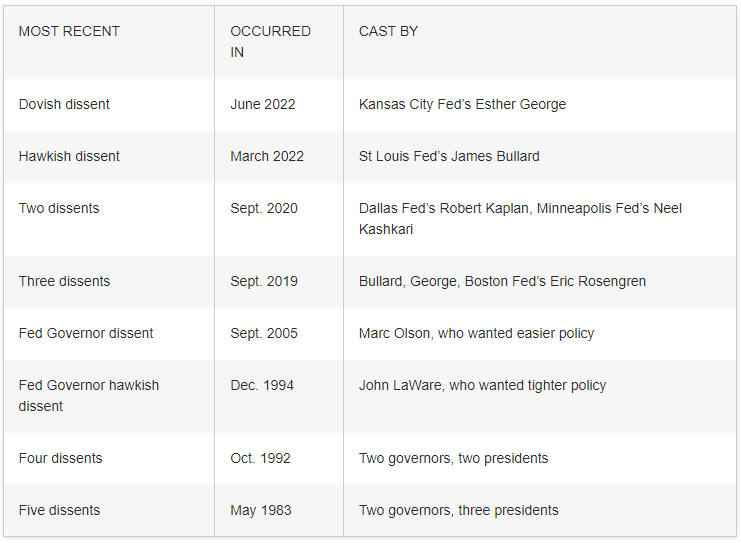
The latest FOMC statement revealed that not all voting members supported the 50-basis-point cut. While 11 out of 12 voted in favor, one member dissented—Michelle Bowman, a member of the Federal Reserve Board of Governors. She advocated for a smaller 25-basis-point reduction to begin the easing cycle.
Bowman thus became the first Fed governor since 2005 to oppose the majority view at an FOMC meeting.
Historically, dissent within Fed meetings has been extremely rare, especially during Powell’s tenure. The last time an FOMC voter opposed the consensus decision was in June 2022, when Esther George, then President of the Kansas City Fed, dissented by advocating for a smaller rate hike.
Some traders commented that given Powell’s emphasis on unity, this situation appears particularly unusual—especially with the U.S. presidential election approaching:
"Powell may be the most consensus-driven Fed chair in history, having faced only one dissenting vote across all meetings since the pandemic.
Starting with a 50-basis-point cut would almost certainly trigger at least one (like Bowman), or possibly two (like Barkin or Bostic) dissenting votes—a sharp departure from his usual style, especially before an election. For someone keen to avoid being labeled 'Arthur Burns 2.0,' this would be a rather odd twist."
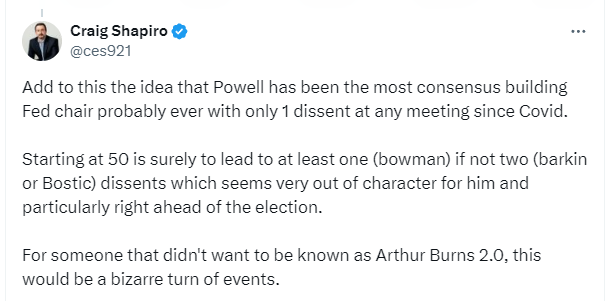
Note: Arthur Burns served as Fed Chair in the early 1970s. His policy stance was seen as too accommodative in tackling inflation, contributing to the subsequent era of stagflation.
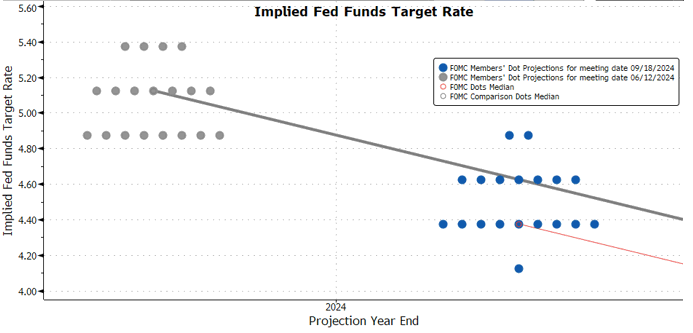
In addition, the less-dovish dot plot has further clouded the outlook for future rate cuts. Only a slight majority of policymakers expect at least another 50 basis points of cumulative cuts this year.
Among the 19 officials submitting projections, all now anticipate rates below 5.0%—compared to just eight previously. Only two project rates between 4.75% and 5.0%, seven see rates between 4.5% and 4.75%, nine expect rates between 4.25% and 4.5%, and one forecasts rates between 4.0% and 4.25%.
In other words, only ten out of 19 officials—just over 53%—expect at least 50 additional basis points of cuts this year. This narrow majority suggests that while two more 25-basis-point cuts in November and December are possible, it diverges from broader market expectations for a faster pace of easing.
What Should We Watch Next? Data, Data, and More Data
With the Fed’s future rate-cutting path still unclear, incoming economic data is set to take center stage once again.
As Singal put it: "Whether the Fed cuts 25 or 50 basis points in November is like flipping a coin... It will depend entirely on the data." He emphasized that the next two nonfarm payrolls reports (October 4 and November 1) will have a significant impact on the Fed’s next steps.
During his press conference, when asked what information should be monitored between now and the November meeting to determine the size of the next rate cut, Powell reiterated the importance of labor market and inflation data:
"You know, more data. Just as always. Don’t look for anything else. We’ll get two labor market reports, we’ll also get inflation data—all the data we normally watch.
You always ask: What do these incoming data mean for the evolving outlook and the balance of risks? Then you run that through our process: What’s the right thing to do? Is policy aligned with our goals? That’s exactly what we’re going to do."
He also stressed the value of anecdotal evidence such as the Fed’s Beige Book:
"Since our last meeting, we’ve received a lot of data—two nonfarm payroll reports for July and August, two inflation reports (one released during the Fed’s blackout period), and the Quarterly Census of Wages suggesting that recent job gains may have been overstated and could be revised downward.
We’ve also seen anecdotal indicators like the Beige Book. So we gather all this information, enter our public communications blackout period, reflect carefully, and then decide what’s right for the economy and for the American people. That’s how we make decisions."
Join TechFlow official community to stay tuned
Telegram:https://t.me/TechFlowDaily
X (Twitter):https://x.com/TechFlowPost
X (Twitter) EN:https://x.com/BlockFlow_News