








Delphi Labs: With multiple models competing in AI, which crypto applications do we favor?
TechFlow Selected TechFlow Selected
Delphi Labs: With multiple models competing in AI, which crypto applications do we favor?
We are still in the early stages of the artificial intelligence (AI) era, especially in the de-AI era.
 Navigating Web3 tides with focused insights
Author: Delphi Labs
Translation: TechFlow
This article was written by Luke Saunders (lukedelphi) & Jose Macedo (ZeMariaMacedo).
Artificial intelligence (AI) represents the largest technological revolution in history, triggering an unprecedented arms race in technology. Current AI models already rank in the top 10% on most standardized university exams and outperform humans in many tasks—including AI research itself. Even at their current level, they are having transformative impacts across industries such as search, customer service, content creation, programming, and education.
We expect AI capabilities, investment, and societal impact to accelerate further. All major tech companies recognize that AI is critical to their businesses and are investing accordingly. NVIDIA’s revenue—the best proxy for AI capital expenditure—is projected to exceed $100 billion in 2024, more than double its 2023 figure and over four times the prior year's revenue.
Google CEO Sundar Pichai’s view on AI investment:
"For us, the risk of under-investing far outweighs the risk of over-investing."
Meanwhile, startups recognize AI as a disruptive force capable of displacing companies that have existed for decades. Over the past 18 months, an estimated $83 billion has been invested in AI startups.
Given that AI capabilities tend to grow exponentially with increased compute power, we are likely within a decade of achieving something resembling Artificial General Intelligence (AGI).
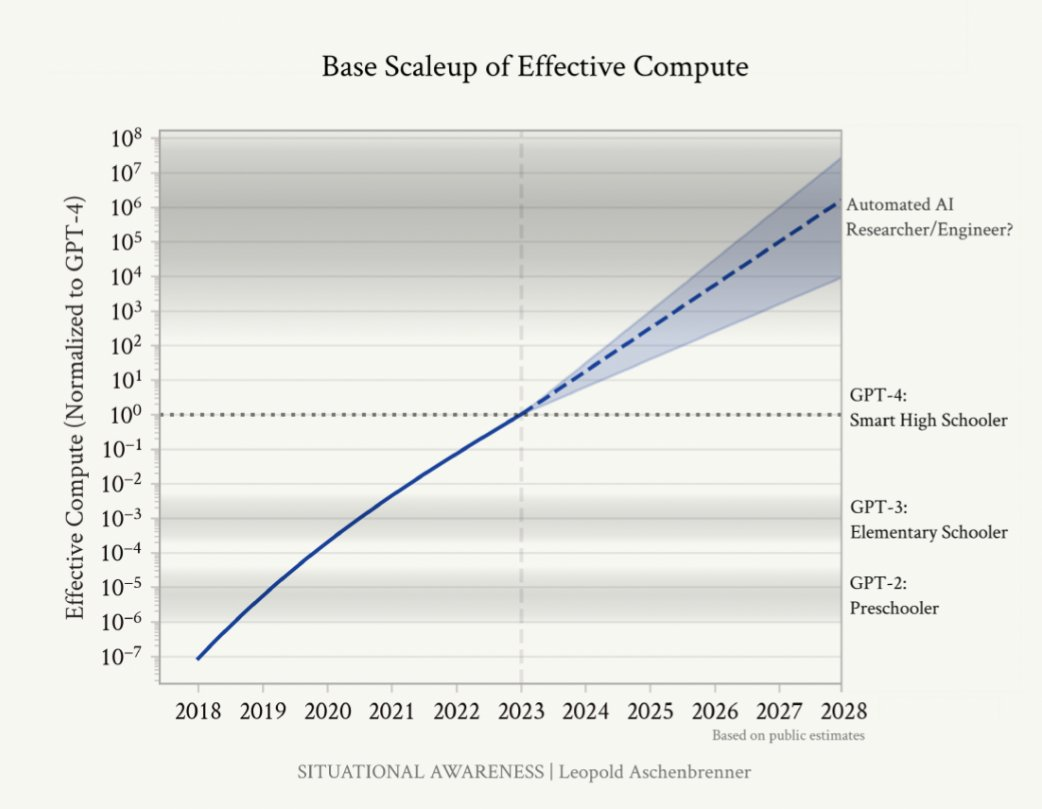
Source: Situational Awareness
Author: leopoldasch
In this article, we argue that competitive dynamics will lead to a world of millions of models—and that crypto is the ideal foundation for this multi-model world. We first discuss why we believe a multi-model world is the inevitable outcome of AI development. Then, we outline the unique advantages crypto offers to AI. Finally, we present our vision of the crypto-AI technology stack and highlight projects we find promising.
There are strong philosophical and ethical arguments for combining open-source AI with crypto—arguments that have been well-articulated elsewhere. We fully agree with these views and they motivate some of our work in this space. However, in this piece, we focus on the practical reasons why crypto + AI will win—not the moral reasons it should win.
Super Models vs. Multi Models
Right now, we’re moving toward a world where a few large vertically integrated tech companies produce “super models” that dominate everything else.
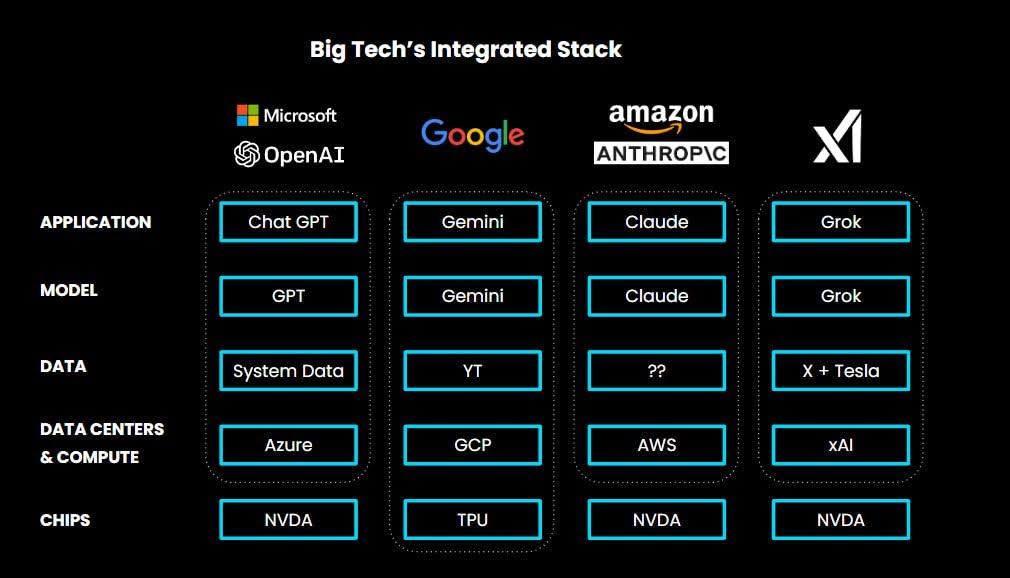
However, we believe this won’t be the final state for several reasons:
-
Risk: Organizations, entrepreneurs, and developers building AI-powered experiences don’t want to rely on a single closed-source company that could change its model, modify terms of use, or cut off access entirely at any time.
-
Cost-performance trade-offs: The extremely large, general-purpose models favored by big tech are inherently more expensive to train and run. This makes them overpriced and overpowered for many use cases. While cost isn’t a primary concern today—since monetization isn't top of mind—people will eventually optimize for the lowest cost to achieve required performance levels. Large models are uncompetitive here. Substantial research supports this: smaller, specialized models outperform general ones in areas like medical imaging diagnosis, fraud detection, speech recognition, and more.
-
Vertical integration: As Apple has repeatedly shown, the best products often come from full-stack vertical integration. Ambitious entrepreneurs building AI-native products will seek competitive advantage by fine-tuning their own specialized models—often using proprietary data—allowing them to capture more value and attract greater investment.
-
Privacy: AI will become core to organizational workflows in ways no other technology has. Many organizations are unwilling to send sensitive data to third-party models.
For these reasons, we believe we're more likely to enter a world with many smaller, specialized models—customized for specific use cases and optimized for cost-efficiency. Application developers and users will take open-source base models like LLaMA or those from MistralAI, then fine-tune their own domain-specific versions, often using proprietary data. Many models will still run on servers, but privacy-focused applications will run locally on client devices, while censorship-resistant apps may leverage decentralized computing platforms.
This is a world of modular AI building blocks, where developers and entrepreneurs compete to deliver value, and users can select and combine services based on their specific needs. Infrastructure for routing, orchestration, composition, payments, and more must be built to dismantle the "God model" stack and serve this emerging AI economy—a world where crypto thrives.
Crypto and AI
Intuitively, crypto seems like a natural fit for utility in this multi-model world. Yet, hype has led many uninformed investors to allocate significant capital into the space. Like previous infrastructure bubbles, many funded projects may not need to exist. This makes it hard to identify which subsectors of crypto + AI truly offer value—leading many to dismiss the entire field as a meme.
We believe it’s not a meme. Indeed, this multi-model world could theoretically exist without crypto. But focusing on crypto’s unique differentiating features helps us build more revolutionary—or even impossible-to-build-without-crypto—products. To do so, we first identify crypto’s distinctive properties and how they can be applied to AI to create better products. Then, we discuss the crypto-AI tech stack and highlight relevant use case examples.
-
Coordination Layer: Crypto rails excel at enabling collective coordination without centralized control. They’re particularly effective at overcoming the classic “chicken-and-egg” problem inherent in most markets, rapidly attracting large user bases through crypto-native incentives.
- Small teams building internal models may lack direct access to all necessary resources. While large tech AI labs may have their own compute, small teams do not. Similarly, they need data and may require diverse human feedback. These needs are well-suited for specialized markets—we believe markets leveraging crypto infrastructure will outcompete those that don’t.
-
Open, Permissionless APIs: Crypto rails act as open, permissionless APIs accessible anywhere, without KYC, credit cards, or approval. This is crucial for AI agents, which need autonomous access to services, code deployment, and value transfer without human intervention—enabling sci-fi behaviors like agent collectives, agents paying each other for services, taking on debt, or raising funds.
-
Trustlessness: Crypto rails are typically trustless—providing cryptographic guarantees that rules won’t change, access won’t be revoked, and execution can be verified. This is vital for modular AI architectures, where builders compose primitives they don’t control, and users must implicitly trust many unknown services.
-
Censorship Resistance: Applications deployed as immutable contracts on crypto rails are unstoppable. Even upgradable ones are usually governed by decentralized autonomous organizations (DAOs) requiring consensus. Given AI’s anticipated power, governments will likely attempt to control it—we’ve already seen early signs. Just as Bitcoin provided financial infrastructure outside the system, crypto + AI delivers unstoppable intelligence.
The Intersection of Crypto and AI
Given these benefits, which applications at the intersection of crypto and AI are particularly compelling?
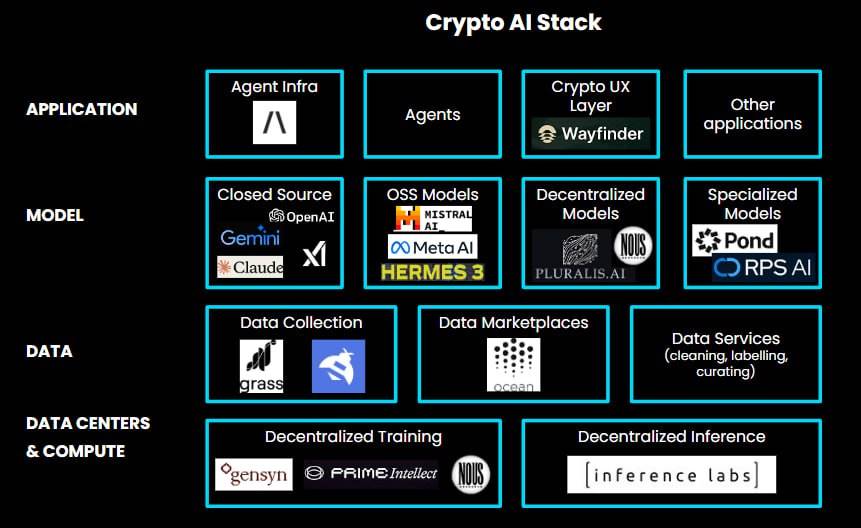
Data Centers and Compute
Model computation falls into two broad categories: training and inference. We believe decentralized compute holds significant promise in both—discussed separately below.
Decentralized Training
Distributed training faces challenges due to strict communication and latency requirements between nodes. Several teams are tackling this; given the scale of potential rewards and talent involved, we believe solutions are forthcoming. Notable approaches include NousResearch's DisTrO and PrimeIntellect's OpenDiLoCo.
Beyond solving technical hurdles and simplifying complexity, winners must also figure out:
- How to ensure quality and accountability on a permissionless network
- How to bootstrap supply—ideally from data centers and clusters, not consumer hardware. Token incentives may be key, with creative approaches including granting compute providers ownership stakes in the final model.
Fundamentally, decentralized compute markets unlock access to the world’s lowest marginal cost of compute. As incumbent provider costs rise, more organizations will resist and seek cheaper alternatives. Downsides include latency, heterogeneous hardware, and loss of optimizations and economies of scale from owning dedicated infrastructure. The long-term balance remains to be seen.
Verifiable Inference
We see verifiable inference as expanding trust-minimized systems with AI capabilities. Embedding models directly in smart contracts isn’t feasible, but models can run off-chain while publishing cryptographic proofs of correct execution on-chain. For example, governance decisions (e.g., risk parameters in money markets) could be delegated to off-chain models in a trustless way.
This concept can also apply more broadly—offering users cryptographic assurance that outputs come from the exact model they expect. As AI handles increasingly mission-critical tasks, this becomes more important. Several projects tackle this challenge differently, including Delphi Ventures portfolio company Inference Labs (inference_labs).
Data
Today, training large language models (LLMs) is a multi-stage process involving various data types and human input. It begins with pretraining, where LLMs learn from cleaned public datasets like Common Crawl and other freely available sources. During post-training, models are refined on smaller, labeled datasets to master specific domains (e.g., chemistry), often requiring expert input.
To secure fresh or proprietary data, AI labs often partner with large data owners. For instance, OpenAI reportedly paid Reddit $60 million. Similarly, News Corp’s five-year deal with OpenAI is valued at over $250 million. Clearly, data has never been more valuable.
We believe crypto networks can effectively help teams acquire the data and resources needed at every stage. The most promising area may be data collection—where crypto incentives can drive supply and unlock vast long-tail data sources.
For example: Grass AI (getgrass_io) incentivizes users to share idle internet bandwidth for web scraping. Collected data is structured, cleaned, and made available for AI training. If Grass builds sufficient supply, it could serve as a real-time API for internet data.
Hivemapper is another strong example—launched in November 2022, it collects millions of miles of road imagery weekly, covering 25% of roads globally. Similar models could apply to other multimodal data and monetize via sales to AI labs.
As the NewsCorp and Reddit deals show, many companies possess valuable data but are too small or lack connections to monetize it. Likewise, AI labs may find individual micro-deals uneconomical. A well-designed data market can bridge this gap by uniformly connecting suppliers and buyers. Challenges remain—especially around data quality, standardization, and fungibility.
Finally, data preparation—annotation, cleaning, augmentation, transformation—is a suite of critical tasks. Small teams often lack these skills and may outsource. Scale AI (scale_AI) is a centralized leader here—reportedly nearing $700 million in annual revenue with rapid growth. We believe crypto-based markets and workflow systems can outperform here. Lightworks, a Delphi Ventures investment, and others are exploring this space—all still early.
Models
According to Delphi Digital’s report The Tower & The Square, AI model production and control are almost entirely in the hands of “big tech” and governments. This is a more dystopian state than government-controlled money—because it grants control not just over a key economic resource, but also over narratives through censorship and manipulation, exclusion of “undesirable” voices, weaponization of private AI interactions, or simply maximizing ad revenue.
Many talented individuals are working to build “the square”—a decentralized network aiming to produce a fully neutral, censorship-resistant model accessible to all. Just as Bitcoin created financial infrastructure outside the traditional system, crypto x AI can provide intelligence infrastructure outside centralized control.
Such projects aim to decentralize every step of model creation—networks gather and prepare data, train models on decentralized compute, run inference on the same infrastructure, and coordinate via decentralized governance. No part is centralized, so the model is truly community-owned and immune to “tower” control.
Clearly, creating a decentralized model competitive with cutting-edge centralized ones is extremely difficult. We can’t expect most users to accept lower quality for ideological reasons. We view these efforts as “moonshots”—unlikely to succeed, but immensely valuable if they do. We sincerely hope they succeed.
It’s worth noting centralized AI labs that embrace crypto principles—some with tokens or crypto integrations.
NousResearch and PondGNN are examples backed by Delphi Ventures. Additionally, model creation infrastructure like Bittensor from opentensor belongs in this category. Bittensor has been covered extensively elsewhere, so we won’t rehash its pros and cons.
Applications
Eric Schmidt recently said in a talk:
If TikTok gets banned, I suggest you all do this: tell your LLM, “Make me a copy of TikTok, steal all the users, steal all the music, customize it to my preferences, build and launch this app within the next 30 seconds, and if it doesn’t go viral within an hour, try similar tactics.”
This illustrates the immense capabilities we expect from AI agents. But to complete such tasks autonomously, agents must use various services independently—transfer value, form economic relationships, deploy and execute code permissionlessly.
Traditional banking apps, KYC processes, and registration flows aren’t built for agents. They’ll inevitably hit systems designed for humans and fail to access them without help.

Crypto infrastructure provides the perfect platform—offering permissionless, trustless, and censorship-resistant foundations for agent operations. Need to deploy an app? Do it on-chain. Need to pay? Send tokens. On-chain services have open, consistent code and data—agents can understand and interact with them without APIs or documentation.
Agents can also catalyze on-chain activity. Shifting from clicking buttons on websites to interacting via AI personal assistants can simplify crypto’s notoriously complex onboarding—removing a major barrier to new users.
Projects like Wayfinder (AIWayfinder), Autonolas (Autonolas), DAIN (dainprotocol), and Almanak (Almanak__) are pioneering this future.
Conclusion
AI has become the most powerful and important resource of the 21st century, profoundly shaping society. A future where it’s fully controlled by big tech and nation-states is a dystopia we wish to avoid. In this article, we’ve outlined a path where crypto prevents such monopolies—not by asking people to adopt solutions for philosophical reasons, but by offering developers and users genuinely superior tools.
We’re still in the early days of the AI era—especially the decentralized AI (deAI) era. Much work remains to bridge the gap between today and the future we’ve described. At Delphi Labs, we’re passionate about the future of crypto and AI, and we’re excited to collaborate with top builders in this space to help shape it.
Join TechFlow official community to stay tuned
Telegram:https://t.me/TechFlowDaily
X (Twitter):https://x.com/TechFlowPost
X (Twitter) EN:https://x.com/BlockFlow_News
 @delphi_labs


