








Foundation transferring assets? Rollups suppressing the mainnet? An analysis of Ethereum's breakthrough and outlook
TechFlow Selected TechFlow Selected
Foundation transferring assets? Rollups suppressing the mainnet? An analysis of Ethereum's breakthrough and outlook
Recently, there have been numerous disputes within the industry regarding Ethereum's development and current state.
 Navigating Web3 tides with focused insights
By: Blu

Recently, Ethereum's development and current state have sparked significant debate within the industry. The main points of contention revolve around the following areas:
Criticism 1: Frequent ETH transfers from Ethereum Foundation wallets, lack of transparent financial planning, and concerns that its assets may not be sufficient to sustain future operations.
Related Events:
Learn More
-
On August 24, 2024, the Ethereum Foundation deposited 35,000 ETH into Kraken. Over the next six days, ETH’s market value dropped by 13%.
-
On September 5, 2024 at 16:10, according to monitoring by @ai_9684xtpa, the Ethereum Foundation transferred another 100 ETH. This address has cumulatively moved 2,616 ETH on-chain over the past eight months.
-
On September 6, 2024 at 14:07, Lookonchain reported that the Ethereum Foundation had transferred 1,000 ETH to a multi-sig address starting with 0xbC9a. Based on previous transaction patterns, this multi-sig wallet is likely to move ETH to an address starting with 0xd779 and convert it into DAI.
Responses and Discussions:
Justin Drake of the Ethereum Foundation stated during the 12th open Q&A session (hereinafter referred to as AMA) hosted on Reddit on September 5, 2024: The Ethereum Foundation’s financial report will be released soon. He estimates the foundation holds approximately 10 years’ worth of funding reserves, though the actual value fluctuates significantly with ETH price movements.
Based on current market valuations, the Ethereum Foundation spends roughly $100 million annually. Its primary Ethereum wallet currently holds about $650 million in assets. Additionally, the foundation maintains fiat currency reserves sufficient to cover operational needs for several years ahead.
Vitalik Buterin, Ethereum co-founder, said during the 12th AMA: Currently, the Ethereum Foundation follows a budgeting strategy of spending 15% of its remaining funds each year. This ensures continued operation, but implies that over time, the foundation’s influence within the ecosystem will gradually diminish.
According to media reports, Aya Miyaguchi, Executive Director of the Ethereum Foundation, previously stated on social media: The foundation’s annual budget is approximately $100 million, primarily allocated to grants and salaries. Some grantees can only accept payments in fiat currency. Since early 2024, due to complex regulatory considerations, the foundation has been advised not to conduct any financial activities and therefore cannot disclose its plans in advance. The ETH transfers made by the foundation are not sales.
Criticism 2: Ethereum’s roadmap overly focuses on Layer 2 solutions (mainly Rollups), neglecting improvements to the Ethereum mainnet (Layer 1), suggesting the need for a revised roadmap.
Responses and Discussions:
Dankrad Feist, Ethereum researcher, shared his personal view during the 12th AMA: Many believe that a Rollup-centric roadmap could weaken Ethereum’s fee revenue and MEV, ultimately making Rollups parasitic. I disagree.
The most valuable transactions will still occur directly on Ethereum’s Layer 1, while Rollups expand the entire ecosystem by providing vast transaction capacity for users. This relationship is symbiotic: Ethereum provides cheap data availability for Rollups, while Rollups make Ethereum Layer 1 the natural hub for high-value transactions.
While advancing the Rollup-centric roadmap, I believe scaling Layer 1 execution should also remain a goal—and it does not necessarily conflict with the current roadmap, demonstrated by the following:
-
Data availability can be nearly infinitely scaled—the ultimate bottleneck lies not in technology, but in user participation: how many people are willing to run full nodes and store all data.
-
Execution capacity faces objective constraints, with the final bottleneck being single-threaded processing. Currently, state access is the immediate limitation to scaling Ethereum Layer 1 execution.
-
Through zkEVM and parallelization technologies, Ethereum Layer 1 scalability could improve by 10x to 1,000x. Rollups will provide the additional scaling needed to meet Ethereum’s ambition of achieving “world-scale” capacity.
The long-term sustainable plan of the Ethereum Foundation is to use SNARKs to scale EVM execution on the Ethereum mainnet. Beyond the vertical scaling benefits of significantly increasing Layer 1 EVM gas limits, there’s also potential for arbitrary horizontal scaling using EVM-in-EVM precompiles to verify EVM execution within EVM at low cost.
This precompile would allow developers to programmatically launch new Layer 1 EVM instances, unlocking a boosted version of execution sharding—where the number of shards is unlimited, and each shard acts as a programmable Rollup, i.e., a “native Rollup.”
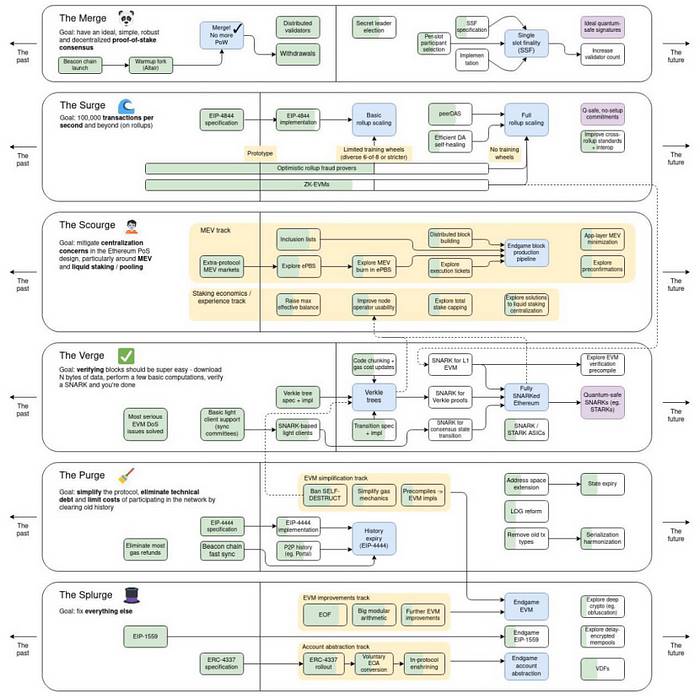
△ Ethereum’s 2024 roadmap consists of six phases:
The Merge, The Surge, The Scourge, The Verge, The Purge, and The Splurge
Criticism 3: While the ecosystem is thriving, ETH’s market value has not seen significant growth.
Responses and Discussions:
Anders Elowsson of the Ethereum Foundation stated during the 12th AMA: In the long run, Ethereum enabling sustainable economic activity is directly linked to ETH’s market value appreciation. If you design a system for sustainable economic activity, you are inherently designing for ETH price growth—and vice versa. Focusing solely on “price growth” in the short term without considering its source could lead to diminished long-term value. Personally, I believe the current roadmap is effectively a “price growth roadmap.” If Ethereum succeeds but ETH doesn’t appreciate in price, I’d be surprised—even disappointed. But that might just be a buying opportunity, as the market will eventually recognize this value proposition.
Justin Drake of the Ethereum Foundation said during the 12th AMA: I believe ETH’s price movement ultimately depends on liquidity and premium. The key metric for liquidity is total fees, not per-transaction fees. For premium, the key indicator is the proportion of ETH used as staked assets. In the future, Ethereum’s success target is 10 million transactions per second. Even if each transaction costs less than one cent, this could generate billions in daily revenue.
Criticism 4: Optimistic Rollups are actually cheaper than ZK Rollups, despite ZK being theoretically superior technology.
Responses and Discussions:
George Kadianakis stated during the 12th AMA: The Ethereum Foundation is currently researching various zero-knowledge (ZK) projects at multiple stages.
Justin Drake of the Ethereum Foundation said during the 12th AMA: I’m very excited about bringing SNARKs to Layer 1 EVM. We’ve made tremendous progress over the past few months. According to recent data from Uma (from Succinct), the current cost of proving all Layer 1 EVM blocks is around $1 million per year, and further optimizations will continue to reduce this cost.
By 2025, the annual cost of proving all Layer 1 EVM blocks could drop to just $100,000, thanks to SNARK ASICs and optimizations across the stack. The Ethereum Foundation is also accelerating formal verification of zkEVM—a project led by Alex Hicks with a $20 million budget.
For the Beacon Chain, our recent benchmarks have accelerated timelines for hash-based signatures aggregated via SNARKs—a critical step toward post-quantum security for the Beacon Chain.
Max Resnick, Ethereum researcher at the Special Mechanisms Group (SMG), said in an interview with Bankless: ZK is the only technology capable of truly breaking bandwidth limitations—Optimistic Rollups cannot do this...
So what should we do next? I think we should start optimizing features required by ZK Rollups.
If we continue down the Rollup path, we must pivot immediately to make on-chain verification of ZK proofs cheaper—not continue reducing data costs, because on-chain data is already nearly free.
Also, I believe Ethereum Layer 1 fees have reached a balanced level. But if you’re launching an application, the key consideration should be: what happens to fees when your app experiences explosive growth?
If I were an app developer building a killer app capable of 100x user growth and massive adoption, I wouldn’t choose to launch on Ethereum today—because in the best-case scenario, my success would congest the network, making fees prohibitively high. Therefore, the real priority for Ethereum isn’t maintaining the current balance, but envisioning just how strong its scalability can become—strong enough to attract top-tier developers aiming to bring 100x user growth into Ethereum’s ecosystem.

How Should We View Ethereum’s Challenges and Criticisms?
Return to Origins, Firmly Bullish on Ethereum’s Value Development
Compared to market skepticism, Ethereum co-founder Vitalik Buterin remains firmly optimistic about Ethereum’s future, calling it full of promise. At ETHTAIPEI 2024, during a group media interview, Vitalik Buterin said:
“I believe the next five years will be critically important for Ethereum’s development. Because now is when many applications that were previously theoretical or small-scale will begin transitioning into real-world deployment. Ideas born in the blockchain space have already permeated the broader world in ways not yet fully recognized.
Non-financial applications are expected to start having greater impact. Decentralization gives these projects a unique advantage: nearly anyone can write a new client, and once you have one, you can read and write to the same system without rebuilding network effects from scratch.
At the same time, I expect rapid growth in Ethereum’s foundational identity space. The technology is improving quickly, and I truly hope we’ll soon see more mainstream use cases emerge. Many worry about account identity issues, but currently, when people seek solutions, they default to centralized options. I hope the Ethereum ecosystem can pioneer truly decentralized identity alternatives and make them easily accessible.
Moreover, Stablecoins may bring significant future impact, and Ethereum can help make Stablecoins more open, decentralized, and less reliant on third parties with weak trust foundations. You can already see efforts in this direction from Layer 2 projects like Base.”
Looking Ahead, the Market Needs to Give Ethereum More Time
1. Outlook on the Pectra Upgrade
Following the Dencun upgrade, Ethereum is set to undergo another major technical update in Q1 2025—the Pectra upgrade. This upgrade will further simplify and enhance the process of creating and maintaining on-chain smart contracts, enabling developers to build more powerful applications efficiently. For users, this means faster transactions, lower fees, and more secure on-chain experiences.
The Pectra upgrade brings direct benefits to modular blockchains, account abstraction, and abstracted wallet projects and users. Additionally, it includes technical improvement proposals favorable to ZK Prover networks—an ongoing effort to strengthen ZK technology.
2. Outlook on PoS Mechanism, Ecosystem Innovation, and Strong Community Power
Whether the PoS consensus mechanism leads to centralization risks remains a concern among many blockchain users.
Vitalik Buterin addressed this in a media interview: The risk of centralization under PoS is currently the biggest challenge. Key areas of concern include rising MEV censorship risks and staking centralization.
Compared to other influential figures in the blockchain space, Vitalik Buterin and Ethereum’s core team have consistently remained highly vigilant against centralization trends on Ethereum and have actively advocated for decentralization principles. This commitment is a core strength that makes Ethereum’s future worth anticipating.
Additionally, although Ethereum’s use case innovation and growth appear to have hit a bottleneck, within the blockchain world, thanks to continuous infrastructure upgrades and technological refinements, Ethereum’s ecosystem remains robust. Its most unique asset is its powerful community—the essential foundation for potential disruptive innovation and sustained breakthroughs in the future.
4. Outlook on ZK Technology
In the Layer 2 ecosystem focused on enhancing Ethereum’s scalability, there is growing consensus regarding the debate between Optimistic Rollups and ZK Rollups: in the short term, Optimistic Rollups—with better compatibility—will develop faster than ZK-based ecosystems. But in the long run, ZK Rollups—which ensure real-time transaction validity and offer privacy guarantees—will inevitably receive stronger support and development.
Privacy is the key to unlocking the next chapter in Ethereum’s narrative. In a blog post discussing three necessary technical transitions for Ethereum, Vitalik Buterin stated: Without a strong shift toward privacy-enhancing technologies, Ethereum could lose most of its users—and potentially fail.
The privacy-preserving capabilities offered by ZK technology represent its primary application in the blockchain space. As Vitalik Buterin once emphasized at an Ethereum community annual meeting: “Over the next 10 years, ZK-SNARKs will be as important as blockchain itself.”
As the technology matures, narratives around ZK in Ethereum’s next phase of development will become richer and more compelling.
5. Outlook on ETH
Nick Tomaino, founder of 1confirmation, expressed strong optimism about digital asset trends in his Q2 2024 partner letter published on X (formerly Twitter) on August 24, 2024: ETH’s market cap could surpass BTC’s within the next five years. Currently, BTC’s market cap is about four times that of ETH. Both will continue growing, but ETH is ultimately poised to overtake BTC.
ETH value accrual remains crucial to Ethereum’s success—a widely shared belief. As Ethereum Foundation members noted during the 12th AMA: ETH value accrual will be driven by total fees and asset premium. ETH’s value growth will support the security and economic activity of the Ethereum ecosystem, helping propel Ethereum into a global financial platform.
Join TechFlow official community to stay tuned
Telegram:https://t.me/TechFlowDaily
X (Twitter):https://x.com/TechFlowPost
X (Twitter) EN:https://x.com/BlockFlow_News
 @imTokenOfficial








