Lack of Momentum for Ethereum? ETFs See Over $400 Million Net Outflows in First Month, Most On-Chain Metrics Remain Weak
TechFlow Selected TechFlow Selected
Lack of Momentum for Ethereum? ETFs See Over $400 Million Net Outflows in First Month, Most On-Chain Metrics Remain Weak
Currently, Ethereum's spot ETFs are experiencing significant capital outflows, while ETH prices show weak downward momentum and trading activity remains sluggish—this confluence of soft indicators continues to erode market confidence in Ethereum.
 Navigating Web3 tides with focused insights
By Nancy, PANews
Currently, as Ethereum spot ETFs experience significant capital outflows, ETH's weak price performance and sluggish trading activity have further eroded market confidence in Ethereum.
Over $430 Million "Bled Out" in First Month; Outflow Pace Slows
Trading volume directly reflects market sentiment and investor trends. Presently, the nine U.S.-listed Ethereum spot ETFs show weak buying momentum, with substantial fund withdrawals signaling uncertainty and concern about Ethereum’s short-term outlook.
In their first month post-launch, according to SoSoValue data as of August 19, the total net asset value of Ethereum spot ETFs reached $7.3 billion, representing a net asset ratio (market cap share relative to total Ethereum market cap) of 2.32%. The top three ETFs by market size were Grayscale’s ETHE ($4.48 billion, 1.54%), Grayscale’s mini-ETF ETH ($950 million, 0.3%), and BlackRock’s ETHA ($840 million, 0.27%).
Compared to Bitcoin spot ETFs, whose pace of capital withdrawal has begun to slow, Ethereum spot ETFs have yet to reverse the trend of continuous outflows. Data from Farside Investors shows that as of August 19, these Ethereum spot ETFs have cumulatively lost over $430 million in net outflows. Grayscale’s ETHE accounted for the bulk of this outflow. According to Farside Investors, ETHE saw a massive $2.43 billion in withdrawals over the past month.
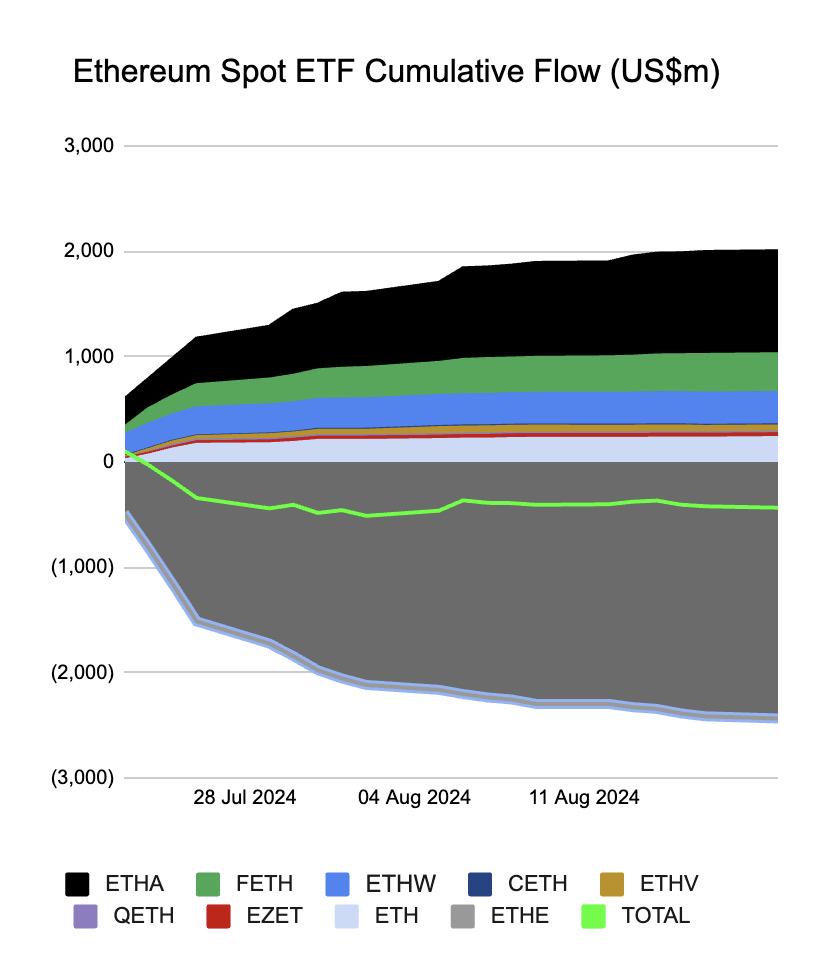
In contrast, BlackRock’s ETHA, Fidelity’s FETH, and Bitwise’s ETHW emerged as the main “capital magnets.” Farside Investors’ data indicates that as of August 19, ETHA, FETH, and ETHW recorded net inflows exceeding $970 million, $360 million, and $300 million respectively—accounting for 82.5% of the total ~$2 billion in net inflows across all Ethereum spot ETFs.
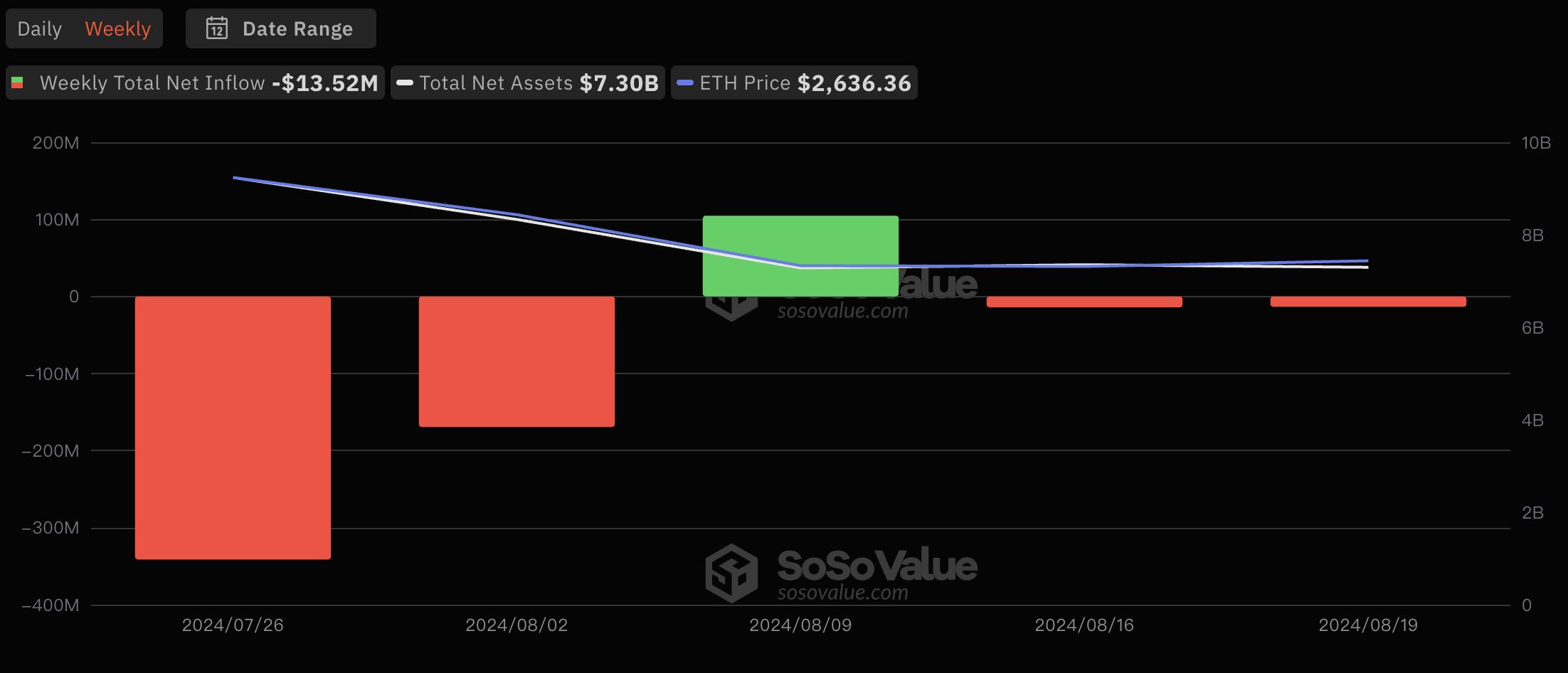
Despite the overall sharp net outflows, weekly capital flow data reveals a clear slowdown. Over the four trading weeks since launch, outflows have steadily narrowed and turned positive for the first time in the third week, with approximately $100 million in net inflows—primarily driven by ETHA. SoSoValue data shows that while the first week saw the heaviest outflow at $340 million, subsequent weeks showed diminishing outflows.
With lackluster investor participation, both ETH and its spot ETFs have underperformed in price. According to CoinGecko, as of August 20, ETH’s price had dropped about 34.2% from its annual peak, falling back to early February levels. Additionally, PANews analysis shows that since their listing, the nine Ethereum spot ETFs have on average declined around 21.7%, with ETHE, ETHA, and ETHW slightly exceeding this average.
Possible Staking Integration May Ease Severe Outflows; Multiple Factors Suppress Price Gains
"Heavy outflows have caused Ethereum to underperform against Bitcoin. Even though newer products like BlackRock’s iShares Ethereum Trust are seeing some positive inflows, established ones like Grayscale’s ETHE continue to bleed capital, exacerbated by aggressive selling from major market makers such as Jump Trading," Bitfinex Alpha noted in its latest report.
The report also stated that the coming months will be crucial for determining whether Ethereum ETFs can recover and sustain investor interest amid current challenges in performance and outflows. Broader macroeconomic conditions and key factors such as potential Federal Reserve rate cuts will significantly influence future capital flows and market dynamics for both Ethereum and Bitcoin ETFs.
However, introducing staking functionality into Ethereum spot ETFs could enhance ETH’s appeal and help reverse the outflow trend. Cynthia Lo Bessette, head of Fidelity Digital Assets, recently said that while the SEC has not yet approved staking-enabled ETH ETFs, this may change in the future, as staking is a core component of the Ethereum ecosystem and a key investment opportunity. She believes it’s only a matter of time—not if—such products will emerge, noting that Fidelity has already held constructive discussions with SEC staff regarding launching staked ETH ETFs.
Beyond persistent ETF outflows, other key indicators—including a record-low ETH/BTC exchange rate and plunging gas fees—have further shaken market confidence. As ETH’s price continues to decline, the ETH/BTC exchange rate recently hit a three-year low of 0.042, prompting many long-position holders to reduce exposure or cut losses. Etherscan data also shows that Ethereum network gas fees have remained below 1 gwei for multiple consecutive days—the lowest level in years. Kaiko Research explained that recent fee declines stem from increased Layer 2 activity and the Dencun upgrade in March, which reduced L2 transaction costs, driving Ethereum gas fees to a five-year low.
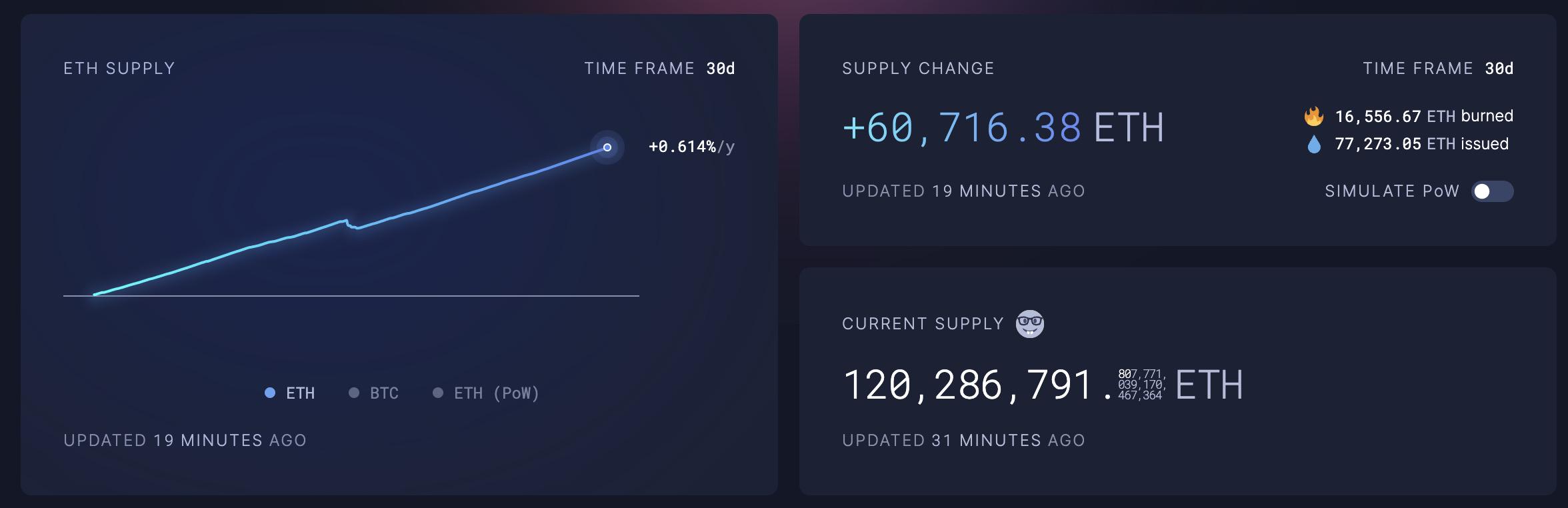
Kaiko noted that lower fees significantly impact Ethereum because reduced fee burning leads to lower ETH destruction, increasing token supply and potentially suppressing price gains in the short term. According to Ultrasound.money, Ethereum’s circulating supply has now reached approximately 120.28 million ETH, with a net increase of about 60,712 ETH over the past 30 days (19,438 ETH burned, 77,091 newly issued). This corresponds to an annual supply growth rate of 0.61%.
Industry Insiders Remain Bullish on Future Growth Potential
Amid prevailing pessimism, several industry experts have shared their outlooks on Ethereum’s price trajectory, generally expressing optimism about its long-term growth potential.
Michaël van de Poppe, founder of MN Trading, recently posted on social media that altcoins, despite being overshadowed by Bitcoin, still have significant breakout potential. A rebound in altcoin market cap could confirm a bullish divergence and signal a shift in market focus toward the Ethereum ecosystem rather than Bitcoin.
Benjamin Cowen, founder of Into The Cryptoverse, believes Bitcoin could make its final move toward reclaiming 60% dominance (market share) as early as September or by December at the latest. Meanwhile, Ethereum and many other cryptocurrencies still have room to grow. During previous "major altseasons," such as in 2021, Bitcoin’s dominance tends to fall, then slowly recovers after the bear market.
Burak Kesmeci, analyst at CryptoQuant, suggested that two distinct on-chain indicators may signal that ETH is nearing the end of its correction phase. Current data shows buyers gradually regaining strength. However, whether this marks a temporary bounce or the beginning of a strong, sustained rally led by bulls remains to be seen.
Join TechFlow official community to stay tuned
Telegram:https://t.me/TechFlowDaily
X (Twitter):https://x.com/TechFlowPost
X (Twitter) EN:https://x.com/BlockFlow_News
 PANews