








The Metaverse Bubble Burst?
TechFlow Selected TechFlow Selected
The Metaverse Bubble Burst?
Here are several "data truths."
 Navigating Web3 tides with focused insights
By: Divyanshi Seth
Translation: MetaverseHub
In recent years, the tech industry has shown immense enthusiasm for the concept of the "metaverse," a vision promising to transform online experiences by delivering immersive virtual worlds where we can work, play, and socialize in ways previously unimaginable.
Tech giants and investors have poured tens of billions of dollars into this vision, with Meta (formerly Facebook) leading the charge. However, recent data suggests that the metaverse bubble may have already burst, leaving many questioning its future.
To understand the current situation, it's important to step back and recall what the metaverse once promised.
Meta CEO Mark Zuckerberg became the poster child for this movement, rebranding his company and investing heavily in virtual reality technology.
Citibank researchers even predicted the metaverse could attract 5 billion users and grow into a $13 trillion market. These bold projections sparked a gold rush, with companies and individuals scrambling to stake their claims in this digital frontier.

01. The Sharp Decline of the Metaverse
Today, the landscape looks drastically different.
Meta’s ambitious Reality Labs division—the company’s flagship metaverse arm—has been hemorrhaging money. In just the last quarter alone, it lost $4.5 billion, bringing its total losses since inception to over $46 billion. These figures stand in stark contrast to the once-promised profitable future.
Tellingly, so has the fate of Horizon Worlds, Meta’s flagship adult-oriented metaverse platform. Despite extensive marketing efforts, the platform has struggled to attract its intended audience. Ironically, it has gained unexpected popularity among children—a demographic it was never designed for.
02. The Collapse of Crypto-Based Metaverses
The metaverse concept wasn’t limited to traditional tech firms.
A full ecosystem of crypto-powered virtual worlds emerged, promising decentralized ownership and unique digital assets.
Built on blockchain technology, these platforms were hyped to astronomical valuations. Yet they too have experienced a dramatic downfall.
Take The Sandbox, for example—a virtual world once valued at over $7 billion. Its daily trading volume has plummeted by 99.9%. At its peak, it saw $117 million in transactions; now, it averages just $8,000 per day.
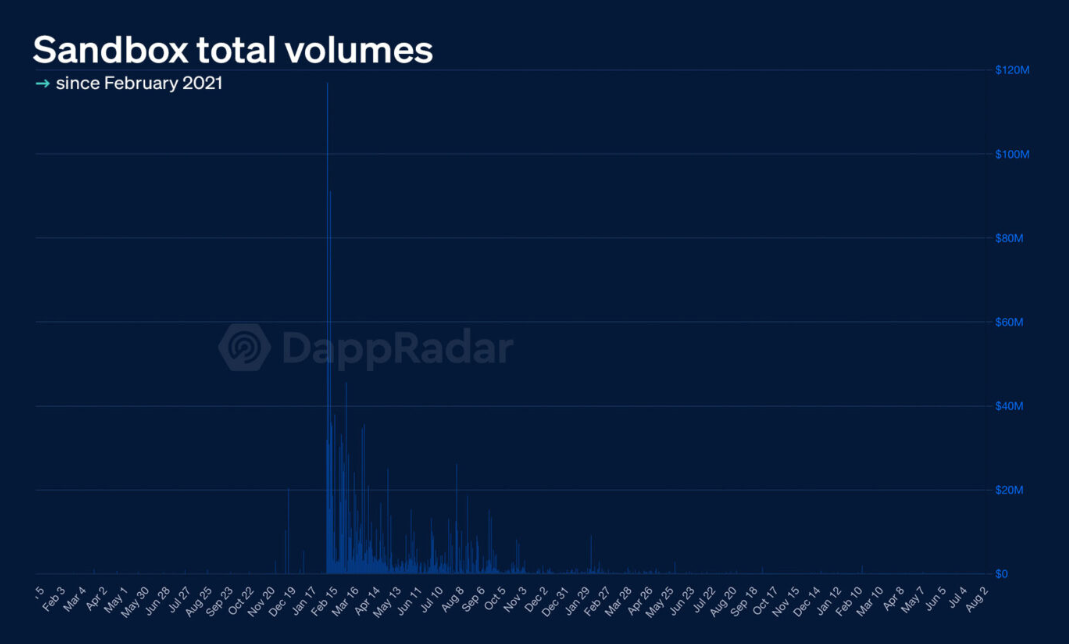
This is not an isolated case. Another pioneering crypto-metaverse platform, Decentraland, has seen a similar 99.9% drop in daily trading volume, falling from a peak of $2.5 million to less than $5,000 today.
03. The Fall of Digital Assets
One of the most compelling aspects of these virtual worlds was the ability to own and trade digital assets, typically in the form of non-fungible tokens (NFTs). These tokens could represent anything from virtual real estate to in-game items.
At the height of the metaverse craze, prices for these assets were staggering. Now, their value has nearly evaporated.
In The Sandbox, daily NFT sales once reached $10.2 million but now struggle to exceed $10,000.
This pattern repeats across other platforms. AxieInfinity, once the poster child of "play-to-earn" gaming, has seen its trading volume crash from nearly $1 billion to under $2 million.
The performance of cryptocurrencies tied to these "metaverse" projects has also been dismal. Tokens such as MANA (Decentraland), SAND (The Sandbox), and AXS (AxieInfinity) have all dropped more than 90% from their November 2021 peaks.
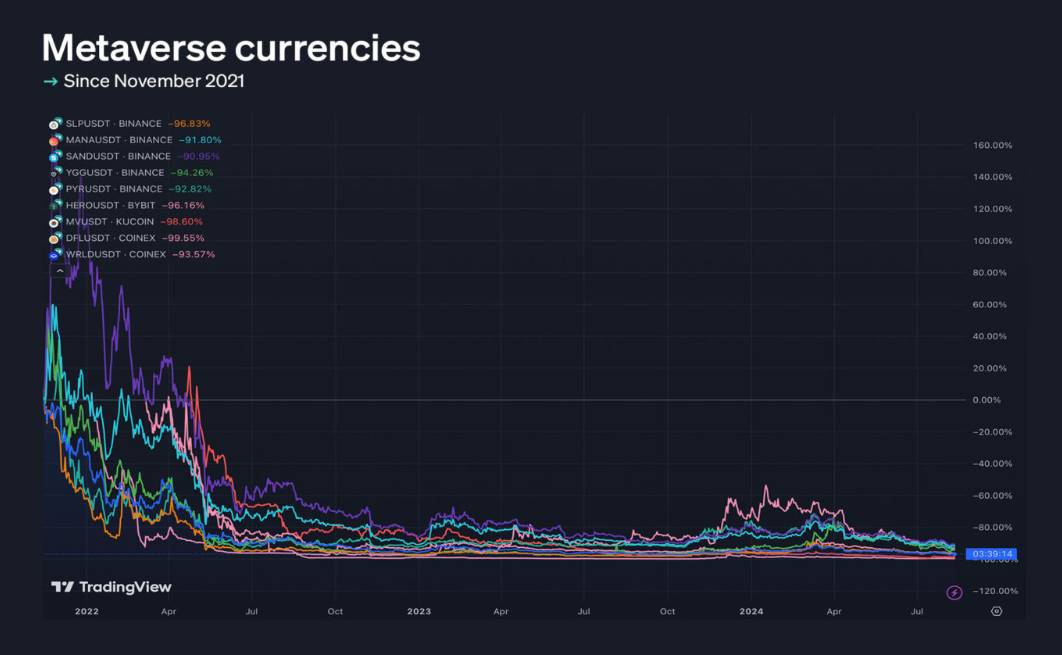
This decline isn't limited to individual projects—the entire metaverse crypto sector has shrunk dramatically, with its total market capitalization falling from $50 billion to $16 billion.
04. What Caused This Collapse?
Several factors contributed to this rapid downturn.
First, the initial hype created unrealistic expectations. The technology required to deliver truly seamless, immersive virtual experiences remains in its infancy. Many users found the current offerings clunky and disappointing compared to the promised vision.
Moreover, the concept itself may have been too abstract for mainstream adoption. While tech enthusiasts were excited, average internet users struggled to see how the metaverse would meaningfully improve their digital lives. High barriers to entry—both in terms of hardware costs and learning curves—further limited adoption.
Broad economic downturns and the collapse of the crypto market also played a significant role. As investment capital dried up and risk appetite declined, many metaverse projects found it difficult to sustain development and user growth.

Despite these setbacks, it may be too soon to completely dismiss the metaverse concept.
Technologies often go through cycles of hype, disillusionment, and eventual practical application. Some proponents, like Mark Zuckerberg, still believe in the long-term potential of the metaverse and continue to invest heavily in its development.
History shows that even after major market corrections, innovative ideas can re-emerge in more practical forms.
Just as companies like Amazon and eBay emerged from the dot-com bubble to become tech giants, some metaverse projects may yet find their footing and deliver value in ways we haven’t yet imagined.
Join TechFlow official community to stay tuned
Telegram:https://t.me/TechFlowDaily
X (Twitter):https://x.com/TechFlowPost
X (Twitter) EN:https://x.com/BlockFlow_News
 @CoinChapter











