









The "bigger one" is coming—can it pull Bitcoin back into a bull market?
TechFlow Selected TechFlow Selected
The "bigger one" is coming—can it pull Bitcoin back into a bull market?
The Fed's interest rate hike may come soon, meaning something "bigger" than the Bank of Japan's rate hike is coming.
 Navigating Web3 tides with focused insights
Author: Huohuo
On August 5, the Bank of Japan's interest rate hike triggered severe turbulence across global financial markets. Japanese and U.S. stocks crashed, Bitcoin's fear index surged nearly 70%, multiple countries' stock markets experienced repeated circuit breakers, and even European and emerging market equities suffered significant blows. Under immense market pressure, investors began seeking relief, calling on the Federal Reserve to cut rates and rescue the markets. A Fed rate cut may come soon—meaning something “bigger” than Japan’s tightening is looming. Could this pull Bitcoin back into a bull market?
Why Is the Federal Reserve So Influential?
1) What Is the Federal Reserve?
Before understanding the concepts and impacts of Fed rate hikes and cuts, we must first understand what the Federal Reserve is.
The Federal Reserve (Fed), or the U.S. Federal Reserve System, is the central banking system of the United States, composed of 12 regional Federal Reserve Banks. Its mission is to stabilize prices and maximize employment by adjusting monetary policy. Inflation and employment rates are crucial indicators of economic health, closely monitored by investors and market participants to assess economic outlook and investment risk.
As the U.S. central bank, the Fed exerts enormous influence over financial markets. How does it wield such power? Primarily through monetary tools that adjust interest rates—either raising or lowering them—to affect the economy:
A rate hike increases interbank borrowing costs, thereby raising loan rates for businesses and individuals. When the Fed raises rates, deposit yields in dollars rise, attracting capital inflows into the U.S. and reducing investments elsewhere, worsening economic conditions and increasing unemployment. Higher borrowing costs also raise default risks for companies and individuals, potentially triggering bankruptcies.
A rate cut has the opposite effect, lowering deposit and borrowing rates. When the Fed cuts rates, dollar deposit yields fall, prompting capital to flow out of banks and into other countries, stimulating global investment and economic recovery.
So how many times has the Fed cut rates in the past, and what were the impacts?
2) History of Rate Cuts
Looking back, since the 1990s, the Fed has gone through six notable rate-cutting cycles. These include two preemptive cuts, three emergency-stimulus cuts, and one hybrid cycle combining both approaches.
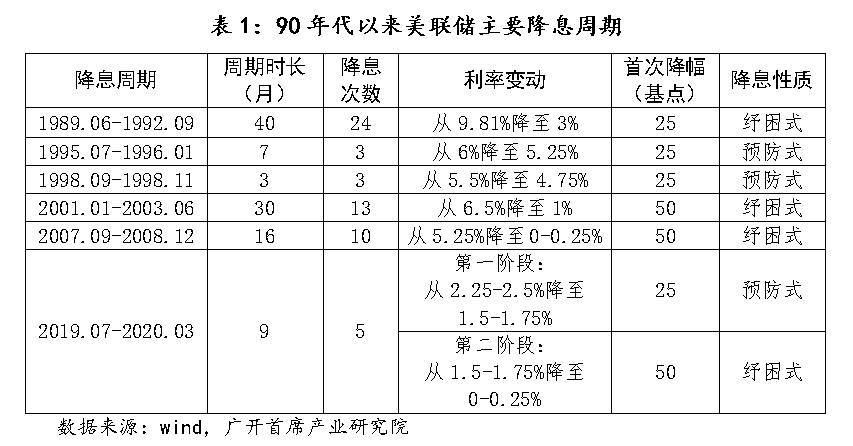
First, let’s clarify the differences between these types of rate cuts:
Preemptive rate cuts occur when a central bank acts proactively amid early signs of economic slowdown or external risks, aiming to avoid recession and achieve a "soft landing." Characteristics include short duration, modest initial cuts, limited number of cuts, and the federal funds rate typically not falling below 2%.
Emergency-stimulus rate cuts are implemented during severe recessions or major shocks, involving aggressive and sustained reductions to support real economies and households. Features include long duration (possibly 2–3 years), steep cuts (often consecutive large cuts initially), strong initial moves (typically over 50 basis points), and deep total cuts (final rate often below 2% or near zero).
In contrast, hybrid rate-cut cycles are more complex, starting as preventive measures but shifting to emergency mode due to rapidly deteriorating conditions.
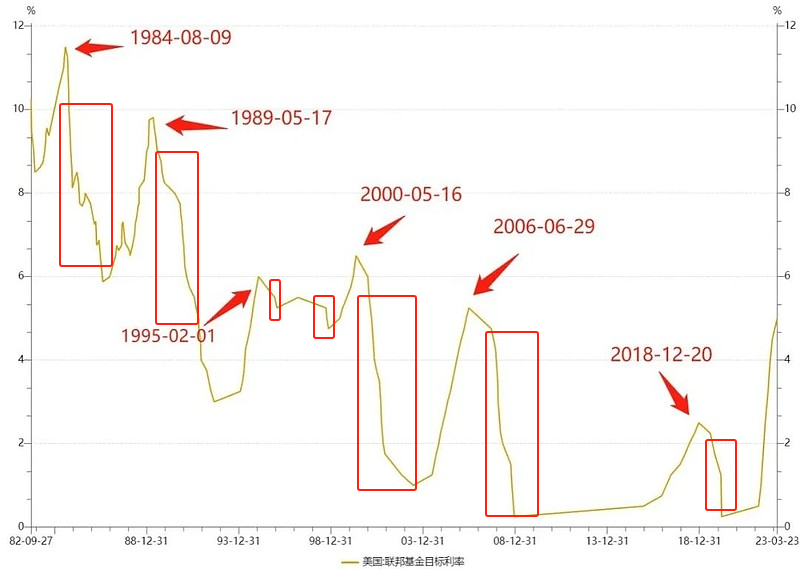
Since the 1990s, what impact have these Fed rate-cutting cycles had on markets and the economy?
1990–1992:
Cut details: The Fed lowered the federal funds rate from 9.810% to 3.0%.
Market impact: This easing supported recovery from the 1990 recession. Equity markets began rising, growth gradually resumed, and though inflation and unemployment remained pressures, the overall economy improved.
1995–1996:
Cut details: Starting in 1995, the Fed reduced rates from 6.0% to 5.25%.
Market impact: Aimed at slowing growth, this easing supported equity gains and stability. It extended an expansion phase, with strong stock performance—especially tech stocks—leading into the late-1990s tech boom.
1998 (September–November):
Cut details: The federal funds rate fell from 5.50% to 4.75%.
Market impact: Eased market tensions and supported growth. Equities responded positively, especially tech stocks, which rebounded sharply. The Nasdaq surged in 1998, laying groundwork for the dot-com bubble.
2001–2003:
Cut details: Rates dropped from 6.5% to 1.00%.
Market impact: Conducted post-2001 recession, these cuts supported recovery and drove equity gains in 2002–2003. However, excessive easing sowed seeds for the housing bubble and subsequent financial crisis.
2007–2008:
Cut details: Rates slashed from 5.25% to near zero (0–0.25%).
Market impact: Responding to the 2008 financial crisis, near-zero rates eased financial stress, supported recovery, and fueled a strong stock rebound after 2009.
2019–2020:
Cut details: Rates cut from 2.50% to near zero (0–0.25%) in 2019 and 2020.
Market impact: Initially aimed at slowing growth and global uncertainty, further cuts and massive stimulus stabilized markets during the pandemic and supported recovery. Stocks rebounded quickly in 2020 despite severe economic damage. This round also indirectly contributed to the crypto "Black Thursday" crash of March 2020.
In sum, each rate-cut cycle has had distinct effects, shaped by prevailing economic conditions, market dynamics, and global circumstances.
3) Why Is the Fed So Influential?
The Fed profoundly affects global financial markets, directly shaping global liquidity and capital flows. Its influence manifests in several ways:
Global reserve currency: The U.S. dollar is the world’s primary reserve currency. Most international trade and financial transactions are dollar-denominated, so Fed policy shifts directly impact global markets and economies.
Interest rate leadership: The Fed’s rate decisions directly influence global interest rate levels. Other central banks often follow suit, creating a transmission mechanism that gives Fed policy far-reaching effects on capital flows and market trends.
Market expectations: The Fed’s statements and actions trigger global market volatility. Investors closely watch its signals, and market expectations about future policy directly affect asset prices and sentiment.
Global economic linkages: Given the high degree of global economic integration and the U.S.’s status as the largest economy, American economic conditions significantly affect others. The Fed’s monetary policy thus influences the trajectory of the global economy.
Risk asset volatility: Fed actions heavily impact prices of risk assets like equities, bonds, and commodities. Market interpretation and anticipation of Fed policy drive global fluctuations in these assets.
Overall, due to the size of the U.S. economy and the dollar’s global role, the Fed’s decisions have deep and direct impacts on global financial markets, making them a focal point for investors worldwide.
So, regarding the upcoming Fed rate-cut cycle: how strong, fast, and frequent will the cuts be? How long will the cycle last? And how will it affect global financial markets?
How to View This Round of Fed Rate Cuts
1) Expectations for This Rate-Cut Cycle
Entering Q3 2024, signs in the U.S. suggest a need for monetary policy adjustment. Rising unemployment, slowing job growth, and stagnant wage gains indicate weakening activity. Tech stock declines signal slowing growth, while the U.S. faces massive debt servicing costs. These factors suggest the Fed may need to cut rates to boost consumption, stimulate the economy, and ease monetary conditions. Ahead of "Black Monday," markets widely expected the Fed to begin cutting as early as September this year.
According to market forecasts, Goldman Sachs previously projected 25-basis-point cuts in September, November, and December, noting a 50-basis-point cut possible if August jobs data proved weak. Citibank suggested 50-basis-point cuts in both September and November. JPMorgan economists revised their outlook, anticipating 50-basis-point cuts in both meetings and even possible emergency cuts between sessions.
After Black Monday, some analysts argued the Fed might act before its September meeting, with a 60% chance of a 25-basis-point emergency cut—a rare move typically reserved for severe crises. The last such action occurred at the start of the pandemic.
However, given the high uncertainty in the U.S. and global economies, it remains unclear whether this cycle will be preemptive or emergency-driven. These two scenarios would have vastly different market implications, requiring further observation.
2) Potential Impacts of This Fed Rate-Cut Cycle
Expectations of a Fed rate cut are already affecting global financial markets and capital flows. To counter downward pressure, bets on rate cuts by the Bank of England and the ECB are rising. Some investors believe the BoE’s chance of a September cut exceeds 50%. For the ECB, traders expect two cuts by October, with a significant September cut not out of the question.
Next, let’s examine potential consequences of this rate-cut cycle:
A. Impact on Global Markets
This Fed rate-cut cycle is expected to significantly impact global financial markets.
First, lower U.S. interest rates could redirect capital toward higher-yielding markets and assets, increasing global capital flows.
Rate cuts may also weaken the dollar, triggering exchange rate volatility and pushing up prices of dollar-denominated commodities like oil and gold. A weaker dollar could boost U.S. export competitiveness but might also intensify global trade tensions.
Meanwhile, lower rates could reduce borrowing costs for global equities, lifting corporate profit expectations and driving stock gains.
Lower global capital costs may encourage more investment, though highly indebted nations and firms may see limited benefit.
Although cheaper capital can spur investment, highly leveraged entities may struggle to access new funding due to debt burdens and tight lending terms.
Finally, rate cuts could fuel global inflation, especially if currency depreciation and rising commodity prices erode economic stability and challenge central bank policies.
B. Will Rate Cuts Directly Benefit Crypto Markets?
While many believe rate cuts increase market liquidity, lower borrowing costs, and may boost cryptocurrency prices—and that in uncertain environments, investors may turn to Bitcoin as a safe haven—others caution against overlooking potential recession risks.
Yet most institutions agree that during periods of complex and volatile conditions, markets may still experience significant swings even during rate cuts. During the 2008 financial crisis, despite early rate cuts by the Fed, markets briefly rallied before plunging. Despite rapid and deep rate reductions, the Fed failed to contain the crisis. The roots lay in the collapse of the dot-com and housing bubbles, which inflicted deep economic damage.
Whether current rate cuts will repeat history—triggering bursts in AI or U.S. debt bubbles that drag down crypto—remains to be seen.
Still, in the short term, rate cuts by the Fed and other central banks serve as a strong confidence boost for global and crypto markets. Undoubtedly, rate-cut expectations will increase liquidity and optimism, potentially sparking a short-term rally in crypto assets and offering quick profit opportunities for investors.
In the long run, however, crypto market trends will depend on more complex and dynamic factors. Price movements are rarely driven by a single variable and require comprehensive analysis:
First, market direction hinges on the strength of economic recovery. If rate cuts successfully stimulate growth, crypto markets may benefit. Otherwise, weak recovery and eroded confidence could drag crypto down too. During the 2020 pandemic, Bitcoin crashed alongside stocks and commodities in the "March 12" meltdown. Markus Thielen of 10x Research recently noted the U.S. economy is weaker than the Fed assumes; if equities follow the ISM manufacturing index downward, Bitcoin could keep falling. Also, during downturns, investors may sell off Bitcoin.
Second, inflation matters. While rate cuts aim to stimulate spending, they also risk fueling inflation. Rising inflation could force central banks to hike again, pressuring crypto markets anew.
Third, the U.S. election and global regulatory changes carry deep implications. Who will win the U.S. presidency? What crypto policies will the new administration pursue? These remain unknown.
In conclusion, the global shift toward looser monetary policy undoubtedly brings new opportunities and challenges for crypto markets. Rate cuts will likely provide short-term liquidity support—boosting both liquidity and safe-haven demand—but also face challenges from past financial crises and other complex factors, making it uncertain whether crypto will truly benefit.
Summary
Overall, "Black Monday" reflected fears of a U.S. recession dragging down markets, compounded by pessimism from industry leaders, global geopolitical unrest, and ongoing policy volatility in the near term.
Based on historical financial cycles, crises and opportunities go hand in hand. Economic slowdowns, market swings, and investment losses may spark panic, but they also offer investors and businesses chances to regroup and seek innovation. Crises force companies to improve operations and efficiency, paving the way for more resilient growth ahead.
Join TechFlow official community to stay tuned
Telegram:https://t.me/TechFlowDaily
X (Twitter):https://x.com/TechFlowPost
X (Twitter) EN:https://x.com/BlockFlow_News
 白话区块链
白话区块链








