









An exchange can be the eye of God, or the eye of an ordinary person
TechFlow Selected TechFlow Selected
An exchange can be the eye of God, or the eye of an ordinary person
From a market trend and sentiment perspective, meme coins will continue to play the leading role in this bull market for a long time to come.
 Navigating Web3 tides with focused insights
In the derivatives market, exchanges that should remain neutral instead continuously leverage data-driven "God's eye" to monitor every ripple and anomaly in the crypto space, steering the market toward outcomes more favorable to themselves. In extreme conditions, they even exploit system outages or network disconnections to harvest already-struggling market participants. By contrast, while the spot market lacks such covert "technical manipulation," it is still rife with behind-the-scenes coordination between platforms and project teams. This year’s performance of numerous VC-backed tokens clearly shows that most reach their peak at launch, then follow a graceful downward parabolic trajectory.
Compared to the sophisticated, high-end operations of this "God's eye," the ordinary trader’s simple principle of “what you see is what you get” has significantly contributed to democratizing the market.
DEX Trading Volume Surges Compared to CEX, Driven Primarily by Meme Coins
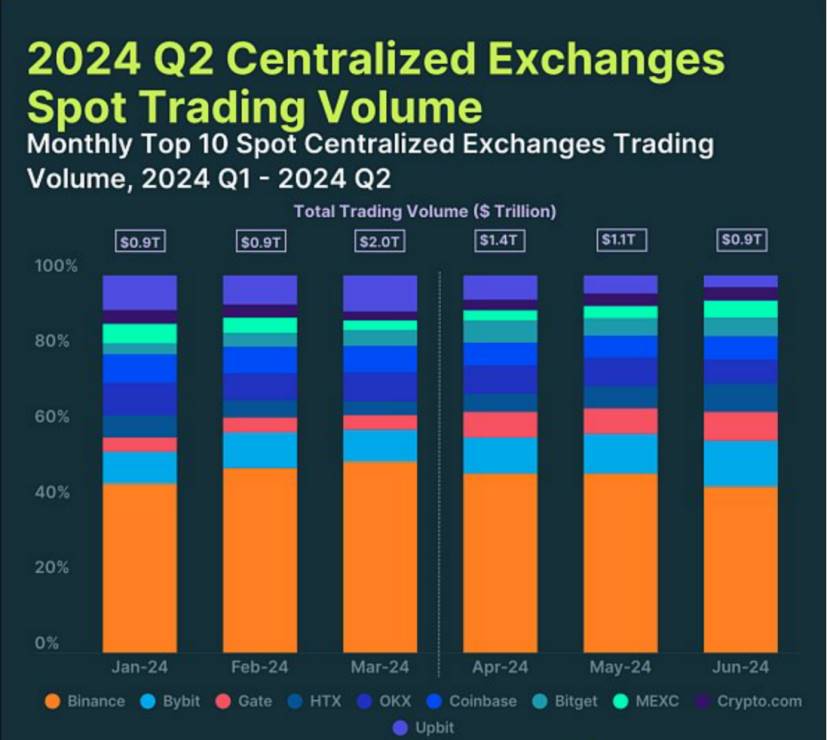
According to CoinGecko data, Q2 2024 saw $3.4 trillion in spot trading volume on centralized exchanges (CEX), a 12.2% decline from the previous quarter. Binance remains the largest CEX, holding a dominant 45% market share, while Bybit increased its share to 12.6%. Despite a noticeable rise in newly listed tokens, only four out of the top ten CEXs reported growth in trading volume.
In stark contrast, decentralized exchanges (DEX) exhibited dramatically different growth trends. In Q2 2024, the combined spot trading volume across the top ten DEXs reached $370.7 billion, a 15.7% increase quarter-on-quarter. Uniswap continues to dominate the DEX landscape, capturing 48% of the market share.
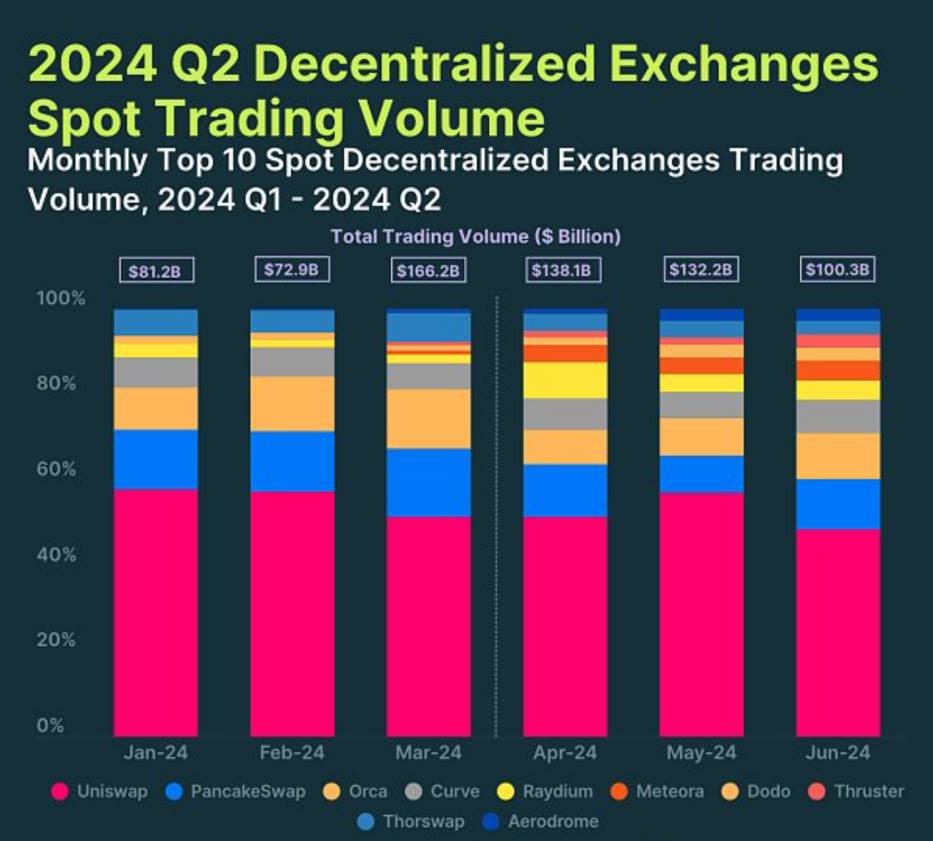
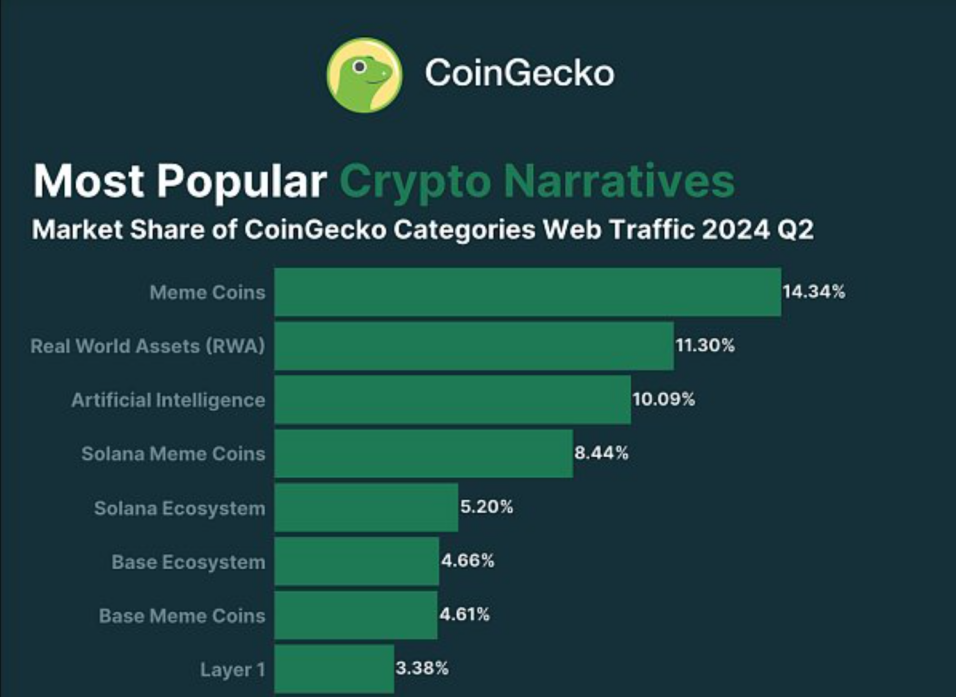
The countercyclical growth of DEX relative to CEX can be largely attributed to the explosive rise in both the number and trading volume of meme coins during Q2. Most meme coins originate and develop initially on DEXs. Data indicates that meme coins emerged as the most popular narrative in Q2 2024, accounting for 14.3% of the market share, with four out of the top 15 crypto narratives being meme-related. The widespread emergence of meme coins in the first half of this year has significantly boosted DEX trading volumes, reflecting a clear shift in user traffic and capital flows—more users are becoming holders of meme coins.
Compared to derivative markets and VC tokens, meme coins possess an innate “user-centric” quality, giving users greater control and deeper engagement.
The Ideal of Decentralization in Crypto Finds Its Maximum Realization in Meme Coins
For market participants, meme coins feel more authentic and represent the highest degree of decentralization achieved so far. While some insider allocations (“rat holes”) and small whales may exist, the majority of price movements in meme coins are driven and sustained collectively by retail users. In reality, meme coins are no longer controlled by project teams or large manipulators but rather governed by community members. The inherent decentralized nature of blockchain technology is vividly embodied in the world of meme coins.
However, despite their explosive growth over the past six months, most meme coins struggle to gain listing on major exchanges. These top-tier platforms—among the most influential “non-decentralized” entities within the decentralized ecosystem—remain indifferent to meme coins due to their uncontrollable and unconventional “hyper-decentralized” nature. The revenue generated from meme coins pales in comparison to that from derivatives and VC tokens.
Take the currently hottest meme coins—MIGGLES, FIGHT, and KAMA—as examples. As shown in the images (data sourced from CMC), these breakout meme coins have not been listed on any top-tier exchange. Instead, they are primarily available on secondary-tier exchanges such as LBank, MEXC, Gate.io, and BitMart. Among them, LBank leads significantly in circulating supply, trading depth, and volume, indicating its status as the primary trading hub for these popular meme coins. This leadership ensures a smoother trading experience for users, minimizing slippage—a critical factor for successful meme coin trading.
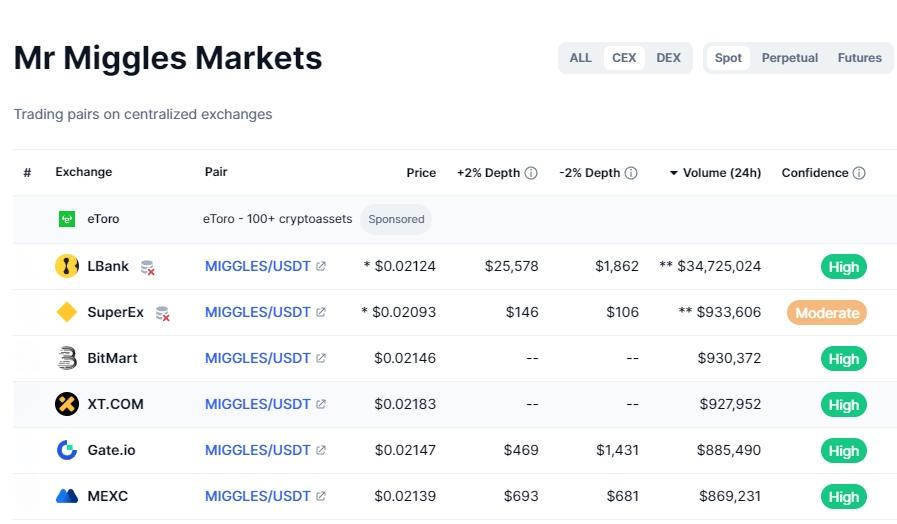
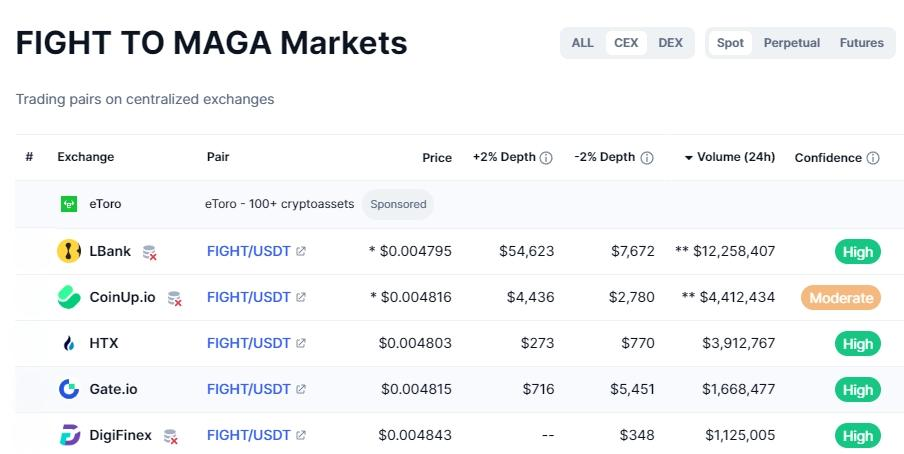
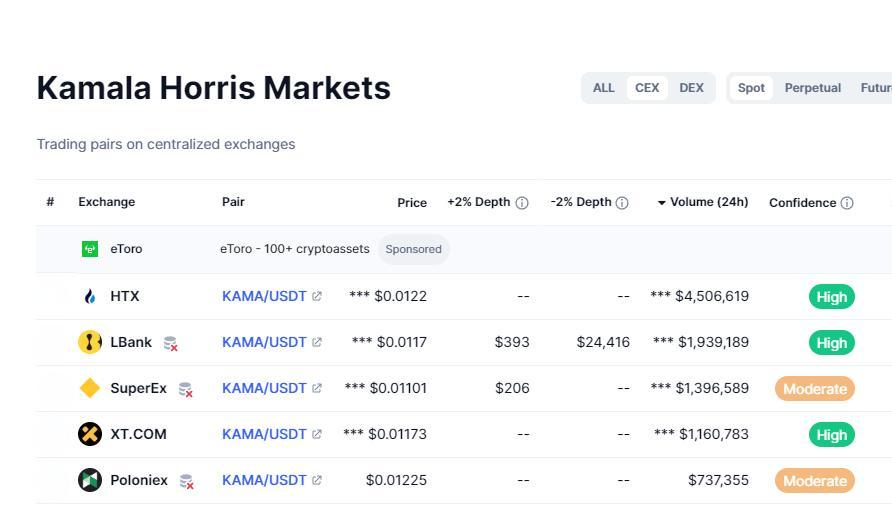
Naturally, by listing meme coins, these exchanges also capture a portion of the associated user traffic. For example, LBank has seen its 24-hour trading volume steadily increase thanks to continuous listings of trending meme coins, bringing it closer to the ranks of well-known second-tier exchanges. Meanwhile, its platform visibility and user traffic have risen to the forefront of the market.
Judging from current market trends and sentiment, meme coins are poised to remain the leading force in this bull run for the foreseeable future. How effectively exchanges can serve these meme coin users and manage the massive influx of traffic will become a key strategic focus. This surge in user activity could, in turn, empower exchanges to break through the competitive clutter.
The "God's eye" of top-tier exchanges is unlikely to notice the needs of grassroots meme coin users. Whether other exchanges can leverage the "ordinary vision" of retail participation and ride the wave of meme coins to prominence remains to be seen.
Join TechFlow official community to stay tuned
Telegram:https://t.me/TechFlowDaily
X (Twitter):https://x.com/TechFlowPost
X (Twitter) EN:https://x.com/BlockFlow_News









