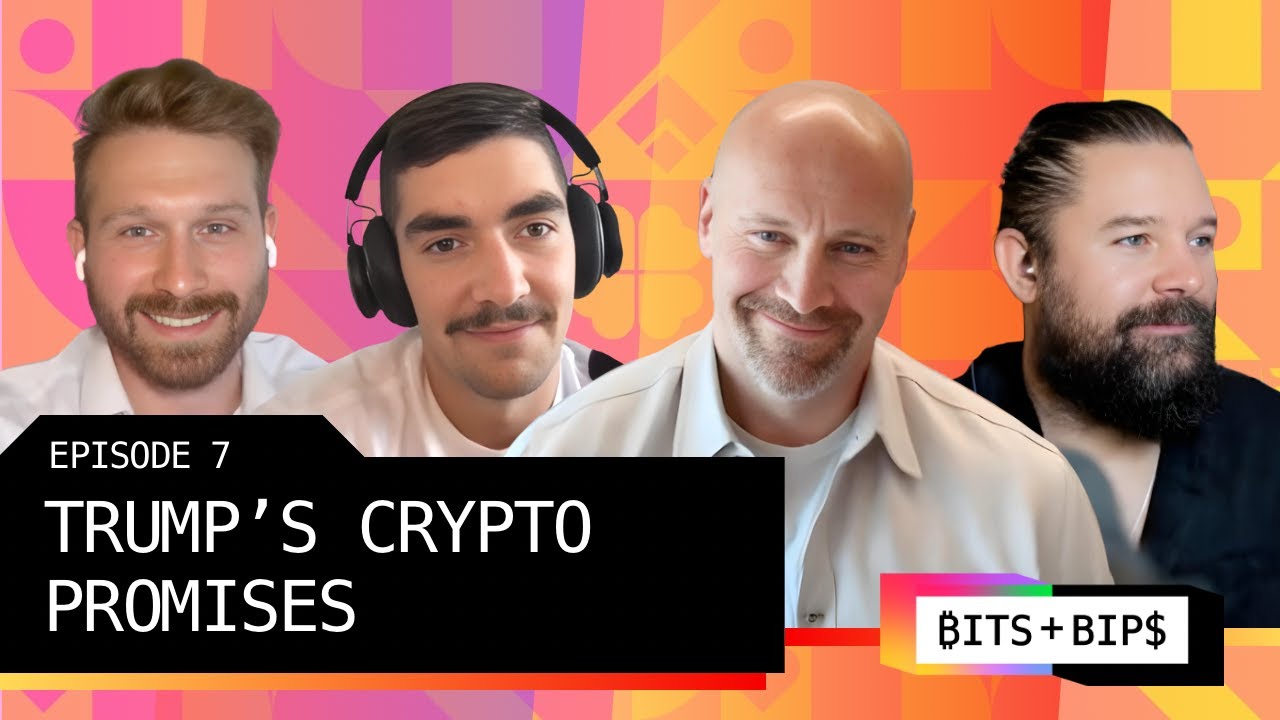
Castle Island Partners: The Bitcoin Strategic Reserve Act is unlikely to pass
TechFlow Selected TechFlow Selected
Castle Island Partners: The Bitcoin Strategic Reserve Act is unlikely to pass
Deep dive into Trump's game-changing promises to the crypto community.
 Navigating Web3 tides with focused insights
Video source: Unchained
Translation: Peyton (7UPDAO Analyst)
Hosts:
-
James Seyffart, Research Analyst at Bloomberg Intelligence
-
Alex Kruger, Founder of Asgard
-
Joe McCann, Founder, CEO, and Chief Investment Officer of Asymmetric
Guest: Nic Carter, General Partner at Castle Island Ventures
Since its launch in 2016, Unchained has become one of the most popular cryptocurrency podcasts. Every Tuesday, host Laura Shin—the author of The Cryptopians—conducts hour-long interviews or discussions with key figures in the crypto space. Every Friday, Laura dives deep into the week's biggest news and summarizes major headlines. The Bits + Bips segment is hosted by James Seyffart, Alex Kruger, and Joe McCann.
In this episode of Bits + Bips, hosts James Seyffart, Alex Kruger, and Joe McCann join Nic Carter to explore Trump’s game-changing promises to the crypto community, Kamala Harris’s unexpected policy shift, and Solana’s explosive rise. Additionally, Nic addresses pressing concerns around Ethereum ETFs and shares insights on why he’s been allocating more capital to certain ecosystems recently.
Nic Carter
Nic Carter is a general partner at Castle Island Ventures, where he focuses on investments in crypto financial infrastructure and internet property rights. He co-hosts the podcast On The Brink and writes a column for CoinDesk. Carter holds a Bachelor of Arts in Philosophy from the University of St Andrews and a Master’s in Finance from the University of Edinburgh. He previously worked at Fidelity Investments and has contributed to publications including the Harvard Business Review, Fortune, and Bitcoin Magazine. Carter frequently appears on media outlets such as Bloomberg, CNBC, and BBC News.
He is known for advocating anti-authoritarian technology and freedom. While not a Bitcoin maximalist, Carter supports Lockean property rights and monetary competition. He believes the Bank Secrecy Act is unconstitutional and advocates for the revival of private money issuance and the establishment of a true digital cash standard. He is involved with the Bitcoin Clean Energy Initiative and serves as an advisor to several organizations in the crypto space. Additionally, Carter is a 1-0 amateur MMA fighter and holds personal investments in multiple tech and crypto companies.
Nic’s Reaction to Trump Mentioning “Chokepoint 2.0”
Nic: Expressed surprise that his blog post became part of political discourse, saying, “It’s astonishing—my blog post becoming part of the national political conversation. I’m genuinely shocked.”
He described Chokepoint 2.0 as a strategy similar to Chokepoint 1.0, which was “an official Obama-era program designed to marginalize businesses they disliked, using unconstitutional methods.” He explained that Chokepoint 2.0 resurfaced after the FTX collapse, as federal regulators began targeting the crypto industry, making it “extremely difficult and costly to access banking services.” Trump mentioning this issue is “highly significant” for the entire sector.
Joe asked Nic to explain Chokepoint 2.0 to listeners, noting it had been discussed before and emphasizing the impact of the Biden administration’s stance on crypto since May. He acknowledged the difficulty digital asset firms face in securing bank accounts and reflected on the importance of Chokepoint 2.0 entering mainstream political discourse.
Joe referenced Nic’s tweet featuring a shirtless photo that highlighted key issues including Chokepoint 2.0. He invited Nic to discuss the spirit behind the tweet and the points raised, suggesting a deeper dive into the karate competition details mentioned in the post.
The Bitcoin Strategic Reserve Act
Nic: Believed Trump’s proposal to retain seized bitcoins is politically more pragmatic, as it avoids controversy over market purchases and potential attacks from Democrats. He noted that most of the seized bitcoins originated from the Bitfinex hack and technically do not belong to the U.S. government, complicating the matter.
Nic expressed skepticism about the Lummis bill passing, viewing it more as a symbolic gesture to attract the Bitcoin community rather than a serious legislative effort. While he appreciated the idea of Trump holding seized Bitcoin, he emphasized the need to resolve legal ownership questions.
Nic also compared Lummis’s proposal—to purchase 5% of all Bitcoin—with the U.S. holding approximately 3.4% of above-ground gold reserves, pointing out that Lummis’s plan is far more aggressive. He concluded the bill is unlikely to succeed, especially amid an upcoming presidential election, and sees it as a narrative-driven initiative with significant global influence but uncertain outcomes.
The Significance of Trump’s Commitments at the Bitcoin Conference
Alex: Noted that even though the Lummis bill has little chance of passing, its value lies in sparking discussion and media attention. He highlighted Trump’s statements at the conference, such as “Bitcoin is the new steel industry,” “Bitcoin will surpass gold,” and “Bitcoin users are highly intelligent people.” Trump also pledged to fire Gary Gensler on day one, dismantle Chokepoint 2.0, oppose central bank digital currencies (CBDCs), support self-custody and trading freedom, transform the U.S. into a Bitcoin mining powerhouse, and never sell Bitcoin. Alex emphasized these statements reflect a shift in perception—from crypto being seen as a threat to now being embraced.
Joe: Believed the key takeaway was the discussion and media attention generated by Trump’s commitments. He acknowledged that many of Trump’s statements may be politically motivated and unlikely to be fully realized, but their inclusion in public discourse is important. It brings mainstream media coverage and draws attention from international leaders.
Nic: Pointed out that Trump made very specific promises—firing Gary Gensler, dismantling Chokepoint 2.0, establishing a crypto advisory council, and passing legislation within 100 days. He said these commitments are hard to walk back, although some argue Trump cannot legally fire Gensler directly—but there may be ways around it. Nic also noted Trump’s support for stablecoins expands the Republican platform and reflects broader trends in crypto adoption.
James: Observed that the audience reacted most strongly to Trump’s promise to fire Gary Gensler. While Trump cannot immediately remove Gensler under current law, Gensler’s position could change under a new administration. Even if Trump cannot fire him outright, he could make Gensler’s tenure extremely difficult.
Alex: Added that Trump can replace the SEC chair but cannot remove Gensler entirely from the commission, meaning Gensler would still retain a vote. He further noted Nic’s significant contributions during the stablecoin discussion. Alex emphasized that if Circle were allowed to issue interest-bearing stablecoins, it would strengthen their dollar reserves. He contrasted this with Tether, which international users often employ to hedge against currency depreciation.
Tether’s Similarity to the Eurodollar System
Joe: Asked Nic to elaborate on how Tether compares to the Eurodollar system, noting it could be helpful for listeners.
Nic: Said he wasn’t sure Trump fully grasped the concept, though Vance might. He referenced Vance’s view that dollar hegemony may harm middle America—a perspective contrasting with the idea of expanding dollar influence through stablecoins. Nic explained that Eurodollars emerged due to restrictions in the U.S. banking system and the demand to circumvent them. Similarly, stablecoins like Tether were created to enable dollar transactions outside the traditional banking system. Initially used for settlement and collateral, stablecoins have evolved into tools for global dollar access, benefiting those excluded from dollar banking—much like Eurodollars.
Alex: Added that Eurodollar deposits currently total around $13 trillion, highlighting the scale of the market.
James: Recalled that when he and Nic first started covering crypto, they referred to stablecoins as “crypto dollars,” noting that 98% of stablecoins are dollar-denominated. Despite this dominance, he observed that the term “crypto dollars” never gained widespread traction.
Potential Impact of Fed Meeting Language
Joe: Mentioned that with the Fed meeting this week, discussing macroeconomic implications is worthwhile. He acknowledged Alex’s expectations and noted no rate cut is anticipated this week, but he maintains his forecast for a 50-basis-point cut in September, versus Alex’s expectation of 25 basis points.
Joe emphasized the importance of the Fed’s language in the press conference, particularly regarding weak economic data, rising unemployment, and negative CPI readings. He warned that waiting too long or cutting too little could result in a policy error and suggested the language might signal a “longer easing cycle,” similar to the ECB’s approach in June.
Additionally, Joe noted that the Bank of Japan’s decision following the FOMC meeting could impact the USD/JPY exchange rate.
Alex: Viewed Wednesday’s Fed meeting as likely uneventful, with no rate cut expected. The focus will be on Powell’s language, which he expects will lay groundwork for a possible September cut while aiming to reduce volatility and maintain predictability.
Alex stressed the importance of solid inflation data and high-frequency indicators like the Dallas Fed Index, which show strength in parts of the economy. He worried that only one rate cut this year might be seen as a policy mistake and advocated for more cuts.
Regarding the Bank of Japan, Alex expected a 25-basis-point hike and potential QE tapering, which could affect USD/JPY. He pointed out recent USD/JPY volatility matters due to implications for carry trades and risk-off sentiment. Alex concluded that the outcome of the Trump-Harris election will have a greater impact on Bitcoin than Fed actions.
Alex: Expressed concern that if the Fed cuts rates twice in September, it could be interpreted as signaling fear of a hard landing—sending a pessimistic rather than optimistic message.
James: Noted that markets currently assign about a 10% probability to more than one rate cut, but personally expects only one 25-basis-point cut. He anticipates three cuts by year-end, though doubts two will occur in September.
Potential Implications of Harris Campaign Reaching Out to Crypto Firms
James: Discussed the Harris campaign’s recent move to reset relations with the crypto industry at the Bitcoin Conference. He suggested a less partisan, ideally bipartisan approach would be preferable. While some in the crypto community are skeptical, he noted that about 15 Democrats signed a letter calling for a reassessment of crypto policy, which could be more favorable than current Biden administration policies. James believes that even if Democrats win, the impact on the industry could be neutral or potentially positive compared to the current administration.
Nic: Compared the move to Hillary Clinton’s 2012 “reset” with Russia, suggesting Harris’s outreach may not translate into genuine crypto support. He noted that progressives, including Harris, typically oppose crypto because it contradicts their preference for state control over financial activity. Nic doubted the left would truly embrace crypto, viewing the outreach as an attempt to reclaim ground lost to Trump rather than a real endorsement. He acknowledged some progressive crypto supporters exist but said they don’t represent the broader progressive stance.
Joe: Agreed with Nic, seeing the Harris campaign’s outreach as more of a political maneuver than a sincere effort to engage the crypto industry. He pointed out that reversals by the Biden administration on crypto-related issues appear politically motivated. Joe expressed skepticism about the campaign’s intent to build a comprehensive crypto regulatory framework, believing it’s more about gaining political points than enacting meaningful change.
James: Highlighted that younger Republican senators tend to be more supportive of crypto and may gain greater influence over time. He also mentioned ongoing concerns around regulatory opacity and Bitcoin mining practices, which could remain contentious despite potential progress elsewhere.
Nic: Commented on Trump’s speeches about AI and energy-intensive industries, suggesting Trump’s platform aims to revitalize America’s heartland—consistent with supporting Bitcoin mining and AI data centers. Nic viewed Trump’s stance as coherent, even if not universally accepted.
Solana’s Recent Performance
James: Reflected on his experience at the Bitcoin Conference, mentioning Jan van Eck’s (CEO of VanEck) substantial personal investment in Bitcoin and discussing Ethereum ETF performance. He noted that Ethereum ETFs experienced net outflows, while Bitcoin ETFs initially saw significant outflows but eventually achieved net inflows. James predicted Ethereum ETFs won’t match the success of Bitcoin ETFs, partly due to lower Wall Street acceptance of Ethereum.
Nic: Believed Ethereum faces a narrative challenge and lacks the same level of institutional entrenchment as Bitcoin. He attributed poor Ethereum ETF performance to Ethereum’s role being less clearly defined than Bitcoin’s “digital gold” identity. Nic argued that newer platforms like Solana benefit from ongoing debates around Ethereum and are seen as more innovative and high-performance alternatives.
Joe: Commented on Ethereum ETFs and their challenges, noting that despite predictions, ETH-E suffered severe outflows compared to other ETFs due to its high fee structure.
He contrasted this with Solana’s recent performance, pointing out that Solana’s metrics—including transaction volume—have surpassed Ethereum’s, despite Solana’s lower market cap.
Joe believed comparing Solana directly to Ethereum as Layer 1 blockchains is fair, as Solana does not outsource execution to Layer 2s like Ethereum does.
He also recalled Kyle Samani’s (Managing Partner at Multicoin Capital) prediction that Solana would surpass Ethereum on key metrics, influencing relative value trades between the two.
Regarding a Solana ETF, Joe admitted it’s uncertain whether one will launch soon, but metrics suggest Solana is a strong candidate. He also discussed his bet with Steven McClurg (from CoinShares’ Valkyrie fund) on Ethereum ETF flows, noting current flows are negative and he’s currently losing the bet.
James: Shared insights on the possibility of a Solana ETF, noting that while VanEck believes it could happen within a year, BlackRock is currently focused on Bitcoin and Ethereum and has no immediate plans for a Solana ETF. He mentioned the final deadline for ETF applications is late March, and while it’s unclear how potential policy changes under Trump might affect timelines, Solana appears to be a strong contender for future ETF consideration.
Alex: Asked Joe to respond to criticism of Jump’s Firedancer, questioning whether it might be a way for Jump to extract value from retail investors.
Joe: Responded that such criticism is classic Crypto Twitter noise. He emphasized his friendship with the Jump team but clarified he is not an investor. Joe praised Jump’s work on advanced global state synchronization technology, believing these innovations benefit retail users. He acknowledged Jump is a for-profit firm that might use custom hardware for a competitive edge with Firedancer but insisted this doesn’t mean retail investors will be harmed. Joe noted Firedancer is an open-source client, allowing anyone to fork and modify it, and pointed out that if Jump wanted to exploit retail users, they’d likely keep it closed-source.
ETH vs. SOL Comparison
Nic: As a venture capitalist, Nic noted his firm is currently more active on Solana than on Ethereum. They don’t impose chain preferences on founders but let them choose based on project needs. However, Nic observed that more founders approaching them are building on Solana. Their approach to ecosystems remains hands-off.
Alex: Shared his view on the Solana vs. Ethereum debate, expressing a preference for a Bitcoin and Solana combination over Ethereum. He admitted that while ETF trading volumes met expectations, the rapid outflows were surprising. He emphasized that ETFs could see positive inflows over the medium to long term.
Alex also noted that including Layer 2s in Ethereum metrics complicates comparisons, suggesting valuations and market caps of Layer 2s should also be considered. He offered an analogy: Bitcoin as digital gold, Ethereum as AWS (Amazon Web Services), and Solana as the App Store—a comparison he found apt.
James: Added that Robert Mitchnick (BlackRock’s Head of Digital Assets) sees Ethereum and Solana as complementary to Bitcoin rather than direct competitors. He agreed, noting Bitcoin serves as a store of value while Ethereum and Solana compete for different—and potentially larger—market shares.
Join TechFlow official community to stay tuned
Telegram:https://t.me/TechFlowDaily
X (Twitter):https://x.com/TechFlowPost
X (Twitter) EN:https://x.com/BlockFlow_News
 @Unchained_pod