Black Monday Revisited: Is the Financial Market's "Stumble" a Fake-Out or the Start of a Major Correction?
TechFlow Selected TechFlow Selected
Black Monday Revisited: Is the Financial Market's "Stumble" a Fake-Out or the Start of a Major Correction?
highlighted the fragility and interconnectedness of global financial markets
 Navigating Web3 tides with focused insights
By Mary Liu, Bitpush News
"Black Monday" has returned, as global asset markets face a waterfall-style selloff.
After the Bank of Japan unexpectedly raised interest rates last week and concerns about a U.S. recession intensified, a weekend news item further dampened market sentiment: Berkshire Hathaway Inc. reduced its stake in Apple by nearly 50%.
Market data shows that Japan, South Korea, and Turkey triggered circuit breakers, two-year U.S. Treasury yields swung by 30 basis points, briefly ending their inversion with longer-term bonds.
On Monday, the combined market cap of the seven major U.S. tech giants erased $1.3 trillion at the open. The Nasdaq closed down 3.4%, the S&P 500 dropped 3%—its worst day in nearly two years—and the Dow Jones Industrial Average fell 1,033 points, or 2.6%. Even gold, a traditional safe-haven asset, declined nearly $100 from its intraday high.
In the crypto market, BTC briefly broke below the critical support level of $50,000, dropping to an intraday low of $49,053—a decline exceeding 16%. Meanwhile, major cryptocurrencies like Ethereum and Solana saw seven-day losses surpassing 30%. At the time of writing, Bitcoin was trading at $54,168, with its 24-hour drop narrowing to 7%.

Amid the broad global market sell-off, altcoins were hit hard. On Monday, only five out of the top 200 tokens by market cap posted gains above 1%. FTX Token (FTT) led the gainers with a 4.6% rise, followed by Galxe (GXE) up 3.2%, and SATS (1000SATS) up 3%. Popcat (POPCAT) suffered the largest loss, falling 27.8%, followed by SKALE (SKL) down 25% and Mog Coin (MOG) down 23.5%.
Liquidations surged. According to Coinglass data, total crypto market liquidations reached $1.2 billion within 24 hours—one of the largest such events since early March this year—with long positions accounting for $922 million and short positions $183 million.
These events highlight the fragility and interconnectedness of global financial markets. A Bitfinex analyst noted: "Policy shifts and economic indicators are driving rapid changes in investor sentiment and market dynamics. Economic and political developments are having significant impacts across all markets—not just cryptocurrency."
Economists call for emergency rate cuts; Goldman raises recession odds to 25%
CoinShares stated in a report released on August 5 that the latest crypto selloff appears to be a reaction to fears of a U.S. economic downturn, geopolitical uncertainty, and the resulting liquidation across most asset markets.
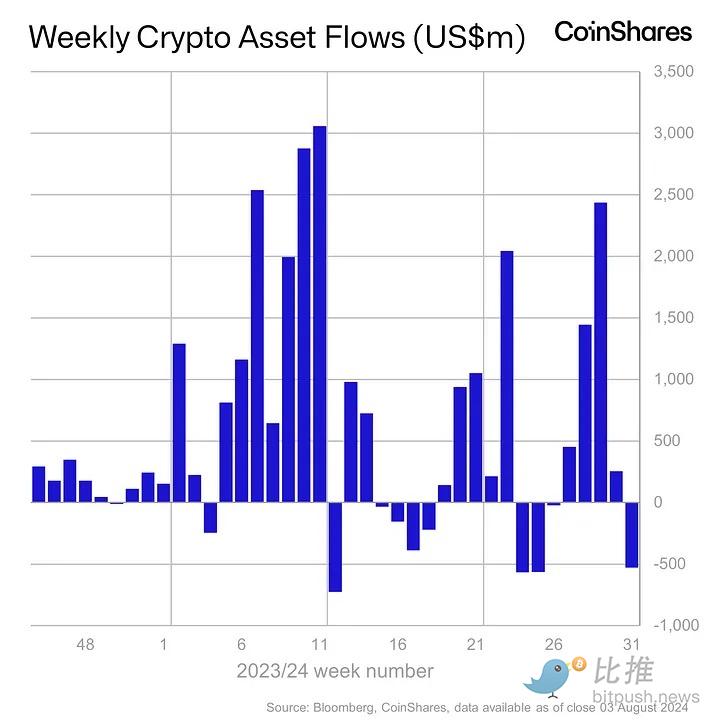
CoinShares' latest Digital Asset Fund Weekly report revealed that digital asset investment products experienced outflows of $528 million for the week of July 28 to August 3—the first outflows in four weeks. On August 2 alone, U.S. Bitcoin ETFs saw their largest capital outflow in about three months. The key question now is whether these products will attract bargain hunters upon resumption of trading or continue to see deeper outflows.
Following weaker-than-expected nonfarm payrolls data released by the Federal Reserve last Friday, the U.S. economy appears to have entered a "technical recession" based on the "Sahm Rule" metric. When the Fed began aggressively hiking rates in March 2022, it clearly acknowledged it was "walking a tightrope": hiking too aggressively could kill economic growth, while insufficient hikes could worsen inflation, negatively impacting all consumers.
On Sunday, Goldman Sachs economists increased the probability of a U.S. recession over the next year from 15% to 25%. However, they still believe the economy remains "broadly healthy," with no major financial imbalances, and that the Fed has ample room to cut rates and can act swiftly if needed.
A Bloomberg report noted that on Monday morning, swap markets priced in a 60% chance of an emergency 25-basis-point rate cut by the Fed within the coming week to prevent a recession.
Tracy Chen, portfolio manager at Brandywine Global Investment Management, told Bloomberg: "The market fears the Fed's policy is too lagging, and the economy is shifting from a soft landing to a hard landing. U.S. Treasuries are a good buy because I truly believe the economy will continue to slow."
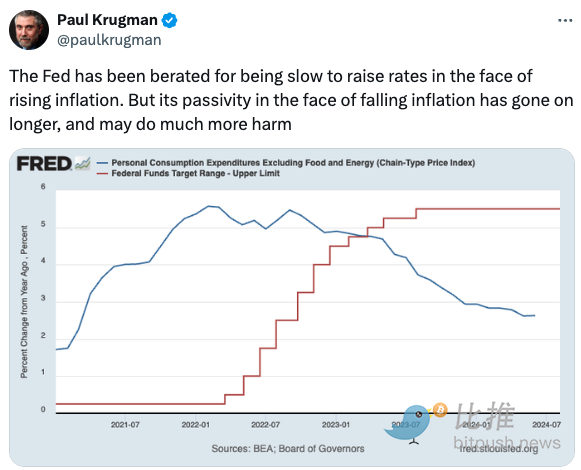
Nobel laureate Paul Krugman also called on the Fed to implement an emergency rate cut following the stock market panic sell-off. He wrote on X: "The Fed was criticized for delaying rate hikes when inflation rose. But its passive stance during the inflation decline lasted even longer and may cause greater harm."
Claudia Sahm, former Fed economist and creator of the Sahm Rule, said the U.S. is already "alarmingly close to recession," and she expects Fed policymakers may recalibrate their approach to account for rising risks.
However, Sahm warned that as financial markets plunge, the "fearful word"—recession—seems increasingly plausible to many, but immediate Fed action to address escalating risks may not be appropriate. "It's important to stay calm in moments like this," she said.
Brian Jacobsen, chief economist at Annex Wealth Management, said: "The Fed could seize the moment and slash rates dramatically to save the day, but the rationale for an inter-meeting rate cut seems weak. Such cuts are typically reserved for emergencies like COVID, and a 4.3% unemployment rate doesn't seem like an emergency."
Has the gate opened for a larger bull run?
Although this decline wasn’t as severe, BTC’s rapid fall recalls the pandemic-induced crash of 2020, when BTC plunged 57% in six days in mid-March.
Daniel Cheung, co-founder of digital asset venture firm Syncracy Capital, said: "Given that much of the current selling is forced and purely panic-driven, we expect a relatively quick recovery in crypto. Ironically, the gates for a larger bull market may already be opening."
Matt Hougan, Chief Investment Officer at asset management firm Bitwise, compared this weekend’s crash to March 2020 in a market update, saying: "Beyond emotions, history suggests this weekend’s selloff presents a buying opportunity."
Bernstein analysts said the sharp selloff in Bitcoin and the broader crypto market was not surprising, as it’s a common occurrence during periods of heightened economic uncertainty.
Bernstein analysts Gautam Chhugani, Mahika Sapra, and Sanskar Chindalia wrote in a report to clients on Monday: "Bitcoin’s initial reaction as a 'safe haven' asset isn’t surprising. This is typically the pattern in Bitcoin markets (as seen during the March 2020 flash crash), especially since it’s the only market trading over the weekend—we remain calm."
They added: "We don’t see any incremental negative implications for crypto. If rate cuts and monetary easing become standard responses to concerns about a U.S. recession, we expect prices of 'hard assets' like Bitcoin—digital gold—to rebound."
While the current situation might represent a solid long-term entry point, short-term risks remain.
Markus Thielen, CEO of 10x Research, wrote in his latest market update on August 5: "Although Bitcoin has been on a gradual downward trend marked by three peaks and two troughs, we expect the $55,000 support level to be breached, potentially pushing prices down to $42,000. While this may seem extreme, weakening economic data from the ISM report, persistently weak market structure, on-chain metrics, and our cycle analysis all suggest further pressure ahead."
Join TechFlow official community to stay tuned
Telegram:https://t.me/TechFlowDaily
X (Twitter):https://x.com/TechFlowPost
X (Twitter) EN:https://x.com/BlockFlow_News
 比推 BitpushNews