Stablecoins Over Ten Years: What Impact Have They Had on Global Development Trajectories, Economic Influence, and Monetary Systems?
TechFlow Selected TechFlow Selected
Stablecoins Over Ten Years: What Impact Have They Had on Global Development Trajectories, Economic Influence, and Monetary Systems?
The total value of the stablecoin market is expected to reach $1 trillion by 2030.
 Navigating Web3 tides with focused insights
By Aiying Ai, Cebr
Over the past decade, the global financial system has undergone significant transformation, with the rise of stablecoins emerging as one of the most notable developments. Stablecoins are digital currencies pegged to fiat money—typically the U.S. dollar—designed to maintain price stability and avoid the high volatility seen in other cryptocurrencies like Bitcoin. This characteristic makes stablecoins an important financial tool, playing an increasingly vital role in global payments, cross-border transactions, and financial inclusion. Aiying Ai has previously covered regulatory policies and operational logic surrounding stablecoins across various countries; for more details, see: Stablecoin Series,Crypto Payments Series
Today, we examine the development trajectory of stablecoins in global markets and their profound economic impact through the report “The Decade of Digital Dollars” by the Centre for Economics and Business Research (Cebr). Aiying Ai summarizes and analyzes the core findings of this report, offering readers a comprehensive perspective on how stablecoins are driving global financial innovation and efficiency.
Part I: The Birth and Development of Stablecoins
1. Origins of Stablecoins
The concept of stablecoins emerged as a response to a major pain point in the cryptocurrency market: price volatility. While Bitcoin and other cryptocurrencies offer advantages such as decentralization and transparency, their extreme price fluctuations make them unsuitable as reliable stores of value or mediums for everyday transactions. This volatility not only hinders widespread adoption but also limits their utility within broader financial systems.
To address this issue, stablecoins were introduced. As digital currencies pegged to fiat money (such as the U.S. dollar), they anchor their value to relatively stable assets, thereby maintaining price stability. The main types of stablecoins include fiat-collateralized (e.g., USDT, USDC), crypto-collateralized, and algorithmic stablecoins. All aim to provide users with a stable and predictable store of value, minimizing the adverse effects of price swings.
2. Early Development
In its early stages, stablecoin usage was primarily concentrated among cryptocurrency traders and exchanges. Given the high volatility of Bitcoin and other cryptocurrencies, traders needed a stable asset for hedging and value preservation. Stablecoins fulfilled this need by enabling quick conversions within the crypto ecosystem without requiring withdrawal into traditional fiat currency—especially beneficial on platforms where direct conversion to fiat is limited.
Over time, stablecoin applications expanded into broader use cases. Key milestones in early development include:
-
Adoption by Exchanges: Major trading platforms began supporting stablecoin trading pairs, allowing users to hedge against price volatility during trades. This significantly improved liquidity and market stability.
-
Cross-Border Payments: Thanks to low fees and fast settlement, stablecoins gained traction in cross-border payments, particularly in regions with inefficient traditional financial infrastructure. Their ability to settle instantly made them a powerful tool for international remittances.
-
Decentralized Finance (DeFi): With advancements in blockchain technology, stablecoins saw rapid growth in DeFi ecosystems. They became primary mediums of exchange on DeFi platforms, used for lending, borrowing, payments, and providing liquidity.
Through these initial developments, stablecoins not only addressed volatility concerns in crypto markets but also laid the foundation for wider financial applications. Their successful adoption established them as key components of the digital finance era.
Part II: Growth of Stablecoins Over the Past Decade
1. Market Size and Transaction Volume
Over the past ten years, the stablecoin market has experienced remarkable growth. According to data from the report “The Decade of Digital Dollars,” the total market capitalization of stablecoins grew from less than $1 billion in 2014 to $165 billion in 2024. This surge reflects both their increasing importance in cryptocurrency markets and their expanding influence in the global financial system.
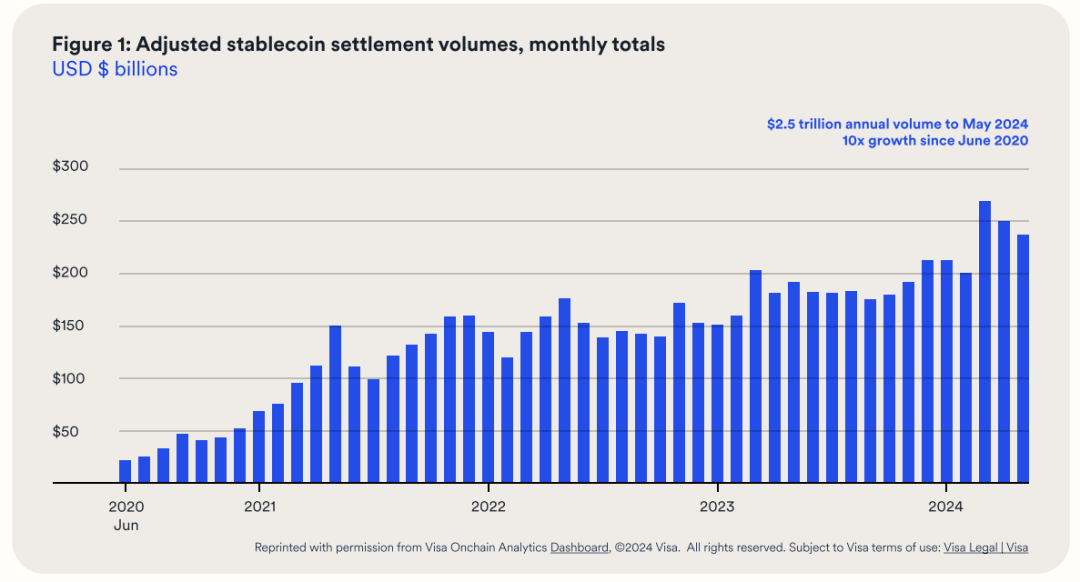
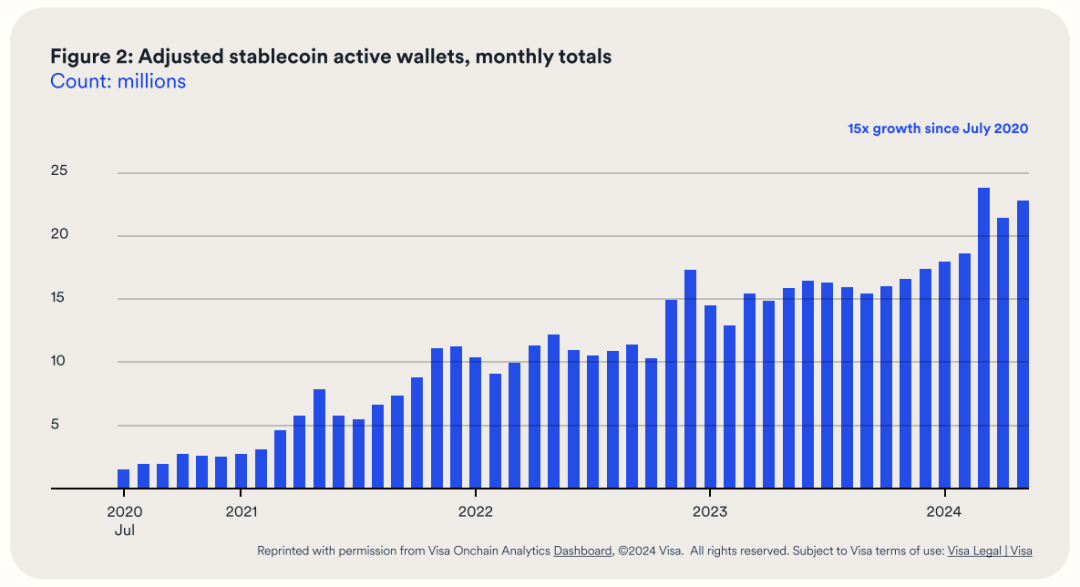
Additionally, transaction volumes have exploded. In 2023, total stablecoin transaction volume reached nearly $7 trillion, with Tether (USDT) accounting for approximately two-thirds of the market share. According to Visa’s Onchain Analytics Dashboard, even after excluding high-frequency trading and large institutional transfers, stablecoin payment settlements amounted to $2.5 trillion over the 12 months leading up to May 2024. These figures underscore the growing adoption of stablecoins in global payments and cross-border transactions, reflecting strong market demand.
2. Major Issuers
Tether (USDT):
-
Company Background: Issued by Tether Limited, USDT is the earliest and currently the largest stablecoin by market cap. Each USDT token is backed one-to-one by U.S. dollars to ensure price stability.
-
Market Applications: Widely adopted across major cryptocurrency exchanges as a trading pair and hedging instrument. USDT is also used in cross-border payments and DeFi platforms to provide liquidity.
USD Coin (USDC):
-
Company Background: Co-issued by Circle and Coinbase, USDC ranks second in market capitalization. Circle emphasizes transparent and compliant operations to enhance USDC's credibility.
-
Market Applications: Used extensively in cross-border payments, DeFi, and enterprise payment solutions. For example, Crypto.com utilized USDC in Visa’s pilot project for global settlements.
First Digital USD (FDUSD):
-
Company Background: Issued by First Digital, FDUSD has rapidly risen in popularity in Asian markets. The company focuses on secure digital asset custody and tokenization services.
-
Market Applications: Performs strongly in Asia, especially in countries like the Philippines and Indonesia, addressing financial inclusion gaps. FDUSD enables faster cross-border payments and savings thanks to its stable value and rapid settlement speed.
Part III: Economic Impact of Stablecoins
1. Reducing Costs from Currency Volatility
Currency volatility has had a profound negative impact on emerging market economies. According to the “Decade of Digital Dollars” report, it caused 17 emerging markets to lose a cumulative $1.2 trillion in GDP between 1992 and 2022—equivalent to 9.4% of their combined GDP. Stablecoins, by offering dollar-pegged value stability, help these nations mitigate uncertainty and economic losses caused by currency swings.
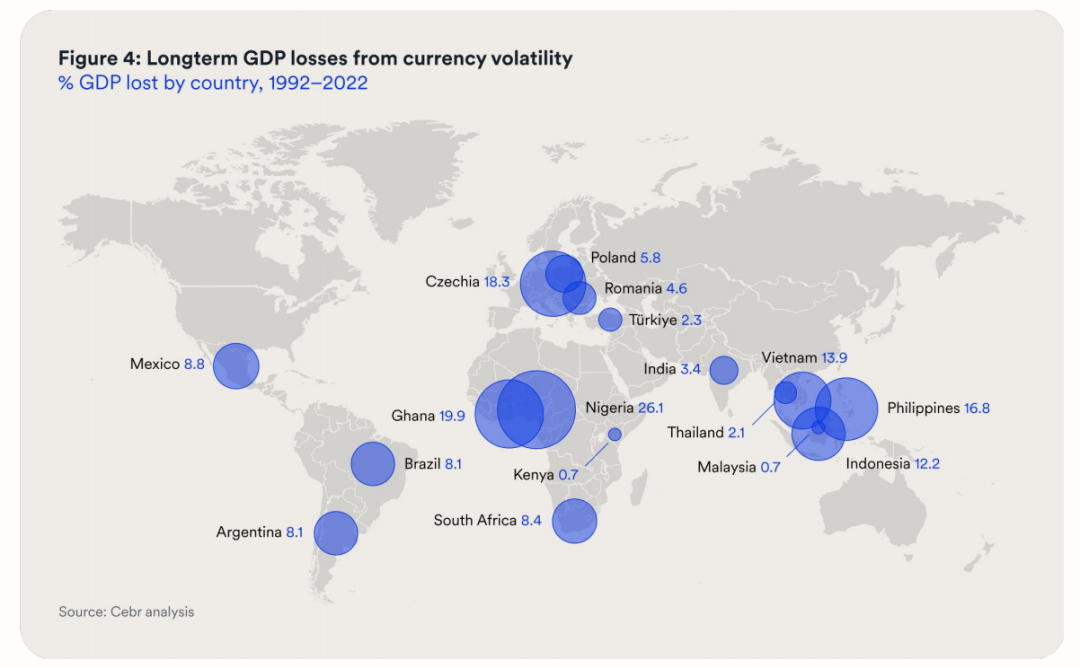
Percentage of long-term GDP loss due to currency volatility in selected countries, 1992–2022
-
Indonesia: Lost $184 billion in GDP from currency volatility between 1992 and 2022. By adopting stablecoins, Indonesians gain access to a stable store of value, helping protect savings and investments from depreciation.
-
Brazil: Suffered $172 billion in GDP losses over the same period. Stablecoins allow Brazilian businesses to hedge against exchange rate risks, ensuring stable contract execution and improving financial planning accuracy.
2. Bridging the Dollar Gap
In many emerging markets, accessing U.S. dollars is difficult and costly, limiting participation in international trade and finance. As digital dollars, stablecoins offer a stable and accessible alternative, fulfilling demand for reliable currency.
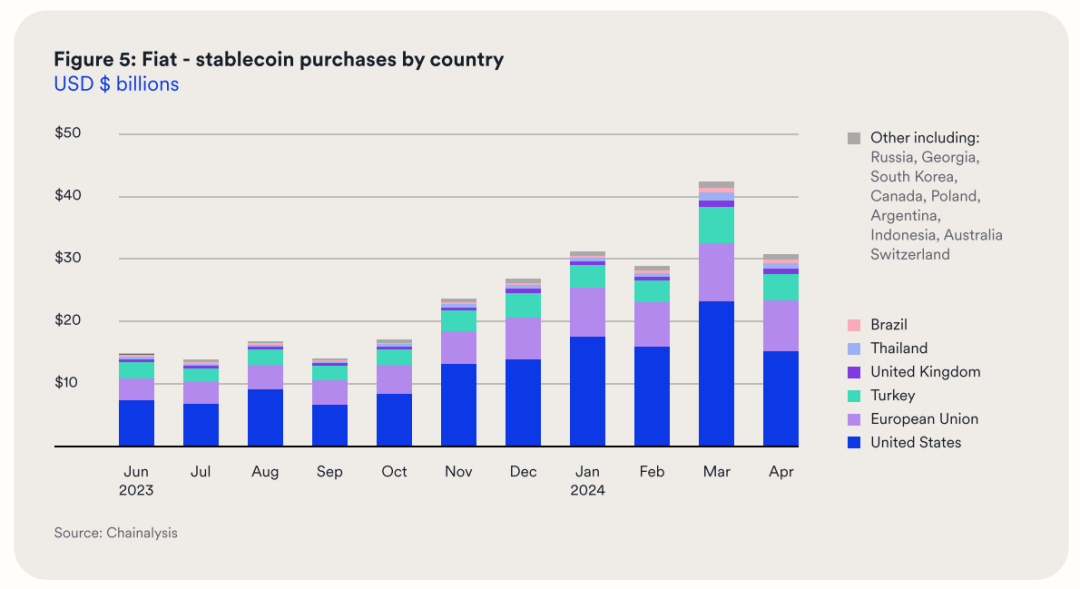
Stablecoin purchases using fiat currencies worldwide, June 2023 – April 2024
The chart shows overall growth in stablecoin purchases during this period, peaking at nearly $5 billion in March 2024. This indicates rising market demand. The United States leads in purchase volume, followed by the European Union and the UK—significantly outpacing other regions and reflecting high levels of acceptance. Purchase volumes spike annually around year-end and beginning-of-year periods, likely due to corporate settlements and increased cross-border payment needs.
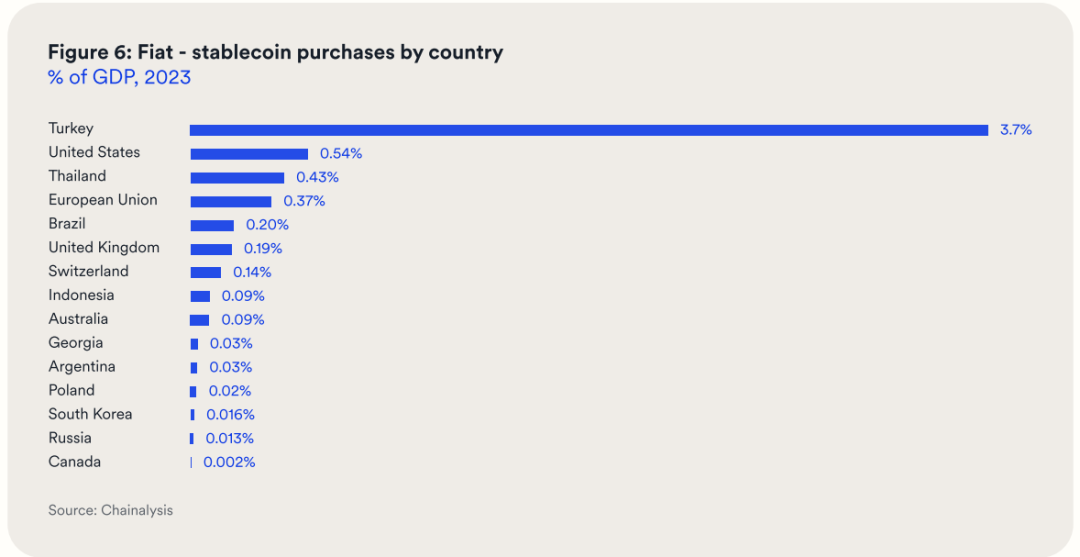
Amount spent on stablecoin purchases as a percentage of GDP by country, 2023
Turkey tops the list at 3.7% of GDP, far exceeding others—indicating extremely high demand driven by severe lira depreciation and economic instability. Other emerging markets including Thailand (0.43%), Brazil (0.20%), and Indonesia (0.09%) also show significant demand.
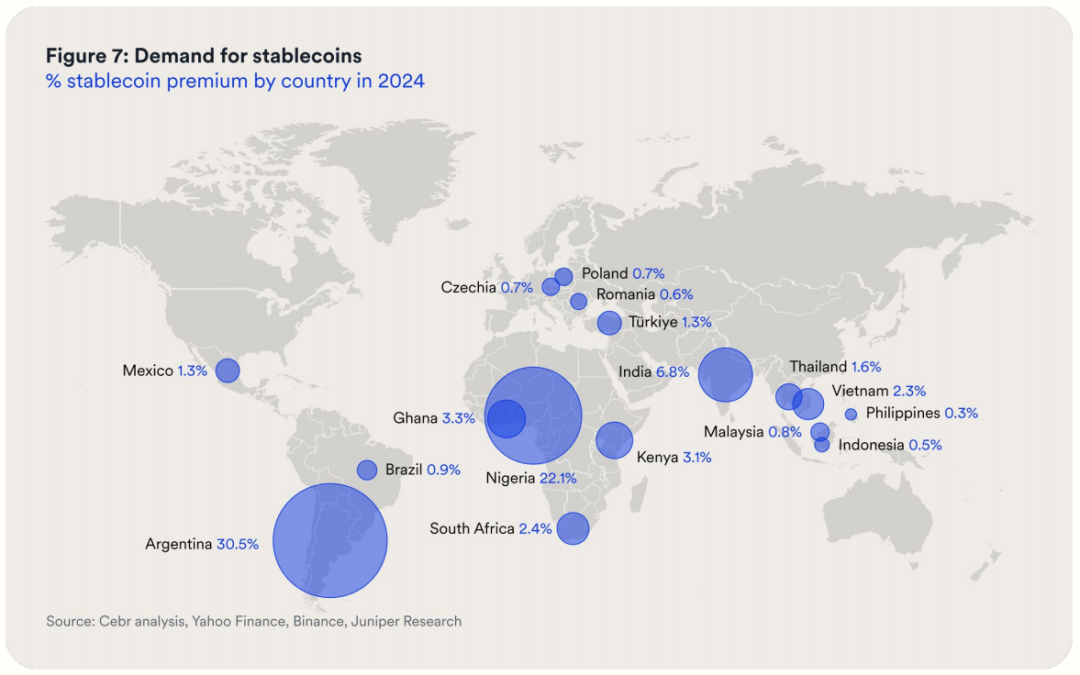
Stablecoin premium percentages across countries
-
The report notes that in 2024, emerging markets will pay a total of $4.7 billion in premiums to acquire stablecoins—a figure projected to reach $25.4 billion by 2027. In Argentina, stablecoin premiums can reach as high as 30%, indicating intense demand.
-
Stablecoins enable individuals and businesses in these countries to access and use U.S. dollars quickly and securely without relying on traditional banking systems, drastically reducing cost and complexity.
People and enterprises are willing to pay more than the face value of the U.S. dollar to obtain stablecoins—this is known as the “stablecoin premium.” Stablecoins can be transferred globally almost instantly, operate 24/7, and require only internet access. Market data clearly shows that stablecoins have achieved tremendous growth and broad application over the past decade. Stablecoins now play a crucial role not only in crypto markets but also in global payments, cross-border settlements, and financial inclusion.
Argentina sees a stablecoin premium as high as 30.5%, while Nigeria reaches 22.1%, reflecting extremely high demand in both countries. Severe local currency depreciation and economic instability drive residents and businesses to adopt stablecoins for asset protection. This trend is further detailed in Aiying Ai’s previous article: [Report] Deep Dive into Latin America’s 2024 Cryptocurrency Market: From El Salvador and Brazil Legalization to Regional Innovation.
3. Unlocking Trapped Capital
Traditional cross-border payment systems are inefficient, often leaving large amounts of capital trapped during transfers—negatively impacting business liquidity and operational efficiency. Stablecoins dramatically reduce settlement times, cutting delays from days to minutes and thus unlocking frozen capital.
Key Data:
-
According to the report, global B2B cross-border payments are expected to reach $40.1 trillion in 2024, with $1.16 billion of funds typically stuck during transit. Stablecoin payments can shorten settlement from days to minutes, greatly enhancing capital turnover.
-
By 2027, these unlocked funds could generate an additional $2.9 billion in economic returns for businesses, significantly boosting operational efficiency and competitiveness.
Part IV: Policy and Regulation
The development of stablecoins depends heavily on supportive and well-guided policy and regulation. Below, Aiying Ai summarizes regulatory attitudes and frameworks across different jurisdictions.
Hong Kong: On July 18, the Hong Kong Monetary Authority (HKMA) announced the list of participants in its stablecoin issuer “sandbox.” Included are JD Blockchain Technology (Hong Kong) Co., Circular Innovation Technologies Ltd., Standard Chartered Bank (Hong Kong), Animoca Group Ltd., and Hong Kong Telecom Ltd. Full-scale issuance of regulated stablecoins is expected to launch this year. For more information:
-
[Details] HKMA Announces List of Sandbox Participants for Stablecoin Issuance, Five Institutions Approved[In-Depth Report] The Stablecoin Sector: Models, Mechanisms, Trends, and Thoughts on Hong Kong's Stablecoin Strategy
Singapore: Singapore is also at the forefront of digital asset regulation. On January 14, 2019, the Monetary Authority of Singapore (MAS) enacted the Payment Services Act (PSA), which came into force on January 28, 2020. It provides a clear regulatory framework for the issuance, trading, and use of stablecoins and other digital payment tokens, promoting market legitimacy and standardization. The PSA is expected to attract more traditional financial institutions and enterprises into the stablecoin space, accelerating adoption in Singapore. Learn more:
-
Paxos Receives MAS Approval to Issue Singapore-Compliant Stablecoins
-
Fund Structures and Regulatory Requirements in Singapore (2024, Virtual Assets)
Europe: Europe leads in digital asset regulation. In 2024, it launched the first cross-jurisdictional regulatory framework for digital assets—the Markets in Crypto-Assets Regulation (MiCA). MiCA provides clear legal guidance for the issuance, trading, and use of stablecoins and other digital assets, fostering market legitimacy and compliance. Its implementation is expected to draw more traditional institutions into the stablecoin market, accelerating adoption across Europe. For more details:
-
EU MiCA Regulation: In-Depth Analysis of Restrictions on Stablecoin Use and Recent Amendments
-
In-Depth: Circle’s Compliance Milestone Under MiCA to Issue USDC and EURC—A Historic Opportunity
-
[Stablecoin Focus] USDC Set to Benefit from EU’s New MiCA Rules, Gaining Market Share Over USDT
United States: U.S. regulation of stablecoins remains complex, with varying approaches across federal and state levels. Despite ongoing uncertainty, agencies like the Securities and Exchange Commission (SEC) and Commodity Futures Trading Commission (CFTC) are gradually strengthening oversight. The report highlights Circle’s proactive compliance with U.S. and European regulations, which has earned USDC broad market trust and adoption. For more information:
-
[Payments] In-Depth Analysis of the Legal Basis and Requirements for U.S. Crypto Payment Licenses
-
What Does the U.S. Stablecoin Bill Mean for Market Regulation?
Other Regions: In Latin America and elsewhere, stablecoins are increasingly recognized as tools of financial innovation by governments and regulators. Regulatory advancements in these regions are providing new momentum for global stablecoin adoption.
The report projects that by 2030, the total market value of stablecoins will reach $1 trillion. As more financial institutions and enterprises adopt stablecoins, demand will continue to grow, further elevating their significance in the global financial system. Aiying Ai will continue monitoring developments in the global stablecoin payment landscape, delivering optimal compliance solutions.
Join TechFlow official community to stay tuned
Telegram:https://t.me/TechFlowDaily
X (Twitter):https://x.com/TechFlowPost
X (Twitter) EN:https://x.com/BlockFlow_News
 Aiying Compliance