
Fears of economic recession trigger sell-off, pushing BTC down to $62,000 intraday
TechFlow Selected TechFlow Selected
Fears of economic recession trigger sell-off, pushing BTC down to $62,000 intraday
Investors are concerned that the U.S. economy is sliding into a recession, driving up risk aversion.
 Navigating Web3 tides with focused insights
By BitpushNews Mary Liu
Financial markets suffered heavy sell-offs on Thursday, with both cryptocurrencies and U.S. stocks sharply declining.
Initial jobless claims in the United States rose to a one-year high, indicating continued cooling in the labor market. Data from the U.S. Department of Labor showed that for the week ending July 27, initial claims reached 249,000, up from the previous week's 235,000, marking the highest level since August 2023.
Additionally, U.S. manufacturing contracted at the fastest pace in eight months. The ISM Manufacturing PMI for July came in at 46.8, down from 48.5 in June, reaching its lowest level since November 2023.
Weaker-than-expected economic data, combined with a selloff in chip stocks such as NVIDIA, erased market optimism sparked by Powell’s hint yesterday of a potential rate cut in September. By the close of trading, the S&P 500, Dow Jones Industrial Average, and Nasdaq Composite all ended lower, falling 1.37%, 1.21%, and 2.30% respectively. The yield on the U.S. 10-year Treasury note dropped 12 basis points to 3.98%, the first time it has fallen below 4% since February. The U.S. dollar index rose 0.38% to 104.351.
According to Bitpush News data, Bitcoin (BTC) lost support near $64,500 during midday trading, quickly plunging to a low of $62,227—a decline of 4.17%. Bulls then stepped in with buying at lower levels, and at the time of writing, Bitcoin was trading at $64,720, down 0.25% over the past 24 hours.
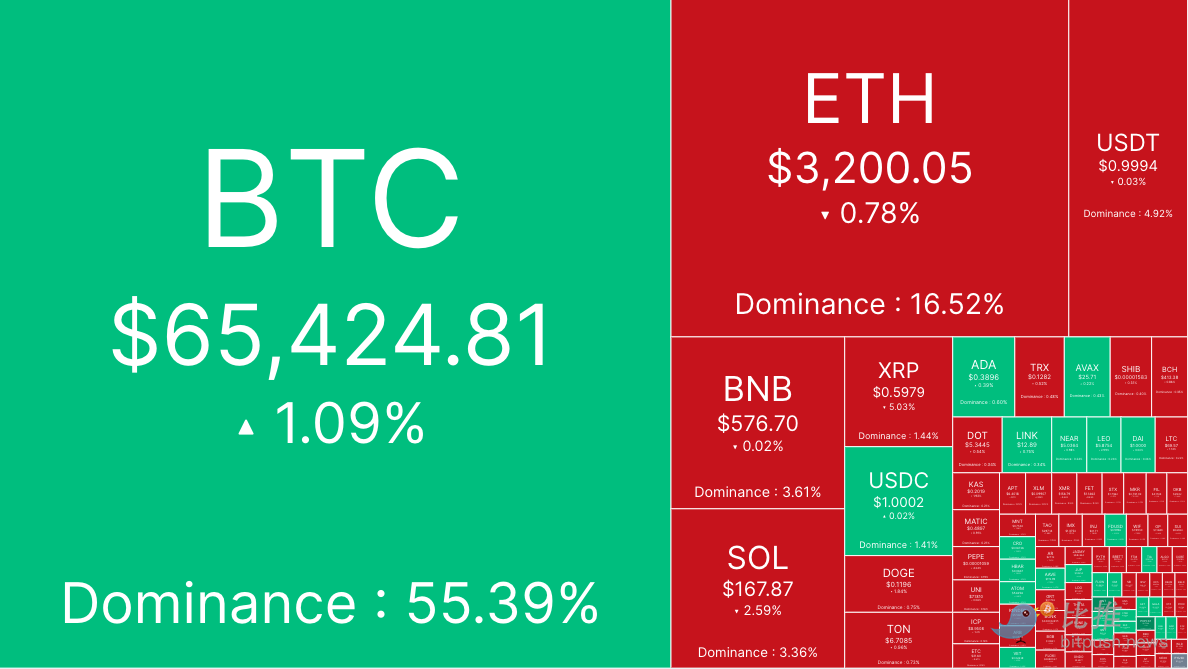
Altcoins suffered significant losses, with only 12 out of the top 200 altcoins by market capitalization posting gains.
Convex Finance (CVX) led the gains, rising 9.3%, followed by Curve DAO Token (CRV) up 6.7%, and Helium (HNT) up 5.7%. Mog Coin (MOG) saw the largest drop, down 19.7%, followed by cat in a dogs world (MEW) down 16.3%, and io.net (IO) down 15.13%.
The total cryptocurrency market capitalization currently stands at $2.27 trillion, with Bitcoin’s market dominance at 55.2%.
Prior to Thursday’s decline, analysts at Kraken noted bullish divergences on Bitcoin’s chart, suggesting BTC might soon challenge its all-time highs.
Kraken analysts stated: "BTC appears poised to test its previous all-time high (ATH) of $73,666. Although it briefly dipped below the 200-day exponential moving average (EMA) and a low of $56,378 in early July, there was no follow-through. BTC successfully reclaimed the 200-day EMA, forming a bullish divergence on the Relative Strength Index (RSI). Since then, BTC has also reclaimed the 21-day and 50-day EMAs, signaling a clear bullish momentum."
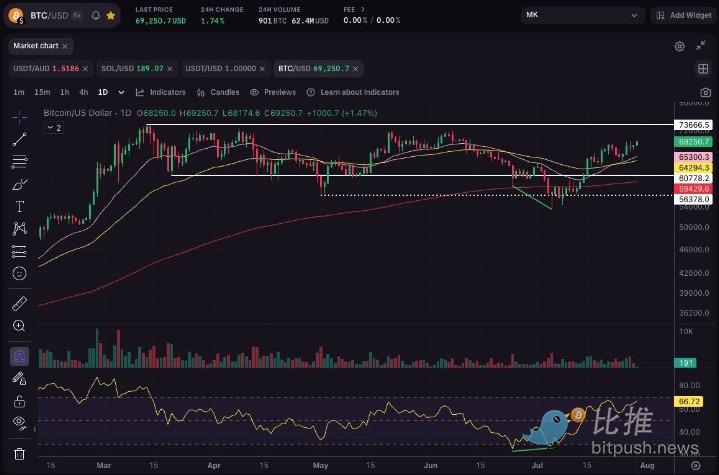
Whether this analysis holds in the long term remains to be seen, as Thursday’s selloff pushed Bitcoin’s price back below both the 50-day and 200-day EMAs (as shown in the chart above).
Rising Risk Aversion
According to Yahoo Finance, investors are concerned that the U.S. economy may be sliding into recession, particularly as jobless claims hit an 11-month high and construction spending in manufacturing declined for two consecutive months.
Investors have increased their bets on U.S. Treasuries, pushing five-year Treasury yields to a six-month low. Escalating tensions in the Middle East have also driven traders toward safer assets. For example, gold prices climbed to $2,450—just 1.5% below its all-time high.
Bullish Outlook Despite Sell-Off
Despite Thursday’s selloff, industry analysts remain united in believing that the outlook for the cryptocurrency market is improving, especially amid growing calls to classify Bitcoin as a strategic reserve asset similar to gold.
John Haar, Managing Director at Swan Bitcoin, said: "Gold and Bitcoin are both monetary assets with limited supply. As such, they tend to react similarly to broader macroeconomic events and trends. Gold currently has an estimated total market capitalization of around $13 trillion, while Bitcoin’s market cap is approximately $1.3 trillion (about 10% of gold’s). Bitcoin can serve as a store of value like gold, with the added benefit of being highly suitable for payments (also known as a medium of exchange)."
Haar added: "We believe gold will likely appreciate gradually over the coming years as we continue to experience an environment where fiat currencies depreciate over time—losing purchasing power—and foreign entities increasingly seek to reduce reliance on the U.S. dollar. We believe Bitcoin has greater price appreciation potential than gold over the next few years. We expect the market capitalizations of gold and Bitcoin to converge over the next 5–10 years."
Haar pointed out that in the short term, "there may be certain factors affecting the prices of gold or Bitcoin differently, leading to divergent performance."
He concluded: "If you believe that currency devaluation, inflation, debt accumulation, financial censorship, or capital controls will continue to intensify, then Bitcoin is the primary asset you should hold."
Taras Kulyk, Co-Founder and CEO of Synteq Digital, believes that "the Federal Reserve holding rates steady may be why Bitcoin failed to break through the $70,000 mark. In the coming months, as more global financial institutions begin adopting Bitcoin as a reserve asset, we should see additional upward price pressure on Bitcoin."
Taras Kulyk added: "Ongoing geopolitical tensions worldwide will certainly increase the value of both over time. However, as more investors recognize Bitcoin’s true status as digital hard money and a wealth preservation tool, we should see greater institutional participation, increasing Bitcoin exposure on corporate balance sheets."
Join TechFlow official community to stay tuned
Telegram:https://t.me/TechFlowDaily
X (Twitter):https://x.com/TechFlowPost
X (Twitter) EN:https://x.com/BlockFlow_News
 比推 BitpushNews