








Dedicated ZK vs. General-Purpose ZK: Which Is the Future?
TechFlow Selected TechFlow Selected
Dedicated ZK vs. General-Purpose ZK: Which Is the Future?
Specialized ZK infrastructure is becoming more generalized, while general-purpose ZKVMs are becoming more specialized.
 Navigating Web3 tides with focused insights
Author: mo
Translation: Luffy, Foresight News
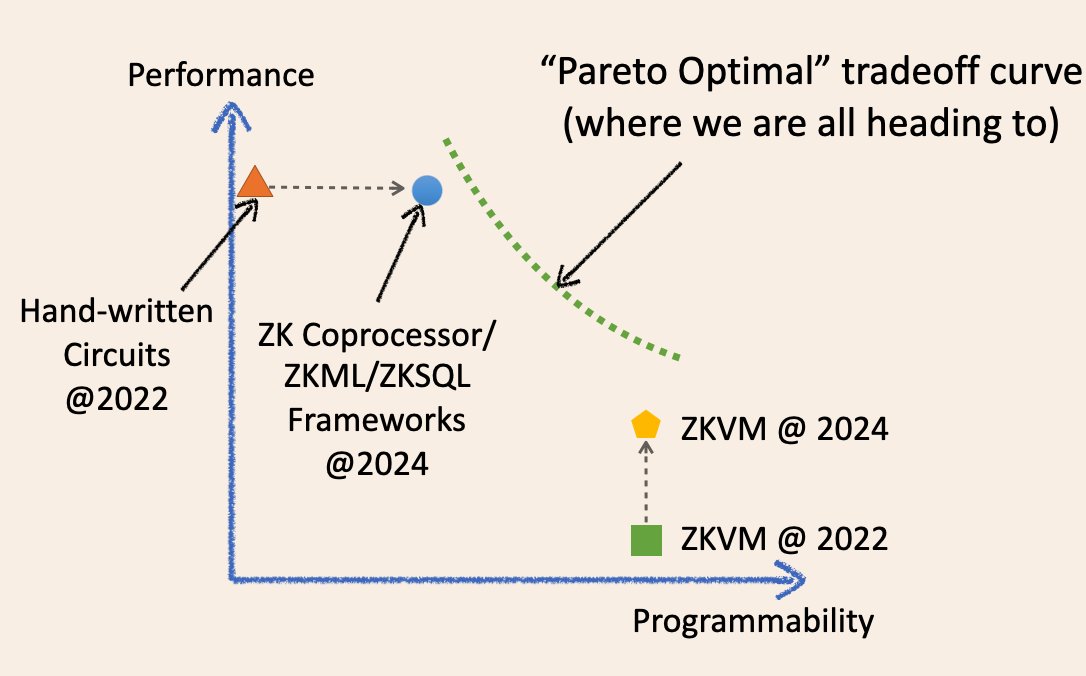
Specialization versus generalization— which one is the future of ZK? Let me try to answer this with a single diagram:
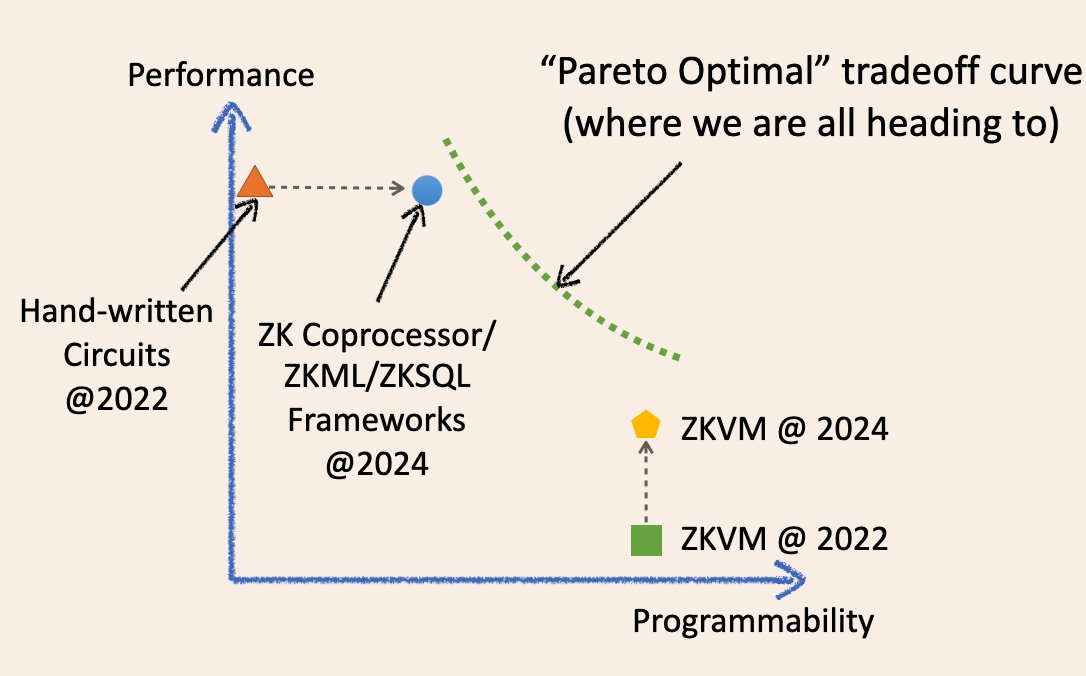
As shown in the figure, could we possibly converge toward a magical sweet spot on this trade-off spectrum in the future?
No. The future of off-chain verifiable computing is a continuous curve that blurs the boundary between specialized and general-purpose ZK. Allow me to explain the historical evolution of these terms and how they will eventually converge.
Two years ago, "specialized" ZK infrastructure meant low-level circuit frameworks such as Circom, Halo2, and Arkworks. ZK applications built using these frameworks were essentially hand-written ZK circuits. They were fast and cost-efficient for specific tasks but generally difficult to develop and maintain. They resembled various application-specific integrated circuit (ASIC) chips (physical silicon) in today’s IC industry, such as NAND chips and controller chips.
However, over the past two years, specialized ZK infrastructure has gradually become more "generalized."
We now have ZKML, zk coprocessors, and ZKSQL frameworks that offer easy-to-use, highly programmable SDKs for building different categories of ZK applications—without writing a single line of ZK circuit code. For example, zk coprocessors allow smart contracts to access blockchain historical states, events, and transactions in a trustless manner and perform arbitrary computations on this data. ZKML enables smart contracts to leverage AI inference results in a trustless way to handle a wide range of machine learning models.
These evolved frameworks significantly enhance programmability within their target domains while still maintaining high performance and low costs due to thin abstraction layers (SDKs/APIs) that remain close to bare-metal circuits.
They resemble GPUs, TPUs, and FPGAs in the IC market: programmable domain experts.
ZKVMs have also made significant progress over the past two years. Notably, all general-purpose ZKVMs are built atop low-level, specialized ZK frameworks. The idea is that you can write ZK applications in high-level languages (even more user-friendly than SDKs/APIs), which can then be compiled into combinations of specialized circuits and instruction sets (RISC-V or WASM-like). They are akin to CPU chips in the IC industry.
A ZKVM is an abstraction layer sitting above low-level ZK frameworks—just like zk coprocessors and others.
As a wise person once said, one layer of abstraction can solve every computer science problem—but simultaneously creates another. Trade-offs: that's the key. Fundamentally, with ZKVMs, we are trading off performance for generality.
Two years ago, the "bare-metal" performance of ZKVMs was indeed terrible. However, in just two short years, ZKVM performance has improved dramatically.
Why?
Because these "general-purpose" ZKVMs have become increasingly "specialized." A key reason for this performance boost is "precompiles." These precompiles are specialized ZK circuits designed to compute common high-level operations—such as SHA2 and various signature verifications—at speeds far exceeding the normal process of breaking them down into instruction-circuit fragments.
Thus, the trend is now unmistakably clear.
Specialized ZK infrastructure is becoming more generalized, while general-purpose ZKVMs are becoming more specialized.
Over the past few years, optimizations in both solutions have achieved better trade-off points than before: advancing one aspect without sacrificing the other. This is why both sides feel confident saying, "We are definitely the future."
Yet, wisdom from computer science tells us that eventually, we will hit the "Pareto optimal wall" (the green dashed line), where improving one metric requires sacrificing another.
Hence, a million-dollar question arises: Will one technology completely replace the other at some point?
Let’s draw insight from the IC industry: The CPU market is valued at $126 billion, while the entire IC industry (including all "specialized" ICs) is worth $515 billion. I am convinced that, at a micro level, history will repeat itself here—they won’t replace each other.
That said, no one today says, "Hey, I'm using a computer entirely driven by general-purpose CPUs," or "Hey, this fancy robot is powered solely by specialized ICs."
Yes, we should indeed look at this issue macroscopically: In the future, there will be a trade-off curve allowing developers to flexibly choose based on their needs.
In the future, specialized ZK infrastructure and general-purpose ZKVMs can work together. This integration can take many forms. The simplest method is already feasible today. For instance, you could use a zk coprocessor to generate certain computation results from blockchain transaction history, but the business logic on top of this data might be too complex to express easily via SDKs/APIs.
What you can do is obtain high-performance, low-cost ZK proofs for the data and intermediate computation results, then aggregate them into a general-purpose VM through proof recursion.
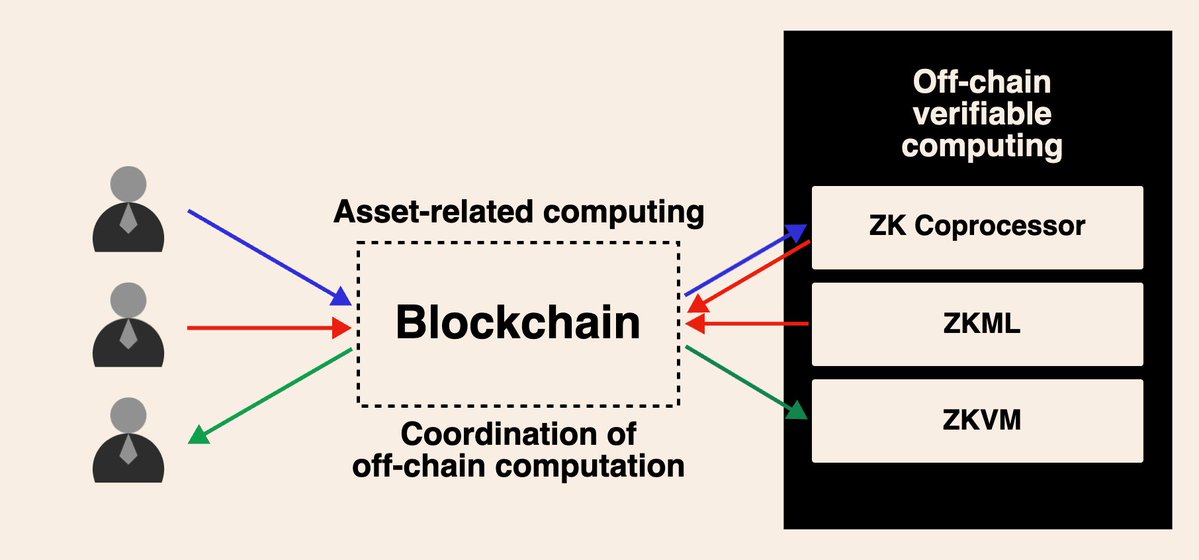
While I find such debates fascinating, I know we're all building toward an asynchronous computing future for blockchains powered by off-chain verifiable computation. As mass-user adoption use cases emerge in the coming years, I believe this debate will ultimately resolve itself.
Join TechFlow official community to stay tuned
Telegram:https://t.me/TechFlowDaily
X (Twitter):https://x.com/TechFlowPost
X (Twitter) EN:https://x.com/BlockFlow_News
 @no89thkey








