








Where to Set Up a Web3 Startup for Lower Taxes? Comparing Hong Kong, Singapore, and Mainland China
TechFlow Selected TechFlow Selected
Where to Set Up a Web3 Startup for Lower Taxes? Comparing Hong Kong, Singapore, and Mainland China
When choosing a location for their startup, entrepreneurs need to consider not only the policy environment but also select regions most conducive to long-term business development from the perspective of tax planning.
 Navigating Web3 tides with focused insights
By Zheng Yuan
As global Web3.0 technology continues to thrive, an increasing number of Chinese entrepreneurs are choosing to launch startups overseas—particularly in Hong Kong and Singapore, which offer favorable policies and stable business environments. Both regions have adopted proactive and transparent regulatory approaches toward Web3.0, providing substantial convenience and support for entrepreneurs. In Hong Kong, leading Web3.0 companies such as Animoca Brands and HashKey have achieved significant global success through continuous innovation and expansion. Meanwhile, Singapore has attracted industry giants like Binance and Crypto.com, becoming a hotspot for blockchain and cryptocurrency ventures thanks to its robust legal framework and attractive tax incentives.
When selecting a location for entrepreneurship, founders must consider not only the policy environment but also optimize long-term development through strategic tax planning.
Comparison Across Three Regions
Tax policies in mainland China, Hong Kong, and Singapore differ significantly. The key distinctions are outlined below.
1 Mainland China vs. Hong Kong
In terms of corporate taxation, the primary differences between mainland China and Hong Kong are as follows:
Mainland China levies six major types of taxes:
-
Corporate Income Tax (5%, 15%, 25%)
-
Individual Income Tax (3%–45%)
-
Value-Added Tax (VAT) (3%, 9%, 13%, etc.)
-
Dividends, capital gains (20%)
-
Overseas income (subject to global taxation)
In contrast, Hong Kong’s main taxes include Profits Tax (8.25%–16.5%) and Salaries Tax (2%–17%). Dividends, foreign-sourced income, and stock appreciation are generally non-taxable.
2 Mainland China vs. Singapore
There are substantial differences between China's and Singapore’s tax systems, as shown below:
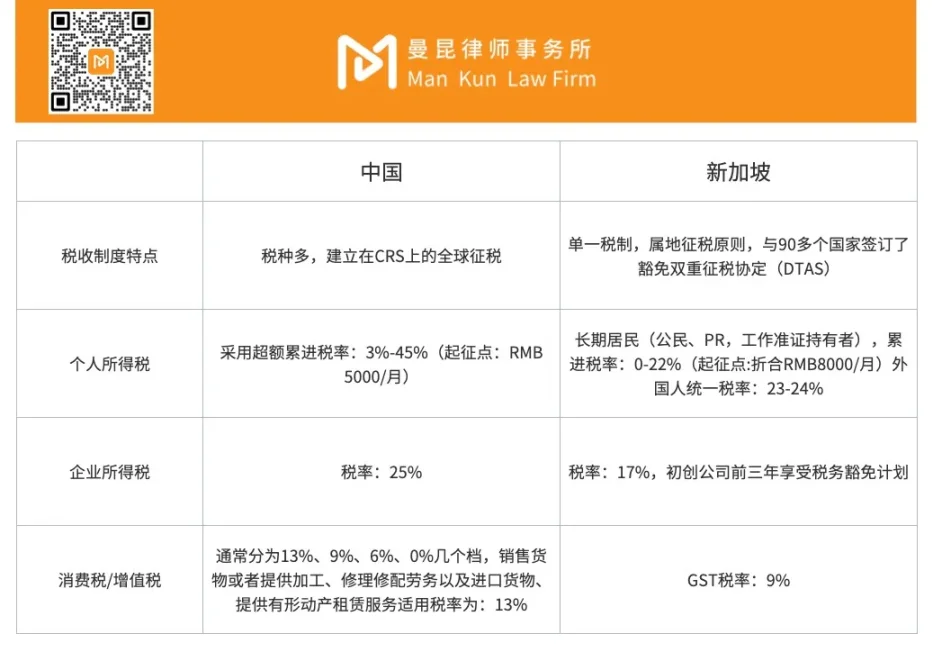
The following three case studies illustrate the tax obligations and costs faced by entrepreneurs establishing companies in mainland China, Hong Kong, and Singapore, respectively.
Case 1: Entrepreneurship in Mainland China
Mr. Wang is a young Web3 entrepreneur who founded a blockchain technology company in Beijing focused on developing decentralized applications (dApps).
1 Corporate-Level Taxation
Suppose Mr. Wang’s company achieves RMB 10 million in revenue during its first year, with a pre-tax profit of RMB 5 million. Under China’s tax regime, the company must pay 25% corporate income tax, amounting to RMB 1.25 million. Additionally, the company is liable for VAT. Assuming a 13% VAT rate and RMB 5 million in input tax credits, the payable VAT would be (RMB 10 million – RMB 5 million) × 13% = RMB 650,000.
2 Individual-Level Taxation
As the sole shareholder, Mr. Wang receives a dividend of RMB 3.75 million (RMB 5 million pre-tax profit minus RMB 1.25 million corporate tax), subject to a 20% dividend tax, resulting in RMB 750,000 in personal tax. Assuming he draws an annual pre-tax salary of RMB 1 million, his individual income tax under China’s progressive rates would be approximately RMB 430,000 (simplified calculation).
Ultimately, Mr. Wang’s net take-home income amounts to: RMB 1 million (salary) + RMB 3.75 million (dividend) – RMB 430,000 (income tax) – RMB 750,000 (dividend tax) = RMB 3.57 million.
Case 2: Entrepreneurship in Hong Kong
Ms. Li is an experienced Web3 entrepreneur who established a fintech company in Hong Kong, primarily offering blockchain solutions to multinational enterprises.
1 Corporate-Level Taxation
Assume Ms. Li’s company generates HKD 10 million in revenue during its first year, with a pre-tax profit of HKD 5 million. Under Hong Kong’s two-tier profits tax system, the first HKD 2 million is taxed at 8.25%, and the remainder at 16.5%. Her company’s profits tax totals HKD 660,000 (HKD 2 million × 8.25% + HKD 3 million × 16.5%).
2 Individual-Level Taxation
As a Hong Kong tax resident, Ms. Li draws an annual salary of HKD 1 million from the company. Under Hong Kong’s progressive tax rates, her salaries tax is approximately HKD 150,000 (simplified). She also receives a dividend of HKD 4.34 million (HKD 5 million pre-tax profit minus HKD 660,000 profits tax), which is tax-free in Hong Kong.
Her total net income is therefore: HKD 1 million (salary) + HKD 4.34 million (dividend) – HKD 150,000 (salaries tax) = HKD 5.19 million.
Case 3: Entrepreneurship in Singapore
Mr. Chen (a Singapore tax resident) is a seasoned Web3 entrepreneur who launched a cryptocurrency exchange in Singapore, focusing on secure and efficient digital asset trading services.
1 Corporate-Level Taxation
Assume Mr. Chen’s company earns SGD 10 million in revenue during its first year, with a pre-tax profit of SGD 5 million. Under Singapore’s tax policy, the first SGD 200,000 of taxable income enjoys partial tax exemption, reducing the effective tax on this portion to approximately SGD 12,750 (SGD 100,000 × 4.25% + SGD 100,000 × 8.5%). The remaining SGD 4.8 million is taxed at 17%, resulting in SGD 816,000. Total corporate income tax is approximately SGD 828,750.
Additionally, the company must pay a 9% Goods and Services Tax (GST). Assuming all sales are taxable, GST liability would be about SGD 900,000 (SGD 10 million × 9%).
2 Individual-Level Taxation
As the principal shareholder, Mr. Chen draws an annual salary of SGD 1 million. His individual income tax under Singapore’s progressive rates is approximately SGD 240,000 (simplified). He receives a dividend of SGD 4.17125 million (SGD 5 million pre-tax profit minus SGD 828,750 corporate tax), which is tax-free in Singapore.
His total net income is thus: SGD 1 million (salary) + SGD 4.17125 million (dividend) – SGD 240,000 (income tax) = SGD 4.93125 million.
Summary of Data Comparison
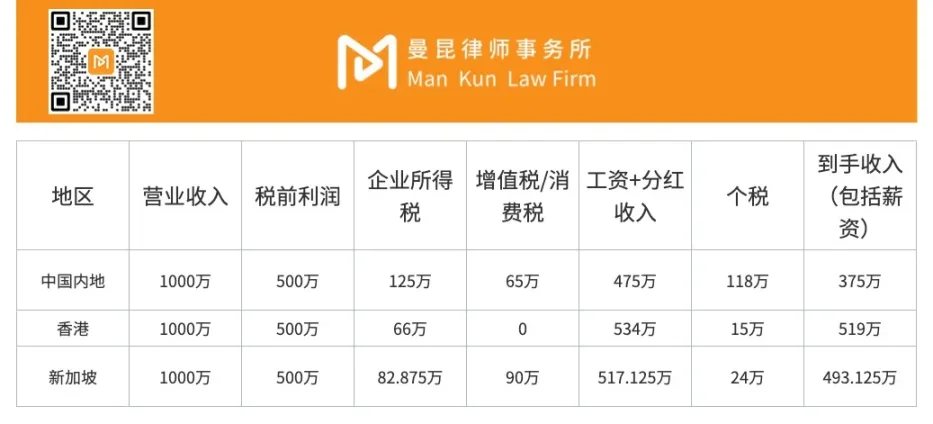
The comparison above highlights the significant impact of regional tax policies on entrepreneurs. Hong Kong offers the lightest tax burden—due to its limited direct taxes and tax exemptions—resulting in the highest net income for founders. Singapore ranks second; despite relatively low income taxes, the inclusion of GST leads to slightly lower net proceeds. Mainland China imposes the heaviest tax burden, yielding the lowest take-home income. These figures can help entrepreneurs make more informed decisions when choosing where to establish their businesses.
It should be noted that the tax rates applied in these cases assume the entrepreneurs are tax residents of the respective jurisdictions. For Chinese tax residents launching businesses overseas, income earned outside China generally requires filing with the local tax authority where they are employed in China. The tax filing period is from March 1 to June 30 of the year following the income receipt.
Conclusion
For Web3 entrepreneurs, choosing the right startup location involves more than just understanding tax implications and costs—it also requires evaluating regulatory frameworks and legal environments across different countries to ensure sustainable growth. Hong Kong and Singapore stand out with their open-minded approach to Web3 and favorable tax regimes, offering strong platforms for entrepreneurial success. Nevertheless, before making any decision, founders are advised to consult professional legal and financial advisors to fully understand local regulations and tax risks, thereby making the most advantageous choice.
Join TechFlow official community to stay tuned
Telegram:https://t.me/TechFlowDaily
X (Twitter):https://x.com/TechFlowPost
X (Twitter) EN:https://x.com/BlockFlow_News









