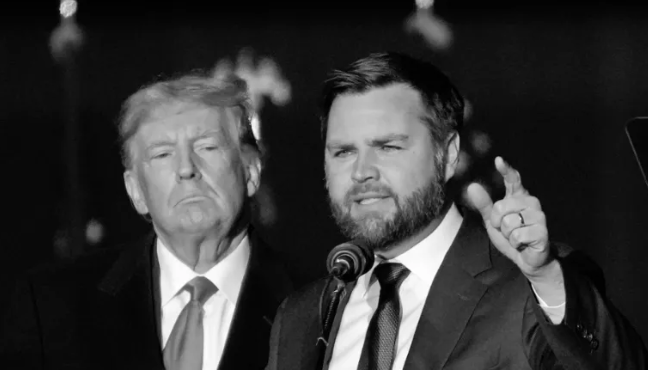
Trump Chooses JD Vance as Running Mate: The Future of Silicon Valley and the Billionaires' Power Game
TechFlow Selected TechFlow Selected
Trump Chooses JD Vance as Running Mate: The Future of Silicon Valley and the Billionaires' Power Game
This article provides an in-depth analysis of Vance's relationships with some of Silicon Valley's most controversial billionaires.
 Navigating Web3 tides with focused insights
By Tree Yang, Treasure Good Business

The news of Trump selecting JD Vance as his vice-presidential running mate has undoubtedly sent ripples through Silicon Valley. How did this former "Never Trumper" transform into one of Trump’s key allies? And how will this political alliance shape the future of Silicon Valley—especially for companies tied to high technology, cryptocurrency, and defense tech?
This article delves into Vance’s connections with some of Silicon Valley’s most controversial billionaires, particularly his ties to Peter Thiel. From Mithril Capital to Narya Capital, from massive Bitcoin gains to influence over crypto regulation, Vance’s political rise appears deeply intertwined with certain powerful forces in Silicon Valley.
As 2024 approaches, the Trump-Vance partnership could have far-reaching consequences for Silicon Valley. This goes beyond tax and regulatory issues—it touches on the shaping of tech policy and even the redefinition of personal privacy and national security.
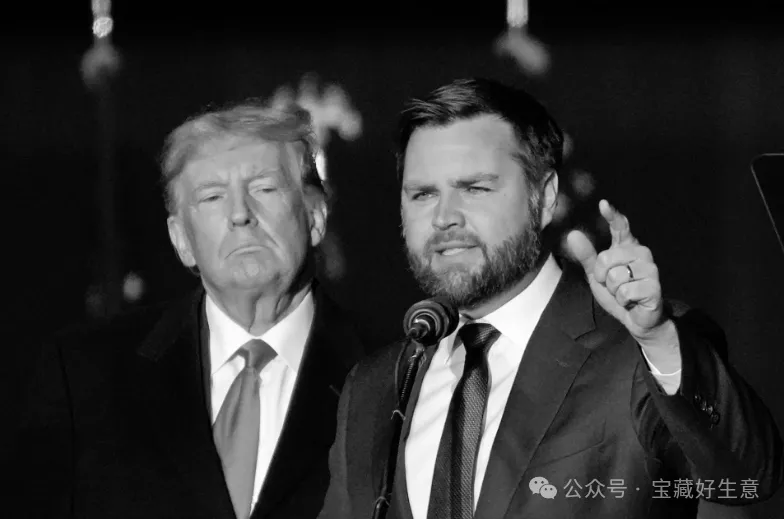
Usually, I wouldn’t spend much time thinking about Trump choosing JD Vance as his running mate. When faced with an open “poop sandwich,” people typically don’t dwell too long on what kind of bread to pick.
But given Vance’s background as a tech investor and his close ties to some of the industry’s most polarizing culture warriors, it’s worth stepping back from the chaos and frustration of reality for a few minutes to consider what this choice might mean for Silicon Valley.
It depends on which Silicon Valley you’re talking about: the traditional, nerdy version epitomized by HP, Google, and Facebook, or the newer version represented by Bitcoin scammers, AI eye-scanning eccentrics, and antisocial drone operators.
If you mean the first kind of Silicon Valley, the Trump-Vance ticket might be a mixed bag. Both Trump and Vance have criticized Big Tech’s alleged censorship of conservative voices, and Vance has explicitly called for eliminating Section 230 protections that shield large social networks.
But if you’re a fan of the second Silicon Valley—the kind that promotes cryptocurrency and autonomous killing machines—then Vance’s potential ascent to the White House might feel like all your Christmases arriving at once.
That’s because Vance isn’t just friends with Silicon Valley’s worst billionaires—he was practically created by them. Billionaire tech investor and digital defense contractor Peter Thiel paved the way for Vance’s entire political career.
It was Thiel who hired Vance at his firm Mithril Capital back in 2017 (Mithril being a metal from *The Hobbit*), and later invested heavily in Vance’s Narya Capital fund (Narya being a ring from *The Lord of the Rings*). Thiel then donated over $15 million to Vance’s Senate campaign and personally escorted him to Mar-a-Lago to mend his previous “Never Trump” stance.
Before Thiel announced he would take a temporary break from democracy, he introduced Vance to his old PayPal Mafia colleague David Sacks. Sacks immediately donated $1 million to a super PAC supporting Vance and hosted fundraising events for him. Sacks and Vance later co-hosted Trump’s only major campaign fundraiser in San Francisco, aimed at pushing the candidate toward greater acceptance and deregulation of cryptocurrency. Thiel reportedly made over $1.8 billion from Bitcoin and other digital currencies.
Of course, this wouldn’t be the first time Thiel and his allies tried to buy outsized influence over Trump’s legislative agenda. After all, it was Thiel who, one week after the 2016 election, rescued Trump’s campaign with a $1.25 million donation—clearly hoping for clout in the incoming administration.
That turned out to be one of Thiel’s rare miscalculations. Despite all the noise around Truth Social, Trump may have been the least tech-savvy president in our lifetime. He famously doesn’t use email and relies on aides to print out websites for him. He’s also reportedly the laziest president since George W. Bush. Paired with Luddite Vice President Mike Pence—who apparently doubted women should be allowed to drive—Trump’s first administration gave Thiel and his tech allies little more than tax cuts and some humiliating photo ops. By 2023, a clearly frustrated Thiel admitted the Trump administration “couldn’t get the most basic pieces of the government to work.… I think that part was maybe worse than even my low expectations.”
Fast forward to 2024, and Thiel isn’t making the same mistake twice. Last time, he merely donated money to Trump’s White House bid; this time, he’s donating the entire candidate.
This candidate will have broad authority to give his former boss exactly what he wants. Trump has made it clear he intends to spend much of his second term pursuing petty vendettas, jailing opponents, and dismantling NATO. So just as Bush happily let former Halliburton executive Dick Cheney plan America’s wars, Vance will be able to set the White House’s tech policy for his Silicon Valley patrons—a policy that, coincidentally, may involve massive new military spending.
Thiel likes to present himself as a peacemaker: his biggest applause line at the 2016 Republican National Convention was “It’s time to end these stupid wars and rebuild our country.” Yet today he’s best known as co-founder of Palantir—a surveillance technology company named after the seeing stones in *The Lord of the Rings*. The firm builds intelligence-gathering tools for the CIA and NSA. More notably, it develops software that directs drone and artillery strikes, shortening the “kill chain” across global battlefields.
Thiel is also a major investor in Anduril, founded by his protégé Palmer Luckey. Anduril—named after a sword from *The Lord of the Rings* (because apparently the valley only read one book)—builds drones capable of killing people without human controllers. It also constructs and operates surveillance towers for U.S. Border Patrol.
At best, with Vance as Thiel’s insider, a second Trump administration would further enrich these companies and others in Thiel’s portfolio, such as OpenAI, Neuralink, and SpaceX.
At worst?
Let’s note that, following the horrifying assassination attempt at Trump’s Pennsylvania rally, it was Vance—who issued an instantly nauseating statement blaming Biden’s campaign team almost immediately, before any facts about the shooter were known.
Trump hasn’t hidden his views on the Constitution (which he says should be “terminated”) or on spying on American citizens (he famously encouraged Russian hackers to target Hillary Clinton’s emails). Vance has likewise pledged loyalty to Trump’s lawbreaking, boasting that he would vote to overturn the 2020 election. Both Vance and Trump proudly embrace the authoritarian slogan “laws for thee, but not for me”: Vance’s proposal to eliminate Section 230 protections notably exempts small platforms like his own Rumble. (And the hypocrisy doesn’t fall far from the tree: Thiel, a self-proclaimed libertarian, builds surveillance tech for the government and is reportedly an FBI informant sharing information about “political corruption” and “Silicon Valley conspiracies.”)
In the past, you’d have been considered a conspiracy theorist to suggest a president and vice president might use technologies built by their donors to spy on and smear political enemies. With Trump, you’d be an idiot not to believe they will.
I’m not just talking about enemies like President Biden or Hillary Clinton. I mean any group that Trump, Vance, and their supporters have sworn to go after: women, transgender children, liberals, judges, juries, the FBI, executives of social networks not on Rumble, immigrants, and even librarians. If, as is statistically likely, you belong to one or more of these groups, you might want to consider going completely offline for the next four years or so.
Still, it’s a great time to be a war profiteer in Silicon Valley. With four more years of Trump and Vance, the party is only going to get wilder.
Paul Bradley Carr has been writing about Silicon Valley for 25 years. His next book, *Confessions*, will be published by Atria next year.
Join TechFlow official community to stay tuned
Telegram:https://t.me/TechFlowDaily
X (Twitter):https://x.com/TechFlowPost
X (Twitter) EN:https://x.com/BlockFlow_News