








Web3 Native Innovation in a Silent Period: Tech Giants Polarizing in Development
TechFlow Selected TechFlow Selected
Web3 Native Innovation in a Silent Period: Tech Giants Polarizing in Development
Looking ahead to 2024, the Web3 industry is entering a new phase of development opportunities: the United States and Hong Kong are gradually integrating Bitcoin and Ethereum into their mainstream financial systems, attracting significant investor attention.
 Navigating Web3 tides with focused insights
Produced by|OKG Research
Author|Hedy Bi

Last weekend, OKG Research was invited by the Financial Times Chinese edition to participate as a panel guest in the "Masterclass in Finance," jointly hosted by FTChinese.com and Shanghai Advanced Institute of Finance (SAIF) at Shanghai Jiao Tong University. During the roundtable discussion, I had an in-depth conversation with professors and frontline practitioners from the financial technology innovation sector about the complex relationships among technology, finance, and humanity, as well as their profound implications for the future. Notably, Professor Liu Xiaochun, adjunct professor at SAIF, provided a comprehensive overview of the evolution of the financial industry over recent decades. One of his insights particularly resonated with me: The financial industry effectively bears the risk costs of the entire society—a reality often misinterpreted as inherent flaws within finance itself.
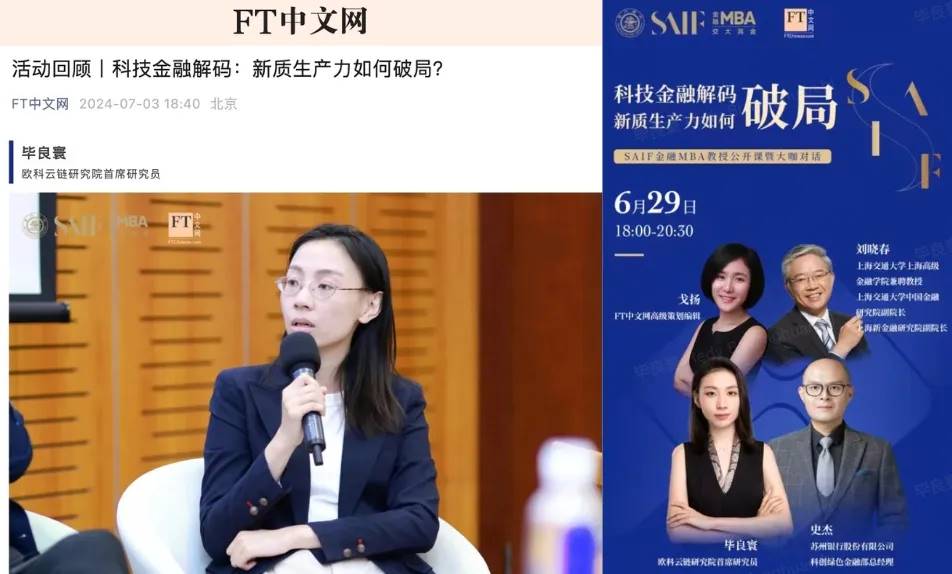
Photo: Event scene from FTChinese's collaboration with SAIF on the SAIF Finance MBA public lecture and expert dialogue session
Professor Liu’s insight reminded me of the mixed reviews Web3 has received in recent years. As he pointed out, emerging technologies are often quickly exploited by bad actors—not because of inherent defects in the technology, but precisely why industry practitioners should be further motivated to accelerate innovation and application. Looking ahead to 2024, the Web3 industry is entering a new phase of development opportunities: both the United States and Hong Kong are gradually integrating Bitcoin and Ethereum into mainstream financial systems, attracting significant investor attention. In the U.S. market alone, inflows through spot ETFs have reached $14.7 billion. While this figure appears substantial at first glance, it hasn’t triggered broader market upheaval. Beyond shifts in the underlying market logic, this article aims to explore where we currently stand and where we are headed.
Native Innovation Stalls: The Shift from FinTech to TechFin
The transition from fintech (financial technology) to techfin (technology-driven finance) is already an ongoing trend across the internet and financial sectors. A similar shift is observable in Web3—our analysis suggests that the era of native innovation has come to a temporary close. Innovations such as DeFi, NFTs, and tokenization represent ways in which technology enhances financial mechanisms or asset liquidity. Since Uniswap's founding in 2018, the total value locked (TVL) in DeFi DApps has surged from an initial $420,000 to a peak of $179 billion in 2021—an increase of approximately 420,000 times in just three years. During this period, many individuals achieved wealth through Web3 opportunities, leading younger generations to regard Web3 as one of the few viable paths for prosperity amid economic downturns.
At Goldman Sachs’ recent Digital Assets Conference, Yat Siu, co-founder and executive chairman of Animoca Brands, noted that the crypto world mirrors real-world structures while offering advanced capabilities. Currently, DeFi’s scale rivals that of the largest central banks globally. According to specific data, its asset size ranks among the top 30 when compared to nearly 200 countries worldwide.

However, since the launch of spot BTC ETFs this year, investor focus has shifted toward mainstream assets like Bitcoin, suggesting a temporary pause in native Web3 innovation. The trajectory is shifting—from using technological tools to improve financial efficiency (fintech) toward technology companies feeding back into finance to deliver user convenience. OKG Group itself began by providing technological tools for digital finance, then strengthened commercial applications of on-chain data across various scenarios, and now leverages its user base spanning over 180 countries to promote deeper integration and advancement of Web3 technology and finance.
Looking forward, we expect technology firms to rapidly enter the Web3 space—especially at the application layer—by leveraging their massive user traffic and data advantages. Beyond cross-industry collaborations with traditional finance, we can anticipate super-applications akin to ChatGPT that quickly attract millions of users. Such applications will not only open new frontiers for Web3 but also introduce powerful new instruments for techfin.
Whether it's Meta recently planning to integrate more generative AI technologies into VR, AR, and mixed-reality games to revitalize its metaverse strategy, Microsoft's acquisition of gaming giant Activision Blizzard in 2022, its 2023 collaboration with Aptos Labs to develop new blockchain-AI tools, or OKG Group already applying AI to optimize and enhance platform efficiency—these developments reflect unstoppable future trends.
Although the metaverse previously faced challenges resembling "ghost towns," in the future, the gaming and social branches within the metaverse could give rise to breakout super-applications, catalyzed by advancements in hardware and AI. Additionally, some Web3-native tech giants are expanding beyond wallets and trading platforms to reach broader user bases.
Diverging East-West Trajectories: Tech Giants Choose Different Paths
By examining the past one to two years of development among leading Eastern and Western tech companies actively exploring Web3, we observe clear differences in strategic focus, technical implementation, and market positioning:
In terms of strategic focus, Eastern tech firms emphasize applying blockchain technology to enterprise services and industrial digitization—such as supply chain finance, data sharing, and open-source community development. For example, Baidu and Tencent offer enterprise-grade technical solutions. In contrast, Western companies have increasingly focused on exploring blockchain and Web3 applications in consumer markets and innovative domains—including VR, NFTs, and gaming—with the goal of creating new digital markets and user experiences. Apple and Meta invest heavily in hardware, while TikTok and Google support NFT integrations within existing user ecosystems. Alphabet, Google’s parent company, continued investing in the Web3 space as recently as early 2024.
Regarding technical implementation, Eastern companies tend to rely on in-house development teams, whereas Western firms favor open collaboration and ecosystem building—for instance, Microsoft partnering with Animoca Brands and Aptos Labs to accelerate technological innovation and market adoption.
In terms of market positioning, Eastern companies typically prioritize deep penetration of domestic markets, while Western counterparts leverage Web3’s global nature for international expansion. For example, Google Cloud’s role as a validator on the Tezos blockchain underscores its global strategic ambitions and influence.
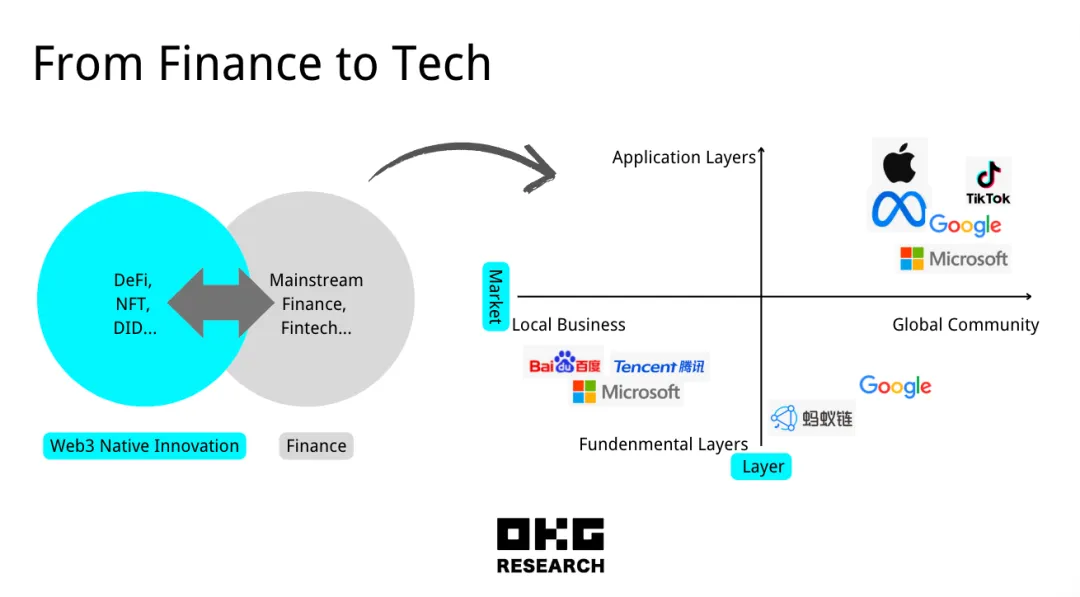
This chart is compiled based on limited public information available as of July 1, 2024.
Given the borderless, global nature of Web3 communities, certain tech companies have rapidly integrated into the Web3 ecosystem. At the application layer, they can expand globally without being constrained by local markets—making international operations significantly easier due to the inherent characteristics of Web3 communities. As a leader in Web3 technology, OKG Group has firsthand experience with the global dynamics of the Web3 market. Based on current public data, Western internet giants have completed foundational infrastructure building and are now shifting toward application-layer innovations, while Eastern internet giants have yet to show a similarly clear trend.
While we observe that Web3 has reached a crossroads—native innovation has stalled, yet major tech and financial institutions continue to enter the space—the convergence of finance and technology is acting like two hands lifting the Web3 industry toward robust growth.
Join TechFlow official community to stay tuned
Telegram:https://t.me/TechFlowDaily
X (Twitter):https://x.com/TechFlowPost
X (Twitter) EN:https://x.com/BlockFlow_News
 @OKGResearch











