Forbes: Why Are Bitcoin Mining Companies Becoming AI Stocks?
TechFlow Selected TechFlow Selected
Forbes: Why Are Bitcoin Mining Companies Becoming AI Stocks?
Leveraging advantages in power resources and equipment, some cryptocurrency mining companies are making strides amid the AI boom.
 Navigating Web3 tides with focused insights
By Nina Bambysheva, Forbes
Translated by Luffy, Foresight News
Electricity has become a hot commodity in the artificial intelligence (AI) era. Take cloud computing provider CoreWeave as an example: earlier this month, it signed a $3.5 billion agreement with Core Scientific. Under the deal, CoreWeave will pay the Austin-based Bitcoin mining firm $290 million annually for 12 years to host AI-related computing hardware at its data centers. In addition, CoreWeave will bear all capital expenditures.
The deal is a major win for Core Scientific—its stock price doubled in early June to $10. Some observers now see Core Scientific as a new “weapon” in the AI space. On June 26, CoreWeave announced a second partnership expected to generate $1.2 billion in revenue for Core Scientific over the coming years. As one of North America’s largest Bitcoin miners, Core Scientific had previously struggled financially and only emerged from bankruptcy in January this year.
AI applications like ChatGPT have driven surging demand for large-scale computing capacity—each ChatGPT query consumes ten times more electricity than a traditional Google search—making companies like Core Scientific highly attractive due to their access to cheap power in regions such as Texas and North Dakota, along with agreements to secure additional energy from other sources. According to the Lawrence Berkeley National Laboratory, building a high-performance computing (HPC) data center from scratch typically takes 3–5 years, while grid connection wait times can stretch up to six years, making existing power availability crucial today.
Adam Sullivan, CEO of Core Scientific
“Demand is infinite,” said Adam Sullivan, CEO of Core Scientific. “If we just execute on what's in our current contracts, we’ll be one of the top 10 data center companies in the U.S., hosting a significant portion of the country’s AI hardware over the next few years.”
JPMorgan research shows that since Core Scientific announced its first CoreWeave partnership on June 3, the combined market capitalization of 14 U.S.-listed Bitcoin miners surged 22%, sharply contrasting with a 12% drop in Bitcoin and a 4% rise in the S&P 500 Index.
A JPMorgan report dated June 24 revealed these 14 miners control about 5 gigawatts (GW) of power, with 3.6 GW suitable for HPC use. They also have purchase agreements for another 4.5 GW from new power plants at various stages of development and permitting.
This energy could power approximately 3.4 million households for a year. The Electric Power Research Institute estimates that driven by the AI boom, data center energy demand could reach 9% of total U.S. electricity generation by 2030—more than double current levels.
However, miners cannot easily repurpose surplus power for AI. Wes Cummins, CEO of data center developer Applied Digital, said: “It’s very hard to get large amounts of power quickly right now—and that’s exactly the key asset many U.S. Bitcoin miners currently possess. But those power contracts only become valuable if you also have supporting infrastructure, primarily fiber-optic connectivity.” Fiber-optic cables are essential for high-speed data transmission in HPC environments.
HC Wainwright analyst Kevin Dede noted, “Bitcoin purists might argue, ‘No, you can’t host AI machines in a Bitcoin mining facility.’ Okay, I get it—you need cleaner air and better cooling. But smaller AI players may not interest hyperscalers (like AWS, Microsoft Azure, or Google Cloud), yet they could fit well within the service offerings provided by Bitcoin miners. This could ultimately lead to hybrid Bitcoin mining/HPC data centers.”
Investors appear to agree with this view.
Mark Palmer, an analyst at investment bank Benchmark, wrote in a June 21 research report: “Over the past three weeks, as the value of miners’ power assets has come into focus, ratings for publicly traded Bitcoin mining stocks have been repriced upward. A group of listed miners including IREN, TeraWulf, and BitDigital now trades at an average enterprise value multiple of 7.8, up from 5.2 just two months ago.”
For mining firms recently hit by the Bitcoin block reward halving—which reduced payouts to 3.125 BTC and brought mining revenues to historic lows—the rising AI-driven power demand offers a much-needed lifeline. Moreover, we found that all 10 miners now venturing into AI projects were unprofitable last year. While Bitcoin has slowly recovered from the 2022 crypto winter, it still trades below mining cost levels.
As Core Scientific garners attention, several other mining firms have also been adjusting operations to ride the AI wave.
IREN
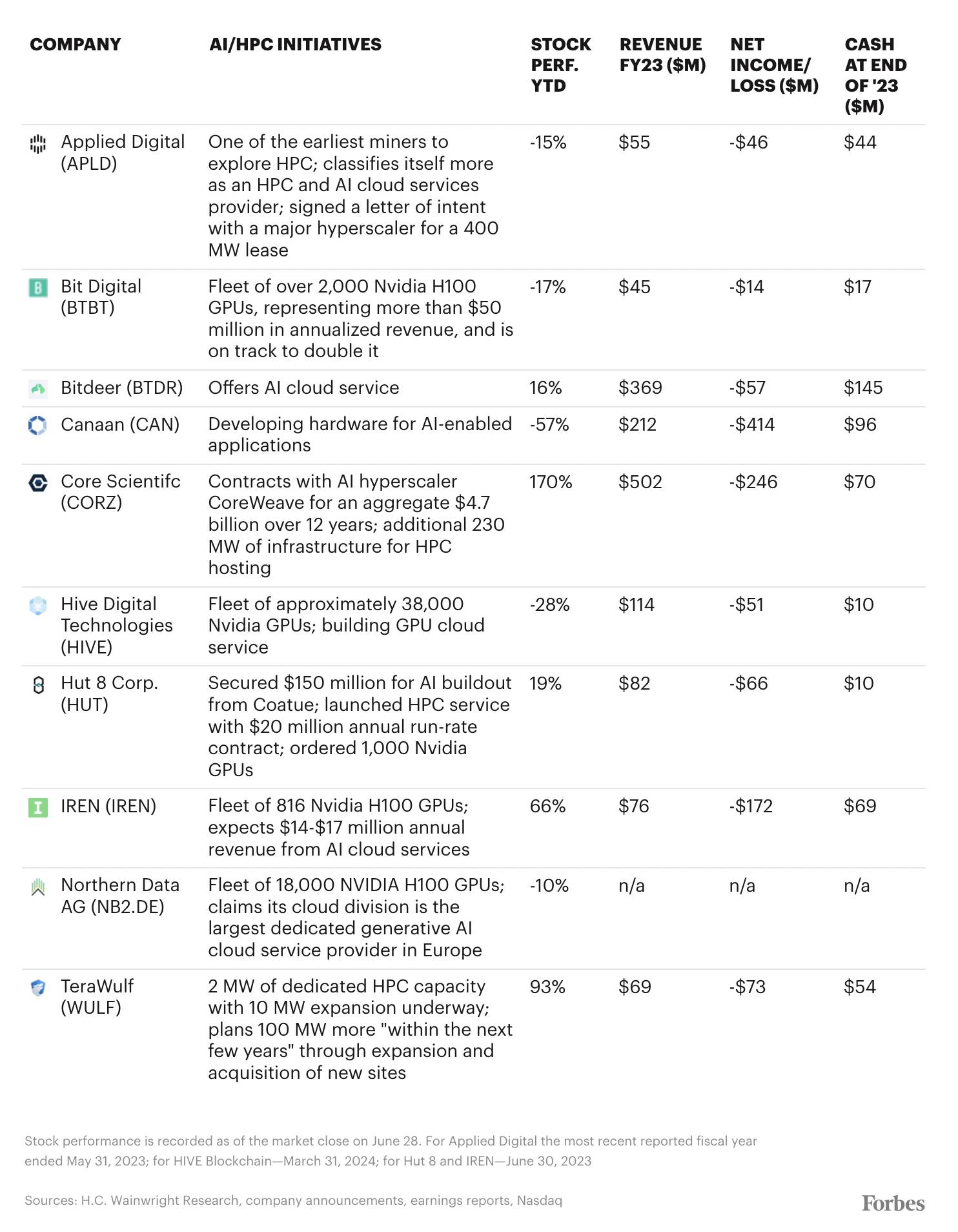
Formerly Iris Energy, IREN was among the first to recognize this opportunity. JPMorgan believes IREN is best positioned among miners to capitalize on HPC/AI demand due to its timely construction of high-quality data centers. The company recently acquired 816 Nvidia H100 GPUs—arguably the most powerful chips in AI. “Outside of Core Scientific, IREN, and Hut 8, we haven’t really seen miner enterprises achieve this level of AI-related revenue,” said Mike Colonnese, another HC Wainwright analyst.
Hut 8
The Miami-based Bitcoin miner announced a $150 million funding round from Coatue Management to build AI-related infrastructure. Coatue will purchase a five-year bond, extendable up to three additional years. The debt carries an 8% interest rate, and Coatue has the option to convert it into stock at $16.395 per share—45% above the stock price when the deal was announced. Hut 8’s current share price stands at $14.99.
Asher Genoot, CEO of Hut 8
“We want to grow and build with partners who have scale or long-term coexistence potential—well-known names in the broader ecosystem and in AI,” said Asher Genoot, CEO of Hut 8. “We’re already in discussions with many such partners.” He emphasized that success isn't just about who gets access to the market, but who can actually deliver—and Hut 8 is one of them.
Benchmark’s Palmer agrees: “Hut 8 has proven it can establish oases of energy assets and data centers relatively quickly and at low cost.” He rates Hut 8’s stock as a buy, with a $17 price target.
Applied Digital
Applied Digital was among the first miners to pivot toward building HPC data centers. It recently signed a letter of intent with an unnamed U.S. hyperscaler to lease 400 megawatts of power. HC Wainwright’s Dede highlighted the company’s Jamestown, North Dakota facility as an interesting case study attempting to balance Bitcoin mining and HPC workloads—a so-called “mullet” data center. These facilities combine HPC and Bitcoin mining during periods of excess power capacity.
“People are focused on power now, but if you want to shift from Bitcoin mining to HPC, many other factors matter too,” said CEO Cummins, noting that lead times for critical electrical equipment exceed 2.5 years and there’s a shortage of talent with large-scale data center experience. “We’ve spent considerable time solving supply chain issues and hiring business experts. We truly see ourselves as a future HPC infrastructure company.”
Needham analyst John Todaro named Applied Digital as his top pick in the HPC/AI space, while also highlighting IREN, Core Scientific, TeraWulf, Bitdeer, Hut 8, Bit Digital, and HIVE Digital Technologies.
For more pure-play crypto firms like Riot, CleanSpark, and Marathon Digital Holdings—the three largest U.S. Bitcoin miners by market cap—traditional crypto operations remain strong. Bitcoin is nearing all-time highs, and macroeconomic and geopolitical uncertainties that support its value are unlikely to fade soon.
Zach Bradford, CEO of CleanSpark, said in a statement to Forbes: “I believe the best use of our resources is to focus on Bitcoin mining. Not only does it help stabilize the grid, but it’s also helping shape the future of money. Some of our data centers can support HPC, but we believe we’re making a more positive impact and achieving greater success under our current strategy.”
Marathon has actually expanded its mining operations by supporting the new PoW cryptocurrency kaspa (KAS). “By mining kaspa, we’re able to create a revenue stream distinct from Bitcoin,” said Adam Swick, Marathon’s chief development officer, in a statement on the company’s website. In March, Forbes included Kaspa on its list of zombie blockchains due to limited utility.
Earlier this month, CleanSpark announced five new mining sites in Georgia totaling $25.8 million in investments. On June 27, it agreed to acquire peer Grid Infrastructure in an all-stock transaction valued at $155 million. Meanwhile, Riot is attempting a proxy battle to take over rival Bitfarms.
An analyst known on X as pennyether warned pure-mining investors to exercise caution: “They’ve already priced in a Bitcoin rally. But if Bitcoin doesn’t rise as expected—if it trades sideways for a year—I hate to think what kind of disaster many mining stocks would face.”
Of course, entering a nascent, highly complex industry is difficult, wrote Colin Harper, head of content and research at Bitcoin mining services firm Luxor Technologies. “The outlook becomes even tougher when you realize miners will be competing against some of the world’s largest and most well-capitalized tech companies.”
HC Wainwright’s Colonnese said building AI data center infrastructure could cost up to $10 million per megawatt, compared to $300,000–$500,000 per megawatt for Bitcoin mining facilities. “Markets usually react positively to anything AI-related, but these are extremely capital-intensive areas,” he said.
Nevertheless, for those with available infrastructure and power capacity, shifting toward AI could offer compelling benefits. Replacing Bitcoin’s volatility with more stable income from AI computing allows miners to benefit from predictable budgets funded by existing clients. Morgan Stanley analysts concluded in a April report that this could also help miners boost revenues, enabling them to afford the high capital investments needed to stay competitive with new mining hardware.
“The reality is, AI companies are willing to pay more because they can—they have stronger business models,” said Dede. “With Bitcoin mining, you don’t know what the price will be or how hard mining will be, so you’re taking on more risk.”
Morgan Stanley’s report highlighted several mines suitable for data center redevelopment, including sites in Texas, Georgia, Canada, the UAE, and Bhutan. Needham analysts estimate most miners pursuing conversion will face capital expenditures exceeding $6 million per megawatt.
For many mining companies, this is an opportunity too big to ignore.
“This doesn’t mean miners will completely overhaul their businesses,” said Phil Harvey, CEO of hosting provider and digital asset mining consultancy Sabre56. “They’ve invested heavily in time, money, and effort into crypto.” But, he added, “It would be foolish not to treat these data centers as a business. It broadens your investment appeal—private equity firms are pouring into HPC/AI because investors don’t want to miss the AI wave.”
Join TechFlow official community to stay tuned
Telegram:https://t.me/TechFlowDaily
X (Twitter):https://x.com/TechFlowPost
X (Twitter) EN:https://x.com/BlockFlow_News
 Forbes