








Open Source Software and Digital Commons
TechFlow Selected TechFlow Selected
Open Source Software and Digital Commons
This article takes you deep into the dynamics between FLOSS developer communities and for-profit companies.
 Navigating Web3 tides with focused insights
Author: Birkinbine, Benjamin
Translation: Tiao, LXDAO
Translator’s Preface:
I偶然 came across this book, and later saw Trent Van Epps mention it in a video discussing the Protocol Guild, using its framework to explain what the Protocol Guild is doing. That convinced me it's worth reading—may your journey through it be rewarding.
This article consists of the first two sections of Chapter One from the book Incorporating the Digital Commons: Corporate Involvement in Free and Open Source Software.
In March 2012, the Linux Foundation released a report titled Linux Kernel Development: How Fast It Is Going, Who Is Doing It, What They Are Doing, and Who Is Sponsoring It. The kernel is a crucial component of an operating system that facilitates communication between computer hardware and software, and the Linux kernel development project is considered "one of the largest collaborative software projects in history" (Linux Foundation, 2012: 1). In addition to offering a technical overview of how kernel development has evolved over time, the authors made an intriguing observation in the report: Microsoft was among the top 20 contributors to the kernel. This marked the first time Microsoft had been one of the leading contributors, but it was not the only company on the list of top 20 contributors. Other corporate contributors included Intel, IBM, Google, Texas Instruments, Cisco, HP, and Samsung. Linux is free and open source software (Free (Libre) and Open Source Software, FLOSS), which allows users the freedom to study, use, copy, modify, adapt, or distribute it. So why would large corporations directly contribute to a FLOSS project that seemingly does not directly benefit their profits? This question becomes even more curious when considering that many companies contributing to the kernel not only compete with each other in the information technology market, but some—like Microsoft and Google—directly compete with Linux in the operating system market.
Indeed, Steve Ballmer, then CEO of Microsoft, once described Linux as “a cancer that attaches itself in an intellectual property sense to everything it touches” (Greene, 2001). Ballmer was referring to the GNU General Public License (GNU GPL), the most widely used free software license. Under the GPL, users are granted the rights to study, use, copy, modify, or adapt software as they see fit. Additionally, users have the right to redistribute the software—even charging for modified versions—as long as distributors do not impose further restrictions on the rights granted by the GPL. The GPL does not prohibit companies from modifying free software or charging for modified versions, but it requires that companies extend the same freedoms to end users. Ballmer’s statement implies that free software is inherently opposed to commercial software companies. If so, Microsoft and other proprietary software firms would have no incentive to contribute directly to one of the largest open source projects.
Moreover, it is notable that Ballmer made this critical remark about Linux on June 1, 2001. Just 27 days later, on June 28, 2001, the U.S. Department of Justice convicted Microsoft of monopolistic practices under the Sherman Antitrust Act, primarily due to bundling its web browser Internet Explorer with the Windows operating system, rapidly expanding its share in the web browser market. Yet since 2001, Microsoft’s stance toward Linux and open source has undergone a significant transformation, evidenced by its inclusion among the top 20 contributors to the Linux kernel in 2012. In that year, Microsoft also established Microsoft Open Technologies, Inc., a wholly-owned subsidiary dedicated to promoting interoperability between Microsoft and non-Microsoft technologies, while advancing open standards and open source. What exactly changed at Microsoft during these 12 years that led to such a complete repositioning of its relationship with FLOSS?
Microsoft is not alone. In fact, corporate participation in FLOSS projects has steadily increased since around 2007–2008. Table 1.1 lists the companies that contributed code to versions 4.8–4.13 of the Linux kernel in 2017. The annual kernel development report confirmed that 225 companies contributed to the project that year. While the Linux kernel is just one example of corporate contributions to FLOSS, numerous similar cases exist. This raises a key question: What motivates these companies to contribute to FLOSS projects? How do they contribute? How do FLOSS developer communities coordinate corporate involvement in their projects? And do FLOSS communities have ways to resist unwanted influence or interference from corporations?
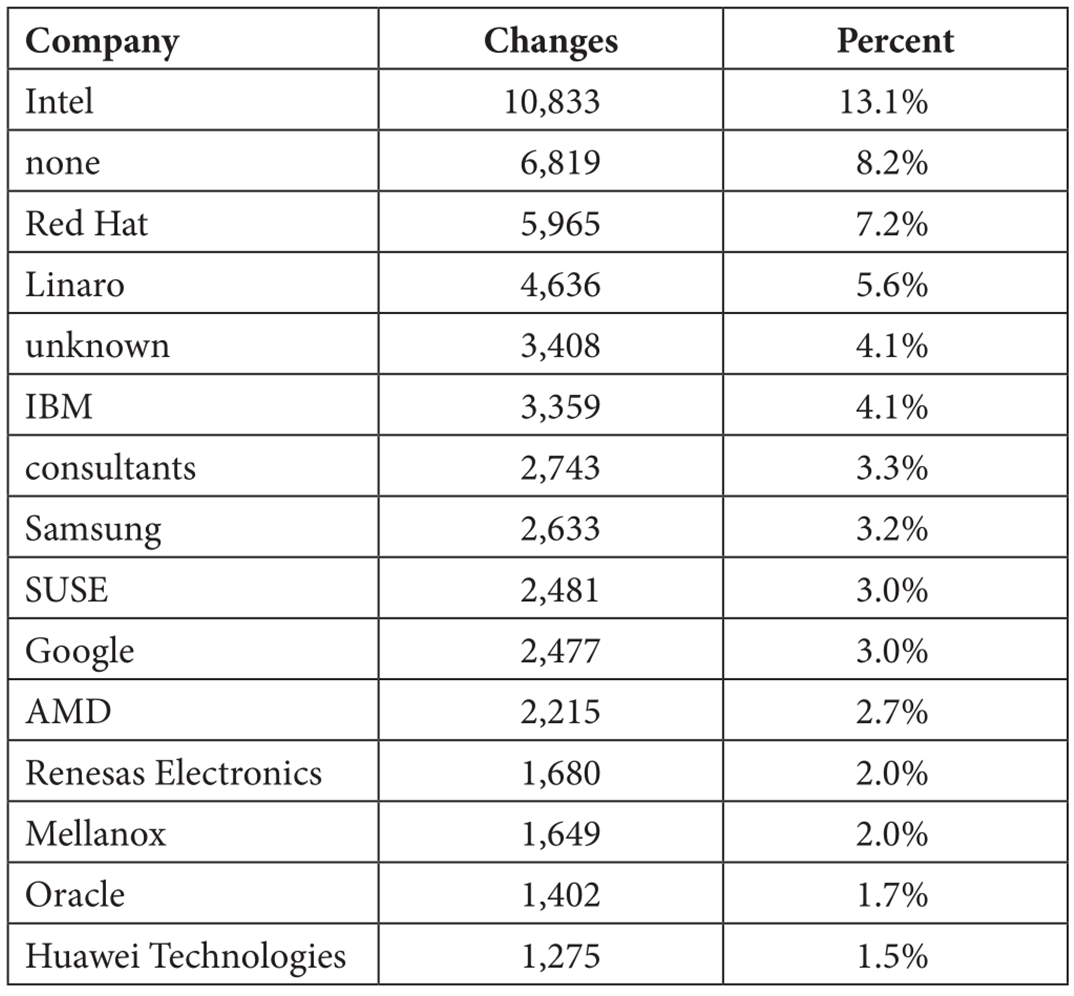
Table 1.1 Top Companies Contributing to the Linux Kernel
1.1. The Book’s Argument and Structure
The overall aim of this book is to examine the seemingly contradictory relationship between FLOSS communities and profit-driven corporations. Drawing on a critical political economy perspective, I explore the power dynamics between FLOSS developer communities and the companies that sponsor FLOSS projects or appropriate the labor and outputs of FLOSS developers. After all, FLOSS products and their production processes have been widely celebrated as revolutionary changes capable of delivering greater freedom and autonomy to users and contributors (Benkler, 2006; Raymond, 2000; Stallman, 2002). My project intervenes in these debates by balancing such claims. I situate technology as a site of social struggle and place commons-based peer production within a broader social context to illustrate its interplay with capitalist production. To this end, I demonstrate how the so-called revolutionary changes brought by FLOSS and commons-based peer production are being incorporated into corporate strategies and structures.
The central argument here is that free and open source software exists dialectically between capital and the commons. On one hand, programmer collectives are engaged in creating software accessible, usable, and adaptable by others—thereby forming a digital commons. Through this iterative software development, both the speed and scale of software production increase. This represents a virtuous cycle where a community of software programmers actively contributes to a shared project, which in turn claims collective ownership over the FLOSS initiative. Thus, FLOSS programmers can be seen as commoners, consistently committed to ensuring the reproduction and sustainability of commons-based software projects. On the other hand, capital seeks to capture the value produced by FLOSS communities. This includes exploiting the FLOSS production process (i.e., collective labor, or commons-based peer productivity) and commodifying the product (i.e., specific FLOSS projects). The latter enables the commercial exploitation of collaboratively produced software within FLOSS communities.
This is not to say that the goals of free software commoners and capitalist corporations are always opposed. Researchers have shown that commercial sponsorship of FLOSS projects often makes them more attractive to developers, thereby ensuring the project’s long-term survival (Santos, Kuk, Kon, and Pearson, 2013). However, we also have examples of ruptures, particularly when capital imposes unwanted enclosures upon shared resources like the digital commons. In such cases, the interests of the FLOSS community diverge from those of sponsors, turning the relationship adversarial. The challenge facing FLOSS communities is not only to ensure the continued vitality of their digital commons but also to preserve the communal ethos that originally enabled the project’s emergence.
So how are relations negotiated between the digital commons and capital’s potentially disruptive intrusions? Multiple factors must be considered, and the following chapters provide empirical evidence illustrating how these dynamics unfold.
Generally speaking, the commons—and more specifically, the digital commons—can be understood as an alternative value system emerging within capitalism. At times, cycles of commons-based value intersect with cycles of capital accumulation. Therefore, a dialectical understanding of the relationship between free software and capital helps explain the contradictions between these two forces operating according to different logics. Chapter 2 outlines these differences more concretely by drawing on theories of capitalism, digital labor, and the commons; my aim there is to develop a critical theory of the digital commons by integrating critiques of capitalism into commons theory.
Chapters 3 to 5 present three detailed case studies that illustrate the dynamic relationships between FLOSS communities and corporations from different angles. I organize the discussion of corporate engagement with FLOSS around three thematic areas—processes, products, and politics—with each case study exemplifying one theme. Together, these case studies reflect general trends in corporate participation in FLOSS projects. Moreover, each provides nuanced insight into the complexities of these dynamics and allows for a detailed interpretation of inherent contradictions.
First, Chapter 3 examines Microsoft’s complex relationship with FLOSS. This case illustrates how the FLOSS production process has effectively ushered in a new era of industrial software development. While other companies have also demonstrated willingness to collaborate with FLOSS communities, Microsoft’s dominance in the personal computing software market during the 1980s and 1990s makes it a pivotal case for understanding how software production has evolved over time. A key historical event here is the antitrust ruling against Microsoft, marking the end of an era in which a single company dominated software production and attempted to exclude others from accessing its product code. Indeed, one of the consent decrees required Microsoft to grant third parties access to its Application Programming Interfaces (APIs)—a stark contrast to its earlier anti-competitive business practices.
During the 1990s, as Microsoft dominated the software market and was eventually found guilty of violating antitrust laws, other software firms were exploring ways to turn FLOSS products into successful commercial ventures. My analysis of Red Hat, Inc. in Chapter 4 illustrates how FLOSS products can be integrated into a corporation’s overall business strategy. Red Hat remains the largest and only publicly traded company fully committed to providing software and services based entirely on free software. As such, Red Hat cannot rely on traditional copyright protections to prevent others from using its source code. Therefore, my analysis explores how Red Hat builds a profitable business model atop free software.
Finally, the third case study in Chapter 5 focuses on how FLOSS communities respond to unwelcome corporate influence over their projects. Sun Microsystems was once a major sponsor of FLOSS initiatives but was later acquired by Oracle Corporation, which had different plans for these projects. In this chapter, I highlight the divergent fates of three projects—OpenSolaris operating system, MySQL relational database management system, and OpenOffice office suite—and how the communities involved resisted Oracle’s erosion of their work. This case study illustrates the political dimensions involved when FLOSS communities negotiate boundaries with corporations, and demonstrates strategies available to protect their projects.
In the remainder of this introduction, I provide additional background to help contextualize the significance of FLOSS. This includes placing FLOSS within historical context and broader discussions of the commons, as well as covering general software development and key moments in FLOSS history. In these sections, I also introduce several terms used throughout the book, aiming to avoid conceptual confusion. Next, I discuss the cultural significance of FLOSS. Finally, I outline the methodology of the current study. Readers already familiar with the history and characteristics of FLOSS may skip directly to the next chapter or the methodological section at the end of this one.
1.2. Situating Free and Open Source Software
Although the free software and open source communities are interconnected and sometimes overlapping, each has distinct characteristics best described by their underlying philosophical foundations. To situate the emergence of FLOSS within the development of computing and software industries, the following section briefly reviews the history of these fields. After this historical overview, I focus on two key figures associated with FLOSS—Richard Stallman and Linus Torvalds—and the historical contexts in which they operated, representing the free software and open source movements respectively.
1.2.1. Tracing the History of Free and Open Source Software
Before machines took over tasks involving information processing or numerical calculation, these were performed manually by humans. However, human computation was prone to errors. To reduce such uncertainty, Charles Babbage, a philosopher and mathematician working at Cambridge University, proposed in 1822 that “only through mechanical means could tables be produced without error” (Gleick, 2011: 95). Based on this idea, Babbage conceived the “Difference Engine,” a mechanical device capable of performing routine calculations—a precursor to the modern computers we know today. Later, Babbage expanded his concept to design a new machine that could be controlled by programmable and stored instructions, facilitating operation. This iteration became known as the “Analytical Engine,” though it still provided only the necessary hardware or mechanism. However, this hardware required accompanying software to function.
The idea of software arguably originated with Augusta Ada Byron King, Countess of Lovelace, commonly known as Ada Lovelace. In 1843, she suggested that Babbage’s Analytical Engine could perform operations beyond mere numerical calculations. By abstracting differences between entities, Lovelace argued that the engine could be programmed to execute symbolic and meaningful operations comprehensible to the machine. Although Lovelace never lived to see her ideas realized, she developed the concept of “software” and is regarded as the world’s first programmer.
While Babbage and Lovelace are recognized as pioneers in the conceptual development of modern computers and software, actual construction of such machines began during World War II. Advances in computer science and information theory—such as Kurt Gödel’s incompleteness theorems, Alan Turing’s concept of the universal Turing machine, Claude Shannon’s mathematical theory of communication, and Norbert Wiener’s cybernetics—provided theoretical inspiration for these developments. Before, during, and after WWII, many early computing advancements served military purposes. Among the most famous examples are Germany’s Enigma machine, used to encrypt secret messages, and Britain’s electromechanical “bombe,” used to decrypt them (Smith, 2011). In 1941, German electrical engineer Konrad Zuse built the Z3, widely considered the first electromechanical, programmable, fully automatic digital computer (Zuse, 1993). The first similar computer in the United States was completed in 1942 by John Atanasoff at Iowa State University (Copeland, 2006). Just one year later, British codebreakers at Bletchley Park began using the first fully functional electronic digital computer, part of the Government Code and Cypher School. This new machine, called “Colossus,” was used during the war to decipher German communications. By war’s end, ten Colossus machines were operational at Bletchley Park, dedicated to breaking German codes (Copeland, 2006).
Following these initial milestones, the development of modern computers accelerated as many early pioneers transitioned to work in academic institutions and private companies after the war. In the United States, Grace Hopper, serving in the U.S. Navy Reserve’s Women Accepted for Volunteer Emergency Service (WAVES) during WWII, was assigned to the Bureau of Ships Computation Project at Harvard University. There, she worked on the Mark I computer project, built by IBM in 1944. Later, Hopper moved to private industry and championed the idea of machine-independent programming languages. This led to the development of COBOL (Common Business-Oriented Language) in 1959. Hopper also popularized the term “debugging”—the process of removing faulty components or code from a program. While she may not have coined the term, she famously removed a moth causing a short circuit from a Mark II computer at Harvard, making the term widely known (Deleris, 2006).
In the 1960s, the invention of the microprocessor dramatically reduced computing costs. As a result, amateur programmers and computer hobbyist communities began experimenting with the technology in subsequent years. A notable example is the Homebrew Computer Club, founded in 1975 by Gordon French and Fred Moore at the Community Computer Center in Menlo Park, California. The club provided an open forum for hobbyists to exchange parts and advice on building personal computers, aiming to make computing accessible to more people. Chapter 3 will revisit this community in detail, as it played a significant role in Microsoft’s rise. Aside from these hobbyist circles, most computer development occurred within military, academic, and corporate settings.
Among the most notable were the U.S. Defense Advanced Research Projects Agency (DARPA), established in 1958, and the MIT Artificial Intelligence Laboratory, founded in 1970. Programmers at the time used a proprietary programming language called Unix, whose intellectual property belonged to AT&T. Richard Stallman, a programmer at MIT, began working at the lab in 1971. He discovered that AT&T denied him access to the Unix source code when he wanted to use it outside officially approved channels. In protest, in 1983, he posted a message on a computer bulletin board announcing his intention to develop a Unix-like system freely available for anyone to use. In 1985, Stallman published “The GNU Manifesto,” outlining the goals, motivations, and targets of his new project. The system was named “GNU,” a recursive acronym for “Gnu’s Not Unix.” In addition to developing the software, Stallman created the GNU General Public License (GPL), stipulating that anyone could access the source code freely and that contributors must make their modifications equally available. This ensured programmers could freely share their work, creating a form of communal property standing in opposition to proprietary and closed alternatives.
Stallman became a leading figure in the opposition to proprietary software. He believed access to source code was a fundamental right and hoped others would share this belief. He famously summarized this view: “free as in freedom, not as in free beer,” positioning free software as a moral right (Stallman, 2002). The Free Software Definition states that “users have the freedom to run, copy, distribute, study, change, and improve the software” (Free Software Foundation, 2012). As the principles of free software spread beyond the United States, others sought to reduce confusion around the English word “free” by using the French term *libre* instead of *gratis*. Stallman founded the Free Software Foundation (FSF) to advance his movement against proprietary software. A passionate countercultural figure, he continues to advocate for the philosophy of free software.
Stallman is widely regarded as the leader of the free software movement, while open source software is typically associated with Linus Torvalds. Torvalds and Stallman share certain similarities, but differ philosophically. In the 1980s, free software projects began emerging, but remained relatively small-scale. At the time, free software lacked mechanisms for broad collaboration. Torvalds aimed to develop a kernel for an open-source operating system. Rather than relying on isolated programmers, he released his project’s source code and named it “Linux”—a combination of his name Linus and Minix, the Unix-derived programming language he used. Torvalds invited anyone interested to contribute, provided they shared their work with the community so others could incrementally build the kernel. The project proved successful, ultimately giving rise to the open-source Linux operating system. By requiring contributors to publish their work—even minor changes—this massive programming effort achieved coordination. The rationale was that coordinated efforts reduce redundant work, encapsulated in what Eric Raymond dubbed “Linus’s Law”: “given enough eyeballs, all bugs are shallow” (Raymond, 2000).
Stallman and Torvalds differ in their views on the relationship between free and proprietary software. Stallman takes a confrontational stance against proprietary software, whereas Torvalds is less rigid. Williams (2002) describes a defining moment at a 1996 conference where Stallman and Torvalds appeared together on a panel. Torvalds expressed admiration for Microsoft’s work and suggested free software advocates could collaborate with companies. Such a suggestion was usually taboo, given Stallman’s revered status in the programming community and the FSF’s hardline position against proprietary software firms. Powell (2012) similarly characterizes the difference between free software and open source:
“Open source software, as an industrial process, emerged from the culture of free software development but diverged from its political emphasis on sharing and maintaining a knowledge commons, focusing instead on the efficiency of the open source production process” (692).
Thus, the 1996 conference marked a turning point: the fervor of the free software movement slightly thawed as Torvalds represented a more liberal approach to free software. Here, “liberal” is used literally, not politically—meaning openness to new ideas or behaviors and a willingness to abandon traditional values. From this perspective, Linus’s support for Microsoft’s work signaled his readiness to collaborate with Microsoft (or other commercial firms) purely to produce better software, rather than adhering to Stallman’s and the FSF’s anti-corporate stance.
In sum, the free software and open source movements can be understood through differing philosophical positions. Stallman and free software advocates tend to emphasize moral arguments against proprietary software, while Torvalds and open source supporters adopt a more liberal and inclusive stance. While Stallman and Torvalds serve to illustrate differences between the two communities, they should not be seen as mutually exclusive representatives or as embodying the entire FLOSS community. A hallmark of the free and open source software communities is that despite a shared belief that software should be freely available for study, modification, adaptation, or customization, members often fiercely defend their preferred FLOSS projects while mocking others. In a way, this signals loyalty and strengthens bonds within niche subcommunities. This project pays less attention to internal divisions and more to the relationship between the group and the corporations dependent on their labor. Hence, we use “Free (Libre) and Open Source Software” or “FLOSS” to refer to the broader community.
1.2.2. Free and Open Source Software: Silent and Ubiquitous
Since the 1980s and 1990s, FLOSS has proven to be an efficient and effective method of software production. Whether we realize it or not, most people rely on FLOSS in everyday computing activities, as it underpins critical internet infrastructure. Taking the Linux kernel discussed in the introduction to this chapter as an example, we can glimpse the scale and scope of some FLOSS projects. First released in 1991, the Linux kernel contained approximately 10,000 lines of code. The Linux kernel version 4.13, released in September 2017, comprised nearly 25 million lines of code, developed by nearly 1,700 developers and 225 companies (Corbet and Kroah-Hartman, 2017: 11). Furthermore, the Linux operating system is widely used. For instance, in the supercomputer operating system market, Linux (or Linux-derived systems) holds 100% market share (Top500.org, 2018a). All of the world’s most powerful computers rely on Linux or Linux-based operating systems, including the supercomputer at Oak Ridge National Laboratory in Tennessee, operated by the U.S. Department of Energy, which, at the time of writing, hosts the world’s fastest and most powerful supercomputer (Top500.org, 2018b). While Linux holds a small share in the personal desktop computer market, the operating system has been customized and deployed in diverse contexts.
In the United States, Linux is used in advanced military operations. For example, the U.S. Navy announced that the USS Zumwalt, a destroyer costing $3.5 billion to build and described as “the most technologically advanced surface warship in the world,” functions effectively as an armed floating data center running various Linux distributions and over six million lines of code (Mizokami, 2017; Gallagher, 2013). Moreover, according to Keith Chuvala, Space Operations Computing Manager at NASA, the International Space Station switched from Windows to Debian Linux because they wanted “...a stable and reliable operating system—something we can control internally” (Bridgewater, 2013).
In fact, Linux and its derivatives provide essential components for some of the most prominent tech companies, as briefly discussed at the beginning of this chapter. While only a few companies are examined in depth in later chapters, other interesting cases exist that illustrate varied dynamics between corporations and FLOSS communities. Mentioning a few notable examples serves to underscore Linux’s ubiquity. For instance, Google’s Android operating system—one of the world’s most popular mobile platforms—is based on the Linux kernel. However, some key components of Android remain proprietary to Google (see Amadeo, 2018). Beyond Google, other companies like Canonical leverage Linux to create customized operating system distributions. Ubuntu, produced by Canonical, is currently one of the most widely used Linux distributions.
Linux is used globally. Some countries have developed Linux versions tailored to their specific needs, and certain cities have even enacted legislation mandating preference for Linux. For example, between 1999 and 2001, four Brazilian cities—Amparo, Soloanópolis, Recife, and Ribeirão Pires—passed laws requiring government agencies to use or prioritize Linux. This decision was primarily driven by economic considerations, as Brazil reportedly paid nearly $1 billion in software licensing fees to Microsoft between 1999 and 2004. Transitioning to free and open source software was expected to save Brazil approximately $120 million annually. Brazil remains one of the more progressive nations in supporting free software. Many FLOSS-related policies and initiatives in Brazil are driven by activist communities who influence policymaking, crafting alternatives to mainstream neoliberal ideologies. In a compelling 2011 article, Shaw refers to these actors as “insurgent experts.”
Similarly, India’s Kerala state has adopted pro-free-software measures—phasing out proprietary software in its education system. This move is estimated to save the state about $58 million annually. Munich, Germany, developed a local version of LiMux (Linux in Munich) and used it as the operating system for 15,000 municipal employees until 2017. China’s National University of Defense Technology has also developed Kylin, a Linux-based operating system. Additionally, the computers used in the “One Laptop Per Child” project run a Fedora-based free and open source operating system. Fedora is a free software project sponsored by Red Hat, which we will discuss in Chapter 4.
Beyond Linux’s widespread use, open source principles have been applied beyond information technology. For example, open source hardware (see Söderberg, 2011) can increase access to physical goods such as furniture, musical instruments, building materials, and wind turbines. These projects are especially appealing to people in developing countries where access to information, goods, and services may be limited. Open Source Ecology is one ambitious project in this domain, offering “blueprints for an open source civilization” with guides for building industrial machines using recycled or low-cost materials. While just one standout example, it reflects the optimism and creativity behind applying open source principles to entire lifestyles, not just IT. However, the core values of these projects do not necessarily originate from open source software. Instead, cultural values such as openness, sharing, mutual aid, respect, and friendliness form the foundation for community building. When applied broadly, these principles can lead to a more sustainable future, especially when linked with environmental and ecological practices. Yet these principles become radical only within systems that rarely encourage or value them.
Although the FLOSS community is a socio-technical system, FLOSS enthusiasts also collaborate face-to-face through a global network of Linux User Groups (LUGs). LUGs hold regular meetings to promote FLOSS, help new users install it, troubleshoot issues, or simply connect with fellow enthusiasts. Social ties within these groups are mediated by shared technical interests. Because community members gather around a common technological passion, their cultural practices depend on and are supported by interconnected network technologies. As more people come online, opportunities for new participants to contribute grow accordingly.
Finally, it is worth noting that more and more of our social lives unfold online—working remotely, communicating with friends and colleagues, reading news, watching films, listening to music, and so on. When we connect to the internet and access websites, information requests are relayed through a network of interconnected servers that facilitate communication between clients. The operating systems running these servers increasingly rely on FLOSS projects such as Linux or FreeBSD, although Microsoft also develops server software. This is another example of FLOSS projects competing with proprietary firms like Microsoft. Thus, whether we realize it or not, our ability to connect to the internet may partly depend on how well FLOSS projects and proprietary software can cooperate. This further underscores the importance of understanding how proprietary software and FLOSS projects collaborate—and what happens when these relationships break down. Analyzing the dynamics at play can help us understand what enables and constrains our capacity to connect with others online.
These examples show that Linux, and FLOSS more broadly, are no longer merely tools used by computer hobbyists. Their extensive application in high-level global environments and sustained growth attest to the strength of the FLOSS production model and the effectiveness of its products. As FLOSS is increasingly deployed across diverse domains, understanding how enterprises, governments, nonprofits, and other institutions engage with FLOSS projects becomes ever more important. Thus, FLOSS emerges as a significant field of study—not only due to its growing prevalence but also because of the claims made about its products and production processes: democracy, equality, and non-market values. This is precisely the angle from which this book aims to contribute to ongoing debates.
1.2.3. FLOSS and Hacker Culture
Recently, the term “hacker” often carries negative connotations, but it traditionally refers to individuals who “tinker” with or modify technology to create something new. In 1984, Steven Levy outlined the principles of hacker ethics, arguing that computers could serve creative purposes, that hackers should be judged by the quality of their work rather than gender, race, or ethnicity, and that mastery of technical skills is a prerequisite for hacking. The last point may seem obvious, but engaging in hacking requires access to relevant technologies—specifically, source code. In other words, closed, proprietary, or otherwise restricted technologies may be perceived as unjust.
Indeed, when confronted with closed, proprietary, or protected technologies, hackers may attempt to bypass or eliminate these restrictions. Sometimes this is done to demonstrate security flaws or to signal the sophistication of their craft. This signaling motive is also recognized within open source software communities (Lakhani and Wolf, 2005), particularly because FLOSS programmers are interested in remixing, modifying, adapting, or creating new things from existing products. The same signaling logic helps explain why programmers contribute to FLOSS projects. Lakhani and Wolf (2005) suggest signaling occurs at multiple levels. At the individual level, a hacker can demonstrate their skills to others. Hackers may also use such signals to convey competence to potential employers, securing paid work. Successfully completing programming tasks and gaining recognition within a broader community can attract opportunities from companies seeking specific skill sets.
However, another form of signaling occurs among hacker collectives. Hacker groups or collectives might shut down websites or disrupt services to demonstrate their power. This is often driven by competitive spirit, but can also stem from ideological motives. For example, in Syria, state-aligned hacker groups such as the “Syrian Electronic Army” have engaged in cyber warfare with rebel-affiliated groups like the “Free Syrian Army” (Fitzpatrick, 2012). In such cases, hacker collectives strategically attack opponents’ websites to showcase the strength of their cause.
In a survey of self-identified hackers, respondents cited the desire for self-challenge and creative work as primary motivations for contributing to FLOSS development. This supports Levy’s (1984) core principle of hacker ethics: creativity and aesthetics. Weber (2004) identified additional motivations, including the belief that all software should be free—echoing the ideals of Richard Stallman and the Free Software Foundation. Weber concluded that motivations are diverse, and such findings must be contextualized. For example, many FLOSS contributors do not publicly disclose their identities or institutional affiliations. Indeed, reviewing the contributor files for Linux kernel development reveals that most are listed under “unknown.” This indicates that a significant portion of the FLOSS community chooses not to self-identify. Therefore, any claim to represent the entire FLOSS community should be met with skepticism.
Signaling and creativity are undoubtedly important in understanding hacker and FLOSS contributor motivations. However, in my view, Christopher Kelty’s research offers the most compelling account of the cultural significance of free software and FLOSS production. Kelty (2008) positions free software as a “recursive public,” defined as:
“a public that is intensely concerned with the maintenance and improvement of the material and practical means—the technical, legal, practical, and conceptual means—by which it is a public; it is a collective independent of other forms of established power, able to speak to existing powers by producing real alternatives” (Kelty, 2008: 3).
In other words, by actively contributing to FLOSS projects, FLOSS programmers are simultaneously creating, reconstructing, or reproducing the very infrastructures that enable their activities. This connects conceptually with theories viewing the commons as a process or becoming (Dyer-Witheford, 2006; Linebaugh, 2008; Singh, 2017). Similarly, Rossiter and Zehle (2013) argue that the commons is not merely “a fragile heritage to be preserved” against enclosure, but must be actively constructed. FLOSS communities actively produce digital commons in the form of code, licensed under intellectual property frameworks that allow users to use and adapt the code for their own purposes. These alternative IP licenses take various forms. The earliest widely adopted copyleft license was the GNU General Public License (GPL). Other notable examples include Creative Commons licenses, which allow varying degrees of reuse under conditions set by creators. For instance, users can release their works freely while requiring attribution to the original author.
Kelty (2008) further argues that FLOSS programmers “do not start with ideology, but encounter ideology through participation in the practice of creating free software and its derivatives” (7–8). Coleman (2004) expresses a similar view regarding FLOSS’s “political agnosticism.” This agnosticism stems from an external rejection of specific political stances, though “this political negation is culturally articulated through a re-articulation of free speech principles, shaped by computer technology and expressed externally, thus constituting hacker values” (Coleman, 2004: 509). Coleman elaborates that the moral philosophy championed by the FLOSS community centers on “a commitment to preventing the restriction of others’ freedom” (509). This open utilitarian ethic is essential for FLOSS programmers to continue building cutting-edge software, as the ability to modify, adjust, and improve software enables innovation in development.
To some extent, these principles and the external denial of specific political positions help explain why the FLOSS community attracts such a large and diverse group. Of course, this does not mean all FLOSS members reject political ideologies. Eben Moglen’s (2003) “dotCommunist Manifesto” launches a polemic against private property regimes. Indeed, in the manifesto’s conclusion, he proposes seven principles for fighting for “free speech, free knowledge, and free technology,” concluding that this struggle will bring about a more just society (translation of Moglen’s quote sourced here):
1. Abolish all forms of private property in ideas and knowledge.
2. Cancel all exclusive-use licenses, privileges, and rights over electromagnetic spectra. Abolish all permanent rights to occupy frequency bands.
3. Develop electromagnetic spectrum facilities that enable equal communication for everyone.
4. Develop publicly owned computer programs and make all other forms of software—including their 'genetic information,' i.e., source code—public goods.
5. Fully respect freedom of speech, including technical speech.
6. Protect the dignity of creative labor.
7. Ensure equal and free access for all to publicly created information and educational resources across all areas of public education.
Through these and other measures, we shall launch a revolution to liberate human thought. We shall overthrow the current intellectual property system and build a truly just society where the free development of each is the condition for the free development of all. (Moglen, 2003)
Likewise, Dmitry Kleiner’s (2010) *Telekommunist Manifesto* outlines proposals for developing a political consciousness among network workers. His concepts of Venture Communism and the “Copyfarleft” license system—though Copyleft efficiently creates software commons, Copyfarleft is needed for cultural commons, a free license that denies free access to organizations that exclude their assets from the commons—offer concrete suggestions for developing alternatives within the existing framework, guided by radical politics. Both proposals aim to protect collectively owned property of independent producers from capitalist exploitation or absorption.
Overall, the FLOSS community holds immense value for software production. The authors discussed above, especially Kelty (2008) and Coleman (2004; 2013), rank among the best in elucidating the cultural significance and ethical frameworks of the FLOSS community. Yet what happens when the specific cultural, political, and economic values of the FLOSS community intersect with the cycles of capital accumulation? This remains an urgent question—one of the contradictions Kleiner (2010) attempts to address through alternative proposals. Furthermore, how do FLOSS communities negotiate and justify holding dual commitments to open knowledge and market success? Alison Powell (2012; 2016; 2018) best captures these complex dynamics. Exploring how participants in peer production communities reconcile competing moral visions, Powell (2018) argues they often adopt “operational pragmatics” to rationalize various design decisions. In doing so, participants blur distinctions between advocating open knowledge and achieving market success, even when these appear incompatible. In fact, both are treated as “good” or virtuous, functioning as “regimes of justification” in making related design choices (Powell, 2018: 514).
How, then, do we understand the complex negotiations of cultural differences within peer production communities and their intersections with capital accumulation? If peer production communities aim to design products that achieve market success, might they risk being exploited by capital? After all, corporations are highly interested in leveraging the productivity of FLOSS communities. The next section will theorize various ways corporations engage with FLOSS communities. However, the following chapter will delve deeper into these dynamics using theories of capitalism, digital labor, and the commons, exploring how exploitation arises when capital and the commons intersect.
Join TechFlow official community to stay tuned
Telegram:https://t.me/TechFlowDaily
X (Twitter):https://x.com/TechFlowPost
X (Twitter) EN:https://x.com/BlockFlow_News
 TaxDAO


