









Arthur Hayes: Japanese banks' sell-off of U.S. Treasuries boosts new crypto bull market
TechFlow Selected TechFlow Selected
Arthur Hayes: Japanese banks' sell-off of U.S. Treasuries boosts new crypto bull market
If the Federal Reserve launches large-scale money printing to buy back U.S. Treasuries sold off by Japan, it will bring a new round of dollar liquidity to the cryptocurrency market.
 Navigating Web3 tides with focused insights
Author: Arthur Hayes
Translation: Ismay, BlockBeats
Editor's Note: Against the backdrop of global economic turmoil and financial market volatility, this article by Hayes delves into the challenges facing Japan’s banking system during the Federal Reserve's interest rate hiking cycle, as well as the profound impact of U.S. fiscal and monetary policies on global markets. By analyzing in detail the foreign exchange hedging strategies employed by Norinchukin Bank and other Japanese commercial banks when investing in U.S. Treasuries, the article reveals why these banks have been forced to sell off their U.S. Treasury holdings amid widening interest rate differentials and rising currency hedging costs. Hayes further discusses the role of the FIMA repo facility and its implications for U.S.-Japan financial relations, predicting its critical function in maintaining market stability. The article ultimately urges investors to seize investment opportunities in the crypto market under current conditions.
I just finished reading the first book of Kim Stanley Robinson’s trilogy, *Red Mars*. One character, a Japanese scientist named Eiji Yagami, frequently says “shikata ga nai” when referring to situations beyond the control of Martian colonists—meaning “it cannot be helped.”
That phrase popped into my consciousness when I was trying to come up with a title for this “short” article. This piece will focus on the Japanese banks victimized by the monetary policy of Pax Americana. What did these banks do? In search of decent yields on yen deposits, they engaged in dollar-yen carry trades. They borrowed from elderly Japanese savers at home, looked around Japan, found that nearly all “safe” government and corporate bonds offered zero yield, and concluded that lending to Pax Americana via the U.S. Treasury (UST) market was a better use of capital—since even after fully hedging currency risk, these bonds delivered higher returns.
But then came massive inflation in the United States, triggered by cash payments to the public aimed at placating them into accepting lockdowns and experimental drug injections to combat the "infant flu." The Federal Reserve (Fed) had no choice but to act. It raised rates at the fastest pace since the 1980s. As a result, it became bad news for anyone holding U.S. Treasuries. From 2021 to 2023, rising yields produced the worst bond rally since the War of 1812. Shikata ga nai!
In March 2023, the first wave of bank losses seeped through the underbelly of the financial system. Within less than two weeks, three major banks collapsed, prompting the Fed to offer full backing for all U.S. Treasuries held on the balance sheets of any U.S. or foreign bank operating in America. As expected, Bitcoin surged sharply in the months following the bailout announcement.
Since the rescue was announced on March 12, 2023, Bitcoin has risen over 200%
To backstop this roughly $4 trillion rescue package (my estimate of the total U.S. Treasuries and mortgage-backed securities held on American bank balance sheets), the Fed announced this March that using the discount window is no longer a “kiss of death.” Any financial institution needing a quick cash injection to plug gaping holes on its balance sheet caused by falling prices of “safe” government bonds should immediately use this facility. When the banking system inevitably bails itself out by devaluing currency and undermining the dignity of human labor, what can one say? Shikata ga nai!
The Fed did the right thing for American financial institutions—but what about foreigners who also piled into U.S. Treasuries during the global liquidity surge from 2020 to 2021? Which country’s banking system is most vulnerable to being wrecked by the Fed? Of course, Japan’s.
Latest reports indicate that Japan’s fifth-largest bank will sell $63 billion worth of foreign bonds, mostly U.S. Treasuries.
Norinchukin Bank to sell $63 billion in U.S. and European bonds
“Rising interest rates in the U.S. and Europe have led to falling bond prices. This has reduced the value of foreign bonds purchased at high prices (low yields) by Norinchukin Bank in the past, leading to growing book losses.”
Norinchukin is the first bank to buckle and announce it must sell bonds. All other banks are engaged in the same trade—I’ll explain how below. The Council on Foreign Relations gives us a sense of the massive scale of bonds Japanese commercial banks may be forced to dump.
According to the IMF’s Coordinated Survey of Portfolio Investment, Japanese commercial banks held about $850 billion in foreign bonds in 2022. This includes nearly $450 billion in U.S. bonds and approximately $75 billion in French bonds—far exceeding their holdings of bonds issued by other major eurozone countries.
Why does this matter? Because Yellen won’t allow these bonds to flood the open market and send U.S. Treasury yields soaring. She’ll ask the Bank of Japan (BOJ), which oversees Japan’s banks, to buy them instead. Then, the BOJ will utilize the Foreign and International Monetary Authorities (FIMA) repo facility established by the Fed in March 2020. The FIMA repo allows central bank members to pledge U.S. Treasuries and receive freshly printed dollars overnight.
An expansion of the FIMA repo signals increased dollar liquidity in global money markets. Everyone knows what this means for Bitcoin and cryptocurrencies… That’s why I feel compelled to remind readers of another invisible money-printing channel. I only understood how Yellen prevents these bonds from hitting the open market after reading a dry Atlanta Fed report titled *Offshore Dollars and U.S. Policy*.
Why Now?
The Fed signaled in late 2021 that it would begin raising policy rates in March 2022—and from that moment, U.S. Treasuries began collapsing. It’s been over two years. Why would a Japanese bank choose now, after enduring two years of pain, to finally recognize its losses? Another odd fact: according to the consensus view of economists you’re supposed to listen to, the U.S. economy is on the brink of recession. Thus, the Fed might cut rates within a few meetings. Rate cuts would push bond prices up. Since all “smart” economists tell you relief is coming, why sell now?
The reason lies in the fact that Norinchukin Bank’s FX-hedged purchases of U.S. Treasuries have turned from slightly positive yield to deeply negative. Before 2023, the interest rate differential between the dollar and yen was negligible. Then the Fed diverged from the Bank of Japan (BOJ), which stuck to a -0.1% rate while the Fed hiked aggressively. As the gap widened, the cost of hedging the embedded dollar risk in U.S. Treasuries exceeded their higher yields.
Here’s how it works. Norinchukin is a Japanese bank holding yen deposits. If it wants to buy higher-yielding U.S. Treasuries, it must pay in dollars. So Norinchukin sells yen and buys dollars today in the spot market to purchase the bonds. If Norinchukin stops there and the yen appreciates before the bond matures, it loses money when selling dollars back into yen. For example, buying dollars at USDJPY 100 today and selling at USDJPY 99 tomorrow means the dollar depreciated and the yen appreciated. Therefore, Norinchukin typically hedges this risk by selling dollars and buying yen in the three-month forward market. It rolls this hedge every three months until the bond matures.
Typically, the three-month forward contract is the most liquid. That’s why banks like Norinchukin use rolling three-month forwards to hedge decade-long currency exposures.
As the dollar-yen interest rate gap expanded, forward points turned negative because the Fed’s policy rate rose above the BOJ’s. For instance, if spot USDJPY is 100 and the dollar earns 1% more than the yen over a year, the one-year forward should be around 99. This follows from the no-arbitrage principle: if I borrow 10,000 yen at 0%, buy 100 dollars, earn 1% interest to get 101 dollars, the forward rate must be ~99 to offset that gain. Now imagine doing all this just to buy a U.S. Treasury yielding only 0.5% more than a comparable Japanese Government Bond (JGB). You’d effectively be paying a 0.5% negative yield. Under such circumstances, Norinchukin or any bank wouldn’t make the trade.
Back to the chart: as the differential grew, the three-month forward points became so negative that the FX-hedged yield on U.S. Treasuries fell below that of directly purchasing yen-denominated JGBs. Starting mid-2022, you can see the red line representing the dollar fall below 0% on the X-axis. Remember, Japanese banks buying yen-denominated JGBs face no currency risk and thus no hedging cost. There’s no incentive to pay for hedging unless the post-hedge yield > 0%.
Norinchukin’s situation is worse than participants in the FTX/Alameda polyamorous relationship. The U.S. Treasuries likely bought in 2020–2021 have fallen 20% to 30% in market value. Additionally, FX hedging costs have risen from negligible to over 5%. Even if Norinchukin believes the Fed will cut rates, a 0.25% cut won’t sufficiently reduce hedging costs or lift bond prices enough to stop the bleeding. Hence, they must sell U.S. Treasuries.
Any scheme allowing Norinchukin to pledge U.S. Treasuries for new dollars fails to solve the cash flow problem. From a cash flow perspective, the only way for Norinchukin to return to profitability is a significant narrowing of the policy rate gap between the Fed and BOJ. Therefore, any Fed program—such as the standing repo facility allowing foreign banks’ U.S. branches to swap U.S. Treasuries and MBS for newly printed dollars—is ineffective here.
While writing this, I’ve racked my brain for any other financial mechanism that could let Norinchukin avoid selling bonds. But as discussed, existing programs are forms of loans or swaps. As long as Norinchukin holds the bonds in any form, currency risk remains and must be hedged. Only after selling the bonds can Norinchukin unwind its FX hedge—a huge cost. That’s why I believe Norinchukin’s management has exhausted all options—selling is the last resort.
I’ll explain why Yellen dislikes this situation—but now, let’s shut down ChatGPT and use our imagination. Is there a Japanese public entity that could buy these bonds from banks and bear the dollar interest rate risk without fear of bankruptcy?
Ding dong.
Who’s there?
It’s the Bank of Japan.
The Rescue Mechanism
The Bank of Japan (BOJ) is one of the few central banks eligible to use the FIMA repo facility. It can conceal price discovery in U.S. Treasuries as follows:
The BOJ “gently suggests” that any Japanese commercial bank needing to sell U.S. Treasuries should instead sell them directly onto the BOJ’s balance sheet—not into the open market—and settle at the latest traded price with no market impact. Imagine being able to dump all your FTT tokens at market price because Caroline Ellison is there supporting the market, ready to provide support at any scale. Obviously, that didn’t work out well for FTX—but she wasn’t a central bank with a printing press. Her printing press handled only $10 billion in customer funds; the BOJ’s handles infinite amounts.
Then, the BOJ uses the FIMA repo facility to swap those U.S. Treasuries for freshly printed dollars created by the Fed.
One, two, tie your shoes. That easily bypasses the free market. Man, this is freedom worth fighting for!
Let’s ask a few questions to understand the policy’s implications.
Someone has to lose money here—the bond losses due to rising rates still exist. Who takes the hit?
Japanese banks will still recognize losses by selling bonds to the BOJ at current market prices. The BOJ now assumes the future duration risk of those U.S. Treasuries. If bond prices fall further, the BOJ will carry unrealized losses. However, this is the same type of risk the BOJ already faces across its multi-trillion-yen portfolio of Japanese Government Bonds. The BOJ is a quasi-governmental entity—it cannot go bankrupt, doesn’t need to comply with capital adequacy requirements, and has no risk management department forcing position reductions when Value-at-Risk spikes due to massive DV01 exposure.
As long as the FIMA repo exists, the BOJ can roll the repo daily and hold the U.S. Treasuries to maturity.
How is the dollar supply increased?
The repo agreement requires the Fed to provide dollars to the BOJ in exchange for U.S. Treasuries. This loan rolls over daily. The Fed obtains these dollars via its printing press.
We can monitor weekly injections of dollars into the system. The program is called “Repurchase Agreements – Foreign Official.”
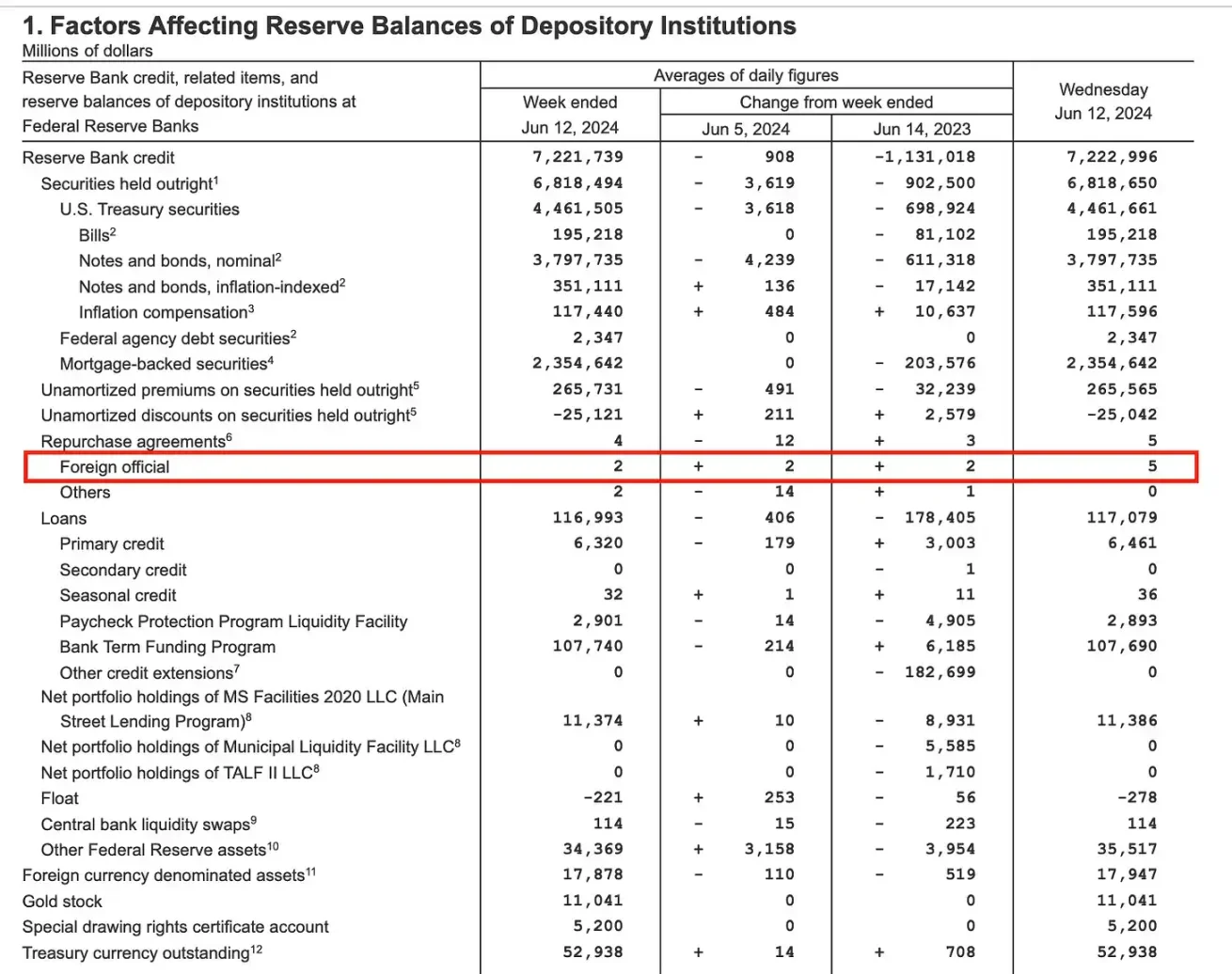
As you can see, FIMA repo usage is currently very small. But the selling hasn’t started yet. I suspect some interesting phone calls between Yellen and BOJ Governor Ueda. If I’m not mistaken, this number will rise.
Why Help Others?
Americans aren’t known for sympathizing with foreigners—especially those who don’t speak English and look “funny.” Appearance is relative, but to sunburned, Confederate-flag-waving farmers in flyover states, Japanese people just seem off. And guess what? These folks will decide who the next emperor is this November. Truly pathetic.
Despite potential xenophobia, Yellen will still reach out—because without new dollars to absorb these junk bonds, all major Japanese banks will follow Norinchukin’s lead and dump their U.S. Treasury portfolios to relieve pain. That means $450 billion in U.S. Treasuries flooding the market rapidly. This cannot be allowed—yields would spike, making federal financing prohibitively expensive.
In the Fed’s own words, this is exactly why the FIMA repo was created:
“During the March 2020 ‘dash for cash,’ central banks were simultaneously selling U.S. Treasuries and depositing proceeds into the NY Fed’s overnight reverse repo. In response, the Fed offered in late March to provide overnight loans to central banks using U.S. Treasuries held at the NY Fed as collateral, at rates above private-sector repo rates. This would allow central banks to raise cash without forced sales in an already stressed Treasury market.”
Remember September–October 2023? During those two months, the U.S. Treasury yield curve steepened, sending the S&P 500 down 20%, with 10-year and 30-year yields surpassing 5%. In response, Yellen shifted most debt issuance to short-term bills to drain cash from the Fed’s reverse repo facility. Markets rebounded, and starting November 1, all risk assets—including crypto—began climbing.
I am highly confident that in an election year, with her boss facing defeat by the orange criminal hands of Trump, Yellen will fulfill her duty to “democracy” by ensuring yields stay low and preventing a financial market disaster. In this case, all Yellen needs to do is call Ueda and instruct him not to allow Japanese banks to sell U.S. Treasuries in the open market, but instead use the FIMA repo to absorb the supply.
Trading Strategy
Everyone is closely watching for the Fed’s eventual rate cuts. However, the dollar-yen interest rate differential stands at +5.5%, or 550 basis points—equivalent to 22 rate cuts (assuming 25 bps per meeting). Over the next twelve months, one, two, three, or even four cuts won’t meaningfully narrow this gap. Moreover, the BOJ shows no willingness to raise its policy rate. At most, it may slow the pace of open market bond purchases. The fundamental reason driving Japanese commercial banks to sell their FX-hedged U.S. Treasury portfolios remains unresolved.
That’s why I’m confident in accelerating the shift from staked USD on Ethena (sUSDe)—currently earning 20–30%—into crypto risk assets. Given this news, the pain has reached the point where Japanese banks have no choice but to exit the U.S. Treasury market. As I’ve outlined, in an election year, the ruling Democrats can least afford a sharp rise in U.S. Treasury yields, as this would affect key financial concerns of median voters: mortgage rates, credit card rates, and auto loan rates. If Treasury yields rise, so will these.
This is precisely why the FIMA repo facility was created. All that’s needed now is for Yellen to firmly request that the BOJ use it.
Just as many begin wondering where the next dollar liquidity shock will come from, the Japanese banking system delivers fresh dollars wrapped in origami cranes straight into the hands of crypto investors. This is just another pillar of the crypto bull run. To sustain the current dollar-based, dirty financial architecture of Pax Americana, the dollar supply must expand.
Say it with me: “shikata ga nai,” then buy the dips!
Join TechFlow official community to stay tuned
Telegram:https://t.me/TechFlowDaily
X (Twitter):https://x.com/TechFlowPost
X (Twitter) EN:https://x.com/BlockFlow_News
 Arthur Hayes








