Bull market fading? Don't panic—these storylines in the second half of 2024 are still worth watching
TechFlow Selected TechFlow Selected
Bull market fading? Don't panic—these storylines in the second half of 2024 are still worth watching
These positive indicators suggest that the crypto bull market will continue.
 Navigating Web3 tides with focused insights
Author: Terry, Baicrypto

Over the past two months, despite constant hype around memes and major project airdrops, the market has remained in a strangely sluggish mood—the bear’s roar seems faintly audible, while the bull's footsteps feel uncertain, with market collapse or recovery appearing just a moment away.
This article aims to uncover and analyze some of the under-the-radar developments over the past two months, highlight overlooked positive factors ahead, and explore potential main narratives that could drive the market in the second half of the year.
01 Bitcoin Spot ETF Inflows Turn Positive
Markets often overestimate the short-term impact of new developments while underestimating their long-term influence. For Bitcoin spot ETFs, which have been live for nearly half a year, a recent signal is particularly noteworthy:
According to SoSoValue data, Bitcoin spot ETFs have seen a renewed wave of capital inflows since mid-May, lasting nearly a month, with June 4 reaching a record-high second only at $886 million (surpassed only by $1.05 billion on March 12).
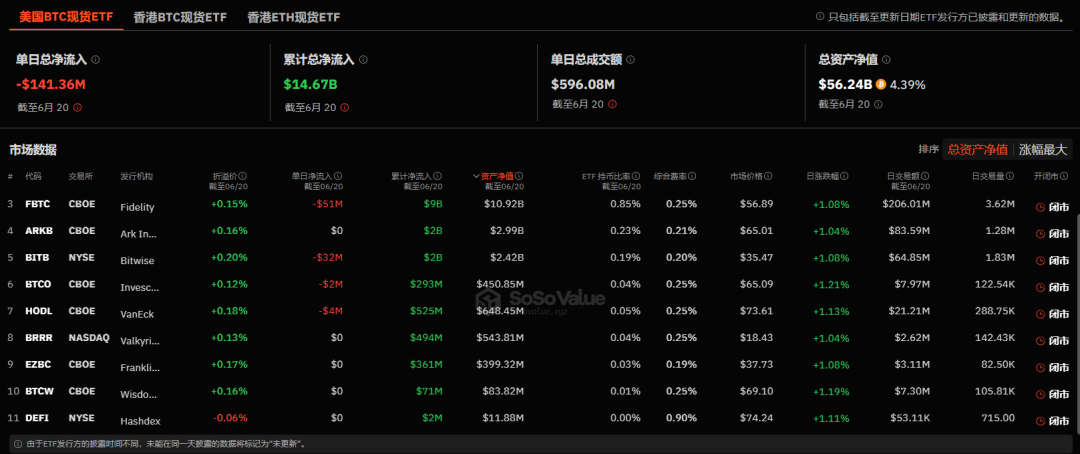
Although outflows resumed this week, the overall situation has clearly reversed compared to April–May. As of writing (June 21), total net assets of Bitcoin spot ETFs reached $56.24 billion, representing an ETF net asset ratio (market cap relative to total Bitcoin market cap) of 4.39%, with cumulative net inflows totaling $14.67 billion.
02 Shift in Crypto Regulation & Sudden Acceleration of Ethereum Spot ETF
Change begins subtly. Against the backdrop of the 2024 U.S. election year, both regulatory and financial macro conditions have recently improved significantly, brewing new bullish catalysts (Recommended reading: Are Trump and Biden Competing for Bitcoin Support? Is U.S. Crypto Regulation About to Pivot?).
On May 22, the Financial Innovation and Technology for the 21st Century Act (FIT21) passed the House of Representatives by a decisive 279 to 136 votes. Then, on May 24, the U.S. Securities and Exchange Commission (SEC) officially approved Form 19b-4 filings for eight Ethereum spot ETFs.
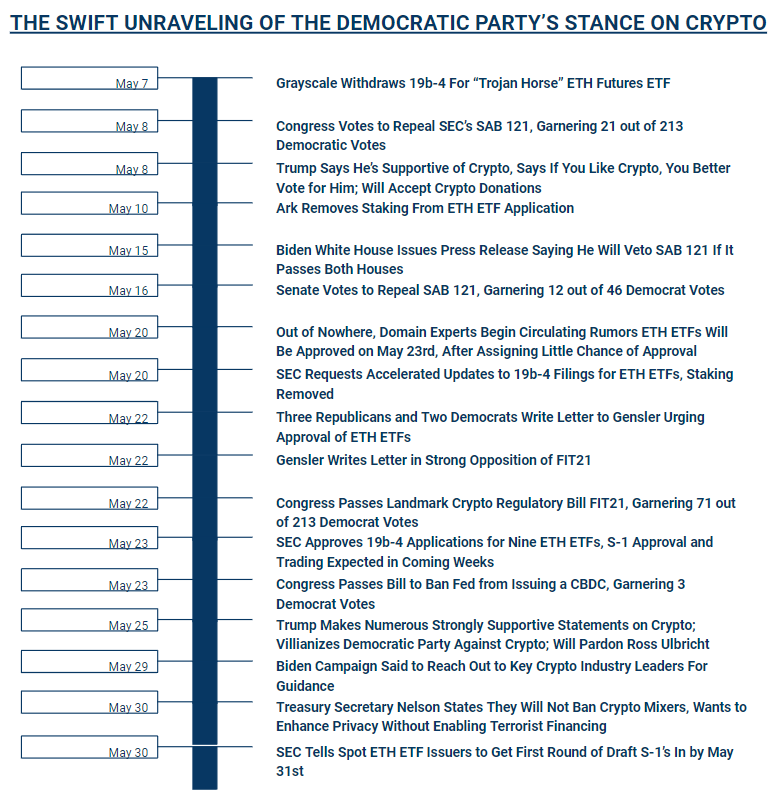
This marks a softening shift in U.S. regulators’ stance, especially as the approval timeline for Ethereum ETFs has dramatically advanced, seemingly now just one step away from launch. Interestingly, although the speed and direction of the SEC’s policy change exceeded expectations, upon reflection, it wasn’t entirely unpredictable:
As early as when ETH was near $3,000, large whales like Justin Sun began accumulating ETH and firmly going long on the ETH/BTC exchange rate, suggesting that astute individuals and institutions had already positioned themselves in advance.
Most directly, ETH’s performance in the secondary market has shaken off its prior weakness and begun strengthening. The most evident sign is the ETH/BTC exchange rate, which had steadily declined since October last year, falling from above 0.064 to below 0.045.
Since mid-May, however, the ETH/BTC ratio has reversed its downtrend, breaking through 0.05 and then 0.055 within the past month, peaking near 0.058—a clear sign of strength.
03 Traditional Web2 Players Accelerate Into Web3
On June 6, Robinhood announced its acquisition of cryptocurrency exchange Bitstamp for $200 million, aiming to expand beyond the U.S. The deal has been agreed upon but awaits regulatory approval—quite a bargain compared to the $400 million paid by NXMH, a subsidiary of South Korea’s NXC, back in 2018.

Robinhood is one of the most widely used stock and crypto CEX platforms in the U.S., with 11 million monthly active users, and is even more popular than Coinbase in crypto trading. Its transaction-based revenue grew 59% YoY in Q1 2024 to $329 million, including $126 million from crypto—a staggering 232% increase.
Founded in 2011, Bitstamp is among the longest-running and most compliant crypto CEXs globally. With operations in Luxembourg, the UK, Slovenia, Singapore, and the U.S., and registered licenses in over 50 countries, it can support Robinhood’s international expansion into crypto services.
This is a near-perfect complementary match—Robinhood’s current focus is primarily in the U.S., while rivals Kraken and eToro have stronger European presence. Though Bitstamp has only about 4 million users, most are based in Europe, offering Robinhood a significant leap forward in European expansion.
Notably, just a month earlier, Robinhood received a Wells Notice from SEC staff concerning its crypto listing, custody, and platform operations (RHC activities). Thus, acquiring Bitstamp allows Robinhood to diversify its global footprint and hedge against aggressive SEC regulation, ensuring it stays in the game.
Moreover, Fortune magazine predicts this deal will not only add around 4 million new crypto customers to Robinhood but also enable it to offer a broader range of crypto products to institutional clients:
Expanding from the current 15 tokens offered in the U.S. and over 30 in Europe, to more than 85 tokens available on Bitstamp. Additionally, Bitstamp’s diversified services—including staking, stablecoins, trading, custody, and prime brokerage—will help Robinhood attract more institutional clients and potentially accelerate its European rollout.
04 Macro Environment Signals Looser Policy Ahead
Although U.S. CPI, PPI, and non-farm payroll data have repeatedly exceeded expectations over the past six months, prompting Fed officials to adopt a "hawkish tone," markets continue to adjust rate cut expectations downward. Yet, inflation appears near its end, and cautious optimism remains for rate cuts in the second half of the year.
FOMC permanent voter and New York Fed President John Williams emphasized on Tuesday that any decisions on timing or extent of rate cuts this year would depend on upcoming economic data. Meanwhile, Fed officials have downgraded their rate cut outlook, with median projections now indicating only one cut this year.
However, central banks viewed as precursors to the Fed—Canada and Europe—have already sounded the pivot, racing ahead with rate cuts:
On June 5, the Bank of Canada cut rates from 5% to 4.75%, its first reduction in four years;
On June 6, the European Central Bank reduced rates from 4% to 3.75%, the first cut in five years;
In any case, the global easing cycle is accelerating, and favorable macro factors are indeed accumulating.
05 Major Payment / Financial Institutions Re-Entering
Additionally, BN recently resumed allowing Mastercard users to purchase crypto assets on its platform, and BN-branded Visa cards have been restored for use on exchanges. BN stated that Mastercard withdrawal services will be reinstated shortly.
Back in March, MetaMask partnered with Mastercard to test its first blockchain payment card. Marketing materials indicate the MetaMask/Mastercard card, issued by Baanx, will be the “first truly decentralized Web3 payment solution,” enabling users to spend crypto for everyday purchases anywhere cards are accepted.
This advancement greatly lowers barriers for new users, moving toward seamless on/off ramps (instant fiat-stablecoin conversion), abstracted user experiences similar to Web2 payments (account abstraction), and crucially bridges the gap between cryptocurrencies and real-world spending, helping anchor crypto assets to broader asset pools.
06 Summary
Overall, even in this uncertain market climate, numerous positive factors are quietly building. Careful observation still reveals grounds for confidence.
While the bear’s growl lingers and the bull’s arrival remains ambiguous, maintaining cautious optimism, staying vigilant, and actively participating may be the only viable approach in the current market environment.
Join TechFlow official community to stay tuned
Telegram:https://t.me/TechFlowDaily
X (Twitter):https://x.com/TechFlowPost
X (Twitter) EN:https://x.com/BlockFlow_News
 白话区块链
白话区块链